Introduction
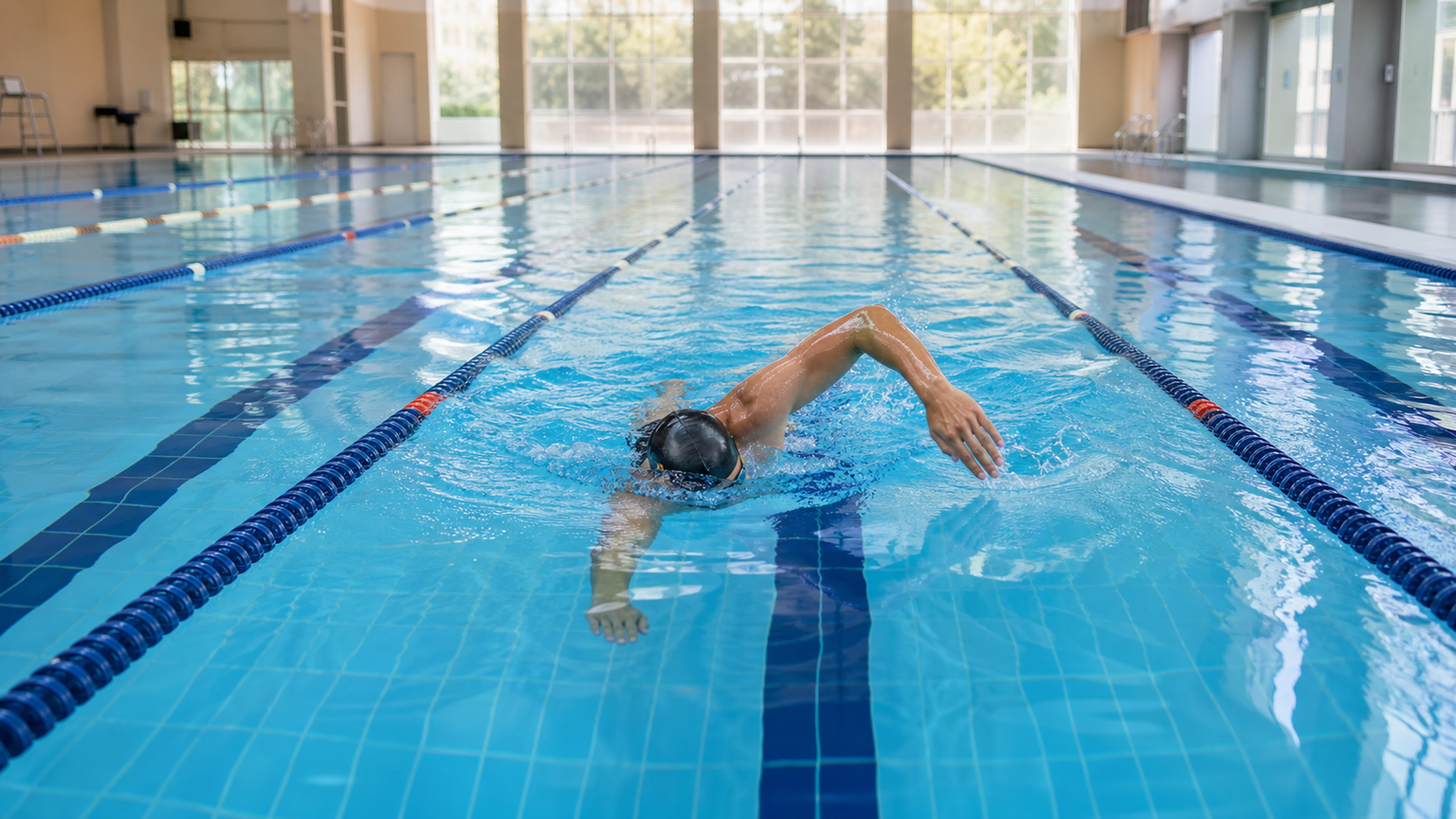
Many amateur swimmers practicing in Taiwan’s pools often jump straight into high-intensity efforts the moment they hit the water, only to stall a few weeks later due to fatigue or hitting a plateau. Long-term progress in swimming must be built on a solid aerobic foundation. Low-intensity long-distance (LSD) training may seem monotonous, but it is the best breeding ground for cardiorespiratory endurance, technical efficiency, and fat metabolism. This article uses a three-sessions-per-week training frequency as an example to explain how to plan an aerobic base period workout schedule.
What Is a Swimming Aerobic Base?
An aerobic base refers to the body’s ability to sustain energy output over a long period without relying heavily on lactate production. For swimmers, a good aerobic base means:
- Stable heart rate: Heart rate does not exceed 75% of maximum during long-distance swimming
- Technique maintenance: Stroke mechanics remain intact even after swimming 1,500m or more
- High lactate clearance rate: Low-intensity swimming efficiently clears metabolic waste
- Strong periodization adaptability: Provides a buffer for future interval and high-intensity training
Taiwan’s swimming environment is dominated by 25m indoor pools, such as those at Taipei’s Sun Yat-sen Memorial Hall, university-affiliated pools, or municipal sports center pools across various cities and counties. Training three times per week, 45–90 minutes per session, is a manageable way for amateur swimmers to build their aerobic base.
The Three-Sessions-Per-Week Training Structure
Below is a sample weekly schedule suitable for beginner to intermediate swimmers, based on a 25m pool, maintaining a “conversational” easy pace throughout (corresponding to RPE 4–5/10):
| Training Day | Main Content | Distance Target | Intensity Target |
|---|---|---|---|
| Monday | Technique-focused aerobic swim (freestyle primarily) | 1,200–1,800m | RPE 3–4 |
| Wednesday | Long continuous swim (800m+ non-stop) | 1,500–2,500m | RPE 4–5 |
| Saturday | Mixed-stroke aerobic swim (including breaststroke, backstroke) | 1,500–2,000m | RPE 4 |
Workout Details Breakdown
Monday (Technique-Focused Aerobic)
- Warm-up 400m (easy swim + pull buoy work)
- Main set: 6×100m, 20 seconds rest between reps, focus on hand entry angle
- Cool-down: 200m easy backstroke
Wednesday (Long Continuous Distance)
- Warm-up 400m
- Main set: Continuous 800m swim without stopping, maintaining a steady rhythm
- Second set: 400m + 400m, 60 seconds rest in between
- Cool-down: 200m easy swim
Saturday (Mixed Strokes)
- Warm-up 300m easy freestyle
- Main set: 200m breaststroke + 200m backstroke + 400m freestyle, 30 seconds rest between sets
- Technique reinforcement: 4×50m focused kicking, 20 seconds rest between reps
- Cool-down: 200m
Intensity Monitoring: Heart Rate and Perceived Exertion
The most common mistake in aerobic base training is “secretly speeding up.” Here are two ways to monitor intensity:
Heart Rate Monitoring
Many swim watches (such as the Garmin Forerunner 945 LTE, Apple Watch Ultra) now support in-water optical heart rate and allow you to set heart rate limit alerts. During the aerobic base period, it is recommended to keep heart rate at:
- 65–75% of maximum heart rate (e.g., if max HR is 185bpm, target 120–138bpm)
- If you don’t have a swim watch, estimate max heart rate using 220 minus your age
RPE (Rate of Perceived Exertion)
- RPE 3–4: You can easily speak a full sentence after finishing the set
- RPE 5: Slightly breathless but rhythm is steady, feels like you could swim another 30 minutes
- If RPE exceeds 6, actively slow down
Practical Recommendations
- Build your base for at least 8 weeks before increasing intensity: Maintain the aerobic base period for 6–8 weeks; don’t rush into adding anaerobic training.
- Increase weekly volume progressively by no more than 10%: If you swim 3,000m this week, the cap for next week is 3,300m, to avoid overtraining.
- Prioritize the stroke that feels best for long-distance work: Most swimmers in Taiwan primarily use freestyle, followed by breaststroke; there’s no need to force yourself into butterfly for aerobic long-distance sets.
- Log your training before bed: Record distance, heart rate, and overall feel to help adjust intensity the following week.
- Pay special attention to hydration during Taiwan’s summers: Even in indoor pools, high temperatures and high-intensity training can cause dehydration; drink 500ml of water before swimming.
Conclusion
Building a swimming aerobic base requires patience, but the rewards are substantial. Once the foundation is laid, you will notice significant improvement in speed training, interval workouts, or competing in the National Sports Festival or swim meets. Three sessions per week of steady, low-intensity long-distance swimming is the least injury-prone and most sustainable way to accumulate fitness. Stick with it, and your feel for the water and endurance will improve dramatically without you even noticing.
Related Reading
- Building Your Swimming Aerobic Base: Setting Weekly Training Volume for Low-Intensity Long-Distance
- Building Your Swimming Aerobic Base: Weekly Scheduling and Monitoring for Low-Intensity Swimming
- Building Your Swimming Aerobic Base: A 12-Week Progressive Plan of 3×2000m Per Week
- Designing the Aerobic Base Period in Swim Training: Structure of Low-Intensity, High-Volume Workouts
一起升級!海鷗盃LSD團練...JJSC Zone2招待 騎到手抖 / 公路車 / CT Yeh
1 天前
一日北高/長距離團騎 常見問題補充篇 / 組團或跟團的眉角 / 壯車友容易被瘦車友慢性拉爆 / 原來屁股痛可能是這個原因...? / 風場配速法 / 公路車 / CT Yeh
2 年前
西進武嶺 免費訓練分析服務 Intervals | 練不夠還是練過頭?你哪一種類型選手?AI模型告訴你! | 備戰神器 | 公路車 訓練 | CT Yeh
4 年前
實景訓練台) 彰化經典百K 高強度喵團 90分鐘 跟著一起練功 2019 Indoor workout Changhua Classic 100 Taiwan
7 年前
一日北高常見問題大集合 | 攻略 | 路線 | 訓練 | 補給 | 自行車 單車 | 一日雙城 | 雙塔 | TWB北高360 | 屁股痛
6 年前
2023桃園團體繞圈賽 / 海鷗繞圈賽 | 全程空拍數據版 | 公路車 | CT Yeh
2 年前
Live) 備戰2019彰化經典百K 賽前攻略 (已完賽請看新影片
7 年前
CT暗黑廚房) 車友必備 宇宙無敵鮮蚵湯 幫助訓練恢復 天然食補 好市多 超肥鮮蚵 破PR
7 年前