Introduction
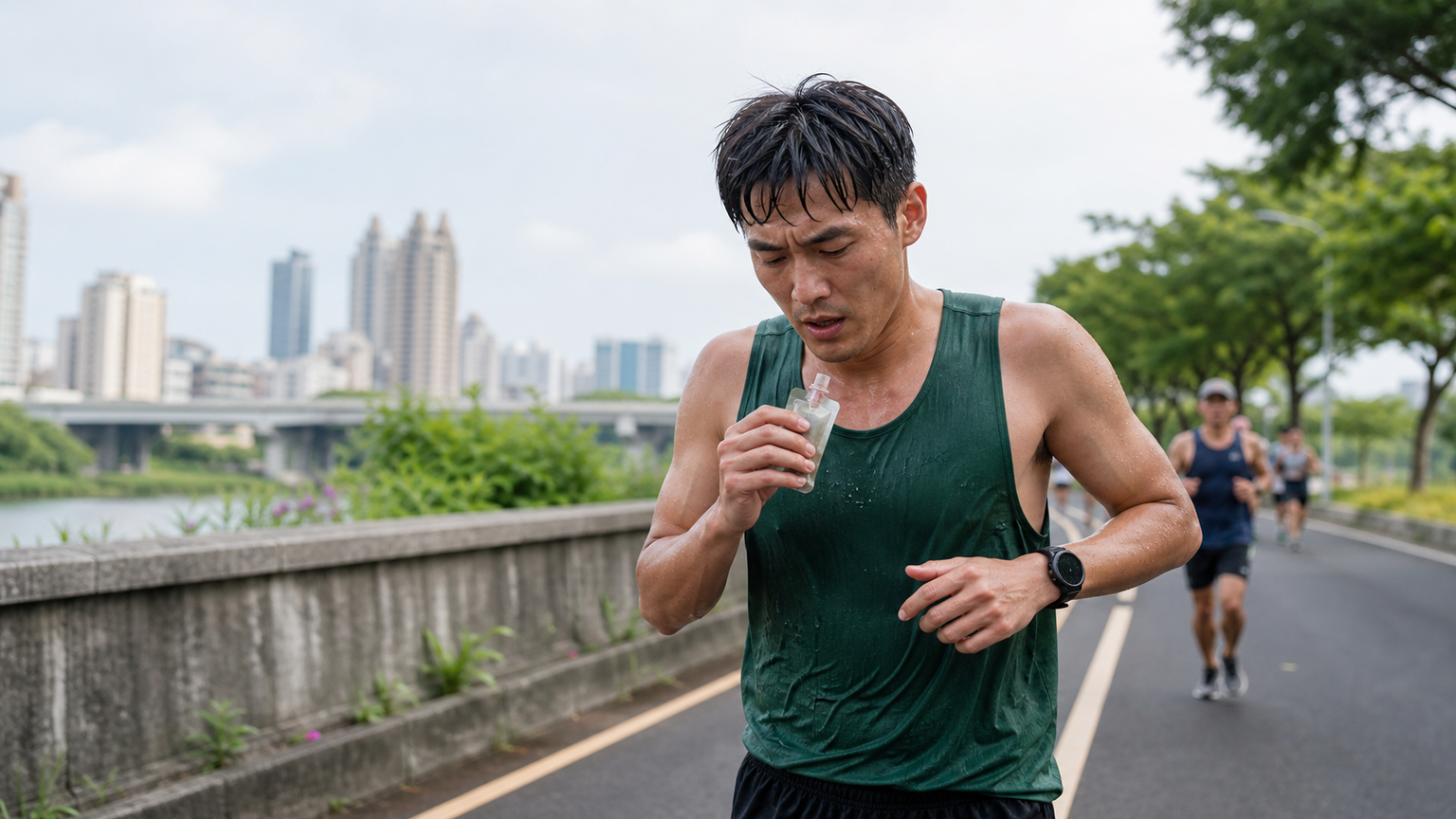
Every marathoner knows the taste of “the wall”—that moment when your steady pace suddenly feels like running through mud around the 30K mark, your legs turn to lead, your pace collapses, and the thought of “just quitting” even crosses your mind. This is the marathon’s infamous “30K Curse” (Hitting the Wall), known in the English-speaking world as “Bonking”—the most common and most destructive race-day mishap in the full marathon. Understanding it, training for it, and preventing it is an essential lesson for completing a marathon.
The Physiological Mechanism Behind Hitting the Wall
During aerobic exercise, the body uses two fuels simultaneously: Glycogen and Fat.
- Glycogen stores: approximately 1,800–2,000 kcal, stored in muscles and the liver
- Fat stores: nearly unlimited (even a lean runner has 80,000+ kcal in reserve)
- The problem: muscles burn fat at a much slower rate than glycogen, and at marathon intensity (approximately 70–80% VO₂max), fat alone cannot sustain your pace
Running a marathon at a Sub-4 pace, glycogen is depleted at around the 30–35 kilometer mark. Once glycogen runs dry, the brain also begins to run low on sugar—which explains why hitting the wall isn’t just about heavy legs, but also comes with severe mental fog and emotional breakdown.
Training-Side Strategies to Prevent the Wall
Strategy 1: Improve Fat Burning Efficiency (Fat Adaptation)
Long runs performed at low intensity (60–65% HRmax) over time train your muscles to use fat more efficiently, reducing your reliance on glycogen during the race.
- Schedule 1–2 “fasted morning runs” per week: get up without breakfast and run an easy 6–10 km
- Maintain a very easy pace for the first 60–70% of your long runs (heart rate no higher than 70% HRmax) to train the fat oxidation pathway
Strategy 2: Increase Glycogen Storage Capacity (Glycogen Loading Training)
Repeated long-run training teaches your muscles to store more glycogen. Carbohydrate replenishment after each long run (consuming 1g/kg of carbs within 1 hour) enhances the muscle glycogen supercompensation effect.
Strategy 3: Train Through Fatigue
Schedule a “Back-to-Back” workout of a Saturday long run followed by a Sunday easy run, running the second day with partially depleted muscle glycogen to train your body to maintain pace under fatigue.
Race-Day Strategies to Prevent the Wall
| Strategy | Specific Execution | Notes |
|---|---|---|
| Early fueling | Take your first gel 30 minutes after the start | Take advantage of optimal stomach absorption |
| Regular fueling | One gel every 40–45 minutes; don’t wait until you feel hungry | Waiting passively is already too late |
| Pace control | Hold MP +15"–+20" for the first half | Starting too fast is the main cause of hitting the wall |
| Caffeine strategy | Take a caffeinated gel (50–75mg) at 25–30K | Activates the central nervous system, delaying fatigue |
| Carbohydrate intake | Consume 60–90g of carbs per hour (gels + sports drink) | Don’t rely on plain water at aid stations |
On-the-Spot Response After Hitting the Wall
If you’ve already hit the wall (your pace suddenly drops 30–60 seconds and won’t recover), don’t panic:
- Slow down immediately: Accept the pace drop; finishing 3–5 minutes slower is far better than quitting outright
- Take sugar immediately: At the next aid station, take both a gel and sports drink—don’t just drink water
- Run-walk intervals: Use a “run 8 minutes, walk 1–2 minutes” strategy to let your body stabilize
- Mental adjustment: “Slowing down now = letting the fat-burning system kick in more = I can keep going”
Special Situations on Taiwan’s Race Courses
At the Taipei Marathon, the return leg along Zhongshan North Road around the 25–27K mark features crowds of spectators cheering, and many runners speed up there—this is the most dangerous temptation before hitting the wall. Be sure to hold your pace and save energy for the later stages. The Wanjin Shi Marathon features a series of small hills around the 30K mark, a high-risk zone for hitting the wall; it’s recommended to proactively slow down by 10–15 seconds to get through the hills.
Practical Advice
- Do a “wall simulation” during training: Skip fueling for the final 8–10K of a long run to experience what low-glycogen feels like, so race day isn’t a surprise
- Test different gel brands at home: Don’t use a gel brand for the first time on race day. Common brands in Taiwan like GU, SIS, and Maurten each have different textures and absorption rates
- Carry backup fuel: Attach 1 spare gel to your race bib or stow it in an armband, so you can fend for yourself if aid stations run short
Conclusion
Hitting the wall isn’t your fault—it’s the fuel limit of the human body by evolutionary design. But with training and strategy, you can push that wall further out, making it appear at 37K or even disappear entirely. Every time you practice fueling on a long run, every time you resist the excitement of the start, every time you choose the right pace—you’re dismantling the bricks of that wall. On race day, let the wall vanish behind you.
Related Reading
- A Complete Analysis of the Marathon 30K Wall Phenomenon: The Physiological Mechanism of Glycogen Depletion, Prevention Strategies, and Coping Methods
- Marathon Hitting the Wall: Mechanisms, Prevention, and On-the-Spot Self-Rescue
- Marathon Hitting the Wall: Psychological and Physical Strategies After 30K
- The Marathon Wall: Physiology and Pace Adjustment After 30K
Never Stop 西進武嶺 前後雙機 完整全程錄影 訓練台 實境
8 年前
爬陡坡被爆胎的車友跑步超車 #cycling #里佳部落
9 個月前
台北闊瀨陡坡 騎旅 / 日本單車雜誌編輯車友臨時加入!/ 髮香才是最強的 / feat. 北迴歸線小隊 / 公路車 CT Yeh
6 個月前
大武山20%魔王陡坡【JJSC南台灣遊騎Day2】!屁股真的要裂開了...凡士林抹滿也沒用?神秘金教堂還有超便宜夜市
3 個月前
新玉門關 單車挑戰賽 多視角主集團衝刺菁華版 4K #公路車
5 年前
2026 輪霸西濱200K 挑戰VLOG / 第一集團 / 首次參加..經驗不足、膀胱不足 /死守6H內 / AI戰鬥力顯示系統 / 公路車 / CT Yeh
4 個月前
水金九不厭五分 10度寒流冷到不願停!feat. 卡卡 / 公路車 / CT Yeh
6 個月前
大武山後門26%歡樂陡坡!JJSC南台灣單車行Day2 / 被颱風追著跑 / 公路車 / CT Yeh
2 年前