Introduction
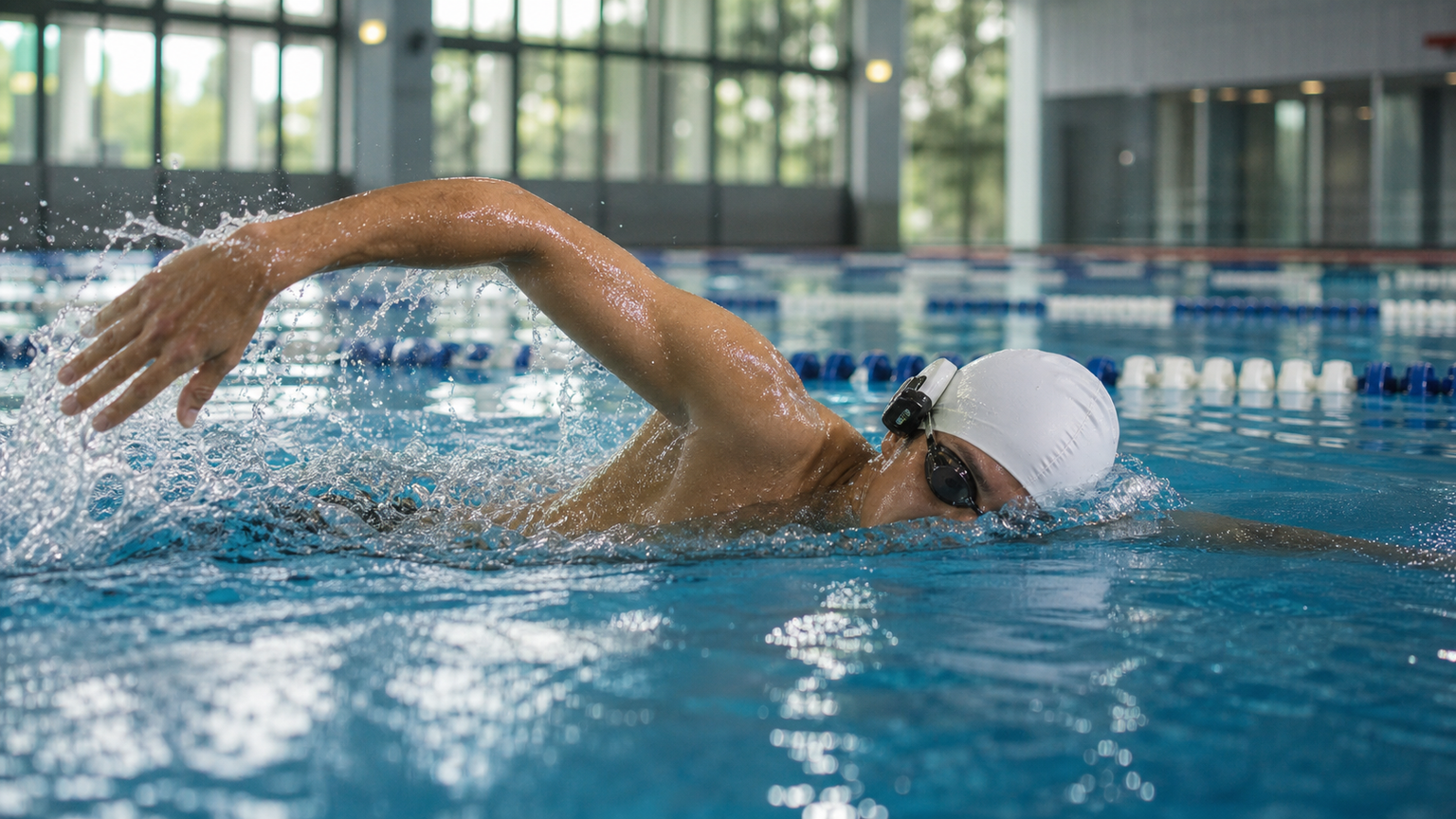
In swim training, pace consistency is one of the keys to improvement. The most common problem among amateur swimmers is: starting too fast in the first half and falling apart in the second half; or varying speed from lap to lap with no sense of rhythm. The Tempo Trainer, commonly known as the “swim metronome,” is a small device that attaches to your swim cap and emits timed beeps. Its principle is simple, but the results are remarkable. This article will introduce the logic behind using the Tempo Trainer and practical workout design.
How the Tempo Trainer Works
The Tempo Trainer (the most common brand being the FINIS Tempo Trainer Pro) has two main modes:
| Mode | Function | Target Goal |
|---|---|---|
| Mode 1 (Stroke Rate Mode) | Sets the interval in seconds between each stroke | Controls stroke rate |
| Mode 2 (Pace Mode) | Sets the target time per lap (25m or 50m) | Controls overall swimming pace |
| Mode 3 (Timing Mode) | Sets rest time between sets | Assists with interval timing |
Mode 1 is the most commonly used training tool. After setting the stroke rate, the Tempo Trainer emits a beep at the set interval, and the swimmer must synchronize each hand entry with the beep, thereby forcing a consistent stroke rhythm.
The Relationship Between Stroke Rate and Swimming Speed
Swimming speed = Stroke Rate × Distance Per Stroke
- Increasing stroke rate (while distance per stroke stays the same) → Speed increases
- Increasing distance per stroke (while stroke rate stays the same) → Speed increases
- Increasing stroke rate but decreasing distance per stroke → Speed may stay the same or even decrease
Therefore, the goal of using the Tempo Trainer is to find the “most efficient stroke rate,” not to simply go faster.
Typical stroke rate references for Taiwanese amateur swimmers (freestyle, 25m pool):
| Level | Target Pace (100m) | Suggested Stroke Rate (sec/stroke) |
|---|---|---|
| Beginner | 2:20–2:40 | 1.4–1.6 sec |
| Novice | 1:50–2:20 | 1.2–1.4 sec |
| Intermediate | 1:30–1:50 | 1.0–1.2 sec |
| Advanced | 1:20–1:30 | 0.85–1.0 sec |
Tempo Trainer Workout Design
Workout 1: Stroke Rate Exploration (Suitable for First-Time Users)
Goal: Find your personal baseline for the “most efficient stroke rate.”
- Warm up with 400m easy swimming
- Swim 2×50m at your usual comfortable pace and calculate your actual stroke rate (have someone count your strokes per lap and divide by time)
- Set the Tempo Trainer to the measured stroke rate and swim 4×50m, feeling whether it feels natural
- Increase the stroke rate by 5% (shorten by 0.05 sec/stroke) and swim another 4×50m
- If speed improves and technique holds, keep the new stroke rate; if technique falls apart, revert to the old stroke rate
Workout 2: Aerobic Threshold Rhythm Swim
Use the Tempo Trainer to force a steady pace during threshold training:
- Warm-up: 400m easy swimming
- Main set: Set the Tempo Trainer to the stroke rate corresponding to your CSS pace
- 4×300m, 30 seconds rest between reps, maintaining synchronization with the beep throughout
- Secondary set: 4×50m, stroke rate increased by 3% (slightly faster), 20 seconds rest between reps
- Cool-down: 200m without the metronome, feeling your natural rhythm
Workout 3: Progressive Stroke Rate Training (Advanced)
Gradually increase stroke rate each set to train neuromuscular control at higher speeds:
| Set | Distance | Stroke Rate Setting | Rest |
|---|---|---|---|
| Set 1 | 100m | Baseline -5% | 30 sec |
| Set 2 | 100m | Baseline | 30 sec |
| Set 3 | 100m | Baseline +3% | 30 sec |
| Set 4 | 100m | Baseline +6% | 30 sec |
| Set 5 | 100m | Baseline +3% (focus on control) | 30 sec |
Common Problems and Solutions
Problem: Hard to hear the beep clearly in the water
- Make sure the Tempo Trainer sits snugly against the swim cap, positioned near the ear
- Certain swim cap materials (silicone caps) transmit sound better than fabric caps
Problem: Setting the stroke rate too fast makes swimming worse
- Start from your natural stroke rate and only increase by 2–3% every 2 weeks
- Increasing stroke rate by more than 15% usually causes technique breakdown
Problem: Can only maintain the rhythm for the first few laps, then fall behind
- This means the current stroke rate setting exceeds your aerobic capacity; lower the stroke rate or shorten the distance of each rep
Practical Tips
- Use the Tempo Trainer at least once per week to help your brain gradually build a stable sense of rhythm.
- Don’t use it for the entire session: Use the metronome for 1–2 sets per workout; swim the rest freely, focusing on feel.
- The FINIS Tempo Trainer Pro costs around NT$1,200–1,800 online in Taiwan, offering excellent value for money.
- Pair it with a lap counter to manage both pace and lap count during longer swims.
- Log your stroke rate settings and how each session feels to track the actual impact of stroke rate increases on speed.
Conclusion
The Tempo Trainer is one of the most cost-effective training aids in swimming. Through enforced rhythmic constraint, it effectively corrects the common amateur swimmer’s habit of “starting fast and fading,” and it also helps advanced swimmers break through stroke rate plateaus. For swimmers accustomed to training alone in Taiwanese pools, the Tempo Trainer is like a pace partner that never makes mistakes—worth trying for every serious swimmer.
Related Reading
西進武嶺 免費訓練分析服務 Intervals | 練不夠還是練過頭?你哪一種類型選手?AI模型告訴你! | 備戰神器 | 公路車 訓練 | CT Yeh
4 年前
單車AI教練!全新 ChatGPT4o 幫你分析訓練成果!排武嶺課表,分析騎車姿勢! 太神了! / 公路車 / CT Yeh / feat. 緯緯
2 年前
西進武嶺配速器 3.0更新 / NEW 免功率FTP估算! / 大數據xAI體能模型 / 如何模擬人止關前集團效應 / 配速儲存功能 / AI全台自行車賽事行事曆 / 公路車 / CT Yeh
1 年前
#公路車 #Fitting 靠人工智慧APP 幫你調整單車
6 年前
西進武嶺 自製新版AI配速表產生器 x 賽前攻略 抱佛腳! 沒有功率計也可以產生配速表嗎?有什麼其他眉角賽前要注意的呢? | 西進武嶺 / 東進武嶺 KOM 攻略 | 公路車 | CT Yeh
4 年前
[教學] Premiere 影片 手震 修正 教學 防抖 單眼 影像 GoPro 穩定 Video Stabilization
8 年前
武嶺配速表最佳使用方式 #bike
1 年前
實景訓練台) 彰化經典百K 高強度喵團 90分鐘 跟著一起練功 2019 Indoor workout Changhua Classic 100 Taiwan
7 年前