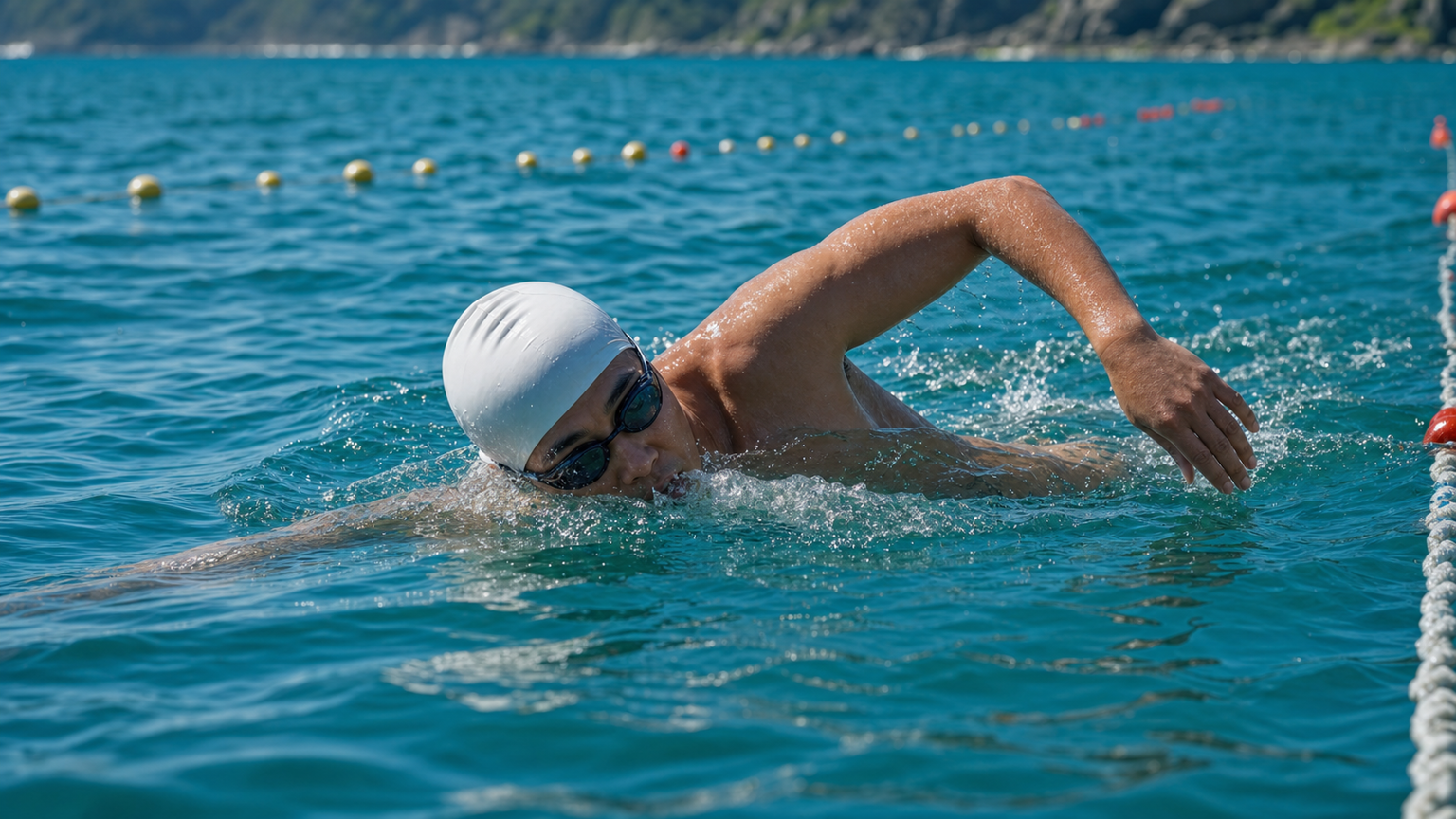
Introduction
Long-distance swimming is one of the disciplines with the highest demands on pacing ability. Whether it’s the 1,500m competitive swim in the pool or the open-water 5K and 10K events that have gained popularity in Taiwan in recent years (such as the Sun Moon Lake Mass Swim or the Chengcing Lake Swimming Festival), going “all-out from the start” almost inevitably leads to a late-race collapse. A scientific pacing strategy is the key to success in long-distance swimming. This article introduces pacing strategies for each of the three distances.
Basic Principles of Pacing
There are three basic pacing models for long-distance swimming:
| Pacing Model | Description | Recommendation |
|---|---|---|
| Even Pacing | Similar speed across each segment, evenly distributed | Recommended (top choice for amateurs) |
| Negative Split | Second half faster than first half | Suitable for advanced athletes |
| Positive Split | Fast start, slower finish | Not recommended (fatigue accumulation) |
Research shows that in endurance swimming events, a negative split strategy (second half 1–3% faster than the first half) yields the best overall results, while excessive positive splitting (first half > 5% faster than the second half) significantly worsens performance.
Pacing Strategy for 1,500m Pool Swimming
1,500m is the signature middle-distance endurance event in swimming and an Olympic discipline. In a 25m pool, it requires 60 lengths.
Target Speed Setting: Based on your personal CSS pace (CSS represents the theoretical maximum aerobic speed you can sustain)
1,500m Segment Pacing Recommendations
| Segment | Distance | Target Pace (relative to CSS) | Notes |
|---|---|---|---|
| Start Segment | 0–100m | CSS - 3 sec/100m | Starting adrenaline, slightly fast but restrained |
| Early Segment | 100–500m | CSS + 2 sec/100m | Slightly slower than CSS, establish rhythm |
| Middle Segment | 500–1000m | CSS ± 1 sec/100m | Maintain steady pace, no acceleration |
| Late Segment | 1000–1400m | CSS | Gradually return to CSS pace |
| Sprint Segment | 1400–1500m | CSS - 5 sec/100m | All-out sprint for the final 100m |
Key Reminder: In the first 100m after the start of a 1,500m, adrenaline surges and it’s easy to go out too fast. From 100–300m, you must actively slow down to your target pace.
Pacing Strategy for 5K Open Water
5K open-water swimming (equivalent to roughly 400–500 lengths of a 25m pool) is a common distance in many swimming events in Taiwan, such as the 3.3K segment of the Sun Moon Lake swim or the swim leg of certain triathlons.
Differences between open water and the pool:
- Crowded start/finish: You’re likely to get bumped at the start; consider starting slightly further back to avoid jostling
- No walls to push off: Without the push-off advantage from turns, feeling slower is normal
- Current and wave effects: Being 5–10% slower than in the pool is normal; no need to panic and speed up
- Navigation: You need to look up periodically to check buoy direction—look up every 6–8 strokes
5K Segment Strategy (using a 5K target time of 1 hour 45 minutes as an example):
| Segment | Distance | Pace Target | Heart Rate Target |
|---|---|---|---|
| Early Segment | 0–1K | CSS + 5 sec | < 75% HRmax |
| Early-Middle Segment | 1–2K | CSS + 3 sec | 75–80% HRmax |
| Middle Segment | 2–3K | CSS | 78–83% HRmax |
| Late-Middle Segment | 3–4K | CSS - 2 sec | 80–85% HRmax |
| Sprint Segment | 4–5K | CSS - 5 sec | All-out sprint |
Pacing Strategy for 10K Marathon Swimming
10K swimming is a true long-distance endurance challenge and the premier distance in Taiwan’s open-water events in recent years.
Energy System Analysis:
A 10K takes approximately 2–4 hours (depending on ability) and relies almost entirely on aerobic metabolism. Heart rate should be maintained at 70–80% HRmax.
Key 10K Strategy Points:
- First 30 minutes: Deliberately conservative; keep heart rate below 75% HRmax to let the body settle into a steady aerobic state
- Middle 60%: Maintain a steady rhythm; don’t change your pace because others pass you
- Final 20%: If you still have energy left, you can gradually accelerate; if you feel low on energy, just maintain your pace
- Nutrition Strategy: 10K events usually have aid stations; it’s recommended to take electrolyte drinks or energy gels every 45–60 minutes
Practical Recommendations
- Do “pace training” before the race: In training, deliberately practice swimming 800m and 1,500m at your target race pace to build pace instinct.
- Use a swim watch or lap counter to monitor segments: It’s hard to accurately sense speed during a race, so tools are essential.
- Watch out for heatstroke in Taiwan’s summer open-water events: Waters such as Sun Moon Lake and Chengcing Lake have higher summer water temperatures (26–30°C); pace should be 5–8% more conservative than in the pool.
- Practice “late-race sprinting”: Add a final 25m sprint to each long-distance set in your training plan to build muscle memory for late-race acceleration.
- Mentally prepare for the “mid-race fatigue phase”: The longer the distance, the more likely you’ll have thoughts of “I can’t keep going” in the middle. Simulate this in training in advance and build mental resilience.
Conclusion
In endurance swimming, the outcome is 50% fitness and 50% pacing strategy. No matter how good your aerobic capacity is, if you go out too hard at the start, it can turn into a painful struggle in the later stages. Through scientific segment planning, pace simulation in training, and an honest assessment of your own abilities, swimmers in Taiwan can achieve their true best results in 1,500m, 5K, and even 10K long-distance events.
Related Reading
- Building Rhythm in Long-Distance Swimming: Pacing Strategies for the 1,500m
- Long-Distance Swim Pace Training: Speed Management from 1,500m to 5,000m
- Swim Endurance Training: Pacing Strategies for Long-Distance Swims
- Segment Pacing Strategies for Swim Races: Front-to-Back Half Ratios for 50m, 100m, 200m, and 400m
崇越盃武嶺冠軍高手 賽前JJSC 群峰會精華!對應大數據分析,會有落差嗎?/ feat. JJSC中部公路車約騎 /公路車 / CT Yeh
2 年前
西進武嶺 免費訓練分析服務 Intervals | 練不夠還是練過頭?你哪一種類型選手?AI模型告訴你! | 備戰神器 | 公路車 訓練 | CT Yeh
4 年前
Live) 備戰2019彰化經典百K 賽前攻略 (已完賽請看新影片
7 年前
西進武嶺 自製新版AI配速表產生器 x 賽前攻略 抱佛腳! 沒有功率計也可以產生配速表嗎?有什麼其他眉角賽前要注意的呢? | 西進武嶺 / 東進武嶺 KOM 攻略 | 公路車 | CT Yeh
4 年前
CT 喇低賽) 武嶺牽車 才是王道 西進牽車四小時內秘訣 攝手位置 如何判斷 防抽筋小秘訣
7 年前
live) 超越北高 之一日北高12小時 策略
7 年前
西進武嶺各路段 前8000名 大數據分析 配速攻略/功率/心律/推力比/維持率/踏頻/踏瓦比/牽車率 大公開 | 建大盃 NeverStop 可參考 | 公路車 | CT Yeh
5 年前
一日北高/長距離團騎 常見問題補充篇 / 組團或跟團的眉角 / 壯車友容易被瘦車友慢性拉爆 / 原來屁股痛可能是這個原因...? / 風場配速法 / 公路車 / CT Yeh
2 年前