Introduction
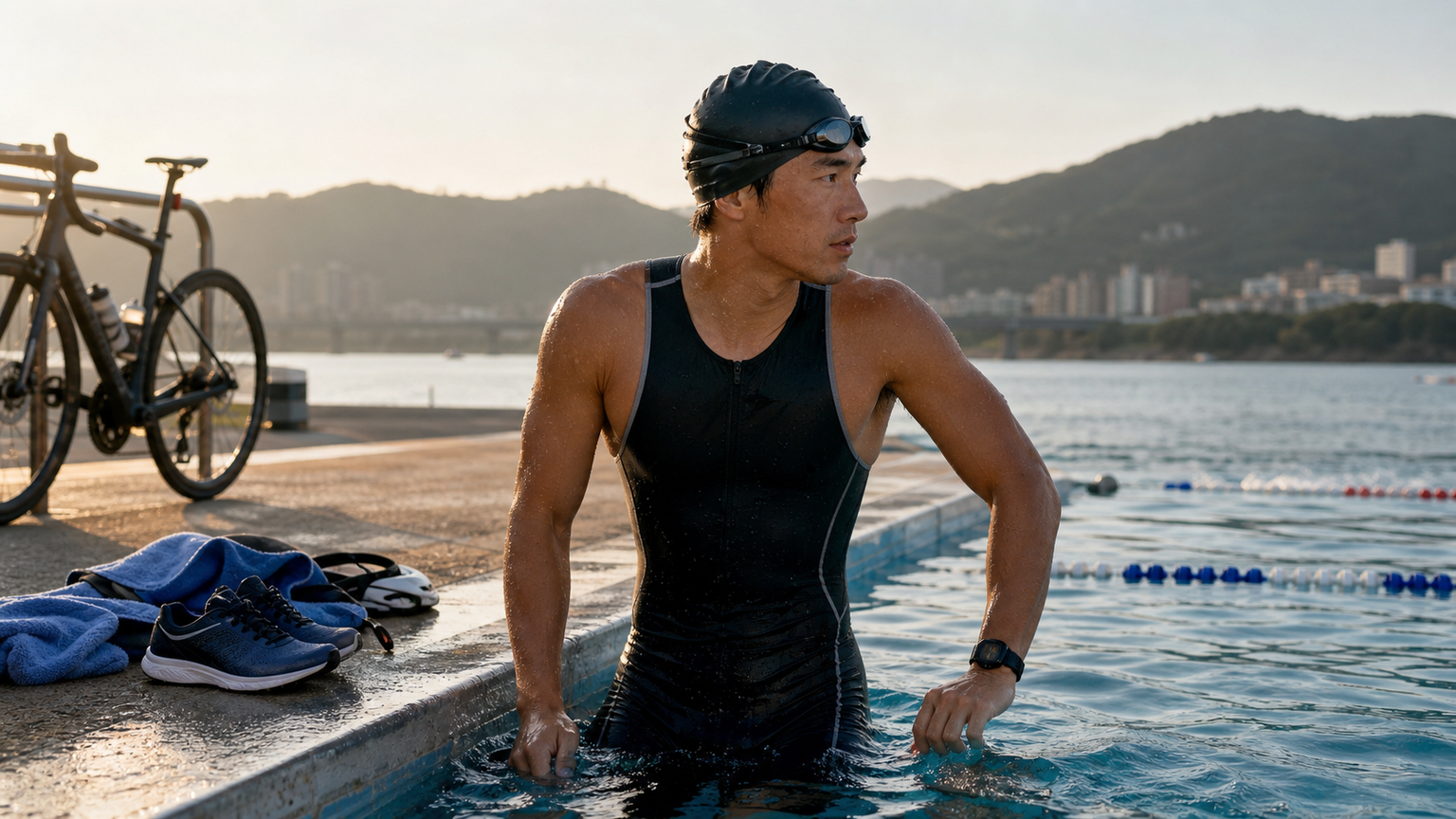
For Taiwanese triathletes, swimming is often the hardest of the three disciplines to improve and the easiest to push to the bottom of the training priority list. In reality, swimming fitness doesn’t just affect your swim split—it directly impacts your energy levels when you hit the bike leg after exiting the water. This article explains how triathletes can scientifically plan the proportion of swimming within their overall training to maximize swimming benefits within limited training time.
The Unique Challenges of Triathlon Swimming
The swim leg in triathlon differs fundamentally from pure competitive swimming in several ways:
- Open water focus: Most triathlons take place in the sea, lakes, or rivers, with no walls, currents, and waves
- Wetsuit wear: Cold open water requires a wetsuit, which affects stroke mechanics and buoyancy
- Immediate transition after exit: You must quickly adapt to an upright position and complete T1 after swimming
- Energy conservation needs: A long bike and run remain after the swim, so you can’t exhaust yourself in the swim leg
Therefore, the training goal for triathlon swimming isn’t just “swim fast,” but “swim fast enough while conserving energy.”
Swimming’s Time Proportion in Triathlon Training
Based on the proportion of the swim leg to total finish time across various triathlon distances, a reasonable training time allocation can be derived:
| Triathlon Distance | Swim Distance | Swim % of Total Time | Recommended Training Time % |
|---|---|---|---|
| Super Sprint | 400m | 15–20% | 15–20% |
| Sprint | 750m | 12–18% | 15–20% |
| Olympic | 1,500m | 15–20% | 20–25% |
| Long (70.3) | 1,900m | 10–15% | 15–20% |
| Full (IRONMAN) | 3,800m | 8–12% | 15–18% |
Key insight: Even though the swim leg takes up the least amount of total finish time, improvements in swimming technique and fitness typically yield the greatest relative returns—because swimming is the discipline where technique has the biggest impact on speed. A 1-minute improvement in swimming is far harder to achieve than a 1-minute improvement in running, but it has a greater psychological impact on overall performance (you enter the water at T1, and your mindset determines your subsequent performance).
Weekly Training Structure for Triathlon Swimmers
Using the example of an age-group athlete preparing for an Olympic-distance triathlon (12 total training hours per week):
| Discipline | Weekly Training Hours | Main Content |
|---|---|---|
| Swim | 2.5–3 hours (3 sessions) | Technique work + aerobic threshold + open water simulation |
| Bike | 5–6 hours (3 sessions) | Aerobic long rides + FTP training |
| Run | 3–4 hours (3 sessions) | Aerobic runs + pace runs + brick training |
Weekly swim schedule with 3 sessions per week:
- Monday: Technique session (including drill work, 1,800m, focusing on correcting open water catch mechanics)
- Wednesday: Aerobic threshold session (3×400m at CSS pace, 2,500m total)
- Saturday: Open water simulation (if access to the sea or a lake is available) or long continuous swim (2,500–3,000m)
Triathlon-Specific Swim Training Drills
1. Open Water Navigation Practice
Practice “sighting” in the pool: every 6–8 strokes, quickly lift your head to look ahead. The movement should be small and fast, without disrupting your swimming rhythm. This is the most important yet most overlooked skill in open water racing.
2. Mass Start Adaptation
Practice “pack swimming” with members of a swim club to adapt to the pressure of being touched and kicked. Triathlon clubs across Taiwan (such as ITU-recognized clubs) typically hold these sessions regularly.
3. Swimming in Brick Training
Some brick sessions begin with swimming, immediately followed by cycling (simulating the T1 transition), helping the body adapt to the rapid shift from horizontal swimming to upright pedaling.
4. Wetsuit Swim Practice
If your race requires a wetsuit, it’s recommended to wear it for at least 3–5 training sessions to adapt to the increased buoyancy and restricted shoulder movement that come with a wetsuit.
Practical Recommendations
- Prioritize swim technique over training volume: Age-group triathletes don’t need high swim volume—6,000–9,000m per week is sufficient—but technical efficiency (strokes per length, hand entry angle) is what truly matters.
- Make use of early morning swims before work: Many pools in Taiwan offer 06:00–08:00 morning swim sessions, allowing you to complete your swim workouts without affecting your job.
- Don’t immediately get in the car or sit for long periods after swimming: Do 5 minutes of dynamic stretching poolside after your swim to fully relax your shoulder and back muscles, preventing accumulated tightness from worsening during the bike leg.
- Do a full race rehearsal two weeks out: Include swim + T1 + a short bike leg to familiarize yourself with the transition rhythm.
- Taiwan’s summer open water temperatures are high: Wetsuits are only needed below 20°C. Most Taiwanese races have water temperatures of 24–29°C, so no wetsuit is required, but be mindful of sun protection and in-water hydration.
Conclusion
The core of a triathlete’s swim training is “high efficiency, energy conservation, and no panic.” Through scientific time allocation, targeted open water technique training, and smart integration with the bike and run schedules, Taiwanese triathletes can significantly improve their swim leg efficiency and confidence without sacrificing fitness in the other disciplines, laying the best foundation for a stellar performance after T1.
Related Reading
- Time Management for Triathlon Swim Training: Swim Priority Across the Three Disciplines
- Open Water Long-Distance Nutrition: Energy Strategies for the Triathlon Swim Leg
- Balanced Triathlon Training Across Three Disciplines: Time Allocation for Swim, Bike, and Run
- Weekly Time Allocation for Triathlon Training: Recommended Swim / Bike / Run Time Ratios
[防寒衣體驗] 鐵人魂 三鐵 防寒衣試穿會 於松運 深水游泳池 鯨魚池
8 年前
靠單車減肥35公斤 心得分享與整理
7 年前
2019 夏季KOM 5小 完賽心得 準備攻略 東進武嶺 夏季登山王之路 Taiwan KOM Challenge
7 年前
西進武嶺 免費訓練分析服務 Intervals | 練不夠還是練過頭?你哪一種類型選手?AI模型告訴你! | 備戰神器 | 公路車 訓練 | CT Yeh
4 年前
福隆鐵人團練隨拍
8 年前
CT暗黑廚房) 車友必備 宇宙無敵鮮蚵湯 幫助訓練恢復 天然食補 好市多 超肥鮮蚵 破PR
7 年前
3D 列印車褲墊 / 舒適改善? / 無痕 x 分區壓縮 / ATK & Decider系列 / JE22黑科技 / #公路車 #CTYEH
11 個月前
Live) 備戰2019彰化經典百K 賽前攻略 (已完賽請看新影片
7 年前