Introduction
Many Taiwanese cyclists tackling Wuling or the Beiyi Highway have experienced the frustrating sensation of being unable to apply force at specific angles of the leg. This discouraging moment is known in sports biomechanics as the “Dead Spot.” Not only does the dead spot reduce pedaling efficiency, but over the long term, compensatory movements can also lead to knee and hip injuries. This article starts from mechanical principles to explain the causes of the dead spot and explores improvement strategies using oval chainrings and pedaling technique.
What is the Pedaling Dead Spot?
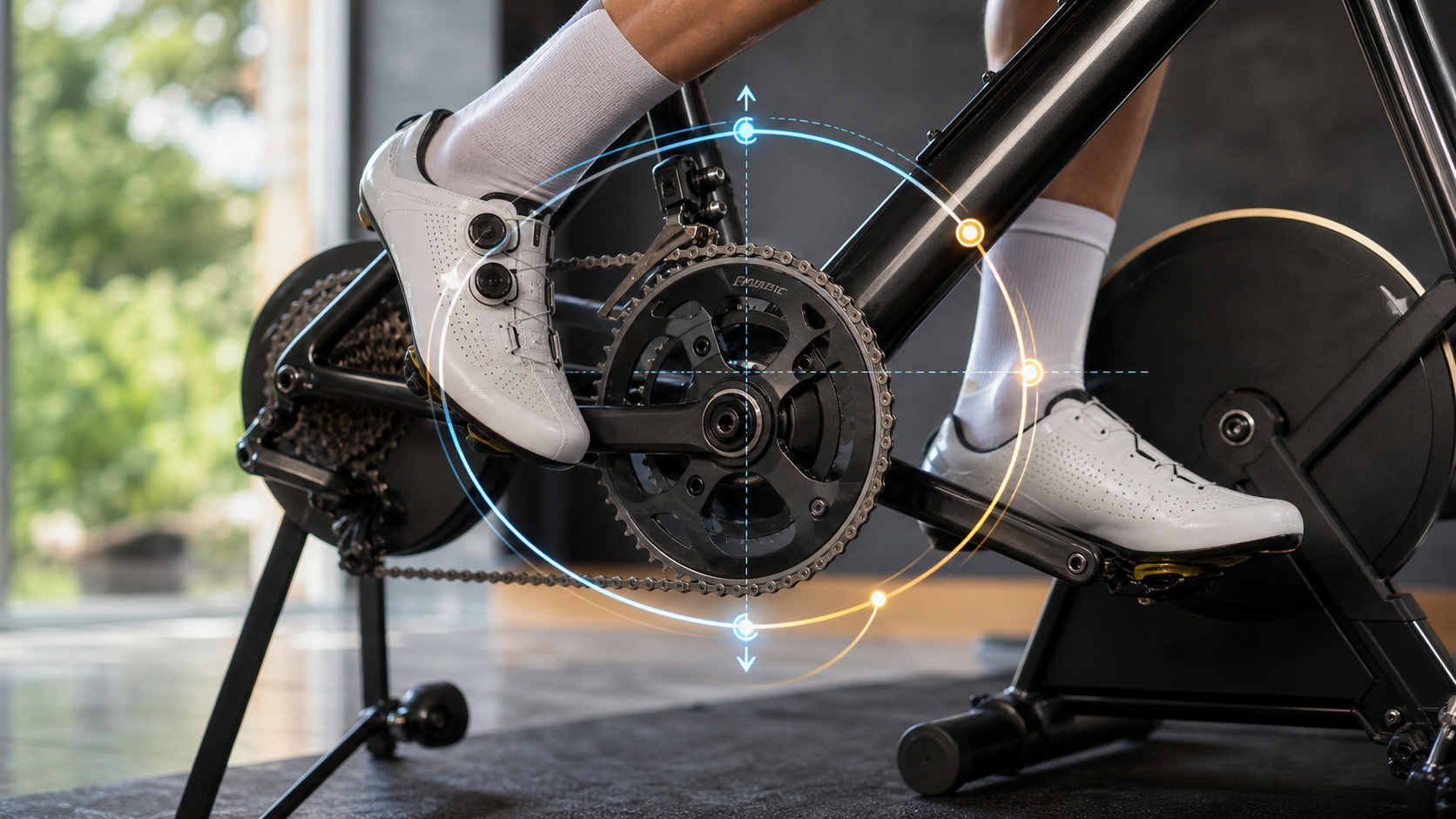
A standard pedaling cycle can be divided into 360 degrees. When the crank is at approximately 0 degrees (Top Dead Center, TDC) and 180 degrees (Bottom Dead Center, BDC), the pedaling torque approaches zero. This is because the direction of the leg’s force is nearly parallel to the crank radius at these points, resulting in extremely low effective tangential force.
According to biomechanical research, power output is lowest within the 30-degree range before and after the dead spots, while the effective pedaling zone is mainly concentrated between crank angles of 90–150 degrees.
| Crank Angle | Effective Tangential Force | Power Output Ratio |
|---|---|---|
| 0° (TDC) | Approx. 5% | Extremely Low |
| 45° | Approx. 60% | Moderate |
| 90° | Approx. 95% | Highest |
| 135° | Approx. 80% | High |
| 180° (BDC) | Approx. 5% | Extremely Low |
| 270° | Approx. 70% | Medium-High |
The Mechanical Principle of Oval Chainrings
Oval chainrings alter the effective radius of the chainring, providing different gear ratios at different crank angles to compensate for the lack of power at the dead spots.
How Oval Chainrings Work:
- Dead Spot Zone (near 0° and 180°): The effective radius decreases, lowering the gear ratio and reducing pedaling resistance, making it easier for muscles to pass through the dead spots
- Maximum Torque Zone (near 90°): The effective radius increases, raising the gear ratio to fully utilize the muscle’s strongest force-producing range
- Overall Effect: This effectively converts uneven muscle output into smoother power delivery
Common oval chainring brands in the Taiwanese market include Osymetric, AbsoluteBlack, and Rotor Q-Ring, with ovality typically ranging between 105% and 113%. Research shows that appropriate ovality can improve pedaling efficiency by approximately 3–8%, with the effect being especially noticeable on long climbs.
Training Methods for Pedaling Technique
Oval chainrings are not the only solution. Through conscious pedaling technique training, the dead spot problem can also be effectively improved.
Key Technical Training Points:
- “Scraping Mud” Motion: Near the bottom dead center (BDC), imagine scraping mud off the sole of your shoe; the active backward pulling motion increases horizontal force
- “Knee Lift” Motion: Around the top dead center (TDC), actively lift the knee to engage the hip flexor muscles (iliopsoas) to help pass through the dead spot
- One-Leg Drill: Pedal with a single leg on a smart trainer to force the body to learn how to apply power evenly
- High Cadence Drill: Train at a cadence above 100 RPM for 10–15 minutes to develop neuromuscular coordination
Practical Recommendations
- Beginners are advised to focus primarily on pedaling technique training, scheduling 2–3 sessions per week of 15 minutes of one-leg pedaling drills, combined with real-time power feedback from a smart trainer.
- Cyclists with a power meter can observe the “Effective Pedaling Arc” in Cycling Dynamics as a quantitative metric for technique improvement.
- When trying oval chainrings, it is recommended to test them on climbing routes (such as Taipei’s Beiyi Highway or Taoyuan’s Lala Mountain industrial road) to feel the difference in smoothness when passing through the dead spots.
- When installing an oval chainring, pay attention to the phase angle setting. It is usually recommended to start with the manufacturer’s default value and then fine-tune by ±5 degrees based on personal feel.
- Avoid over-reliance on equipment: Oval chainrings are an assistive tool; solid pedaling technique training is the fundamental solution.
Conclusion
The pedaling dead spot is a biomechanical challenge every cyclist faces. By understanding the principles of torque, whether you choose oval chainrings or refine your pedaling technique, you can deliver smoother power output on Taiwan’s mountain roads and accomplish the same amount of work with less energy expenditure. Scientific training combined with the right equipment is the twin engine for improving cycling efficiency.
Related Reading
- Pedaling Efficiency and the Dead Spot: How to Eliminate Your Power Black Hole
- Pedaling Smoothness Training: Advanced Technique Workouts to Improve Pedaling Efficiency
- Pedaling Smoothness: Dead Spots, Pulling, and 360° Power Output Techniques
- Identifying and Eliminating the Pedaling Dead Spot: A Study of Angular Velocity Analysis of Crank Angle
Nepest NOVA 碳條輪組:輕量、空力、舒適一次滿足!/ 公路車 / CT Yeh
7 個月前
碟煞公路車 銑面器 !? 原來銑完差這麼多! 降低蹭碟機率! | TIME 公路車 保養小記錄 | CT Yeh
3 年前
武嶺配速表最佳使用方式 #bike
1 年前
西進武嶺 自製新版AI配速表產生器 x 賽前攻略 抱佛腳! 沒有功率計也可以產生配速表嗎?有什麼其他眉角賽前要注意的呢? | 西進武嶺 / 東進武嶺 KOM 攻略 | 公路車 | CT Yeh
4 年前
台北闊瀨陡坡 騎旅 / 日本單車雜誌編輯車友臨時加入!/ 髮香才是最強的 / feat. 北迴歸線小隊 / 公路車 CT Yeh
6 個月前
CT 喇低賽) 武嶺牽車 才是王道 西進牽車四小時內秘訣 攝手位置 如何判斷 防抽筋小秘訣
7 年前
大禹嶺 到 武嶺牌樓 全程前後實況錄影 | 北進武嶺 | 東進武嶺 | KOM | 訓練台 | 坡度分析 | Taiwan KOM Last 10 km HARD | 公路車
6 年前
全台首發!邁金P715踏板功率計!市場價格撼動者再出招 / 功率對比實測 / FAVERO ASSIOMA 可參考! / 公路車 / CT Yeh
1 年前