Introduction
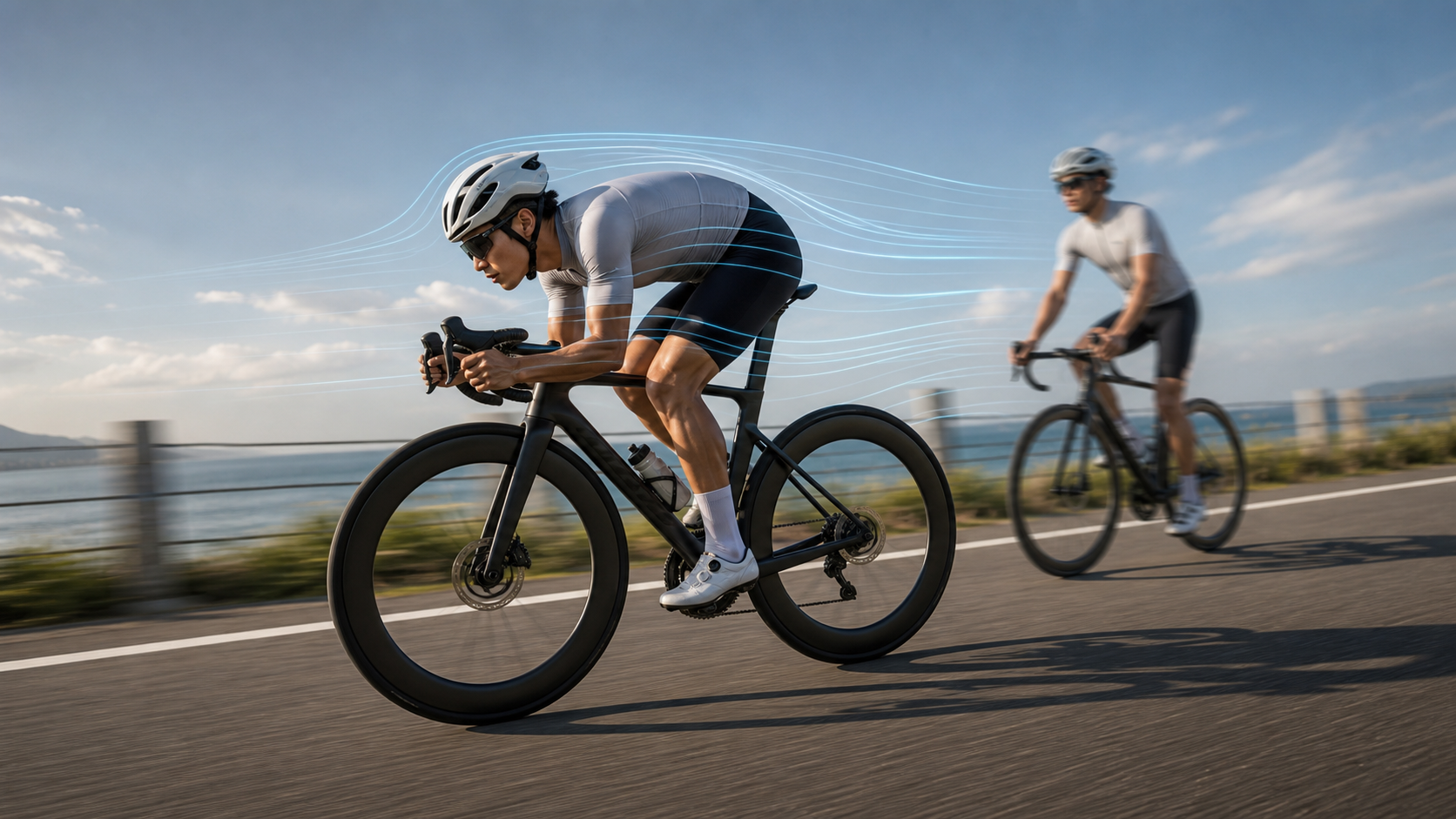
On the bike paths of western Taiwan’s plains, or along Provincial Highway 3, have you ever wondered why triathletes riding in a special tucked position can be noticeably faster than those in a standard road bike posture? The answer lies in a core concept of fluid mechanics—aerodynamic drag. This article will delve into the most critical aerodynamic metric affecting cycling speed and provide adjustment strategies that Taiwanese riders can apply immediately.
CdA Value: A Quantified Metric for Air Resistance
CdA (Drag Area) is the core metric describing the magnitude of air resistance acting on an object, composed of the following two parameters:
- Cd (Drag Coefficient): The efficiency with which an object’s shape blocks airflow, related to streamlined design
- A (Frontal Area): The cross-sectional area of the object facing the direction of airflow (unit: m²)
The formula for calculating air resistance is:
F_drag = ½ × ρ × v² × CdA
Where ρ is air density (approximately 1.2 kg/m³) and v is velocity (m/s). This shows that resistance is proportional to the square of velocity—double your speed, and resistance increases fourfold!
| Riding Position | Typical CdA Value (m²) | Power Required at 40km/h |
|---|---|---|
| Upright on top of handlebars (city bike) | 0.45–0.55 | ~490W |
| Road bike, hands on hoods | 0.32–0.38 | ~370W |
| Road bike, tucked position (drops) | 0.28–0.32 | ~320W |
| TT time trial bike, tucked position | 0.20–0.25 | ~250W |
| Super tucked (extreme aero position) | 0.18–0.22 | ~220W |
Position Adjustments: The Lowest-Cost Aerodynamic Optimization
Equipment upgrades can be expensive, but position adjustments are nearly free. Here are key position recommendations for Taiwanese road cyclists:
Lowering upper body height:
The torso accounts for approximately 40% of total CdA. Keeping your upper body as horizontal as possible is the most direct way to reduce wind resistance. However, this must be done without compromising breathing capacity and power output; otherwise, the trade-off isn’t worth it.
Elbow width:
Flaring your elbows outward increases frontal area. Research shows that tucking both elbows inward by about 15cm can reduce CdA by approximately 0.015 m², equivalent to saving about 15W of power at 40km/h.
Head position:
Lifting your head into the wind is a common aerodynamic killer. Keep your head as low as possible, looking forward only with your eyes, with the top of your helmet slightly lower than the highest point of your back.
Clothing fit:
Loose clothing flapping in the wind significantly increases drag. The habit of choosing breathable, loose-fitting clothing in Taiwan’s summer heat comes at a greater cost during high-speed riding. It is recommended to wear form-fitting aero jerseys for high-speed rides.
The Aerodynamic Impact of Equipment
Aero helmets can reduce CdA by approximately 0.005–0.015 m², equivalent to saving 5–15W at 40km/h. Taiwan’s summer heat makes many riders hesitant to choose aero helmets with poorer ventilation; it is recommended to use them for time trials or short-distance high-speed challenges.
Wheel selection (see the wheelset article for details) Deep-section rims can reduce rolling + air resistance when there is no crosswind.
Aero bars allow riders to adopt a time trial position with forearms horizontal, representing the single biggest aerodynamic upgrade for a road bike.
Frame: An aero frame saves approximately 20–30W at 40km/h compared to a traditional round-tube frame.
Practical Recommendations
- Use virtual wind tunnel applications (such as Aeropod or Notio) to conduct CdA testing on wind-exposed test sections in Taiwan to find your optimal position
- Prioritize improving your position before considering equipment upgrades; the effect is more significant and the cost is minimal
- In summer heat, it is not recommended to force an extreme tucked position during long-distance rides, as it may affect breathing efficiency and core heat dissipation
- During long rides on the western plains (such as during a round-island tour), deliberately practicing the tucked position on the drops can significantly save energy
Conclusion
Aerodynamics is the most fascinating and practical field in cycling physics. On the flat sections of western Taiwan’s plains, a correct tucked position combined with suitable aero equipment could make you 5–10% faster at the same power output. Understanding the significance of CdA value ensures that every watt you produce is put to good use.
Related Reading
- Cycling Aerodynamics: Quantifying the Impact of Riding Position and Equipment on Wind Resistance
- Advanced Cycling Aerodynamics: How to Quantify and Improve Your CdA
- Applications of Aerodynamics in Cycling: Riding Position, Helmets, and Clothing
- New Insights in Cycling Aerodynamics: Research Progress on CdA Values of Forks and Frame Tubing
用了AirTag 單車就不怕被偷?盲點大測試 結果… |公路車|CT Yeh
5 年前
CT 喇低賽) 單車 比賽總是沒照片? 攝影師的觀點大公開 姿勢就是力量! 請加速1.25倍收看
7 年前
多機位拍片神器 DJI Action 2 拍出速度張力感 | 類空拍機視角 4陣列麥克風超強降風噪 實測! | 公路車 | CT Yeh
3 年前
西進武嶺 免費訓練分析服務 Intervals | 練不夠還是練過頭?你哪一種類型選手?AI模型告訴你! | 備戰神器 | 公路車 訓練 | CT Yeh
4 年前
風櫃嘴 | 全台最多大砲的單車路線 | 尋寶網攝影師告訴你怎麼擺拍起來才好看 | 熱門攝影地點巡禮
6 年前
再快都跟的上!? 單車跟隨攝影機之王 HOVERAir X1 PROMAX 全面實測 / 唯一!8K畫質&自行車專用模式和跟蹤信標&前後避障 / DJI Neo 可參考/ 公路車 / CT Yeh
1 年前
Insta360/DJI做不到的!如何製作「騎士頭頂瓦數特效」單車影片?CycleDash 完整教學 / 超強批次影片數據疊加軟體
12 天前
一日北高/長距離團騎 常見問題補充篇 / 組團或跟團的眉角 / 壯車友容易被瘦車友慢性拉爆 / 原來屁股痛可能是這個原因...? / 風場配速法 / 公路車 / CT Yeh
2 年前