Frame Stiffness and Vibration Damping: The Mechanical Principles of Carbon Fiber Structural Design
Introduction
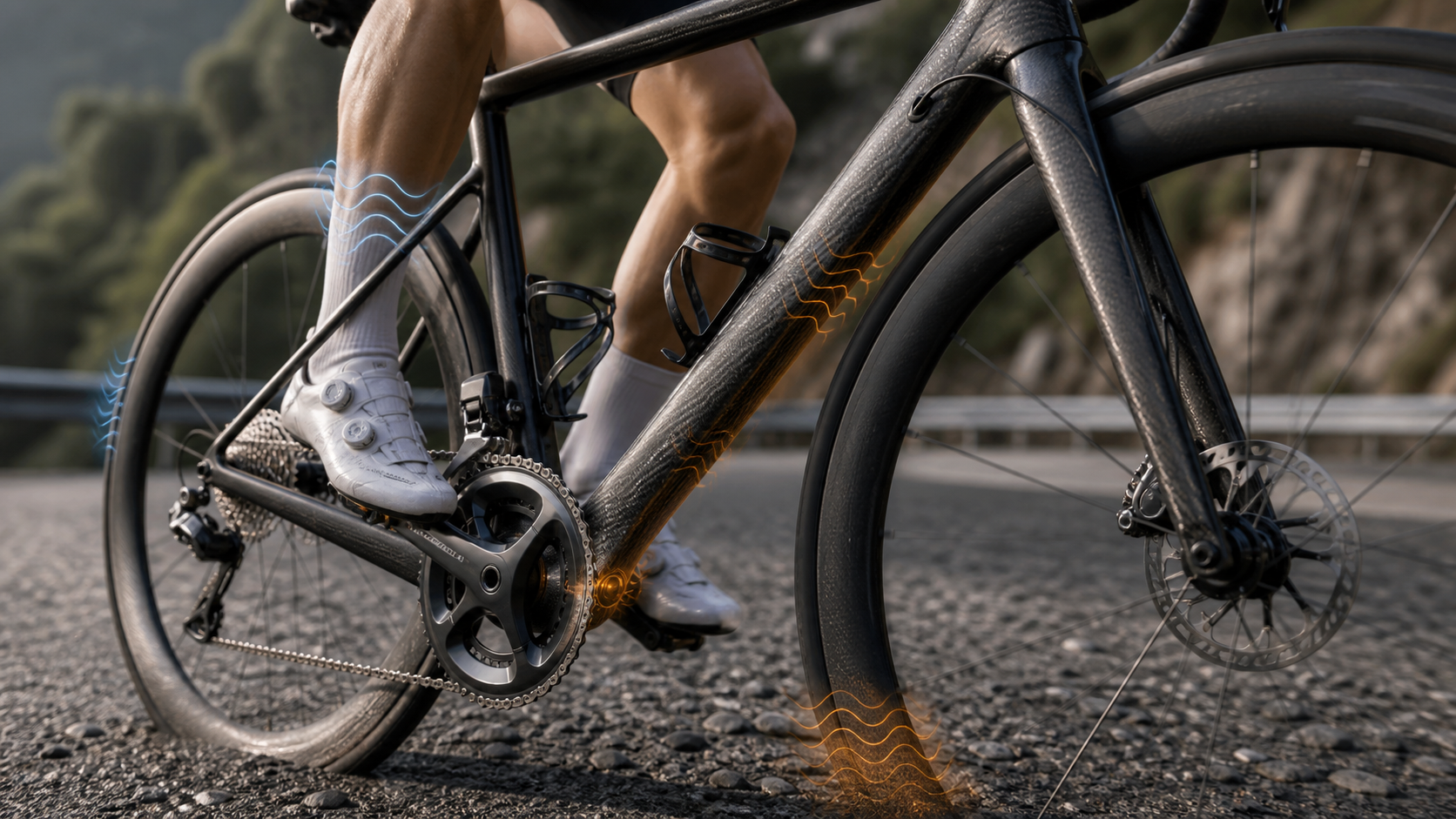
When you spend tens of thousands of dollars on a top-tier carbon fiber frame, and it feels like a solid “thunk” as you push down and surge forward—yet your wrists and hips feel fatigued after a long ride—this is the core contradiction frame engineers must solve: Stiffness and Vibration Damping. Taiwan’s road conditions are diverse, from the asphalt of Taipei’s urban streets to the rough surfaces of the Suhua Highway. Understanding frame mechanics can help you find the best fit for your needs.
The Mechanical Properties of Carbon Fiber
Carbon Fiber Reinforced Polymer (CFRP) has become the material of choice for high-end frames due to its unique material properties:
Anisotropic:
Unlike metallic materials, carbon fiber’s strength and stiffness are highly directional—extremely strong along the direction of fiber alignment, but relatively weak perpendicular to it. Engineers stack multiple layers of carbon fiber at different angles (e.g., 0°, 45°, 90°) to precisely control the stiffness distribution across different parts of the frame.
Specific Stiffness:
Carbon fiber’s specific stiffness (stiffness-to-weight ratio) is approximately 5 times that of steel and 3 times that of aluminum, giving frame engineers greater freedom to design high-stiffness structures without adding weight.
| Material | Specific Stiffness (GPa·cm³/g) | Specific Strength (MPa·cm³/g) | Damping Coefficient |
|---|---|---|---|
| Carbon Fiber (T700) | ~60 | ~450 | High (0.005–0.01) |
| 6061 Aluminum Alloy | ~26 | ~115 | Low (0.0002) |
| Chromoly Steel | ~26 | ~130 | Medium (0.001) |
| Titanium Alloy | ~24 | ~220 | Medium-High (0.003) |
Zone-Specific Stiffness Design
Top-tier frame engineers set different stiffness targets for different areas:
High-Stiffness Zones (requiring power transfer):
- Bottom Bracket Shell: The area of greatest pedaling torque concentration; any deformation means power loss. Top-tier frames can achieve 80+ N·m/deg of bottom bracket stiffness
- Chainstay: Connects the bottom bracket to the rear hub; high stiffness ensures pedaling force is efficiently converted into forward thrust
- Head Tube: Key to handling precision; insufficient stiffness results in a “front-heavy” wobbling sensation
Zones Requiring Vibration Damping:
- Fork: The first filter for road vibration; moderate flex reduces impact transmitted to the wrists
- Upper Seat Tube: Absorbs road vibration, protecting the hips and spine
- Seatstay: A thin, flattened design allows moderate vertical flex, commonly known as the “vibration-damping rear triangle”
Engineering Approaches to Vibration Damping
Modern frame engineers have multiple methods to achieve both contradictory goals simultaneously:
- Cross-Section Shape Optimization: D-shaped or oval seat tubes offer high stiffness in the horizontal (pedaling) direction while allowing flex vertically
- Carbon Fiber Layup Angle Tuning: Increasing the proportion of 45° carbon fiber in the upper seat tube enhances vibration damping
- IsoSpeed Technology (Trek), Future Shock (Specialized): Partially decouple the seat tube from the frame, allowing independent vibration absorption
- Flap Design: Seatstays are made as thin blade-like structures, significantly reducing vertical stiffness
Practical Recommendations
- Primarily long-distance riding (e.g., cycling around Taiwan): Prioritize models with well-designed seat tube vibration damping to reduce cumulative impact over time
- Primarily racing/time trials: Choose race-oriented frames with high bottom bracket stiffness—every watt must be transferred efficiently
- Combine wider tires to reduce vibration: Tires of 28mm or wider at appropriately low pressure absorb road vibration more effectively than the frame
- Carbon wheel pairing: Carbon fiber also has natural damping properties; pairing carbon wheels with a carbon frame enhances overall comfort
- Regular torque checks on bottom bracket bolts: Taiwan’s rainy, humid environment can cause bottom bracket interfaces (BB386, PF30, etc.) to loosen, affecting the perceived pedaling stiffness
Conclusion
The engineering beauty of carbon fiber frames lies in using precision materials science to make “rigidity and compliance” a reality. Understanding the logic behind stiffness design in each frame zone allows you to more accurately judge whether a frame’s characteristics match your riding needs during a test ride—rather than being swayed by marketing hype.
Related Reading
- In-Depth Carbon Fiber Road Frame Review: Comprehensive Comparison of Stiffness, Weight, and Vibration Damping
- Buying a Carbon Fiber Road Frame: Balancing Stiffness, Weight, and Budget
- 【Equipment Analysis】Essential for Advanced Full Marathon: Selection Criteria for Carbon Fiber Frame Geometry and Stiffness, with Quantitative Evaluation of Drivetrain Efficiency and Vertical Shock Absorption (Part 3) Practical Guide
- 【Equipment Analysis】Essential for Advanced Full Marathon: The Golden Rules for Selecting Carbon Fiber Frame Geometry and Stiffness, with Quantitative Evaluation of Drivetrain Efficiency and Vertical Shock Absorption
Nepest NOVA 碳條輪組:輕量、空力、舒適一次滿足!/ 公路車 / CT Yeh
7 個月前
鉅齒紋輪組!? ControlTech MEG-T50 EVO 碳纖維幅條輪組/ 功率對比實驗 / 公路車 / CT Yeh
2 年前
多到選擇障礙... 換個單車把帶想一個小時 / BTP / 編織&軟木特有材質超吸睛! / 公路車 / CT Yeh
1 年前
Unaas X50 全碳纖幅條輪 數據實測對比PK | Lun Hyper 的高階版 | 板輪爬坡也可以很厲害? ! 武嶺2小時大師一起親測! CP值超高 | 公路車 | CT Yeh
4 年前
功率實測 Lun Hyper 2023 碳幅條輪組 D45 碟煞 | 公路車 | CT Yeh
3 年前
再一組! 全碳幅條 碟煞/無內胎輪組 開箱! 到底好騎嗎? UNAAS X40 | 公路車 | CT Yeh
4 年前
換車囉! TIME ADH 2023 全內線碟煞公路車 開箱實錄!/ Dyneema 碳纖維真的太猛了 / 曜越單車 / CT Yeh
3 年前
Vision Metron RS 37碳幅條輪組 (非SL)官網沒有的 低調開箱 / 這重量太銷魂了 / 公路車 / CT Yeh
6 個月前