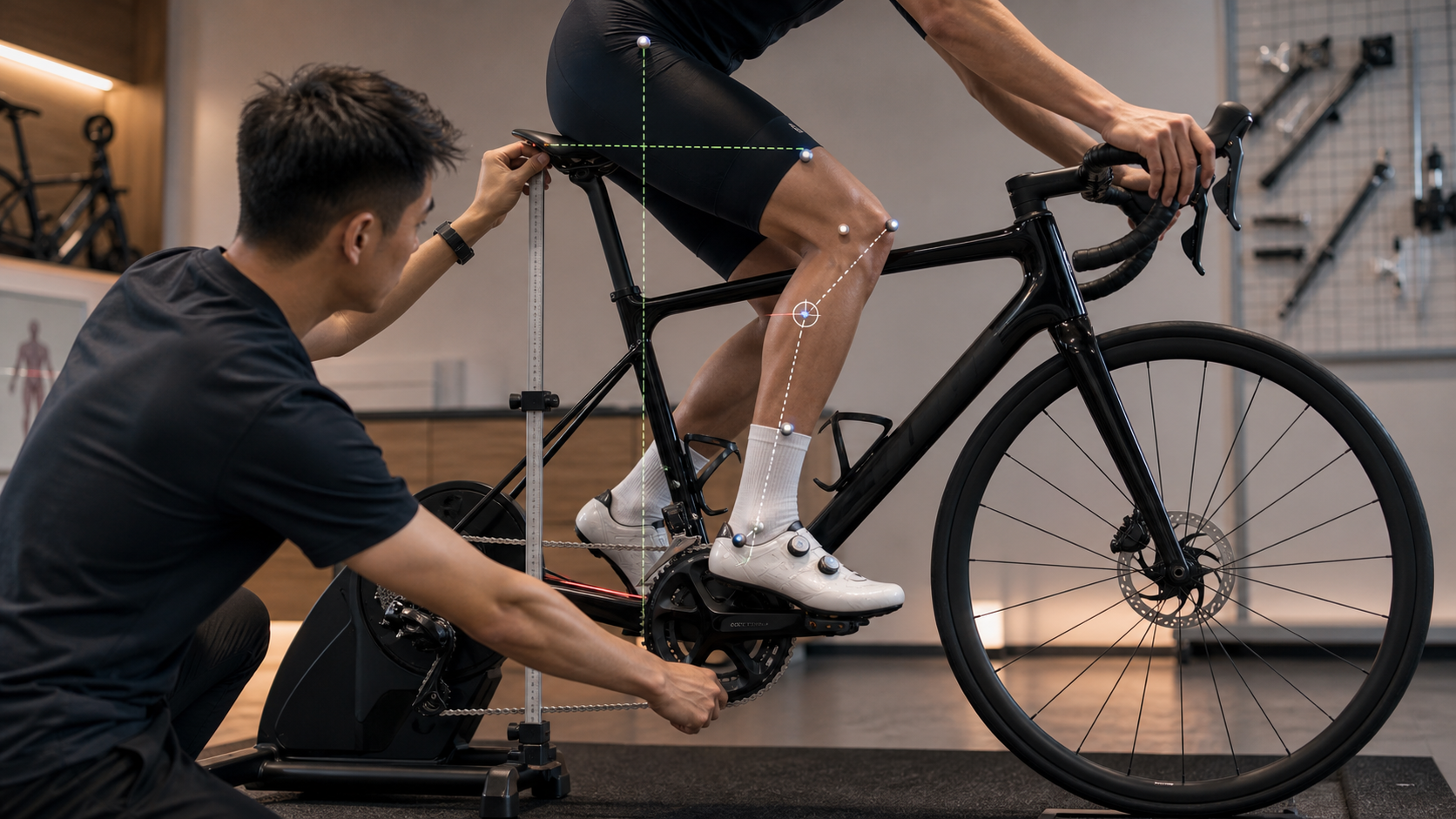
Introduction
Every year, a large number of cyclists in Taiwan are forced to stop training due to knee pain, and a significant proportion of these cases stem from incorrect bike fitting. The knee joint is the most complex joint in terms of force loading during the pedaling motion. With a high frequency of approximately 5,000 pedal strokes per hour, even the slightest biomechanical deviation can accumulate into injury. This article systematically analyzes the core principles of Bike Fit from a biomechanical perspective.
Saddle Height: The Core Control of Knee Angle
Saddle Height is the most influential parameter in Bike Fit, primarily affecting knee loading by controlling the “knee flexion angle at bottom dead center.”
Scientific Standards:
- Knee flexion angle at bottom dead center (the remaining bend angle when the knee is fully extended) is recommended to be 25–35 degrees
- Angle too small (<25°, saddle too high) → Risk of strain to the back of the knee (hamstring tendons)
- Angle too large (>35°, saddle too low) → Excessive compressive force on the patellar tendon
Comparison of Common Calculation Methods:
| Method | Formula | Advantages | Limitations |
|---|---|---|---|
| LeMond Method | Inseam (pubic bone to floor) × 0.883 | Quick estimate | Does not account for individual differences |
| Holmes Method | Knee angle at bottom dead center 25–35° | Based on knee mechanics | Requires dynamic measurement |
| Hamley Method | Inseam × 1.09 (measured to mid-calf) | More precise | Requires measurement skill |
| Dynamic Bike Fit | 3D motion capture system | Most accurate | Requires professional equipment |
Saddle Fore-Aft Position (KOPS Principle)
The fore-aft position of the saddle determines the loading on the knee at the point of maximum pedaling torque (crank arm horizontal, at 90 degrees).
Traditional KOPS (Knee Over Pedal Spindle) Principle:
When the crank arm is extended horizontally forward, the lower edge of the kneecap should align vertically with the pedal spindle. This principle ensures that at maximum pedaling torque, the knee does not tilt too far forward, which would cause excessive pressure on the patellar cartilage.
Modern Perspective Refinements:
Recent research indicates that purely pursuing KOPS is not necessarily the optimal solution; more important considerations include:
- Pedaling smoothness: Moving the saddle forward helps engage the quadriceps and improves pedaling efficiency at top dead center
- Body proportion differences: The ratio of thigh length to shin length affects the optimal fore-aft position
- Functional goals: A slightly rearward saddle position is recommended for climbing, while a slightly forward position may suit time trials
Knee Tracking Analysis: Frontal vs. Lateral Deviation
A complete Bike Fit looks beyond the sagittal plane (side view) and requires analysis of knee tracking in the frontal plane (front view).
Common Knee Tracking Issues:
- Knee Valgus: Knee drifts outward during pedaling—often caused by collapsed arches or weak gluteus medius; can be improved with wedged insoles or adjusting the pedal Q-Factor outward
- Knee Varus: Knee drifts inward—more common in high-arched feet; requires inward wedged insoles
- Vertical tracking deviation: Asymmetrical pedaling paths between left and right legs, possibly stemming from pelvic tilt or leg length discrepancy
Special Note for Taiwanese Cyclists:
The proportion of arch issues (flat feet) is relatively high among cyclists in Taiwan. It is recommended to undergo a foot pressure scan before deciding on insole configuration, to avoid long-term injury accumulation from incorrect knee tracking.
Practical Recommendations
- DIY adjustment starting point: Set the initial saddle height using the LeMond Method (inseam × 0.883), then fine-tune based on knee sensation after riding, with each adjustment no more than 3mm
- Saddle height fine-tuning direction: Pain in the front of the knee (below the kneecap) → raise the saddle slightly; pain in the back of the knee → lower the saddle slightly
- Use video assistance: Have a friend record you from the side and observe the knee angle at bottom dead center in slow motion
- Insoles before saddle: For knee tracking deviations caused by foot issues, address the insoles first, then adjust the saddle position
- Seek professional Bike Fit: At least once a year, especially after changing frames, increasing mileage, or when new pain appears
Conclusion
Bike Fit is a precise discipline combining biomechanics, anatomy, and engineering. A 1-centimeter difference in saddle height may seem minor in terms of knee angle per pedal stroke, but multiplied by hundreds of thousands of pedal strokes per year, it becomes the dividing line between injury and health. Investing in a professional Bike Fit is the most worthwhile equipment upgrade for every serious rider.
Related Reading
- The Biomechanics of Bike Fit: The Causal Chain of Knee Joint Load, Saddle Height, and Long-Term Injury
- The Science of Seated Bike Fit: From Biomechanics to Power Maximization
- The Science of Road Bike Fit: Saddle Height, Reach, and Rotation Point Adjustments
- The Complete Guide to Cycling Posture Fitting
#公路車 #Fitting 靠人工智慧APP 幫你調整單車
6 年前
靠單車減肥35公斤 心得分享與整理
7 年前
一日北高常見問題大集合 | 攻略 | 路線 | 訓練 | 補給 | 自行車 單車 | 一日雙城 | 雙塔 | TWB北高360 | 屁股痛
6 年前
單車 一日北高 ( 雙城 ) 肥宅雙人瘋狂行 紀錄片 REACTO
10 年前
一日北高/長距離團騎 常見問題補充篇 / 組團或跟團的眉角 / 壯車友容易被瘦車友慢性拉爆 / 原來屁股痛可能是這個原因...? / 風場配速法 / 公路車 / CT Yeh
2 年前
Nepest NOVA 碳條輪組:輕量、空力、舒適一次滿足!/ 公路車 / CT Yeh
7 個月前
摔車後補裝備: 好市多新款單車安全帽& Specialized Romin 北高整路屁股都不痛的坐墊 | 一千元居然有MIPS | CT Yeh | 公路車
4 年前
下次拍照前要查清楚啦🤣 #cycling
7 個月前