Introduction
Many Taiwanese riders know to choose a good wheelset, but overlook that the tire is the only point of contact between the ground and the bike. In fact, for most amateur riders, the performance gain from a tire upgrade often exceeds what the same amount of money spent on a frame upgrade would achieve. Understanding the science of rolling resistance lets every dollar of your equipment investment count more precisely.
How Rolling Resistance Is Generated
Rolling resistance (Crr) is mainly produced by the following mechanisms:
1. Energy loss from tire deformation (hysteresis loss):
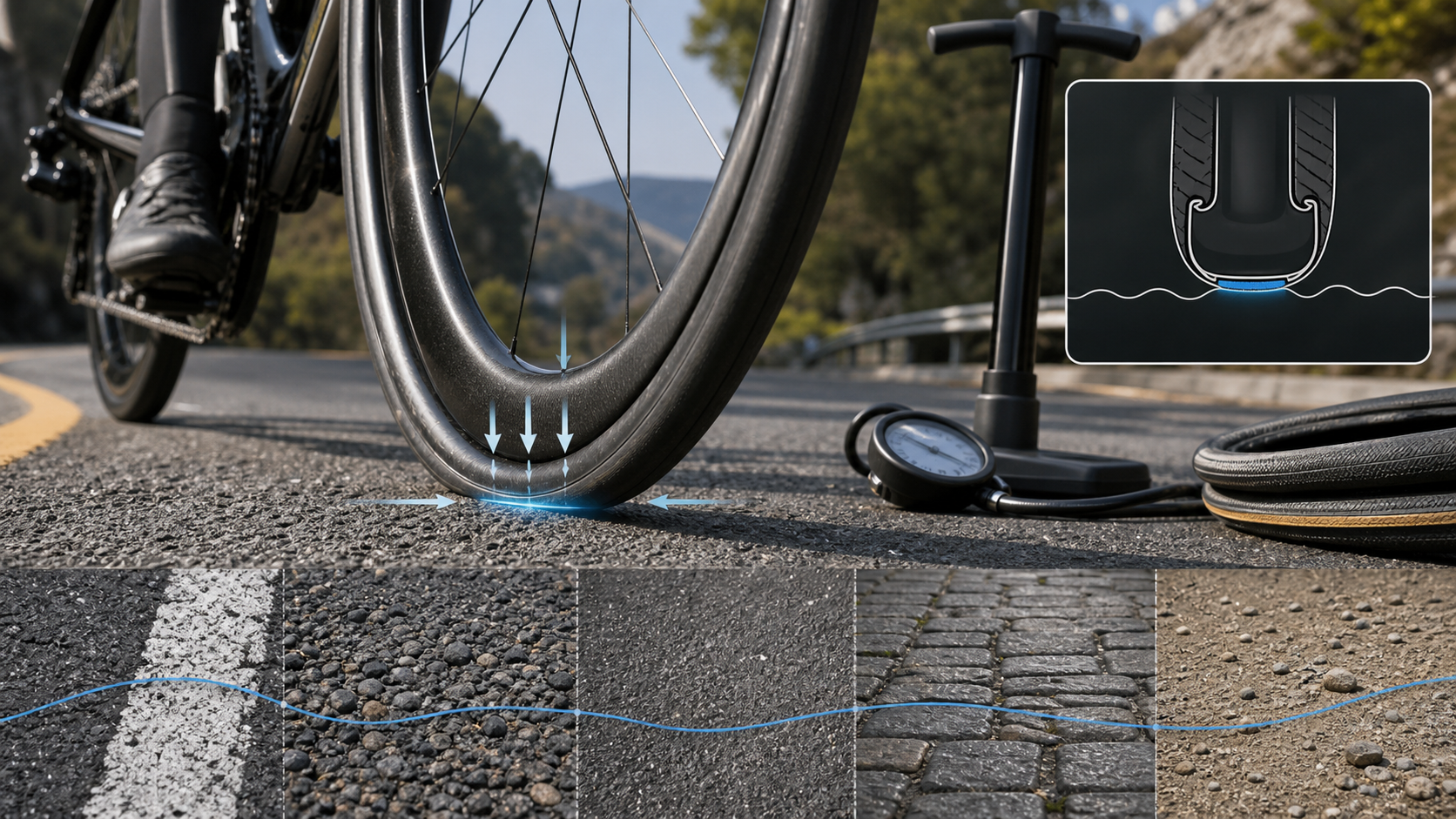
With every rotation, the contact patch of the tire undergoes cyclical deformation — elastic potential energy is stored during compression, but the rebound is not 100% efficient, and part of the energy is dissipated as heat. This is the main source of rolling resistance (accounting for about 75–85%).
2. Impact energy from road surface irregularities:
When a tire crosses small road surface bumps, the wheel must be “lifted” and then “dropped,” a process that consumes additional energy (about 10–20%).
3. Air resistance between the tire and the road surface:
The small amount of air trapped between the contact patch and the road surface contributes about 5% of rolling resistance.
The Effect of Tire Compound
| Tire Type | Tread Compound | Typical Crr | Durability | Puncture Resistance |
|---|---|---|---|---|
| Training tire (thick tread) | High-hardness rubber | 0.006–0.008 | Very high | High |
| All-purpose tire | Medium hardness | 0.004–0.006 | High | Medium |
| Race tire (thin tread) | High-elasticity natural rubber | 0.002–0.004 | Low | Low |
| Premium racing tubular | Cotton casing + thin rubber | 0.002–0.003 | Very low | Very low |
The importance of the casing:
Beyond the tread compound, casing suppleness has a major effect on hysteresis loss. A casing with a high TPI (Threads Per Inch, the weave density) is more supple, deforms and rebounds more efficiently, and produces lower rolling resistance. Training tires commonly available in Taiwan typically have a TPI of around 60–120, while race tires can exceed 320 TPI.
Inflation Pressure: The Most Overlooked Adjustment
The effect of inflation pressure on rolling resistance is opposite on smooth versus rough road surfaces:
Smooth road surfaces (such as Taiwan’s West Coast asphalt or newly paved roads):
- Higher pressure → smaller contact patch → less deformation → lower Crr
- On good road surfaces, it is recommended to maintain a higher pressure
Rough road surfaces (such as rural farm roads or older urban roads):
- Pressure too high → the tire cannot deform to absorb surface bumps → the bike “bounces” → actual resistance increases instead
- There is a sweet spot, the “optimal pressure” — both too high and too low increase resistance
Recommended pressures for Taiwan’s road surfaces:
| Rider Weight | 25mm Tire (normal road) | 28mm Tire (normal road) | 32mm Tire (mixed surface) |
|---|---|---|---|
| 60kg | Front 75 / Rear 80 psi | Front 65 / Rear 70 psi | Front 55 / Rear 60 psi |
| 70kg | Front 80 / Rear 85 psi | Front 70 / Rear 75 psi | Front 60 / Rear 65 psi |
| 80kg | Front 85 / Rear 90 psi | Front 75 / Rear 80 psi | Front 65 / Rear 70 psi |
| 90kg | Front 90 / Rear 95 psi | Front 80 / Rear 85 psi | Front 70 / Rear 75 psi |
Practical Recommendations
- Prioritize tire upgrades over wheel upgrades: The rolling resistance difference between a race tire and a training tire (about 0.003 Crr) is equivalent to saving roughly 5W at 25km/h — often more practical than many wheelset upgrades.
- Adjust pressure based on the road surface: Check road conditions before departure; if your route includes a lot of older urban roads, lower the pressure by 2–5 psi accordingly.
- Watch for thermal expansion in Taiwan’s summer: High temperatures raise the internal tire pressure; the pressure you set before departure may have risen by 5–10 psi by midday.
- Choose puncture protection wisely: Taiwan’s roads have a lot of glass debris; outside of racing, it’s advisable to choose tires with a puncture-resistant layer, with models like the Schwalbe Pro One and Continental GP5000 that balance rolling resistance and puncture protection being good choices.
- Replace tires regularly: After more than 5,000 km, the worn-thin tread causes Crr to rise significantly, and the risk of flats increases.
Conclusion
Rolling resistance is where science and everyday riding intersect most closely. The right tire paired with the appropriate pressure lets the same physical effort convert into more speed. Next time you need a new tire, it’s worth reconsidering your tire choice — it is one of the most cost-effective “upgrades” you can make.
Related Reading
- The Science of Choosing Road Bike Tires: How Tread Pattern, Pressure, and Compound Affect Rolling Resistance and Grip
- The Physics of Rolling Resistance and Tire Pressure: Why “Harder Is Faster” Is Wrong
- Bicycle Tire Buying Guide: Differences in Width, Tread, and Compound
- Choosing Bike Tires: The Speed vs. Comfort Trade-off Between 25c, 28c, and 32c Widths
單車胎壓觀察到的有趣現象,SRAM Quarq TyreWiz 2.0 無內胎胎壓計 / 裝了有哪些幫助? / Tubeless / 公路車 / CT Yeh
1 年前
公路車 爬坡 破PR 紀錄 小技巧 分享
6 年前
碟煞公路車 銑面器 !? 原來銑完差這麼多! 降低蹭碟機率! | TIME 公路車 保養小記錄 | CT Yeh
3 年前
單車 一日北高 ( 雙城 ) 肥宅雙人瘋狂行 紀錄片 REACTO
10 年前
多到選擇障礙... 換個單車把帶想一個小時 / BTP / 編織&軟木特有材質超吸睛! / 公路車 / CT Yeh
1 年前
靠單車減肥35公斤 心得分享與整理
7 年前
「悲情男車友」創作單曲 爆笑MV / 公路車 / CT Yeh / 4K劇情版
7 個月前
爬陡坡被爆胎的車友跑步超車 #cycling #里佳部落
9 個月前