Introduction
In Taiwan, the road running population continues to grow, with races ranging from the Standard Chartered Taipei Marathon to the Tainan Ancient Capital Marathon every year. However, many beginners often casually buy a pair of shoes that “look sporty,” only to end up with knee pain or plantar fasciitis within three months. Choosing shoes is, in fact, a rigorous science.
This article will start with arch types, help you understand cushioning needs and material choices, and explain how to determine a shoe’s mileage lifespan, so every dollar you invest is well spent.
Arch Type: Find Your Foot Shape
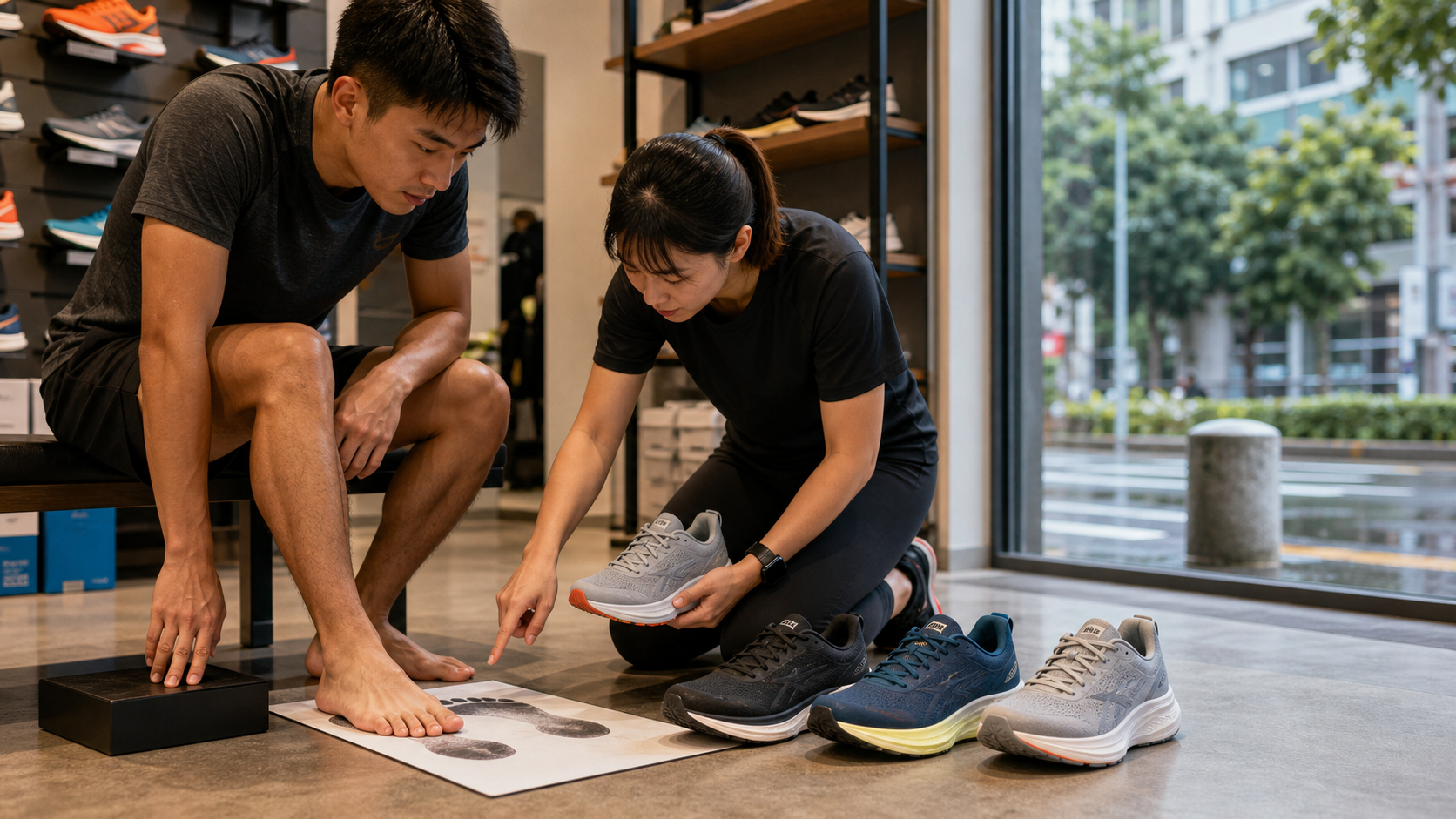
The arch is one of the most critical factors influencing running shoe selection. You can determine your arch type with the “wet foot test”—step on paper with wet feet and observe the footprint shape:
- Normal arch (medium): The mid-foot shows a clear curved gap; suitable for most stability or neutral shoes
- Flat feet (low arch): The footprint is almost fully grounded; requires higher support and dynamic stability designs to avoid overpronation
- High arch: The mid-foot barely touches the ground; the ankles are stiffer; requires thicker cushioning designs to absorb impact
Due to genetics and lifestyle habits (long-term use of flip-flops or flat shoes), the proportion of flat feet is relatively high among Taiwanese people. It is recommended to get a gait analysis at a professional running shoe store before purchasing. Many sports brand stores in major cities already offer free treadmill gait analysis services.
Cushioning Needs and Material Analysis
Modern running shoe cushioning midsoles mainly fall into three categories:
| Midsole Material | Representative Brand Materials | Characteristics | Suitable Scenarios |
|---|---|---|---|
| EVA Foam | Traditional Phylon, Boost | Lightweight, durable but lower rebound | Daily training, long-distance easy runs |
| PEBA Foam | Nike ZoomX, ASICS FF BLAST | Ultra-light, high rebound but lower durability | Racing, speed training |
| TPU/Blend | Adidas Lightstrike Pro | Balances responsiveness and durability | Long-distance training, marathons |
Stack Height is also a hot topic in recent discussions:
- High stack (>35mm): Slightly less stable but excellent cushioning; suitable for long distances or beginners
- Mid stack (25–34mm): Balanced; suitable for most training
- Low stack (<25mm): Better ground feel; suitable for speed training or advanced runners
Special Considerations for Taiwan’s Road Conditions
Taiwan’s urban road surfaces are mainly asphalt and tiles, and tiled sidewalks become extremely slippery in the rain. Here are a few localized recommendations:
- Outsole durability: Taiwan’s climate is humid and road surfaces are varied; choosing shoes with carbon rubber outsoles offers better durability
- Breathability: Taiwan summers often exceed 35°C; knit mesh uppers (Flyknit, Engineered Mesh) are far more breathable than leather or thick fabrics
- Waterproofing considerations: If you’re used to training outdoors in the rain, consider Gore-Tex waterproof versions, though breathability will be slightly reduced
- Width options: Taiwanese runners have slightly wider average foot widths than Europeans and Americans; ASICS 2E wide widths and New Balance 2E/4E versions are worth prioritizing
Mileage Lifespan: When to Replace Your Shoes
The recommended mileage for a pair of running shoes is typically 500–800 km, but the following factors will shorten their lifespan:
- Heavier body weight (>80kg) accelerates midsole compression
- Mixed use for everyday wear (not purely for running)
- Taiwan’s hot climate accelerates midsole aging
Three indicators for determining when to replace your shoes:
- Press test: Press the midsole firmly with your thumb. If it rebounds immediately, the shoe is still in good condition; if it rebounds slowly, the midsole has aged
- Outsole wear: If the rubber outsole wears through and exposes white EVA, replace immediately
- Body signals: If you experience knee or calf pain sooner than usual after runs, the shoes may have reached the end of their lifespan
Practical Advice
- Prepare two pairs of running shoes and rotate them, allowing the midsoles more than 24 hours to rebound, which extends the total lifespan of both pairs
- Shop for shoes in the afternoon to evening, when your feet are slightly swollen, closer to their state during long runs
- When trying on, leave about one thumb’s width (approximately 1cm) of space between your toes and the toe box
- Taiwanese runners can refer to shoe reviews from local running communities such as iRunners and 長跑先生 (Mr. Long Run), which better reflect local running conditions
Conclusion
Running shoes are not about being the most expensive—they are about being the most “suitable.” Understanding your arch, mileage needs, and Taiwan’s local climate is the key to making the smartest choice. Beginners on a budget can start with mid-tier stability shoes, and after accumulating a certain mileage, upgrade to advanced models based on personal feedback. Remember: a good pair of shoes is your first line of defense against injury.
Related Reading
- Road Running Shoe Buying Guide: Correct Matching of Foot Types (Flat, Normal, High Arch) with Shoe Models
- Your First Pair of Road Running Shoes: Key Considerations and Fitting Methods for Beginners
- Beginner’s Guide to Choosing Running Shoes: Finding the Perfect First Pair for You
- Running Shoe Selection for Older Runners: The Logic of Choosing Shoes for Fallen Arches and Cushioning Needs
單車 一日北高 ( 雙城 ) 肥宅雙人瘋狂行 紀錄片 REACTO
10 年前
大家都在開箱的...單車用藍芽對講耳機真的有幫助嗎? SENA BiKom 20 長距離旅遊 & 海鷗繞圈賽 實際體驗心得 / 公路車 / CT Yeh
9 個月前
多到選擇障礙... 換個單車把帶想一個小時 / BTP / 編織&軟木特有材質超吸睛! / 公路車 / CT Yeh
1 年前
#公路車 #Fitting 靠人工智慧APP 幫你調整單車
6 年前
再快都跟的上!? 單車跟隨攝影機之王 HOVERAir X1 PROMAX 全面實測 / 唯一!8K畫質&自行車專用模式和跟蹤信標&前後避障 / DJI Neo 可參考/ 公路車 / CT Yeh
1 年前
3D 列印車褲墊 / 舒適改善? / 無痕 x 分區壓縮 / ATK & Decider系列 / JE22黑科技 / #公路車 #CTYEH
11 個月前
2026 車錶排行榜!誰是最多車友正在使用?練家子最愛哪款?🏆 (2萬名車友數據) / 公路車 / CT Yeh
5 個月前
白沙屯媽祖進香在家走!UREVO 坡度自調走步機 / 可連接訓練遊戲APP MyWhoosh / 邊看直播邊走起來 / CT Yeh
11 個月前