/no_think The Benefits of Running Compression Tights: A Comparison of Calf Sleeves, Compression Tights, and Loose-Fit Pants
/no_think
Introduction
At the starting line of the Taipei Marathon or the Linkou Taiwan Marathon, runners wearing calf sleeves are everywhere. Compression gear has become a popular accessory among Taiwanese runners, but does it really work? Or is it just a placebo? This article will help you clarify the true effectiveness of compression gear from both scientific research and practical use perspectives.
The Scientific Basis of Compression Gear
The core principle of compression gear is to apply a specific level of external pressure to muscles and veins, achieving the following effects:
- Promoting venous return: Compressing the leg veins helps blood flow back from the extremities to the heart, reducing blood pooling in the lower limbs
- Reducing muscle vibration: Compression fabric limits the transverse amplitude of muscles, theoretically reducing cumulative muscle damage
- Enhanced proprioception: Compression stimulation on the skin increases awareness of muscle position, helping stabilize running form
However, research findings are inconsistent. Some studies show that compression gear can significantly improve post-exercise recovery (such as muscle soreness index and lactate clearance rate), but its effect on race-day performance is limited and varies from person to person. The current scientific consensus is that the benefits of compression gear for recovery are more established than its benefits for competitive performance.
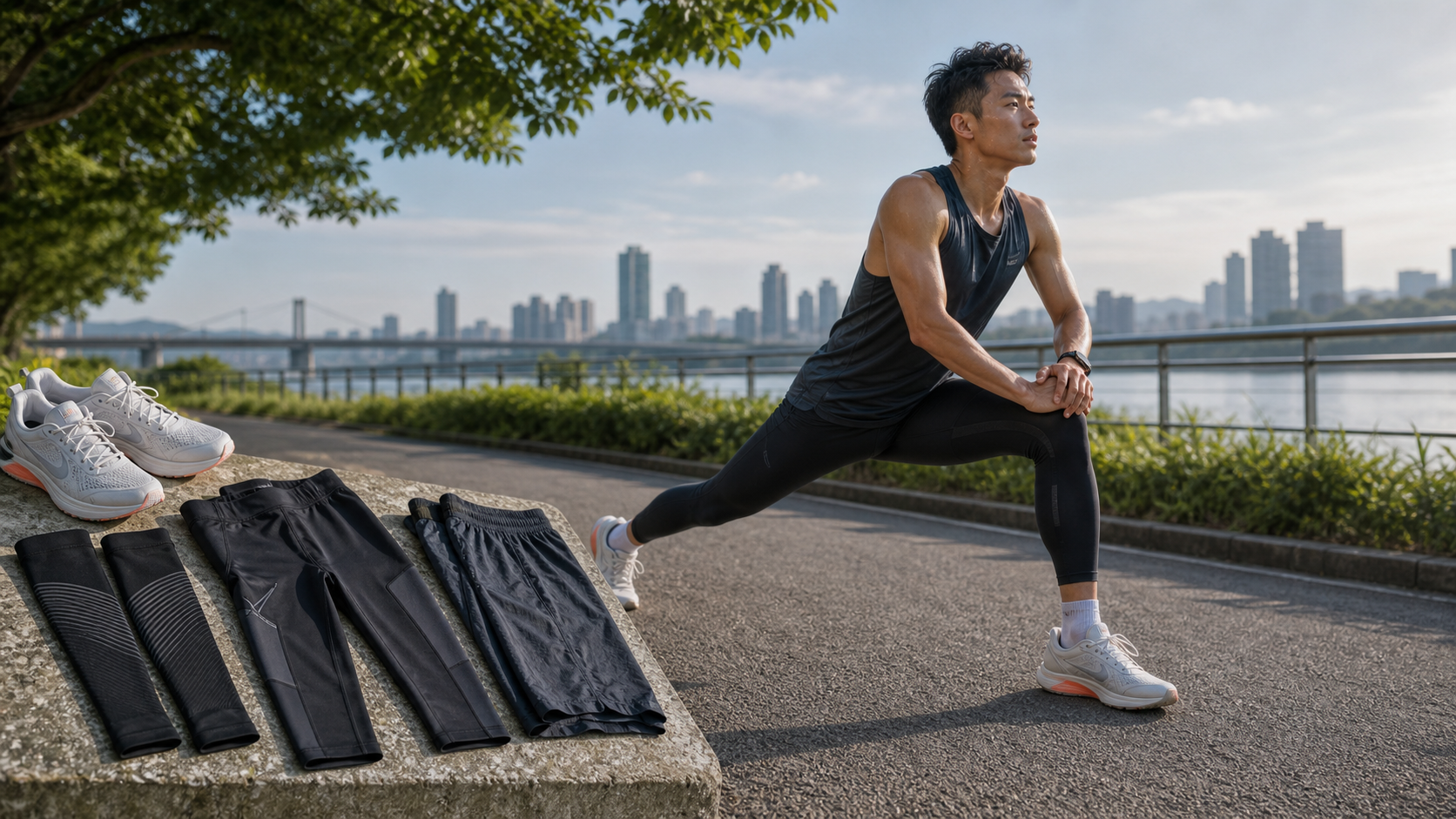
Comparison of Three Types
| Type | Coverage | Pressure Level | Suitable Scenarios | Comfort in Taiwan’s Summer |
|---|---|---|---|---|
| Calf Sleeve | Ankle to below knee | Medium (15–20 mmHg) | Races, post-long-run recovery | ★★★ (Better breathability) |
| Compression Tights | Full leg to waist | Medium to high (20–30 mmHg) | Long-distance training, post-race recovery | ★★ (Higher heat retention) |
| Loose Compression Shorts | Thigh to hip | Low to medium | Daily training, preventing inner-thigh chafing | ★★★★ (Most breathable) |
Calf Sleeves
Calf sleeves are the most common compression gear among Taiwanese runners because they only cover the calves and are relatively less stuffy in summer. Their main function is to support the tibialis anterior and gastrocnemius muscles, making them particularly helpful for runners prone to calf cramps. Brand recommendations: 2XU, CEP, and Taiwanese local brand Triathlete Master all offer solid options.
Compression Tights
Full-leg compression tights are very practical in winter or for cool-weather mountain trail training, but they feel stuffy and hot in Taiwan’s summer. Wearing them for post-race recovery (while riding in a car or resting) is the best use case for compression tights, as activity levels are low and recovery benefits are maximized at that time.
Compression Shorts
The main functions of compression shorts are to prevent inner-thigh chafing (especially important over long distances) and to support the groin and gluteus maximus muscles, offering some benefit in preventing thigh soreness. In Taiwan’s summer, the most suitable combination is wearing compression shorts with a lightweight outer layer of shorts.
Choosing the Compression Level
Compression gear is graded by pressure value (mmHg):
- Light compression (8–15 mmHg): Everyday comfort wear, vein protection for prolonged standing or sitting
- Medium compression (15–20 mmHg): Athletic training, long-distance running
- Strong compression (20–30 mmHg): Medical use, accelerating post-race recovery
For the average runner, choosing athletic-grade compression at 15–20 mmHg is sufficient. Excessive compression may actually restrict blood flow and cause discomfort.
Usage Recommendations for Taiwan’s Summer
From June to September, temperatures in Taiwan often exceed 33°C, so the heat retention issue of compression gear cannot be ignored:
- Prioritize knitted breathable fabrics (such as 2XU’s MCS series or CEP’s Ultralight versions)
- During long-distance races, when using ice cooling on the upper body, keep calf sleeves on the lower limbs for minimal support
- Wearing compression tights for 1–2 hours after a race (such as before bed) is a low-cost, high-benefit recovery strategy
- For reviews and recommendations from Taiwanese runners, refer to the CT Yeh Taiwan running community or post-marathon discussion forums
Practical Advice
- For your first purchase, try on compression gear at a sporting goods store; sizing varies significantly between brands, and buying purely from size charts online can easily lead to misfits
- Wash in cold water by hand or on a gentle machine cycle to avoid high temperatures damaging the compression force of the elastic fibers
- If you feel noticeable numbness or see skin discoloration within 30 minutes of wearing, the compression is too tight and you should switch sizes immediately
Conclusion
Compression gear has scientific backing for aiding running recovery, but its effect on race performance varies from person to person. Rather than believing every claim in the advertisements, it’s better to test it yourself over several training sessions and feel how your body responds. If you’re prone to calf cramps or noticeable post-run soreness in Taiwan’s summer, calf sleeves are a worthwhile entry-level investment; if you’re seeking maximum recovery benefits, wearing compression tights after a race is the most effective way to use them.
Related Reading
- Evidence on the Benefits of Running Compression Tights: What Scientific Research Tells You
- The Recovery Effects of Compression Garments: What Does Science Say?
- Running Compression Apparel: A Full Analysis of the Scientific Benefits for Muscle Support and Venous Return
- The Benefits of Pressure Garments for Road Runners: A Scientific Evaluation of Recovery Compression Gear
3D 列印車褲墊 / 舒適改善? / 無痕 x 分區壓縮 / ATK & Decider系列 / JE22黑科技 / #公路車 #CTYEH
11 個月前
靠單車減肥35公斤 心得分享與整理
7 年前
Fitting訓練兩用功率車 ! Thinkrider ST900 完整實測!/ 坡度升降 / 鄰居測試/ smart bike/公路車/ CT Yeh
2 年前
#公路車 #Fitting 靠人工智慧APP 幫你調整單車
6 年前
大家都在開箱的...單車用藍芽對講耳機真的有幫助嗎? SENA BiKom 20 長距離旅遊 & 海鷗繞圈賽 實際體驗心得 / 公路車 / CT Yeh
9 個月前
#PUSHBIKE 原來這麼好玩! 小朋友 滑步車 初體驗 超可愛
6 年前
CT暗黑廚房) 車友必備 宇宙無敵鮮蚵湯 幫助訓練恢復 天然食補 好市多 超肥鮮蚵 破PR
7 年前
詳測) 小米 電動打氣筒 公路車胎要充多久? 值得買嗎? 米家充氣寶 小心燙手!
7 年前