Choosing a Running Hydration Carry System: Soft Flasks, Waist Packs, and Vests for Long Distances
Introduction
When running in Taiwan’s summer heat, hydration isn’t optional — it’s essential for survival. At 33°C, a 60kg runner can lose 1–1.5 liters of sweat per hour. If aid stations are only every 5km and your pace is 6 minutes/km, that means you need to maintain hydration for 30 minutes using only the water you carry yourself. Choosing the right hydration gear directly affects training quality and race performance.
Three Main Types of Hydration Gear
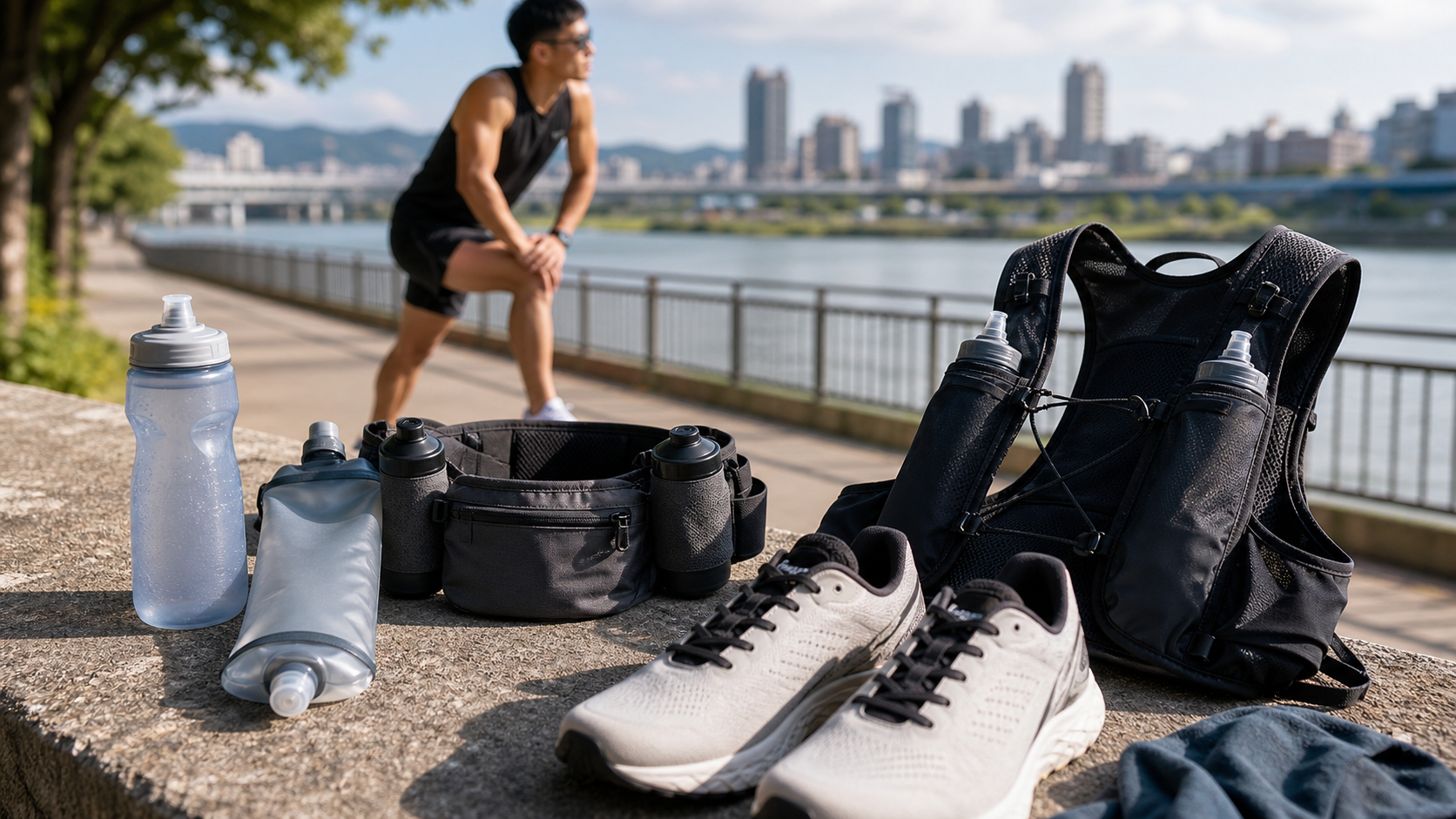
| Type | Capacity Range | Weight (with water) | Suitable Distance | Suitability for Taiwan Races |
|---|---|---|---|---|
| Handheld soft flask | 250–500ml | 300–600g | 5–21km | Half marathon, urban road races |
| Waist pack (Belt/Hip Pack) | 500ml–1.5L | 600g–1.5kg | 10–50km | Full marathon, trail routes |
| Hydration vest | 1.5–10L | 1.5–4kg | 30km+ | Ultramarathon, trail races |
Handheld Soft Flasks
Features
Handheld soft flasks (such as those from Nathan and Salomon) are extremely lightweight. As the water level drops, the flexible flask collapses and shrinks, avoiding the “sloshing empty bottle” problem that rigid bottles have. Most models include a hand strap, so you don’t need to grip tightly even over long distances.
Advantages
- Quick and convenient hydration without opening a pack
- Weight decreases as water is consumed, making the second half of a run nearly weightless
- Some models have an integrated pocket for energy gels or supplements
Disadvantages
- Limited capacity (mostly 250–500ml), requiring refills mid-run for training beyond 10km
- Holding a flask affects natural arm swing, requiring an adjustment period for form-conscious runners
- In Taiwan’s summer daytime heat, water in a handheld flask warms quickly, becoming lukewarm after about 20 minutes
Recommended use cases: 5–10km short distances, lightweight hydration for half marathons, urban road races with frequent aid stations
Running Waist Packs
Features
Waist packs (also called hip packs or hydration belts) are a popular choice among full marathon runners, typically holding one to two 250ml soft flasks plus a pocket for snacks. A good waist pack should have an anti-bounce design to prevent it from bouncing up and down while running.
Advantages
- More freedom than handheld options, with both hands completely free
- More storage space (for a phone, supplies, a spare key)
- Weight sits at the waist, minimizing impact on running form
Disadvantages
- Some waist packs can trap heat around the waist in Taiwan’s summer
- If the soft flask design doesn’t fit snugly against the waist, it can bounce and chafe over long distances
Recommended models for Taiwan:
- Nathan Pinnacle Belt: Stable dual-flask design, commonly seen among Taiwan marathon runners
- Salomon Active Skin 4: Ample storage, comfortable front-mounted flask design
Hydration Vests
Features
Hydration vests combine a bladder with multiple storage pockets, and are standard gear for ultramarathons and trail races. Taiwan’s well-known TNF 100 ultramarathon requires runners to carry substantial supplies and emergency gear, making a hydration vest nearly mandatory.
Bladder vs. Front Flasks
- Bladder: Large capacity (1.5–3L), drink through a bite valve without stopping, but troublesome to clean
- Front flasks: Smaller capacity (150–500ml x 2), but easier to refill and swap out, suitable for long-distance races with aid stations
Buying considerations:
- Check the front-to-back weight distribution of the vest — an overly heavy pack will affect running mechanics
- The vest should fit snugly against the body to minimize bounce; adjustable shoulder and chest straps are very important
- A breathable mesh back panel reduces heat buildup on the back, which is especially important in Taiwan’s summer
Cleaning and Maintenance of Hydration Gear
Taiwan’s humid climate makes bladders prone to mold if not cleaned properly:
- Rinse immediately after each use and hang to dry upside down (never store it sealed)
- Deep clean weekly by soaking with diluted food-grade cleaning tablets (such as Camelbak Cleaning Tablets)
- Replace the bite valve regularly (typically every 3–6 months)
Practical Tips
- Before buying, determine your longest training distance and race type — don’t buy an ultramarathon-grade pack for a half marathon
- Always test-fit with water inside; an empty pack feels very different from one loaded for an actual run
- In Taiwan’s summer, add electrolyte tablets to your bladder or flask to replenish both water and salt
- For waist packs, choose a buckle design rather than a plain elastic strap for better stability while running
Conclusion
In Taiwan’s hot, humid summer conditions, your choice of hydration gear directly affects running safety. For short, easy runs, a handheld soft flask is enough; for full marathons or long-distance training, a waist pack offers the best balance; for ultramarathons or trail routes, a hydration vest is indispensable gear. Choosing based on your running distance and the demands of Taiwan’s races is the smartest investment in gear.
Related Reading
- Hydration Vest vs. Handheld Flask vs. Hydration Belt: A Complete Comparison of Running Hydration Methods
- Running Hydration Belts and Packs: The Logic Behind Choosing Long-Distance Hydration Gear
- A Complete Comparison of Running Hydration Gear Designs: Handheld Flasks vs. Waist Packs vs. Hydration Vests
- Choosing a Running Backpack: Evaluating Capacity and Stability of Trail Running Hydration Packs
類空拍神器 Feiyu Pocket 2s (有優惠連結)三軸穩定 運動攝影機 開箱!比GoPro 還強的滑順視角!三小時長時間錄影 行車記錄器 | 環花東365實測 | 公路車 CT Yeh
4 年前
單車 一日北高 ( 雙城 ) 肥宅雙人瘋狂行 紀錄片 REACTO
10 年前
CT暗黑廚房) 車友必備 宇宙無敵鮮蚵湯 幫助訓練恢復 天然食補 好市多 超肥鮮蚵 破PR
7 年前
詳測) 小米 電動打氣筒 公路車胎要充多久? 值得買嗎? 米家充氣寶 小心燙手!
7 年前
大家都在開箱的...單車用藍芽對講耳機真的有幫助嗎? SENA BiKom 20 長距離旅遊 & 海鷗繞圈賽 實際體驗心得 / 公路車 / CT Yeh
9 個月前
西拉雅五庫單車挑戰 / 曾文水庫 & 南168 二寮 / 500元報名費居然這麼超值/ 公路車 / CT Yeh
10 個月前
一日北高前的高裝檢 | 北高 360 | 挑戰11小時的裝備 | 一日雙塔 | 補給
6 年前
單車 重低音 藍芽喇叭 音質實測 SoundBot SB525 Real Sound Test
8 年前