Introduction
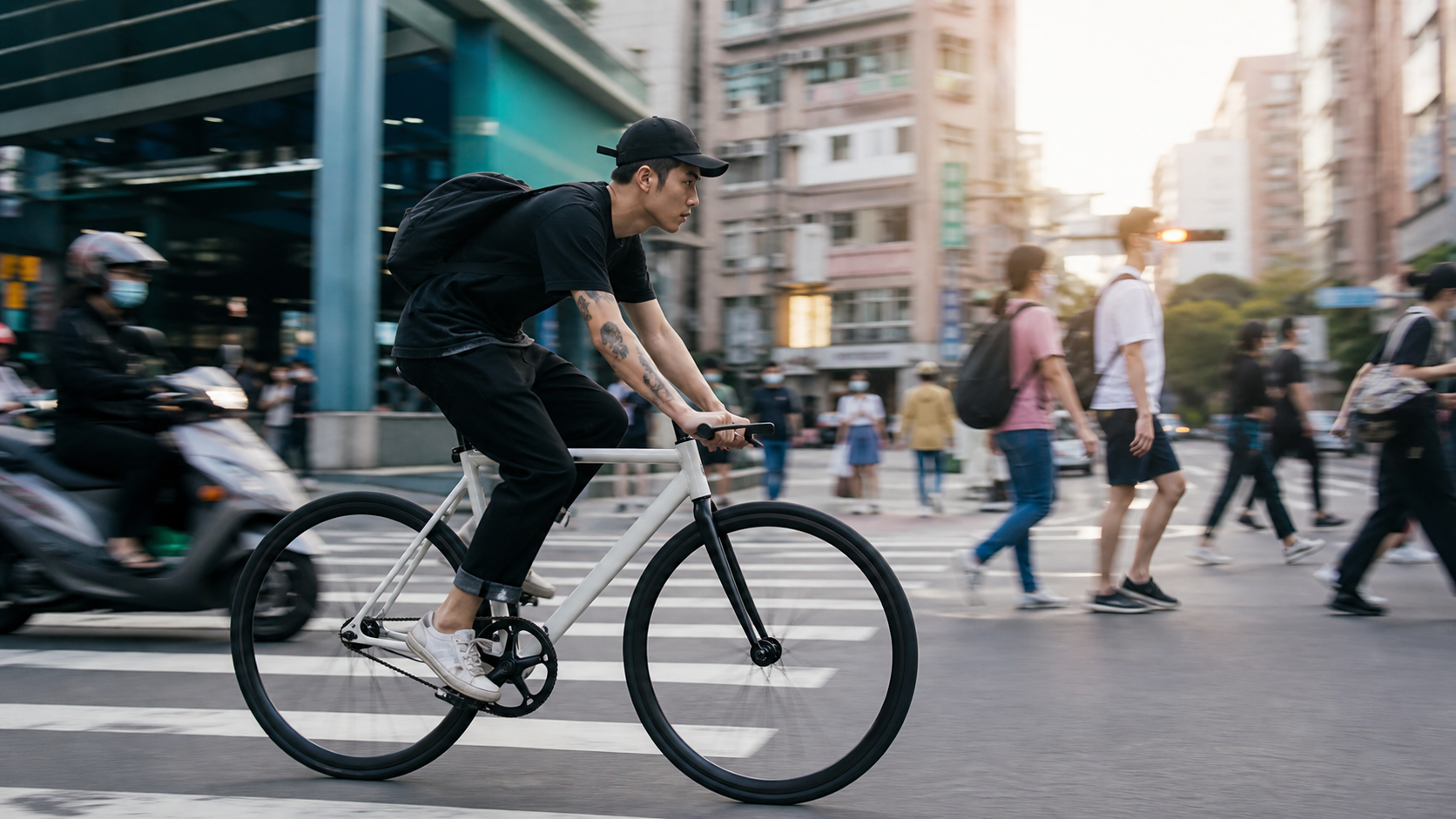
On the streets of Taipei, you might occasionally spot a special kind of bicycle: no gear system, the pedals keep turning even when the rider stops, and colors so vivid they’re impossible to ignore. The riders often dress just as distinctively—slim-straight pants, a messenger bag slung diagonally, wearing a special helmet or none at all. This is the Fixed Gear bike (fixed-gear bicycle, commonly known as Fixie), a type of bicycle that moved from the racing track to city streets, along with an entire subculture built around it.
What is a Fixed Gear
The core feature of a Fixed Gear is the “fixed gear”—the rear cog is directly attached to the rear hub, with no freewheel mechanism. This means:
- When the pedals turn, the rear wheel must turn; when the rear wheel turns, the pedals must also turn
- To slow down, you must apply backward force to resist the pedal rotation (known as backpedaling)
- The purest form of Fixie has no brakes at all, relying entirely on the rider’s leg strength to control speed
- With no gear system, the frame structure is extremely simple—lightweight and easy to maintain
This design originally came from “Track Cycling” in bicycle racing, where freewheels are not allowed on the wooden tracks of velodromes to prevent the danger of sudden coasting. In the 1980s, bike messengers in New York City introduced fixed-gear bikes to the urban environment, where they gained popularity for being lightweight, durable, and easy to maintain. After the 2000s, Fixie culture spread from North America and Europe to Asia, taking root among urban youth in Taiwan.
The Localization of Taiwan’s Fixie Culture
When Fixie culture was first introduced to Taiwan, it was heavily imitative, but it quickly developed its own distinctive characteristics:
The Origins in the Gongguan Cultural Hub: Around 2008–2012, several fixed-gear bike shops around the NTU Gongguan commercial area became the birthplace of Taipei’s Fixie culture. These shops didn’t just sell bikes—they functioned more like community spaces. Shop owners would organize group rides on weekends, share modification tips, and gradually formed a tight-knit enthusiast community.
DIY Modification Culture: A prominent trait of Taiwanese Fixie riders is a strong DIY spirit. Many people use second-hand road bike frames as a base, then assemble their own wheelsets, cranksets, and handlebars to create fully personalized builds (commonly called “hand-built bikes”). This process of building a bike from scratch is treated as a ritual and serves as an important medium for riders to exchange technical knowledge.
High Emphasis on Visual Aesthetics: Compared to the competition-oriented road bike culture, the Fixie community invests much more attention in the aesthetic design of their bikes. Color combinations, rim styles, handlebar types (bullhorn, drop, riser), and the gear tooth count on the cog—every detail can become an expression of the rider’s personal style.
The Community Ecosystem of Fixed Gear Culture
| Activity Type | Description | Frequency |
|---|---|---|
| Night Ride | Late-night group rides touring the city, small groups, high speed | Several times a month |
| Alleycat Race | Non-road racing, urban navigation + technical challenges | Irregular |
| Meet | Enthusiasts gather to show off their bikes and exchange modification tips | Quarterly |
| Track Night | Renting velodrome tracks for informal racing | Regular |
The Alleycat Race is the most iconic activity format in Fixie culture. These races don’t take place on the road but instead set up multiple “check points” throughout city streets. Participants must reach all points within a set time using any route and complete designated tasks (such as taking photos or finding specific objects). This race format, blending urban exploration with speed challenges, perfectly embodies the metropolitan character of Fixie culture.
Social Perceptions and Safety Controversies
Fixed Gear culture in Taiwan is not without controversy. Riding without brakes (the “pure” form of Fixed Gear philosophy) is illegal under Taiwan’s Road Traffic Safety Regulations and has repeatedly caused friction with the general public and law enforcement. Some Fixie riders’ aggressive riding styles (running red lights, weaving around pedestrians at high speed) have also damaged the community’s overall image.
However, there are also many responsible voices within the Fixie community advocating for “legal riding” and a safety culture of “installing front brakes.” In recent years, the mainstream of Taiwan’s Fixie community has shifted toward a greater emphasis on safety, with pure brakeless riding gradually moving from the streets back to the velodrome.
Practical Advice
If you’re interested in Fixed Gear and want to get into this culture, here are a few suggestions:
- Beginners must install a front brake; only consider adjusting after you’re familiar with how fixed-gear control works
- Start with a lower gear ratio (e.g., 44/16) to make it easier to master leg braking force
- Join a local Fixie community or ask at a fixed-gear bike shop—the community is the best learning resource
- Before buying a second-hand Fixie, be sure to check whether the frame geometry fits your body type and whether the rear dropouts are horizontal dropouts
- Be sure to install front and rear lights for night riding. The Fixie community’s late-night rides may be romantic, but visibility is the top safety priority
Conclusion
The cultural phenomenon of Fixed Gear in Taiwan’s cities reflects a generation of young people’s resistance to standardized living—in an increasingly homogenized consumer society, a Fixie built entirely from parts of one’s own choosing represents a personal statement of individualism that is hard to quantify yet genuinely real. Regardless of how outsiders judge it, that feeling of becoming one with the bike on an empty night road is the core appeal that continues to draw new members into this subculture.
Related Reading
- Fixed Gear Culture: Another Choice for Urban Cycling
- Fixed Gear Urban Culture: The Pinnacle of Speed and Aesthetics
- Fixed Gear Culture Around the World: A Comparison of Fixie Culture in New York, London, Tokyo, and Taipei
- Fixed Gear Urban Riding: Taiwan’s Fixie Culture, Accessory Selection, and Urban Riding Techniques
單車 一日北高 ( 雙城 ) 肥宅雙人瘋狂行 紀錄片 REACTO
10 年前
再快都跟的上!? 單車跟隨攝影機之王 HOVERAir X1 PROMAX 全面實測 / 唯一!8K畫質&自行車專用模式和跟蹤信標&前後避障 / DJI Neo 可參考/ 公路車 / CT Yeh
1 年前
風櫃嘴 | 全台最多大砲的單車路線 | 尋寶網攝影師告訴你怎麼擺拍起來才好看 | 熱門攝影地點巡禮
6 年前
再一組! 全碳幅條 碟煞/無內胎輪組 開箱! 到底好騎嗎? UNAAS X40 | 公路車 | CT Yeh
4 年前
2023自行車展!與環台賽選手一同表演賽 / 全自動AI Fitting?/ TIME新車發表/神秘充電桌等 精華分享 VLOG | CT Yeh | 公路車
3 年前
高雄綠園道鐵路自行車道 / 外地人能輕鬆駕馭 還是整路崩潰? / 2025 全線開通 春節實地探索一次!(附GPS連結)/ 公路車 / CT Yeh
1 年前
#公路車 #Fitting 靠人工智慧APP 幫你調整單車
6 年前
多到選擇障礙... 換個單車把帶想一個小時 / BTP / 編織&軟木特有材質超吸睛! / 公路車 / CT Yeh
1 年前