Introduction
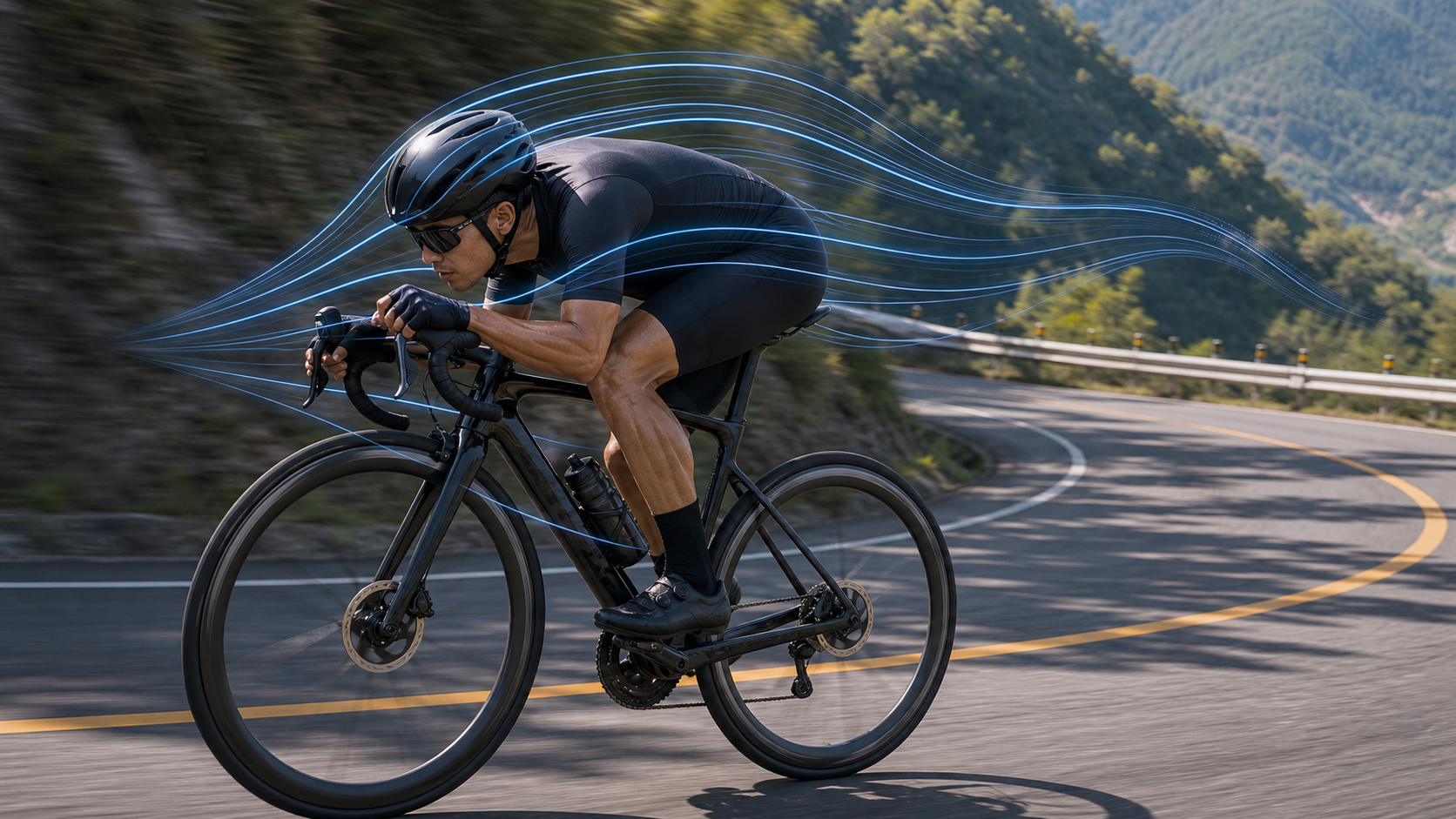
Gliding down from Wuling to Cuifeng, or on the long descents of the Northern Cross-Island Highway, the thrill of the speedometer climbing to 60, 70, or even 80 km/h is an unforgettable experience for many Taiwanese cyclists. But behind this speed, fluid dynamics is exerting its greatest influence. Understanding downhill aerodynamics isn’t just about chasing higher speeds—it’s the scientific foundation for understanding when to brake and how to control your speed safely.
The Mechanical Balance of Descending
When descending, the bike accelerates until it reaches Terminal Velocity—the point at which the gravitational component equals aerodynamic drag plus rolling resistance.
Mechanical Equation:
F_gravity = F_aero + F_rolling
(M × g × sin θ) = (½ × ρ × v² × CdA) + (Crr × M × g × cos θ)
Solving for v (terminal velocity):
v = √[2 × (M×g×sin θ - Crr×M×g×cos θ) / (ρ × CdA)]
Comparison of terminal velocities for different positions on a 10% descent (70kg rider + 8kg bike, air density 1.2 kg/m³):
| Riding Position | CdA (m²) | Theoretical Terminal Velocity | Actual Maximum Speed (with safety factor) |
|---|---|---|---|
| Upright on hoods | 0.50 | ~52 km/h | ~45 km/h |
| Drops tucked | 0.32 | ~65 km/h | ~58 km/h |
| Light tuck | 0.25 | ~74 km/h | ~65 km/h |
| Deep tuck | 0.20 | ~83 km/h | ~72 km/h |
Technical Points of the Tuck Position
A proper downhill tuck position isn’t simply about “getting low”—it requires simultaneously optimizing aerodynamics and bike stability:
Key points of the standard aggressive tuck:
- Upper body: Keep your back as horizontal as possible, or even slightly angled downward, so your back forms a streamlined slope
- Arms: Bend your elbows and keep them close to your body, avoiding the wind resistance caused by elbows flaring outward
- Head: Keep your head low, looking forward only, with the top of your helmet as the highest point
- Knees: Gently squeeze your knees against the top tube to reduce vortices on both sides of your legs
- Crank position: Generally keep the cranks at 3 o’clock/9 o’clock (horizontal), so your legs also act as a streamlined fairing surface
- Center of gravity: Shift your weight slightly rearward (sit toward the back of the saddle) to improve high-speed stability
Dangerous mistakes:
- Pedals at 6 and 12 o’clock (vertical): Increases the frontal area of your legs
- Knees splayed outward: Creates a massive vortex-generating zone
- Arms braced outward: The most common CdA killer in the tuck position
The Relationship Between Gradient and Speed
| Descent Gradient | Upright Riding (CdA=0.50) Terminal Velocity | Tucked Riding (CdA=0.22) Terminal Velocity | Speed Difference |
|---|---|---|---|
| 5% | ~37 km/h | ~56 km/h | +51% |
| 8% | ~47 km/h | ~71 km/h | +51% |
| 10% | ~52 km/h | ~79 km/h | +52% |
| 15% | ~64 km/h | ~97 km/h | +52% |
(These are theoretical terminal velocities; actual speeds are affected by road conditions, braking, and other factors. They should not be used to set actual riding speed targets.)
Safety Considerations and Practical Advice
- Practice the tuck position at low speeds first: Familiarize yourself with the position on low-gradient sections in Muzha or Taoyuan first, confirm bike stability, then use it on steeper descents
- Check tires and wheels: Confirm proper tire pressure before high-speed descents; be aware of crosswind risks when using deep-section wheels (see the wheels article)
- Brake system condition: Disc brakes are more reliable than rim brakes in Taiwan’s rainy environment; check disc and brake pad condition before high-speed descents
- Follow regulations: Some mountain descent sections in Taiwan have speed limits; riders should obey traffic rules and not aim to challenge maximum speeds
- Progressive speed increases: Increase your maximum speed by no more than 5 km/h at a time, giving your body and skills time to adapt
Conclusion
Downhill aerodynamics is physics on display in its most intuitive setting—position changes CdA, CdA determines speed, and speed affects safety. The tuck position isn’t just a racing technique; it’s a way to understand your mechanical state within the speed. Descending with scientific knowledge is how you find the optimal balance between speed and safety.
Related Reading
- Aerodynamics and Cycling Speed: The Impact of CdA Values, Position Adjustments, and Equipment
- Cycling Aerodynamics: Quantifying the Effects of Riding Position and Equipment on Wind Resistance
- Road Bike Downhill Aerodynamics: Position Optimization to Reduce the Cd Coefficient
- Biomechanics of Cycling Position: The Science of Reducing Air Resistance
單車 梅山36灣 坡度介紹 路段介紹 空拍 (相關遊記影片,請參考說明或我的頻道喔,歡迎訂閱)
6 年前
靠單車減肥35公斤 心得分享與整理
7 年前
一日北高/長距離團騎 常見問題補充篇 / 組團或跟團的眉角 / 壯車友容易被瘦車友慢性拉爆 / 原來屁股痛可能是這個原因...? / 風場配速法 / 公路車 / CT Yeh
2 年前
大武山後門26%歡樂陡坡!JJSC南台灣單車行Day2 / 被颱風追著跑 / 公路車 / CT Yeh
2 年前
多機位拍片神器 DJI Action 2 拍出速度張力感 | 類空拍機視角 4陣列麥克風超強降風噪 實測! | 公路車 | CT Yeh
3 年前
CT 喇低賽) 單車 比賽總是沒照片? 攝影師的觀點大公開 姿勢就是力量! 請加速1.25倍收看
7 年前
公路車 爬坡 破PR 紀錄 小技巧 分享
6 年前
再快都跟的上!? 單車跟隨攝影機之王 HOVERAir X1 PROMAX 全面實測 / 唯一!8K畫質&自行車專用模式和跟蹤信標&前後避障 / DJI Neo 可參考/ 公路車 / CT Yeh
1 年前