Cardiopulmonary Function and Cycling Output: The Relationship Between Heart Volume and Maximal Oxygen Uptake
Introduction
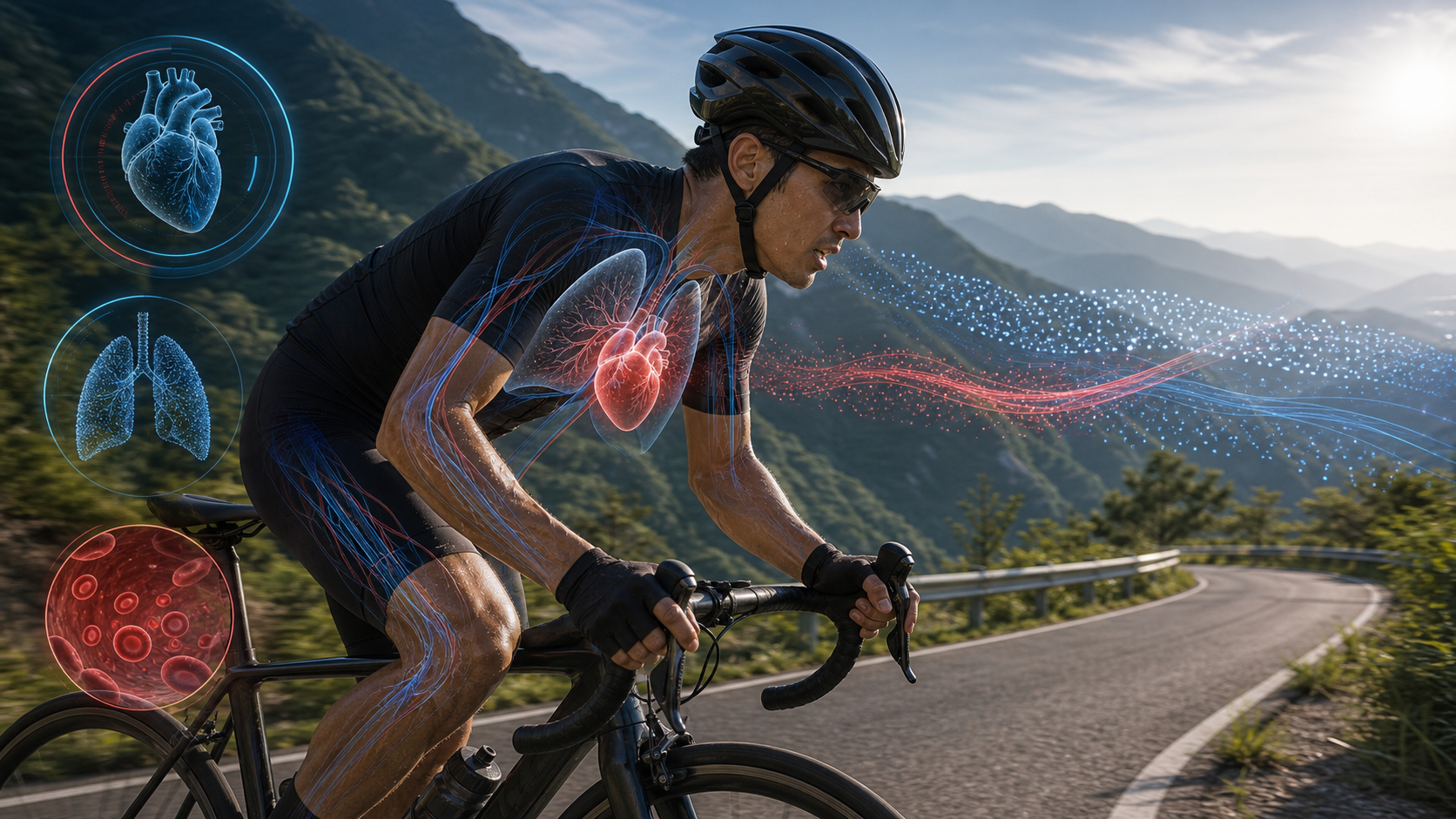
Why do some Taiwanese cyclists plateau at a certain power output even after riding for three years and climbing Wuling countless times? The answer often lies not in the leg muscles, but in the heart inside the chest. The heart’s transport capacity—how much oxygenated blood it can deliver to the muscles per minute—is the ultimate determinant of aerobic endurance. This article will delve into the relationship between cardiopulmonary function and cycling output, and what you can do to strengthen this critical system.
The Physiological Basis of VO2max
VO2max is defined as the maximum amount of oxygen the body can consume per minute per kilogram of body weight during maximal-intensity exercise (mL/kg/min).
The Fick Equation is the most important formula for understanding VO2max:
VO2max = Maximum Cardiac Output × Maximum Arteriovenous Oxygen Difference
= (Maximum Heart Rate × Maximum Stroke Volume) × (Arterial Oxygen Content - Venous Oxygen Content)
What each factor means:
- Maximum Heart Rate (HRmax): Largely determined by genetics, with limited training influence (approximately 220 - age)
- Maximum Stroke Volume (SVmax): The volume of blood pumped per heartbeat; can be significantly increased through training
- Arteriovenous Oxygen Difference (a-vO2 diff): The muscles’ ability to extract oxygen from the blood, also improvable through training
| VO2max Level | Male (mL/kg/min) | Female (mL/kg/min) | Corresponding Riding Ability |
|---|---|---|---|
| Very Poor (< 35) | <35 | <28 | Struggles even with easy flat-road riding |
| Poor (35–42) | 35–42 | 28–34 | Can ride on flats, struggles on climbs |
| Average (42–52) | 42–52 | 34–43 | Beginner amateur |
| Good (52–62) | 52–62 | 43–52 | Intermediate-to-advanced amateur, can challenge Wuling |
| Excellent (62–72) | 62–72 | 52–62 | Elite amateur, front of the race pack |
| Elite (> 72) | >72 | >62 | Professional level (Tour de France riders approximately 85+) |
Heart Volume: The Innate Advantage of Elite Athletes
Long-term endurance training leads to “Athlete’s Heart” adaptations:
- Increased Ventricular Chamber Size (Eccentric Hypertrophy): Left ventricular volume increases, boosting stroke volume per beat
- Thickened Ventricular Wall (Concentric Hypertrophy): Greater myocardial strength, more forceful contractions
- Lower Resting Heart Rate: A more efficient heart that needs fewer beats per minute to maintain circulation at rest
The world’s top road cyclists can achieve a stroke volume of up to 250 mL per beat (compared to roughly 70–80 mL for the average person)—an almost astronomical difference. Part of this gap is genetically determined, but consistent, proper training can maximize individual potential.
Training Methods to Improve VO2max
Zone 5 High-Intensity Intervals (VO2max Intervals):
- Goal: Maximize cardiac output to stimulate development of the heart muscle wall
- Typical workout: 4–6 sets × 4–5 minutes at 110–120% FTP, with 4–5 minutes of rest between sets
- Suitable routes in Taiwan: the fixed climb section of Fengguizui Road on Yangmingshan, select sections of the Beiyi Highway
Longer Moderate-Intensity Work (Zone 2 Training):
- Goal: Build the foundation for stroke volume and increase heart chamber volume
- Typical workout: 3–4 sessions per week, 60–120 minutes each, at 60–70% VO2max (an intensity where you can easily hold a conversation)
- This is the core of building your aerobic base, and many Taiwanese cyclists neglect it in favor of excessive high-intensity training
Practical Recommendations
- Measure an estimated VO2max once per season (via algorithms on devices like Garmin/Polar, or a structured 20-minute field test)
- Follow the “80/20 Rule” for training distribution: 80% of training volume in Zone 2, 20% in Zones 4–5
- Taiwan’s summer heat elevates heart rate; during summer training, use heart rate rather than power as your reference to avoid overtraining under heat stress
- Sleep quality directly affects cardiopulmonary recovery; at least 7–8 hours per night is a prerequisite for improving VO2max
- Altitude training (camping and riding at Wuling) can further stimulate red blood cell production, enhancing blood’s oxygen-carrying capacity
Conclusion
The heart is not just a pump—it is the central limiter of aerobic performance. Through proper training stimuli, allowing the heart to gradually grow and learn to transport oxygen more efficiently is the fundamental path to breaking through long-distance riding plateaus. Scientific training begins with understanding your own heart.
Related Reading
- VO2max: The Most Important Aerobic Metric for Cyclists
- Improving Cycling VO2max: A Complete Analysis of Mechanisms and Training Strategies
- VO2max Training Methods: What Maximum Oxygen Uptake Means for Road Cyclists
- The Ceiling of VO2max: Does Cardiac Output or Muscle Oxygen Extraction Determine the Limit
#公路車 #Vo2Max #最大攝氧量 測驗 體驗 | 心肺測試
6 年前
西進武嶺 免費訓練分析服務 Intervals | 練不夠還是練過頭?你哪一種類型選手?AI模型告訴你! | 備戰神器 | 公路車 訓練 | CT Yeh
4 年前
再快都跟的上!? 單車跟隨攝影機之王 HOVERAir X1 PROMAX 全面實測 / 唯一!8K畫質&自行車專用模式和跟蹤信標&前後避障 / DJI Neo 可參考/ 公路車 / CT Yeh
1 年前
多機位拍片神器 DJI Action 2 拍出速度張力感 | 類空拍機視角 4陣列麥克風超強降風噪 實測! | 公路車 | CT Yeh
3 年前
2026 車錶排行榜!誰是最多車友正在使用?練家子最愛哪款?🏆 (2萬名車友數據) / 公路車 / CT Yeh
5 個月前
#雙崎部落 單車挑戰賽 心跳破200 #公路車 Neko's Fun
6 年前
#公路車 台北 #風櫃嘴 23:47 全台單車實境請訂閱鎖定
7 年前
單車 一日北高 ( 雙城 ) 肥宅雙人瘋狂行 紀錄片 REACTO
10 年前