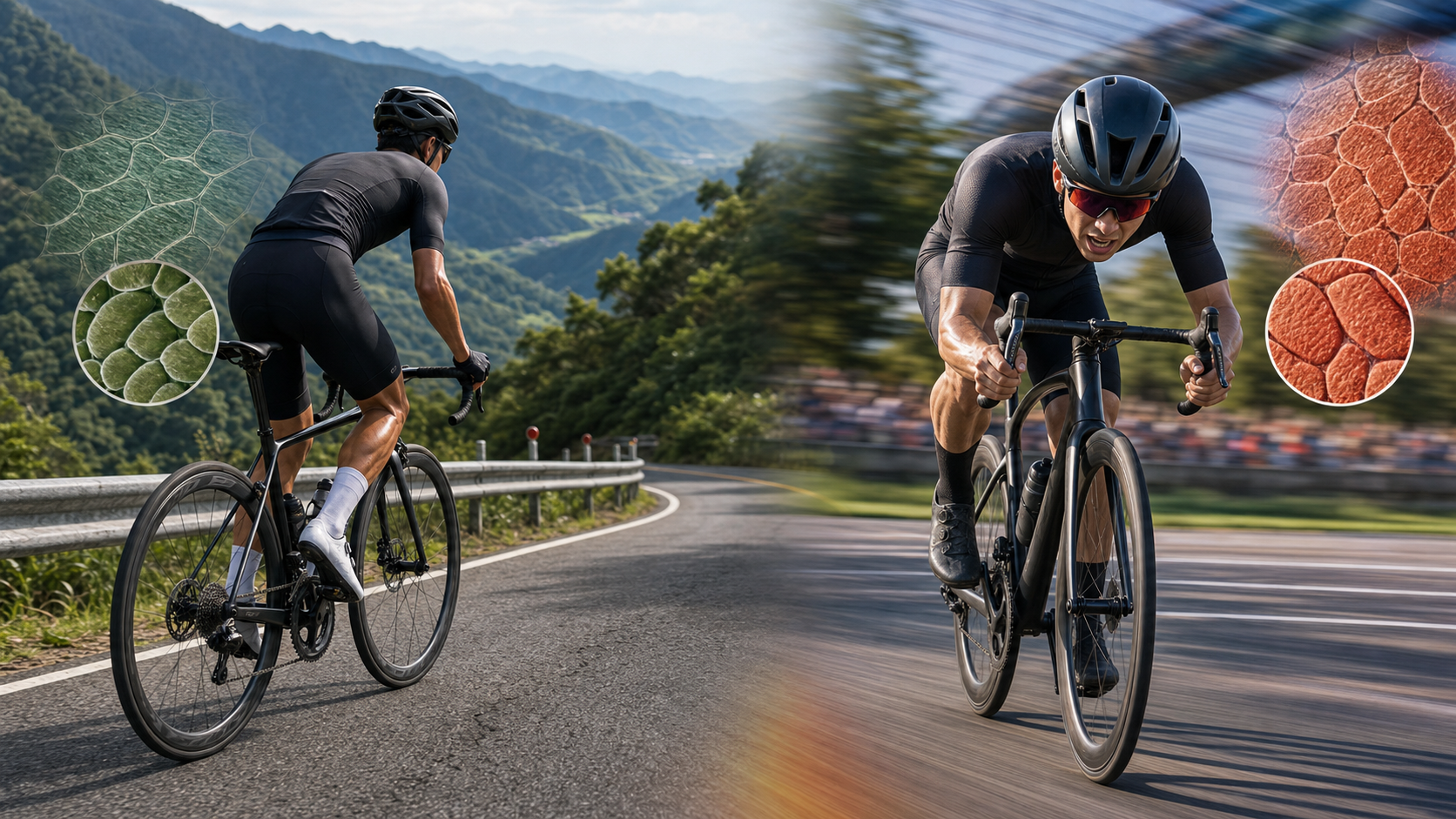
Introduction
Have you ever wondered why a teammate with the same training volume as you can pull far ahead on the long climb to Wuling, yet gets dropped easily in a 100-meter sprint? Part of the answer lies in the muscles themselves — more precisely, in the composition ratio of muscle fiber types. Understanding the physiological characteristics of muscle fibers and how they respond to training is the scientific foundation for building a precise training plan.
Classification and Characteristics of Muscle Fibers
Skeletal muscle fibers are mainly divided into two major types, each with distinctly different energy metabolism characteristics:
| Characteristic | Type I (Slow-Twitch) | Type IIa (Fast-Twitch Endurance) | Type IIx (Fast-Twitch Power) |
|---|---|---|---|
| Contraction speed | Slow | Medium | Fast |
| Fatigue resistance | Very high | Medium | Low |
| Aerobic capacity | Very high | High | Low |
| Anaerobic capacity | Low | Medium | Very high |
| Mitochondrial density | Very high | High | Low |
| Capillary density | Very high | High | Low |
| Primary fuel source | Fat + glycogen | Glycogen + fat | Phosphocreatine + glycogen |
| Best suited activity | Long-distance endurance | Medium-distance tempo | Sprint power |
Fiber Composition and Cycling Aptitude
Type I-dominant riders (high proportion of slow-twitch fibers):
- Strengths: Excellent long-distance endurance, can sustain a stable output at lower intensity for extended periods, and recover quickly
- Weaknesses: Weaker sprinting ability, easily dropped in bunch sprints, lower peak power
- Suitable Taiwan events: Wuling KOM, ultra-long-distance endurance races, the climbing stages of Tour de Taiwan
- Representative rider type: Climbers, ultra-endurance specialists
Type II-dominant riders (high proportion of fast-twitch fibers):
- Strengths: Impressive sprint power, strong anaerobic burst, standout performance in short, high-intensity efforts
- Weaknesses: Relatively weak long-distance endurance, slow recovery after work above the anaerobic threshold, lower fat-metabolism efficiency
- Suitable Taiwan events: Short-distance criteriums, short time trials, bunch sprints
- Representative rider type: Sprinters, track cyclists
Can Muscle Fiber Type Change?
Key facts:
- Type I ↔ Type IIa: Can convert into one another, influenced by training
- Heavy endurance training → Type IIa shifts toward Type I (improving endurance)
- Detraining or pure power training → Type I shifts toward Type IIa
- Type IIa ↔ Type IIx: Training has limited influence, but the proportion of Type IIx increases with complete detraining
- Between Type I and Type IIx: Almost no direct conversion is possible; this is mainly determined by genetics
Practical implications:
While your baseline fiber-type ratio is genetically constrained, training can help you maximize your existing potential — and the most productive place to focus is on Type IIa, the intermediate fiber type with the highest plasticity.
Targeted Training Recommendations
Endurance-oriented (strengthening Type I characteristics):
- High-volume Zone 2 training: 4–5 low-intensity, long-duration rides per week to promote mitochondrial biogenesis
- Long-distance metabolic training: Rides of 90+ minutes to train fat-oxidation efficiency
- Taiwan recommendations: The long Beiyi ride out of Taipei (approx. 80km), round-island touring plans
Power-oriented (strengthening Type II characteristics):
- Short sprint intervals: 6–10 sets × 10–15 seconds all-out sprints, with 3–4 minutes of rest
- Anaerobic power training: All-out sprints up short, steep climbs (such as the small steep sections near Jinmian Mountain in Neihu, Taipei)
- Weight training: Squats and explosive movements (box jumps) can recruit Type IIx fibers and boost power output
Assessing your own fiber type:
- 5-second vs. 20-minute power ratio: Divide your 5-second maximum power (W/kg) by your 20-minute average power (W/kg) — the higher the ratio, the higher your proportion of fast-twitch fibers
- Typical Type I-dominant riders: ratio around 5–7x; Type II-dominant riders: ratio can reach 8–12x
Practical Tips
- Find your best 5-second, 1-minute, 5-minute, and 20-minute power values from your power meter’s historical data, plot your personal power curve, and determine your fiber-type tendency
- Don’t try to “change your nature” — strengthening your strengths is more efficient than compensating for your weaknesses
- If you’re Type I-dominant, schedule 1–2 short sprint sessions per week just to maintain neuromuscular recruitment ability
- If you’re Type II-dominant, you must significantly increase your Zone 2 training volume, or your fast-twitch fibers will have nothing left to give once fatigued on long rides
- When designing a training cycle: emphasize Type II development in the strength phase (winter), Type I development in the base phase, and maintain both in a balanced way during the racing phase
Conclusion
The biology of muscle fibers tells us that everyone is born with a different stage to perform on. Understanding your own fiber composition isn’t about accepting limitations — it’s about putting in effort in the right direction. Train smart, and make every kilometer count.
Related Reading
- Muscle Fiber Type and Cycling Specialization Training: Choosing Between Slow-Twitch and Fast-Twitch
- Muscle Fiber Type and Endurance Sports: Type I vs. Type IIa vs. Type IIx
- Muscle Fiber Composition and Cycling Performance: Are You a Born Climber or a Sprinter?
- Skeletal Muscle Fiber Types in Cyclists: Training Effects of Type I and Type II Fibers
靠單車減肥35公斤 心得分享與整理
7 年前
#公路車 #Fitting 靠人工智慧APP 幫你調整單車
6 年前
西進武嶺 免費訓練分析服務 Intervals | 練不夠還是練過頭?你哪一種類型選手?AI模型告訴你! | 備戰神器 | 公路車 訓練 | CT Yeh
4 年前
一日北高/長距離團騎 常見問題補充篇 / 組團或跟團的眉角 / 壯車友容易被瘦車友慢性拉爆 / 原來屁股痛可能是這個原因...? / 風場配速法 / 公路車 / CT Yeh
2 年前
多機位拍片神器 DJI Action 2 拍出速度張力感 | 類空拍機視角 4陣列麥克風超強降風噪 實測! | 公路車 | CT Yeh
3 年前
單車 一日北高 ( 雙城 ) 肥宅雙人瘋狂行 紀錄片 REACTO
10 年前
大武山後門26%歡樂陡坡!JJSC南台灣單車行Day2 / 被颱風追著跑 / 公路車 / CT Yeh
2 年前
2016 彰化經典百K - 風景宜人精華版
10 年前