Introduction
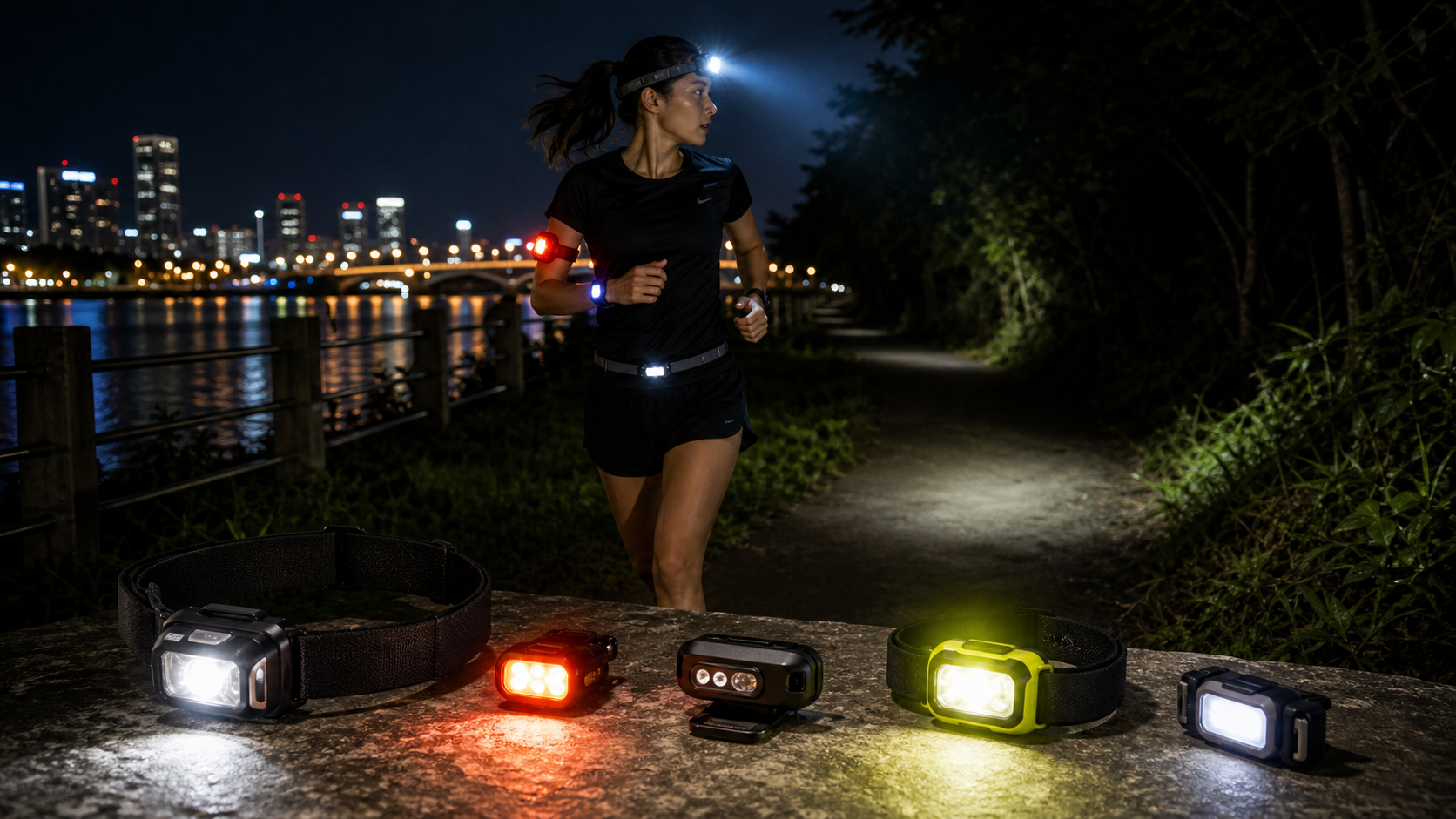
Summer days in Taiwan are scorching hot, so many runners choose to train at 5 AM or after 9 PM to avoid the midday heat. However, Taiwan’s night running environments are not uniform—urban streets are well-lit, but once you enter riverside parks, mountain trails, or suburban industrial roads, light can suddenly disappear. A suitable running light is the first line of defense for night running safety.
Common Night Running Scenarios in Taiwan
- Urban roads (well-lit): The main need is “to be seen by others,” so taillights matter more than headlamps
- Riverside parks/bike paths: Uneven lighting, some sections are dim; a low-to-mid lumen headlamp is sufficient
- Mountain trails/suburban industrial roads: No streetlights at all; a high-lumen headlamp is needed to illuminate the path ahead
- Night sections of trail races (e.g., ultramarathons): Requires stable brightness over long periods; battery life is critical
The Practical Meaning of Lumens
Lumens measure a light’s brightness, but “how many lumens are enough” depends on the running scenario:
| Lumen Range | Suitable Scenarios | Representative Models |
|---|---|---|
| 100–200 lm | Urban night running, riverside parks | Black Diamond Spot 350 low mode |
| 300–600 lm | Suburban industrial roads, beginner trail running | Petzl Tikka Core 300 lm |
| 600–1200 lm | Trail running, Wushanling/Dakeng trails | Black Diamond Storm 1000 lm |
| 1200 lm+ | Ultramarathon night sections, fast trail running | Petzl Nao RL 1500 lm |
Key concept: Lumens represent peak brightness, not sustained brightness. Many entry-level headlamps advertise 300 lm but can only maintain that in high mode for 30–60 minutes before automatically dimming (step-down mode). When purchasing, look at “sustained duration in medium mode” rather than “peak lumens.”
Headlamp Buying Considerations
1. Weight and Balance Design
Neck fatigue from headlamp weight is the biggest concern in long-distance night running:
- Under 100g: Top choice for lightweight running headlamps (e.g., Petzl Tikka, Nao series)
- Rear-battery models: Battery moved to the back, distributing weight and reducing forehead pressure
2. Water Resistance Rating
Taiwan often has showers or humid conditions at night:
- IPX4: Splash-resistant, sufficient for regular night running
- IPX7 / IPX8: Submersible, suitable for trail running or severe weather
3. Charging Method
- USB charging: Convenient, but you’ll need to carry a power bank for ultramarathons
- Battery models (AA): Spare batteries are easy to find; a must-consider for ultramarathons
- Dual-use models (USB rechargeable and AA compatible): Most flexible; recommended for ultramarathon runners
4. Beam Angle
- Spot beam: Suitable for fast trail running, long-distance illumination
- Flood beam: Suitable for jogging, wide peripheral vision
- Hybrid (spot + flood): Most versatile; the design choice for most running headlamps
Taillights and Auxiliary Lights
Night running safety isn’t just about “seeing”—it’s also about “being seen.” Scooters often overtake from behind at night in Taiwan, making rear taillights essential for urban night running:
- Waist-mounted flashing taillight: Clips to the lower back, visible 360 degrees, e.g., Nathan HyperBrite Chase Light
- Shoe clip LED lights: Clip onto running shoes; lights flash with each stride, drawing attention
- Reflective vest: No batteries needed; reflects car headlights over a large area at night, suitable for running near highways or expressways
- LED arm bands: Ring-shaped LED lights for the arm; lightweight and easy to charge
Ultramarathon Nighttime Power Calculation
If you’re participating in the TNF 100 ultramarathon or other trail races with night sections, power management is critical:
- Check the race’s mandatory gear requirements (usually specifying a minimum lumen count, e.g., 200 lm or above)
- Calculate the hours of night sections and choose a headlamp with battery life at least 30% more margin
- Spare batteries or a power bank are essential; for USB-rechargeable headlamps, pair them with a 10000mAh power bank
Practical Tips
- Headlamp straps loosening from sweat is a common issue; choose models with silicone anti-slip straps
- Test your light’s brightness on an open track in Taiwan before night running to avoid discovering insufficient battery on a dark mountain trail
- Taiwan’s summer nights are humid; if lights are stored without thorough drying, USB charging ports can corrode easily
- When night running outdoors in Taiwan from July to September, note that headlamps easily reveal puddles on the road; adjust the lamp angle down about 30–45 degrees
Conclusion
Taiwan’s night running environments are diverse, from well-lit urban tracks to dark mountain trails, and different scenarios require different lighting setups. The minimum gear for urban night runners is a rear taillight plus a lightweight headlamp; trail runners need a reliable headlamp of 600 lm or above; ultramarathoners need a complete power management strategy. Invest in a full set of night running lights, and Taiwan’s nights will no longer be an obstacle to training—they’ll be your own personal running time.
Related Reading
- Choosing Running Lights: Lumen Requirements and Battery Life for Night Running Headlamps
- Road Running Headlamp Buying Guide: Complete Comparison of Lumens and Battery Life for Night and Morning Runs
- Road Running Headlamp Buying Guide: Lumens, Wide-Angle Beam Distribution, and Real-World Testing Advice for Taiwan
- Night Running Safety Lighting Systems: A Complete Buying Guide from Headlamp Lumens to Reflective Gear
雷達尾燈 雷不雷? 邁金L508 智慧雷達尾燈 情境考驗實測 | 同場加映 2千元等級的專業車錶 C406 Pro | 公路車 | CT Yeh
3 年前
趣味單車配件:多功能智慧尾燈 / 有方向燈 可app編輯圖案!? / GRC x Lumii 聯名款 / 公路車 CT Yeh
9 個月前
Live) 備戰2019彰化經典百K 賽前攻略 (已完賽請看新影片
7 年前
大家都在開箱的...單車用藍芽對講耳機真的有幫助嗎? SENA BiKom 20 長距離旅遊 & 海鷗繞圈賽 實際體驗心得 / 公路車 / CT Yeh
9 個月前
2026 車錶排行榜!誰是最多車友正在使用?練家子最愛哪款?🏆 (2萬名車友數據) / 公路車 / CT Yeh
5 個月前
一日北高前的高裝檢 | 北高 360 | 挑戰11小時的裝備 | 一日雙塔 | 補給
6 年前
再快都跟的上!? 單車跟隨攝影機之王 HOVERAir X1 PROMAX 全面實測 / 唯一!8K畫質&自行車專用模式和跟蹤信標&前後避障 / DJI Neo 可參考/ 公路車 / CT Yeh
1 年前
單車 一日北高 ( 雙城 ) 肥宅雙人瘋狂行 紀錄片 REACTO
10 年前