Introduction
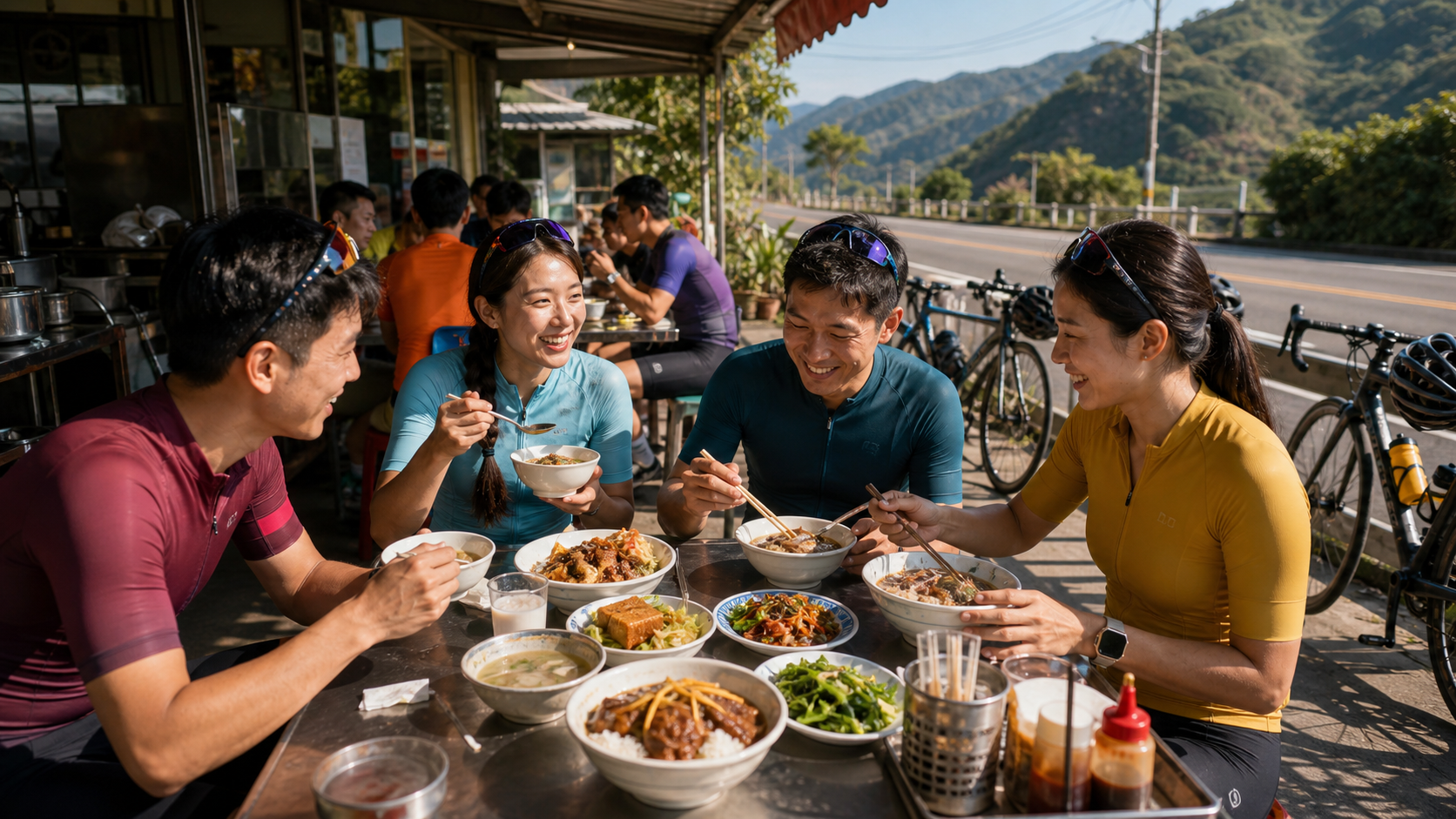
“What should we eat after the ride?” This question ranks just as high in the minds of many Taiwanese cyclists as “Where are we riding today?” Taiwan is a treasure island of food and a treasure island of cycling. When these two come together, a unique “cycling food culture” is born—earning a guilt-free feast through physical effort, with stomachs primed by sweat ready for the most authentic flavors of Taiwan.
Why Post-Ride Refueling Matters
Before diving into the food, let’s first understand the importance of post-ride refueling from a sports science perspective. Long endurance rides deplete large amounts of glycogen stored in the muscles. The 30–60 minutes after a ride is the “golden replenishment window,” during which properly consuming carbohydrates and protein helps to:
- Accelerate muscle glycogen replenishment and restore energy
- Promote muscle repair and reduce next-day soreness
- Replenish electrolytes lost through sweat (sodium, potassium)
Taiwanese local cuisine has a natural advantage in this regard—many traditional snacks are rich in carbohydrates, protein, and sodium, making them perfect post-exercise refueling options.
Regional Cycling Food Map of Taiwan
| Region | Recommended Refueling Foods | Highlights |
|---|---|---|
| Taipei Beitou/Tamsui | Pig’s blood cake, Tamsui fish ball soup | Pig’s blood is rich in iron, replenishing red blood cells depleted by riding; fish ball soup is warming and hydrating |
| Yilan | Gaoza (crispy pork lard cubes), Sanxing scallion pancake | The lard and starch in gaoza provide quick energy; Sanxing scallion pancake has moderate sodium to replenish electrolytes |
| Changhua | Ba-wan (meatball), braised pork rice | Changhua ba-wan has thin skin and less oil; the pork in braised pork rice provides quality protein |
| Tainan | Eel yee mein, bowl rice cake | Yee mein has high carbohydrate density, and eel is rich in protein—a perfect post-long-ride replenishment |
| Kaohsiung | Cijin seafood, beef soup by the roadside | The zinc and omega-3 in seafood aid muscle recovery; beef soup efficiently replenishes electrolytes |
| Hualien | Gongzheng steamed buns, indigenous barbecue | Hot buns quickly replenish energy; indigenous-style barbecue provides high protein |
| Taitung | Chishang bento, millet mochi | The high GI of Chishang rice suits rapid post-ride recovery; the glutinous carbs in mochi provide sustained energy |
Ways to Combine Cycling Routes with Food
Taiwanese cyclists have developed several riding patterns that incorporate food:
Destination Ride: Using a specific food as the ride’s destination, with the route designed around “how to ride to that shop.” For example, itineraries like “ride from Taipei to Yilan for fried pork strips, then take the train back” are the most common one-day ride plans on weekends.
Food Stop Ride: Setting multiple food refueling points along a long-distance ride, serving not just as energy replenishment but also as opportunities to rest and explore local culture. For example, on a Huadong Valley ride, set a refueling stop every 40 kilometers: Hualien Gongzheng buns → Yuli Qiaotou stinky tofu → Guanshan bento.
Post-Ride Feast: Many cycling communities have a fixed “what to eat after the ride” tradition, often the moment of strongest community cohesion—weary bodies, relaxed minds, and shared conversation make the dining table the warmest post-ride gathering point.
The Science and Culture Tug-of-War of Post-Ride Eating
Sports science recommends replenishing “body weight x 1g carbohydrates + 0.3g protein” after a ride. Translated into food, a 65-kilogram cyclist needs roughly 260g of carbs plus 20g of protein.
However, the logic of Taiwanese food culture is completely different—“After riding that far, of course you deserve to treat yourself.” A big bowl of braised pork rice, a double portion of oyster vermicelli, a whole plate of fried chicken cutlet—these are the most common “post-ride rewards” among Taiwanese cyclists.
While this cultural logic is problematic from a weight-management perspective, it is an irreplaceable and beautiful part of Taiwan’s cycling culture. Riding is not just a tool for burning calories; it is also a pass that allows you to fully enjoy food.
Practical Tips
- Replenish 50–80g of carbohydrates per hour during the ride (energy gels, bananas, salt tablets) to avoid arriving at refueling points overly hungry and binge-eating
- Taiwan’s climate is hot, and sweat loss during rides is significant. Besides water, also replenish electrolytes (by adding sports drink powder or directly choosing local foods with salt content)
- Avoid consuming large amounts of high-fat foods immediately after riding, as gastrointestinal blood flow is still low post-exercise and can easily cause indigestion
- Incorporating food exploration into route planning can greatly boost riding motivation, especially useful for persuading “non-cycling partners” to join in
Conclusion
The liveliness and vitality of Taiwan’s cycling culture owe much to the magic of food. When you’ve climbed over mountain passes, crossed the coastline, and pedaled a hundred kilometers, sitting down to a steaming bowl of local noodle soup—that moment of satisfaction is complete: physical, psychological, and cultural. Taiwan’s land has generously given us stunning riding scenery and also the most bountiful post-ride refueling. Every road deserves to be concluded with a good meal.
Related Reading
- Cycling and Food Culture: A Taiwanese Food Refueling Map After Riding
- Cycling and Food Culture: The Perfect Finish to a Post-Ride Food Map
- Post-Ride Food Culture: The Favorite Refueling Food Map of Taiwanese Cyclists
- Food Culture in Cycling Tourism: Specialty Snacks and Local Cuisine for Refueling Across Taiwan
CT暗黑廚房) 車友必備 宇宙無敵鮮蚵湯 幫助訓練恢復 天然食補 好市多 超肥鮮蚵 破PR
7 年前
4K 東眼山 x 水蜜桃冰沙 百人單車約騎! 操完再吃冰 多爽快
7 年前
山道猴出沒!? JJSC屏東單車行 Day1 一直催 / 皮卡丘來了!/ 墾丁 旭海 恆春 社頂 / 公路車 / CT Yeh
2 年前
太平山單車員工旅遊 | 這樣玩CP值最高!| 公路車
5 年前
單車 一日北高 ( 雙城 ) 肥宅雙人瘋狂行 紀錄片 REACTO
10 年前
大武山20%魔王陡坡【JJSC南台灣遊騎Day2】!屁股真的要裂開了...凡士林抹滿也沒用?神秘金教堂還有超便宜夜市
3 個月前
風櫃嘴 | 全台最多大砲的單車路線 | 尋寶網攝影師告訴你怎麼擺拍起來才好看 | 熱門攝影地點巡禮
6 年前
JJSC南台灣單車走春三日行 DAY 1 / 強度 x 美食 x 節慶體驗 / 公路車 CT Yeh
5 個月前