Running Footstrike Patterns: A Biomechanical Comparison of Forefoot, Midfoot, and Rearfoot Strikes
Introduction
“Switching to a forefoot strike will prevent injuries”—this claim is widespread in Taiwan’s road running community, especially gaining traction after the rise of barefoot and minimalist running trends. However, over a decade of biomechanical research has painted a more nuanced picture: the merits of foot strike patterns are far more complex than what word-of-mouth suggests.
Defining the Three Foot Strike Patterns
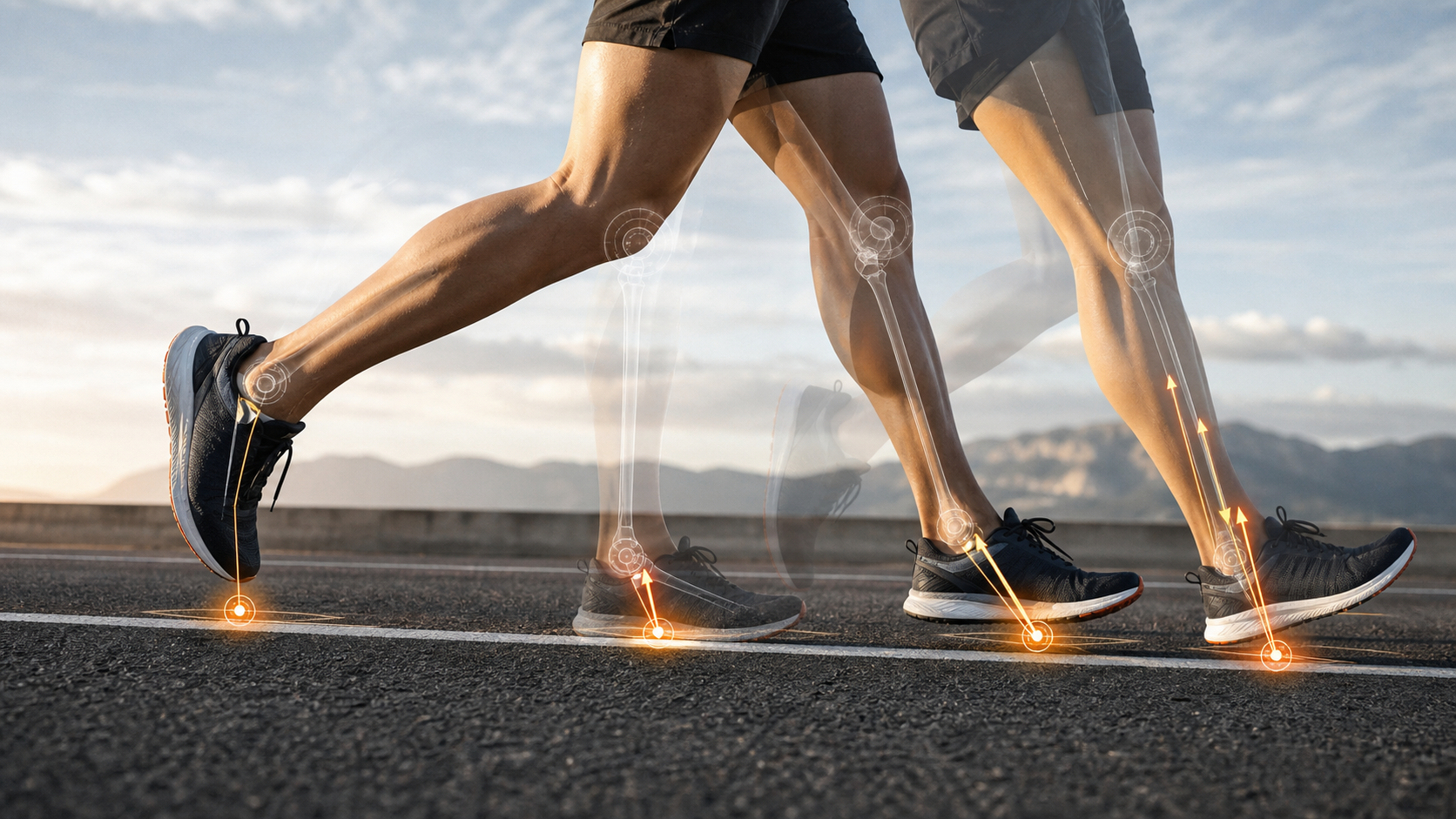
Foot Strike Pattern (FSP) is classified by which part of the foot first contacts the ground:
- Rearfoot Strike (RFS): The heel contacts the ground first, then gradually transitions to the forefoot. Research statistics show that approximately 75–80% of recreational runners adopt this pattern.
- Midfoot Strike (MFS): The heel and forefoot contact the ground almost simultaneously; this is a common pattern among elite runners.
- Forefoot Strike (FFS): The metatarsal heads (ball of the foot) contact the ground first, with the heel barely touching or briefly grazing the ground.
Biomechanical Differences Among the Three Patterns
Impact Peak
With a rearfoot strike, the ground reaction force curve shows a pronounced impact transient, occurring within approximately 50 milliseconds after foot strike. This force travels as a shock wave along the bones up to the knees, hips, and even the spine. A forefoot strike lacks this peak, with a more gradual rise in impact force—but the trade-off is greater eccentric loading on the calf muscles and Achilles tendon.
| Metric | Rearfoot Strike | Midfoot Strike | Forefoot Strike |
|---|---|---|---|
| Impact peak | High | Low | Very low |
| Knee joint moment | Moderate-high | Moderate | Low |
| Ankle joint moment | Low | Moderate | High |
| Achilles tendon load | Low | Moderate | High |
| Soleus muscle load | Low | Moderate | High |
| Common stress fracture sites | Tibia | Tibia/metatarsals | Metatarsals |
Achilles Tendon and Calf Muscles
Forefoot strikers experience greater Achilles tendon stretch at each foot strike, storing and releasing elastic potential energy, which theoretically improves running economy. However, if training volume spikes suddenly or the tendon already has degenerative issues, the risk of Achilles tendinopathy and metatarsal stress fractures also rises.
Stride Length and Braking Effect
With a rearfoot strike, the foot tends to land ahead of the body’s center of mass, producing a greater “braking force”—each step slightly decelerates the body, which then needs to be regained through push-off. Forefoot strikers land with the foot closer to directly beneath the center of mass, resulting in less braking effect. However, this is more closely related to stride length than to the foot strike pattern itself; adjusting cadence is often a more direct intervention than forcing a change in foot strike pattern.
Current Research on Injury Rates
Several prospective studies (Daoud et al., 2012; Kasmer et al., 2013) reported lower injury rates among forefoot strikers, once sparking a widespread movement to change foot strike patterns. However, larger systematic reviews (Mousavi et al., 2021) show:
- No significant difference in overall injury rates—each pattern has its own injury-prone sites.
- More common in rearfoot strikers: medial tibial stress syndrome (MTSS), stress fractures (tibia), iliotibial band syndrome.
- More common in forefoot strikers: Achilles tendinopathy, metatarsal stress fractures, gastrocnemius strains.
Practical Recommendations
- Do not drastically change an already-adapted foot strike pattern: If you are currently injury-free, your adapted foot strike is often the most efficient personalized choice.
- If changing, progress gradually: When transitioning from rearfoot to forefoot striking, practice it in only one to two sessions per week, with distances not exceeding 20% of your usual weekly mileage, and allow at least 3–6 months for adaptation.
- Coordinate with shoe selection: Heavily cushioned heel shoes (high drop) encourage rearfoot striking; zero-drop or low-drop shoes suit forefoot/midfoot striking—but wearing them does not automatically change your pattern.
- Consider the Taiwan context: Flat surfaces like the Dajia River Bikeway and riverside parks suit all foot strike patterns; however, on mountain trails such as the Jiujiufeng Trail Race, forefoot striking places particularly pronounced impact on the calves during descents, so adequate calf strength preparation is essential.
Conclusion
There is no absolute superiority among foot strike patterns—what matters is alignment with an individual’s anatomical structure, running habits, and training volume. A scientific approach is to understand the mechanical characteristics of each pattern and make precise adjustments targeting your own weaknesses, rather than blindly rewriting your running form to follow a trend.
Related Reading
- Running Gait Analysis: The Science of Forefoot vs Midfoot vs Rearfoot Strikes
- Running Posture Analysis: Research on Forefoot vs Rearfoot Striking
- Running Foot Strike Analysis: Mechanical Trade-offs of Heel, Midfoot, and Forefoot
- Running Landing Patterns: Speed and Injury Comparison Between Forefoot and Rearfoot Strikes
CT 喇低賽) 武嶺牽車 才是王道 西進牽車四小時內秘訣 攝手位置 如何判斷 防抽筋小秘訣
7 年前
戰略) Zwift Race 如何咬在第一集團 如何評估自己要開多少推力 (請開1.5倍速看)
7 年前
[教學] Premiere 影片 手震 修正 教學 防抖 單眼 影像 GoPro 穩定 Video Stabilization
8 年前
單車元宇宙新霸主?TrainingPeaks Virtual 實測 / Zwift 完美平替? 還是超越?/ 有台灣國旗!前身 indieVelo / 公路車 / CT Yeh
1 年前
Insta 360 One 超級防手震技術實測
7 年前
類空拍神器 Feiyu Pocket 2s (有優惠連結)三軸穩定 運動攝影機 開箱!比GoPro 還強的滑順視角!三小時長時間錄影 行車記錄器 | 環花東365實測 | 公路車 CT Yeh
4 年前
2024 如來神掌 百人約騎挑戰!feat. 秘境單車社團 / 神人們太可怕 / 全程錄影 x 完整坡度解析 / 公路車 / CT Yeh
2 年前
Never Stop 西進武嶺 前後雙機 完整全程錄影 訓練台 實境
8 年前