/no_think
Introduction
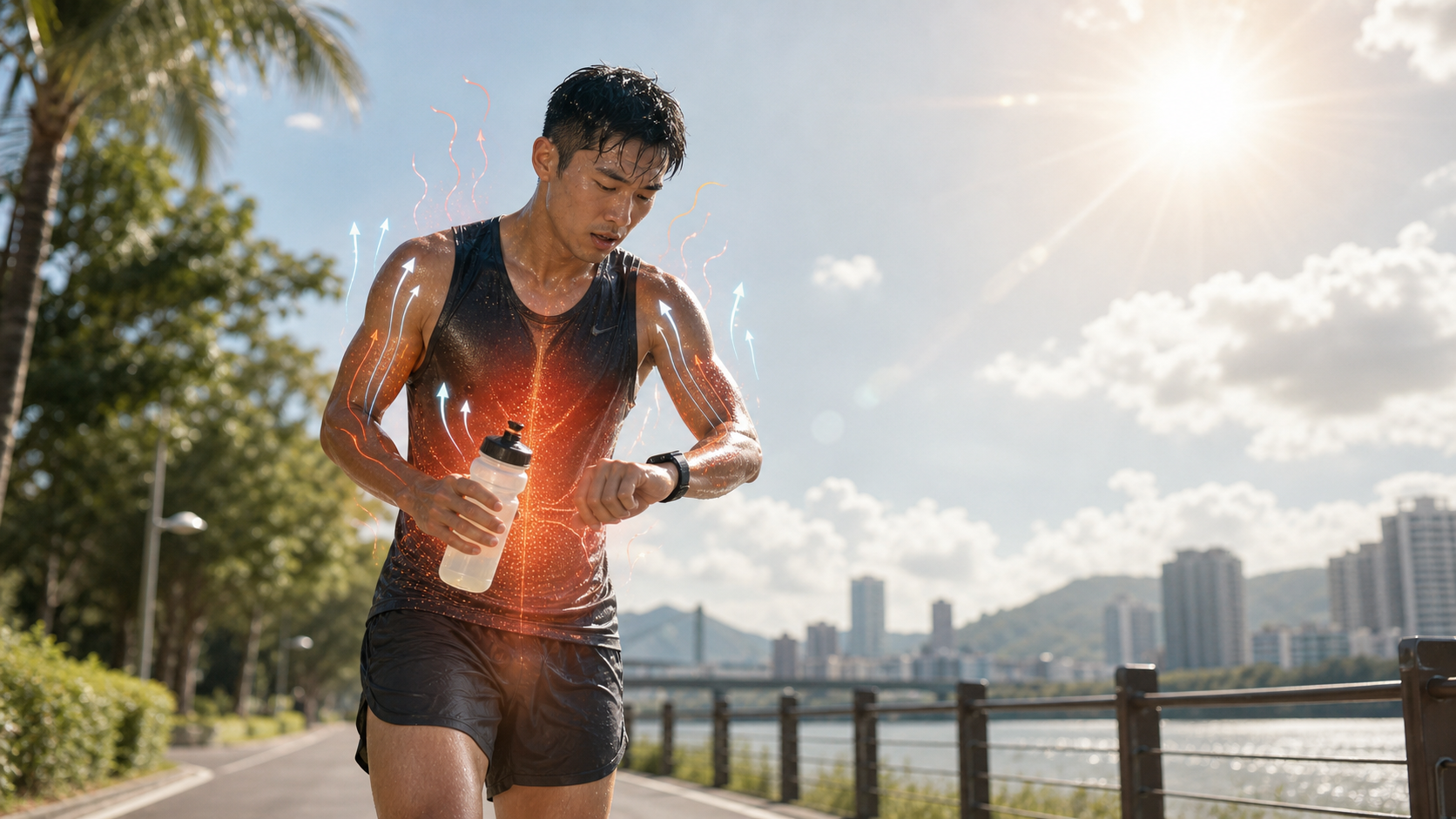
From June to September each year, temperatures on Taiwan’s western plains routinely reach 35–38°C, and with humidity exceeding 80%, the apparent temperature often surpasses 40°C. Running continuously in such conditions places immense strain on the body’s core temperature regulation system. Understanding the heat balance mechanism not only makes your training safer, but also allows you to leverage heat acclimatization to enhance overall athletic performance.
The Body’s Heat Balance Mechanism
The normal range for human core temperature is approximately 36.5–37.5°C, which can rise to 38.5–39.5°C during intense exercise. Exceeding 40°C enters the danger zone for heatstroke, and surpassing 41–42°C can lead to protein denaturation and organ failure.
The heat balance equation:
Metabolic heat production = Radiative heat loss + Conductive heat loss + Convective heat loss + Evaporative heat loss
During running, approximately 75–80% of energy is converted into heat, with only 20–25% converted into mechanical work. Each heat dissipation pathway has its own efficiency:
| Dissipation Pathway | Efficiency in Taiwan’s Summer | Explanation |
|---|---|---|
| Radiation | Low | When ambient temperature exceeds skin temperature, heat is absorbed in reverse |
| Conduction | Negligible | Only a small amount occurs where the shoes contact the ground |
| Convection | Moderate | More effective with higher wind speed; low benefit in windless, humid heat |
| Evaporation (sweating) | Most significant | Each gram of evaporated sweat removes 2,430 J; efficiency drops sharply in high humidity |
Taiwan’s Summer-Specific Challenge: High Heat + High Humidity
Taiwan’s summer problem is not just high temperature, but the combination of high heat and high humidity. When humidity exceeds 70%, sweat evaporation efficiency drops significantly, and sweat accumulating on the skin surface actually hinders subsequent perspiration. This means:
- At the same pace, core temperature rises faster in summer.
- The time to reach the “thermal set point” is shorter.
- Summer training based on winter paces equates to a higher-intensity training stimulus.
Wet Bulb Globe Temperature (WBGT) is the best indicator for measuring the thermal environment:
| WBGT | Risk Level | Running Recommendations |
|---|---|---|
| <18°C | Low | Normal training |
| 18–23°C | Moderate | Pay attention to hydration, monitor heart rate |
| 23–28°C | High | Reduce intensity by 20–30%, avoid long distances |
| >28°C | Extreme | Recommended to move indoors or complete training before 5 a.m. |
Physiological Benefits of Heat Acclimatization
After 10–14 consecutive days of moderate-intensity training in a hot environment, the body develops significant heat acclimatization:
- Plasma volume increases by 5–10%: Increases blood flow to the skin, improving heat dissipation efficiency.
- The core temperature threshold for initiating sweating lowers: The cooling mechanism activates earlier.
- Electrolyte concentration in sweat decreases: Less salt is lost for the same amount of sweating, maintaining electrolyte balance.
- Heart rate drops by approximately 5–10 bpm (at the same intensity): Reduces cardiac workload.
Practical Recommendations
- Morning training: Taipei temperatures are lowest between 5–6 a.m., around 28–30°C, far safer than the 36–38°C at 3–4 p.m. Dadaocheng Riverside Park, Daan Forest Park, and Youth Park are all commonly used morning training venues.
- Use heart rate instead of pace: Maintain the same heart rate zone in summer (e.g., Zone 2, 65–75% of max heart rate); your pace will naturally be 30–60 seconds slower than in winter. This is normal—don’t force it.
- Active pre-cooling: Drinking a cold beverage at 4–8°C or wearing an ice vest 30 minutes before training can delay the time it takes for core temperature to reach its limit.
- Hydration strategy: Hourly sweat loss during exercise is approximately 0.5–1.5 liters; it is recommended to replenish 150–250 mL of fluid every 15–20 minutes. In races, electrolyte drinks are preferable to plain water.
- Recognize the warning signs of heatstroke: Dizziness, nausea, cessation of sweating, flushed and dry skin—stop exercising immediately if any of these occur, move to a shaded area, rehydrate, and seek assistance.
Conclusion
Taiwan’s summer is a high-stress environment for running training, but it is also an excellent opportunity for heat acclimatization. By understanding the heat balance mechanism, runners can scientifically adjust their training plans to maintain fitness safely and effectively through the scorching heat, preparing for the fall and winter racing season.
Related Reading
- Running Body Temperature Regulation: The Physiological Challenges of Summer Road Running in Taiwan
- Running Strategies in Hot Environments: Heat Dissipation and Pace Adjustments for Taiwan Summer Training
- Running in Taiwan’s Summer Heat: Training Strategies for 33°C Conditions
- Body Temperature Regulation in Road Running: The Science of Sweating Mechanisms and Heat Acclimatization
實景訓練台) 彰化經典百K 高強度喵團 90分鐘 跟著一起練功 2019 Indoor workout Changhua Classic 100 Taiwan
7 年前
水金九不厭五分 10度寒流冷到不願停!feat. 卡卡 / 公路車 / CT Yeh
6 個月前
CT暗黑廚房) 車友必備 宇宙無敵鮮蚵湯 幫助訓練恢復 天然食補 好市多 超肥鮮蚵 破PR
7 年前
西進武嶺 免費訓練分析服務 Intervals | 練不夠還是練過頭?你哪一種類型選手?AI模型告訴你! | 備戰神器 | 公路車 訓練 | CT Yeh
4 年前
[防寒衣體驗] 鐵人魂 三鐵 防寒衣試穿會 於松運 深水游泳池 鯨魚池
8 年前
#東進武嶺 全程實況錄影 5小時半 #夏季KOM #太魯閣 Taiwan KOM Challenge Reality Video Taroko scenery
7 年前
2019 夏季KOM 5小 完賽心得 準備攻略 東進武嶺 夏季登山王之路 Taiwan KOM Challenge
7 年前
單車 一日北高 ( 雙城 ) 肥宅雙人瘋狂行 紀錄片 REACTO
10 年前