Introduction
“Running efficiency” or “Running Economy” is one of the core variables determining long-distance running performance—at the same VO2max, runners with better running economy can maintain their target pace with lower oxygen consumption. The level of running economy largely depends on the quality of neuromuscular coordination, particularly the activation patterns of antagonist muscles.
What is Antagonist Co-activation?
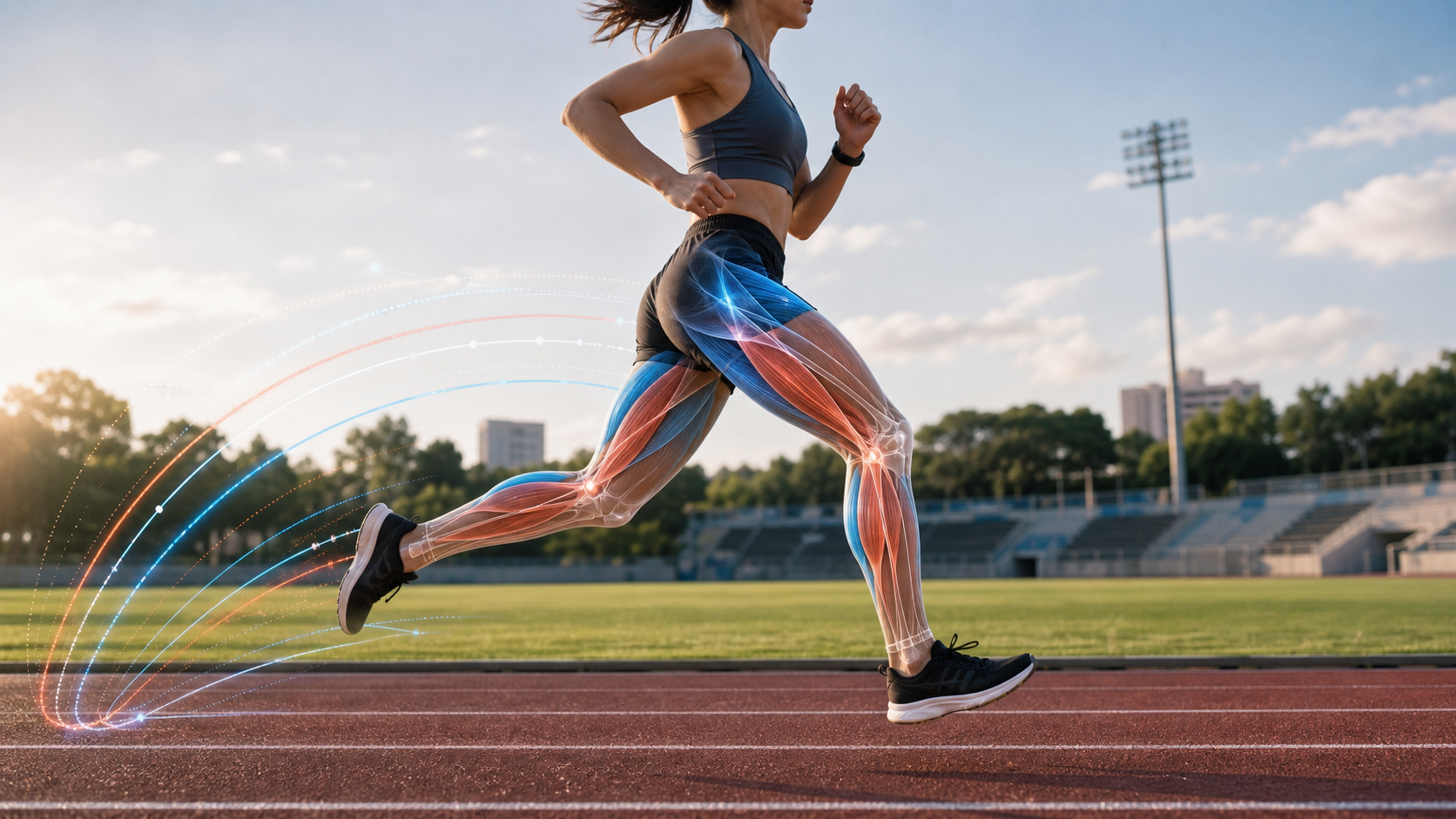
In any joint movement, the agonist muscle is responsible for producing the movement, while the antagonist muscle should theoretically be completely relaxed. In reality, however, the human muscular system typically maintains a certain level of activation in the antagonist—this is called co-activation.
Take the push-off phase of running as an example:
- Agonist: The triceps surae (gastrocnemius + soleus) contracts to push off
- Antagonist: If the tibialis anterior is simultaneously highly activated, it will partially counteract the push-off force
Moderate co-activation serves to stabilize joints and protect ligaments; but excessive co-activation is equivalent to pressing the brake while stepping on the accelerator, wasting metabolic energy.
Major Antagonist Muscle Pairs in Running
| Joint | Agonist | Antagonist | Common Co-activation Issue |
|---|---|---|---|
| Ankle joint (push-off) | Triceps surae | Tibialis anterior | Over-activation in beginners/fatigued runners |
| Knee joint (extension) | Quadriceps | Hamstrings | Excessive co-activation in those with knee instability |
| Hip joint (extension) | Gluteus maximus | Iliopsoas | Anterior pull in those with tight hip flexors |
| Core (trunk stability) | Transversus abdominis | Erector spinae | Excessive oscillation in those with weak core |
Factors Affecting Antagonist Co-activation
Training Level
Research (Hortobagyi & DeVita, 2000) indicates that untrained individuals have significantly higher antagonist co-activation ratios than elite runners. With accumulated training, the nervous system learns to suppress unnecessary antagonist activation, making movements “cleaner” and reducing oxygen consumption accordingly.
Fatigue State
As fatigue accumulates in the later stages of a run, neural inhibition capacity declines and antagonist co-activation rates rise. This is precisely why gait efficiency visibly deteriorates in the second half of a marathon, and why compensatory movements from overexertion become more likely.
Muscle Tightness
Excessively tight iliopsoas (hip flexors) is a common issue among Taiwanese runners who are sedentary office workers. When tight hip flexors are passively stretched during the push-off phase, their activation reflexively increases, directly counteracting the push-off efficiency of the gluteus maximus.
Training Strategies to Improve Muscle Coordination
-
Running Drills:
- A-Skip, B-Skip, high knees, butt kicks: reinforce neural learning of movement patterns.
- Barefoot short sprints on a gentle slope (20–30 meters): reshape coordination patterns in a proprioceptively rich environment.
-
Single-Leg Strength Training:
- Bulgarian split squats, single-leg RDLs (Romanian deadlifts)—simultaneously strengthen the agonist while training timely inhibition of the antagonist.
-
Iliopsoas Stretching:
- Lunge with forward lean, 30 seconds × 3 sets, performed daily before running, effectively reducing hip flexor interference during the push-off phase.
-
Rhythmic Ladder Drills:
- High-frequency footwork transitions train the nervous system to rapidly alternate between activation and inhibition. Many Taiwanese high school track teams commonly use this tool.
Practical Recommendations
- If your legs feel noticeably “heavy” after long runs but your cardiorespiratory system is still fine, consider that antagonist co-activation efficiency has declined—you should strengthen neuromuscular training rather than increase mileage.
- Schedule 1–2 sessions of running technique-specific drills per week (20–30 minutes); the long-term results often outperform adding an extra long run.
- Strength training should emphasize movement quality over load; “controlled” single-leg squats improve running coordination better than heavy bilateral squats.
Conclusion
Improving running efficiency relies not only on more mileage, but on smarter neuromuscular coordination. Once you understand the mechanisms of antagonist co-activation, you will realize that sometimes “doing less” unnecessary muscle contraction is the real secret to running faster.
Related Reading
- Core Muscle Activation in Running: The Scientific Link Between Stability and Efficiency
- Running Economy: What Makes Some People Naturally Efficient Runners
- The Impact of Core Strength on Running Efficiency
- Runner-Specific Strength Prescription: Gym Strategies from Hip Drive to Lower Limb Stiffness to Improve Running Economy
戰略) Zwift Race 如何咬在第一集團 如何評估自己要開多少推力 (請開1.5倍速看)
7 年前
多機位拍片神器 DJI Action 2 拍出速度張力感 | 類空拍機視角 4陣列麥克風超強降風噪 實測! | 公路車 | CT Yeh
3 年前
[教學] Premiere 影片 手震 修正 教學 防抖 單眼 影像 GoPro 穩定 Video Stabilization
8 年前
#公路車 #Fitting 靠人工智慧APP 幫你調整單車
6 年前
西進武嶺 免費訓練分析服務 Intervals | 練不夠還是練過頭?你哪一種類型選手?AI模型告訴你! | 備戰神器 | 公路車 訓練 | CT Yeh
4 年前
CT暗黑廚房) 車友必備 宇宙無敵鮮蚵湯 幫助訓練恢復 天然食補 好市多 超肥鮮蚵 破PR
7 年前
大家都在開箱的...單車用藍芽對講耳機真的有幫助嗎? SENA BiKom 20 長距離旅遊 & 海鷗繞圈賽 實際體驗心得 / 公路車 / CT Yeh
9 個月前
CT 喇低賽) 武嶺牽車 才是王道 西進牽車四小時內秘訣 攝手位置 如何判斷 防抽筋小秘訣
7 年前