Counterclockwise vs. Clockwise Round-Island Cycling: Difficulty and Scenery Differences by Direction
Introduction
Almost every cyclist planning a round-island trip faces the same question: clockwise or counterclockwise? This choice affects not only the daily order of climbs, but also what scenery you see when you’re most exhausted. Both directions have their advocates, and there’s no absolute right answer, but some differences are worth understanding in depth.
Defining the Directions
Using Taipei as the starting point:
- Counterclockwise (North → East → South → West → North): Depart along Provincial Highway 9, riding the east coast first (Yilan, Hualien, Taitung), then crossing the Southern Cross-Island route to Pingtung and Kaohsiung, before heading back north along the west coast
- Clockwise (North → West → South → East → North): Head down the west coast first to Pingtung, cross the Southern Cross-Island route, ride north along the east coast, and finally return to Taipei via the Suhua Highway
Difficulty Comparison
| Item | Counterclockwise | Clockwise |
|---|---|---|
| Timing of Suhua Highway | Day 2 (fresh legs) | Last 1–2 days (most fatigued) |
| Timing of Southern Cross-Island climbs | Day 4 (warmed up) | Day 4–5 (still manageable) |
| West coast wind | Return leg heading north, summer headwind | Outbound leg heading south, summer tailwind |
| East coast wind | Outbound leg, aided by southerly winds | Return leg, occasional headwind |
| Overall feel | Hard first, easy later | Easy first, hard later |
Timing the Suhua Highway
The Suhua Highway is one of the most difficult sections of the round-island route, spanning roughly 118 kilometers with multiple stretches of continuous steep grades and tunnels. Going counterclockwise puts this challenge on day two, when your energy is at its peak. Going clockwise saves Suhua for last — after seven or eight days through Kaohsiung and Tainan, many riders are nearly exhausted by the time they reach it.
Differences in Scenery and Experience
The View from the East Coast
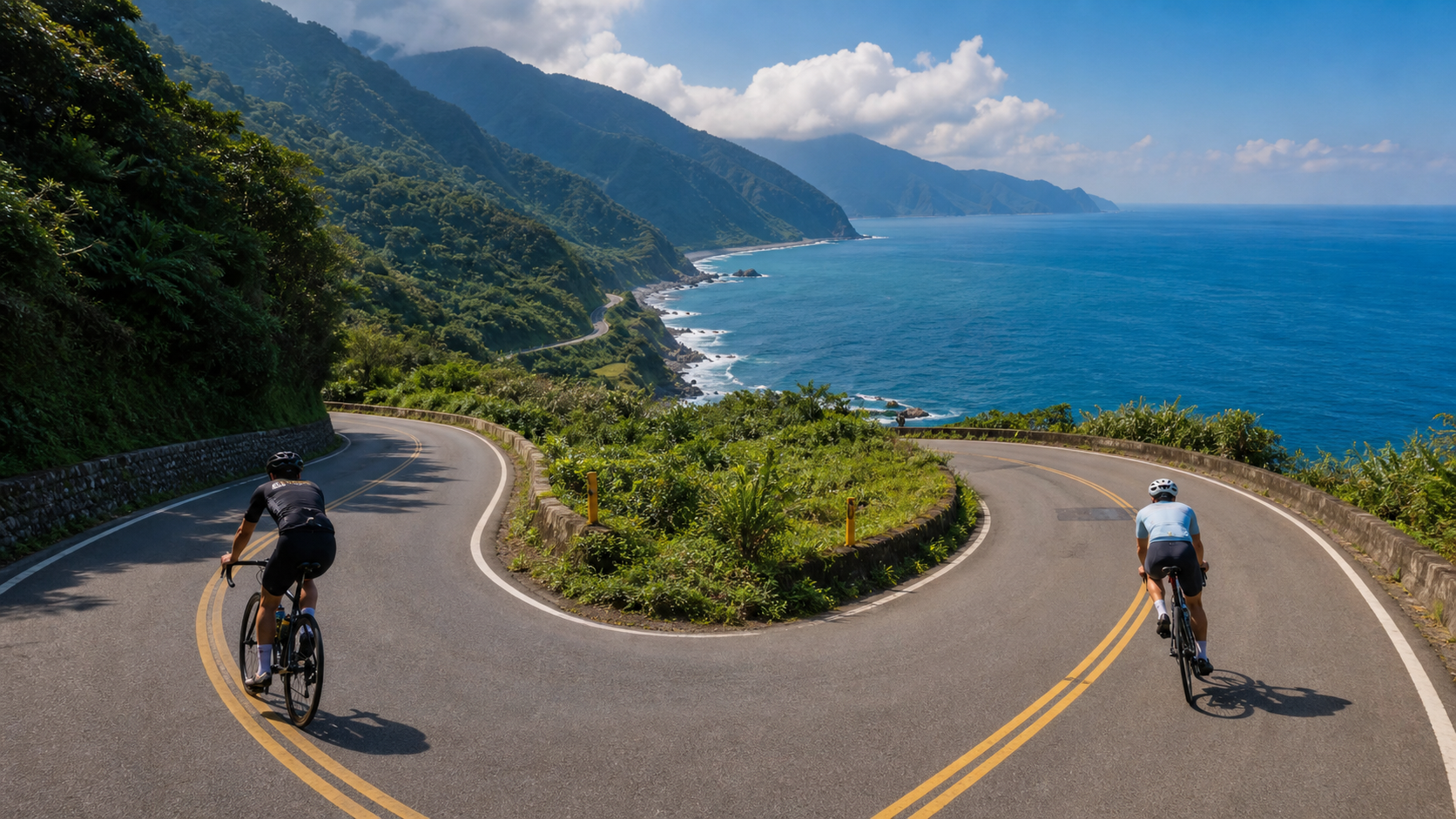
Riding counterclockwise, heading south along the east coast, the ocean is on your left, so your gaze naturally falls toward the Pacific — the view is expansive. Riding clockwise and heading north, the ocean is on your right; the way you take in the scenery is slightly different, but still beautiful.
The Feel of the West Coast Scenery
The west coast is flat and has a more industrial character. Counterclockwise riders must push through this relatively unexciting stretch during their final two days; clockwise riders ride the west coast in the first few days, while it still feels fresh.
Sunshine in Southern Taiwan
Regardless of direction, the sunshine on the Hengchun Peninsula in Pingtung leaves a strong impression. Counterclockwise riders arrive in Kenting after looping around from Taitung via the Southern Cross-Island route, while clockwise riders enter from the direction of Kaohsiung. The latter often face strong crosswinds from the southwest monsoon and need to pay extra attention.
Who Each Direction Suits
Counterclockwise is recommended if:
- This is your first round-island trip and you want to tackle Suhua while your energy is at its best
- You’re departing in summer (June–September), when riding south along the east coast lets you benefit from southerly tailwinds
- You prefer the psychological rhythm of “hard first, easy later”
- You want the final days to be easier, finishing up near Taipei
Clockwise is recommended if:
- You’re confident about the Suhua Highway and want to save the most spectacular mountain-and-sea memories for last
- You’re departing in winter (November–March), when the northeast monsoon makes riding south along the west coast smoother
- You prefer the strategic approach of “easy first, hard later”
- You’re riding with beginners, and the flat stretch of the west coast lets everyone build a rhythm together first
Practical Tips
- Regardless of direction, check the weather forecast for the Suhua Highway for the week of your departure — if a typhoon or heavy rain is expected, build in flexible extra days
- “Counterclockwise in summer, clockwise in winter” is a seasonal rule of thumb passed around among Taiwanese cyclists, and it has a real wind-pattern basis
- If you’re riding with a group with varying fitness levels, going counterclockwise lets you identify who needs extra support as early as day two
- Trip reports for both directions can be found online — it’s worth reading a few from each before you set out, to compare experiences
Conclusion
Counterclockwise or clockwise — in the end, there’s no standard answer. What matters is making the call based on the season, your fitness, and your personal preferences. Whichever direction you choose, a round-island trip in Taiwan is a journey moving enough to bring tears to your eyes. Once you set out, you’ve already won.
Related Reading
大武山後門26%歡樂陡坡!JJSC南台灣單車行Day2 / 被颱風追著跑 / 公路車 / CT Yeh
2 年前
微東進 太魯閣 蘇花 單車兩日遊 ! 颱風過後路況超刺激 行程大亂 | 最狂的鹹酥雞訂單 | CT Yeh | 4K 高畫質空拍絕景!
4 年前
山道猴出沒!? JJSC屏東單車行 Day1 一直催 / 皮卡丘來了!/ 墾丁 旭海 恆春 社頂 / 公路車 / CT Yeh
2 年前
金門 ! 我騎過最棒的離島了 / 最後可以騎車上金門大橋的機會!?/ 公路車 / CT Yeh
1 年前
台北闊瀨陡坡 騎旅 / 日本單車雜誌編輯車友臨時加入!/ 髮香才是最強的 / feat. 北迴歸線小隊 / 公路車 CT Yeh
6 個月前
2022 環花東挑戰賽 Day2 搭到特快車 高速真空吸引! 台東一路逆風殺回花蓮! 總排 ??| Feiyu Pocket 2s | 公路車 | CT Yeh
4 年前
爬坡ITT實境)台中 魔王 松鼠坡 首航 6:12 大肚山 大三元 科福路
8 年前
半日 小台灣 極限單車路線挑戰實錄
7 年前