Round-Island Bike Preparation Guide: Choosing Between Road Bikes, Touring Bikes, or Folding Bikes
Introduction
Every year, riders complete the round-the-island trip on all kinds of unusual bikes—folding bikes, BMX bikes, even tricycles. But if you’re seriously planning a round-the-island ride, choosing the right bike can make a world of difference over a 10-day journey. Riding the wrong bike not only tires you out more, but you may also find yourself in a bind mid-trip when replacement parts are hard to come by.
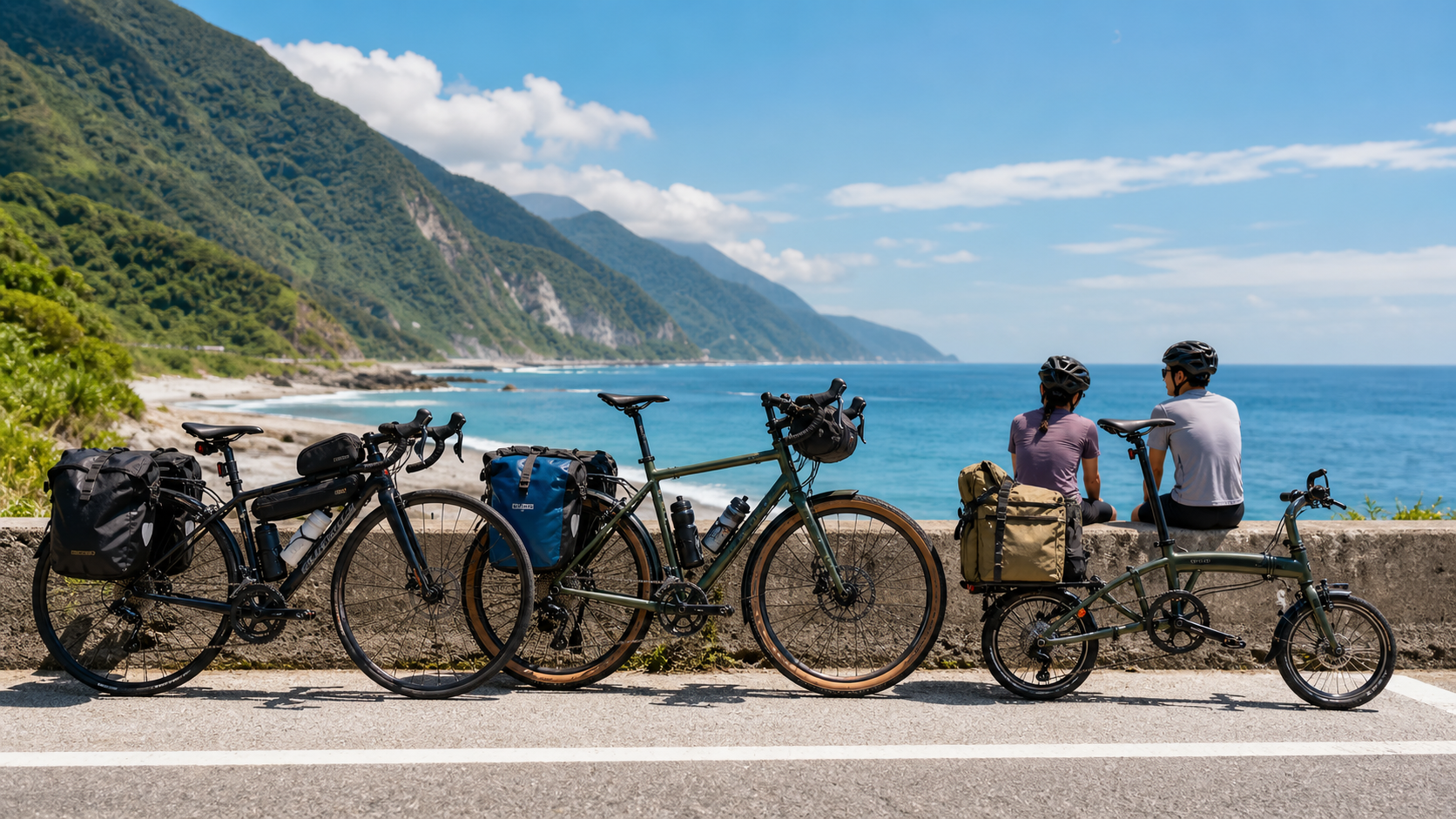
Basic Characteristics of the Three Bike Types
| Bike Type | Typical Tire Width | Load Capacity | Comfort | Climbing Efficiency | Ease of Maintenance |
|---|---|---|---|---|---|
| Road Bike | 25–32mm | Low (no rack mounts) | Medium (drop bars feel cramped) | Excellent | Requires specialized tools |
| Touring Bike | 32–45mm | High (front/rear racks, multiple mounting points) | Good (flat or swept bars available) | Good | Easy roadside repairs |
| Folding Bike | 20–24mm | Low | Average | Poor (small wheels, high cadence) | Parts harder to find |
Road Bike: Speed Above All, But With Trade-offs
Road bikes are the most common choice among round-the-island riders, especially those chasing speed with a goal of finishing within 9 days. Modern carbon road bikes can weigh under 8 kg, making them light on climbs and stable on descents.
Pros:
- Fast; you can cover 20–30 km more with the same effort
- Every city and county in Taiwan has road bike specialty shops, making parts relatively easy to source
- The road feel and handling at high speed are deeply satisfying
Cons:
- Luggage capacity is limited; you’ll need a backpack or saddle bag, resulting in poor weight distribution
- Narrow tires are less forgiving on the gravel sections of some county roads in Taiwan
- The aggressive riding position can cause neck and wrist fatigue over long hours
- Many road bikes can’t mount racks, requiring clamp-on racks (which are less stable)
Best for: Riders who already own a road bike, are not on their first round-the-island trip, and prioritize speed as the main goal.
Touring Bike: The Best Companion for a Round-the-Island Ride
Touring bikes are designed for long-distance travel and are extremely common in the cycling-touring cultures of Europe and Japan. The market in Taiwan is relatively niche, but as bike travel has grown in popularity in recent years, Giant and Merida have both released touring-oriented models.
Pros:
- Full front and rear rack mounts; can carry four panniers with a load capacity of 40–60 kg
- Wide tires offer strong grip, unbothered by gravel or wet pavement
- Upright riding position is kind to the lower back, greatly improving long-distance comfort
- Steel frames can be welded for roadside repairs (aluminum and carbon cannot)
- Steel’s vibration-damping properties reduce overall body fatigue
Cons:
- Heavier bike weight (about 12–15 kg including racks), making climbs relatively more demanding
- Not cheap; entry-level models run about NT$30,000–60,000
- Limited stock at Taiwan shops; waiting may be required for specific parts
Best for: First-time round-the-island riders, those carrying lots of luggage, riders who want a comfortable journey, and those not in a hurry.
Folding Bike: Flexible, But at a Cost
Every year, some riders still complete the round-the-island trip on folding bikes—mostly commuters who already own one and want to take on the challenge.
Pros:
- Can be folded and brought into your accommodation, no worry about theft
- Easy to carry if you need to take a train or bus mid-trip
- Lightweight models (such as Brompton) weigh only around 10 kg
Cons:
- The 20-inch small wheels require a higher cadence, leading to excessive muscle fatigue on long rides
- Climbing is extremely energy-draining; the South Link Highway and Suhua Highway are huge tests for folding bike riders
- Folding-bike-specific parts (chains, tires) are hard to find at rural bike shops
Best for: Riders already familiar with folding bikes, those with excellent fitness, and those who see the challenge itself as the goal.
Practical Tips
- The less luggage, the better: Regardless of bike type, try to keep your carry-on luggage under 8 kg—it will noticeably reduce the burden on climbs
- Test ride before you decide: Before departure, ride 80 km or more for 3 consecutive days to feel the bike’s true comfort
- Spare parts checklist: 2 inner tubes, patch kit, chain quick link, and brake pads—these are essential for any bike type
- Get the right frame size: An ill-fitting frame is the biggest culprit behind knee pain on a round-the-island trip; have a shop confirm your saddle height before you leave
Conclusion
The answer to “What bike should I ride around the island?” varies from person to person, but one principle holds true everywhere: ride the bike you know. An old road bike you’ve ridden for two years is far more trustworthy than a brand-new high-end touring bike. Being familiar with how your bike handles and how it fails is the real key to a successful round-the-island trip.
Related Reading
- Choosing a Bike for a Round-the-Island Trip: Comparing Road Bikes, Touring Bikes, and Folding Bikes
- Bicycle Touring: The Complete Guide to Packing Luggage and Choosing a Touring Bike
- Complete Preparation for Cycling Around the Island: A 14-Day Route, Accommodation, and Resupply Plan
- Round-the-Island Gear Checklist: Minimalist Packing Principles for Bag Systems, Essential Tools, and Clothing
碟煞公路車 優缺點?換車一年半實際經驗分享 / 公路車 / CT Yeh
2 年前
金門 ! 我騎過最棒的離島了 / 最後可以騎車上金門大橋的機會!?/ 公路車 / CT Yeh
1 年前
公路車 BB培林大升級! / 備戰海鷗繞圈賽 Canyon Aerod & TIME 一起改 / MIT大廠 CEMA對鎖式陶瓷培林BB & 導輪 / 公路車 / CT Yeh
2 年前
碟煞公路車 銑面器 !? 原來銑完差這麼多! 降低蹭碟機率! | TIME 公路車 保養小記錄 | CT Yeh
3 年前
大家都在開箱的...單車用藍芽對講耳機真的有幫助嗎? SENA BiKom 20 長距離旅遊 & 海鷗繞圈賽 實際體驗心得 / 公路車 / CT Yeh
9 個月前
一日北高/長距離團騎 常見問題補充篇 / 組團或跟團的眉角 / 壯車友容易被瘦車友慢性拉爆 / 原來屁股痛可能是這個原因...? / 風場配速法 / 公路車 / CT Yeh
2 年前
單車 一日北高 ( 雙城 ) 肥宅雙人瘋狂行 紀錄片 REACTO
10 年前
公路車 | 塔塔加驚險員工旅遊 | 還好手腳快沒被抓交替!
5 年前