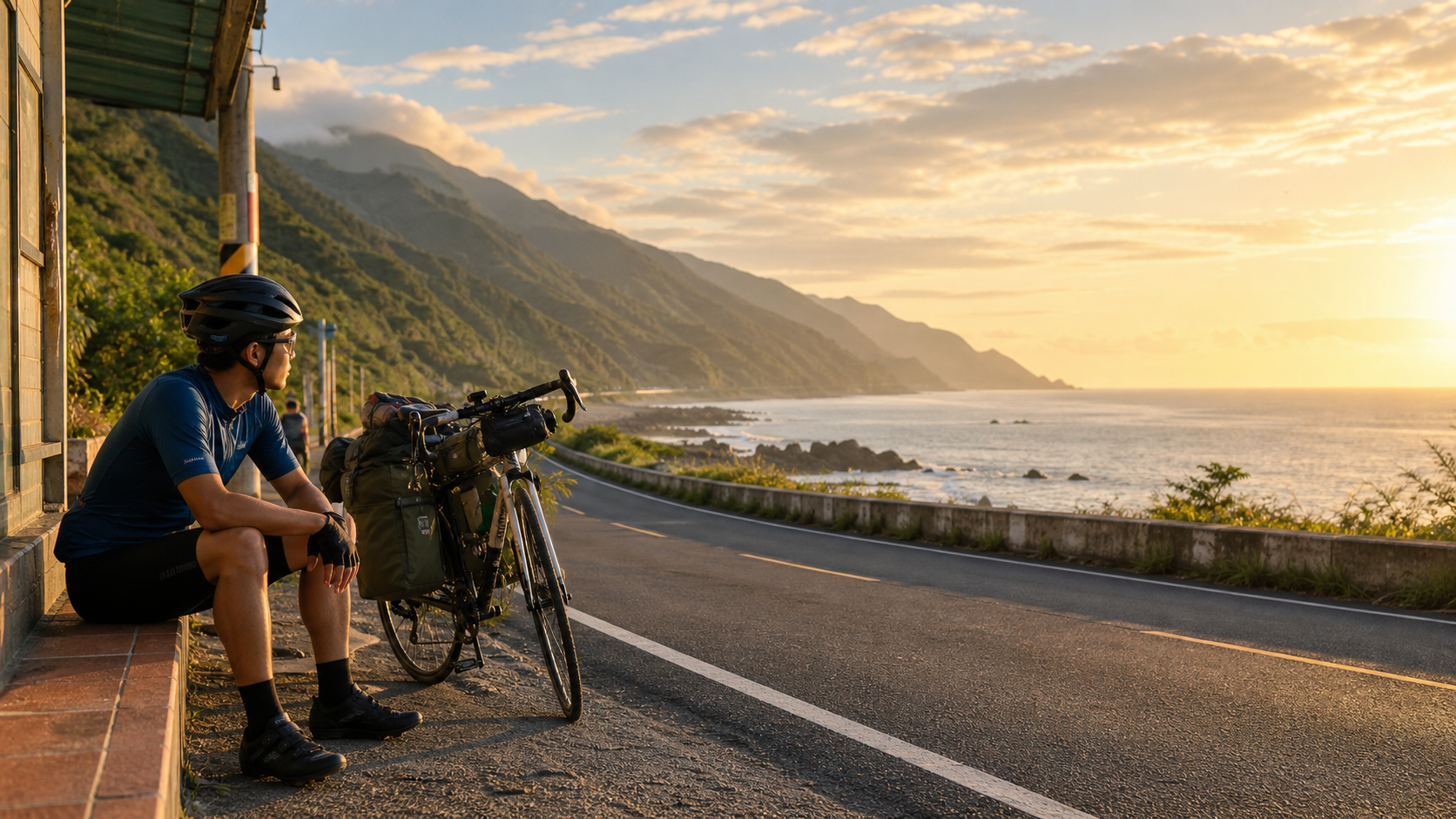
Introduction
Almost every cyclist who has completed a trip around Taiwan remembers that feeling: around the morning of day five, you look at the remaining distance on the map and suddenly it all seems completely unreasonable. Your legs still hurt, your backside is numb, the homestay you stayed at last night had no hot water, and you’ve eaten convenience store food for four straight days. This is “the wall,” and it’s the moment of greatest psychological vulnerability in the entire journey.
Why Are Days 5–6 the Hardest?
The wall appears due to both physiological and psychological roots:
Physiological factors:
- Accumulated muscle fatigue: Although sleep helps repair the first 4 days of riding, micro-damage keeps building up, and on day 5 your legs often feel “heavy”
- Depleted carbohydrate stores: If you haven’t refueled enough in the previous days, your glycogen reserves may be at a critical level
- Accumulated skin irritation: Saddle friction and insufficient sun protection cause skin problems that flare up all at once on day 5
Psychological factors:
| Mental State | Typical Thought | Reality |
|---|---|---|
| Novelty fades | “Same scenery again” | The stretch from Taitung to Pingtung is one of the most beautiful sections |
| Misjudging the finish | “Still halfway, this will never end” | By day 5, you’ve usually completed 40–50% of the distance |
| Misjudging your energy | “I can’t hold on anymore” | Physical fatigue is adaptive; day 6 is usually better than day 5 |
| Comparing yourself to others | “Everyone else looks fine” | Everyone is struggling; no one says it out loud |
Specific Strategies for Getting Through the Wall
Strategy 1: Shrink Your Goal—Focus Only on Today
When you look at the map and see 500 km remaining and feel despair, the most effective approach is to stop looking at the overall map and focus only on “where do I need to get today.” A trip around Taiwan is made up of nine “todays,” not one 1,000 km monster.
Each morning before setting off, set only one destination, and on the road, use “the next rest stop” as the smallest unit of progress. When leaving Taitung, your goal isn’t “get to Kaohsiung,” but first “get to Chenggong Township to refuel,” then “get to Changbin for lunch.”
Strategy 2: Give Your Body Comfort
When you hit the wall, your body needs small rituals to reignite your motivation:
- Soak your feet in hot water: After checking in, soak your feet in hot water for 15 minutes to boost circulation; the next morning, leg fatigue will be noticeably reduced
- Eat a good meal: On the evening of day 5, don’t skimp on food—treat yourself to a local specialty (Chishang bento in Taitung, Indigenous cuisine in Hualien), reward yourself with food
- Stretch for 10 minutes before bed: Three stretches—front of the thighs, glutes, and calves—can ease morning stiffness the next day
- Call family or friends: A 5-minute phone chat is far better than scrolling through photos on social media
Strategy 3: Reframe What You’ve Already Accomplished
The human mind has a tendency to pay more attention to “how much is left” rather than “how much has been done.” Try shifting your perspective:
- Completing 5 days means you’ve already conquered the Suhua Highway (one of Taiwan’s hardest roads)
- You’ve already seen the most beautiful coastline on the east coast
- Your body has already adapted to the rhythm of consecutive days of riding
If you’re on day 5 of a counterclockwise route, ahead of you is the flat road from Fangliao to Kaohsiung, followed by the easy sections of the west coast. The hardest part is already behind you.
Strategy 4: Find a Fellow Rider
When you encounter other cyclists on the road, don’t part ways just because your speeds differ. Even if you only ride together for 20 km, having someone to talk to and share road conditions with significantly lightens the psychological burden. The stretch from Taitung to Kaohsiung has the highest density of cyclists—say hello; you’re not alone.
The Turning Point on Day 7: A Sense of Rebirth
Almost every cyclist who has gone around Taiwan describes the same thing: after pushing through days 5–6, day 7 brings “rebirth mode.” Your body has fully adapted to the rhythm of consecutive riding, the remaining route is clearly visible, and you even start to feel reluctant for the journey to end. This turning point usually happens near Tainan or Chiayi, and most people describe waking up that morning and “suddenly not feeling as tired for no apparent reason.”
This isn’t a miracle—it’s your body’s adaptation mechanism kicking in. The wall is a door, not the end.
Practical Advice
- Know about the wall before you set out: Mental anticipation can significantly reduce its impact
- Prepare an “emergency energy source”: Keep your favorite snack or chocolate in your bag at all times, and save it for when the wall hits hardest
- Set a “quitting baseline”: Tell yourself, “Today I just need to ride to XX; if I really can’t go on, we’ll talk about it then.” This sense of permission is what keeps most people riding
- Don’t make any decisions during the wall: If you want to quit on day 5, wait until the next morning to reassess
Conclusion
The wall on a Taiwan cycling trip is every rider’s rite of passage. The psychological weight of those two days rivals the gradient of the Suhua Highway’s climbs. But once you push through, you’ll find that your understanding of your own willpower has changed. The greatest gift of cycling around Taiwan isn’t the scenery along the way—it’s the version of yourself that chose to keep going when you were at your most exhausted.
Related Reading
- The Psychological Challenge of Cycling Around Taiwan: The Willpower Breakdown on Days 3–4 and Coping Strategies
- The Mental Hurdles of Long-Distance Riding: Psychological Strategies for the 100 km Wall
- After Completing the Taiwan Cycling Trip: Physical Recovery and Reflecting on the Meaning of the Journey
- The Psychological Challenge of Marathon: An Anatomy of the Mind at the 35 km Wall
金門 ! 我騎過最棒的離島了 / 最後可以騎車上金門大橋的機會!?/ 公路車 / CT Yeh
1 年前
大武山後門26%歡樂陡坡!JJSC南台灣單車行Day2 / 被颱風追著跑 / 公路車 / CT Yeh
2 年前
2022 環花東挑戰賽 Day2 搭到特快車 高速真空吸引! 台東一路逆風殺回花蓮! 總排 ??| Feiyu Pocket 2s | 公路車 | CT Yeh
4 年前
水金九不厭五分 10度寒流冷到不願停!feat. 卡卡 / 公路車 / CT Yeh
6 個月前
JJSC南台灣單車走春三日行 DAY 1 / 強度 x 美食 x 節慶體驗 / 公路車 CT Yeh
5 個月前
一日北高/長距離團騎 常見問題補充篇 / 組團或跟團的眉角 / 壯車友容易被瘦車友慢性拉爆 / 原來屁股痛可能是這個原因...? / 風場配速法 / 公路車 / CT Yeh
2 年前
2026 輪霸西濱200K 挑戰VLOG / 第一集團 / 首次參加..經驗不足、膀胱不足 /死守6H內 / AI戰鬥力顯示系統 / 公路車 / CT Yeh
4 個月前
一日北高常見問題大集合 | 攻略 | 路線 | 訓練 | 補給 | 自行車 單車 | 一日雙城 | 雙塔 | TWB北高360 | 屁股痛
6 年前