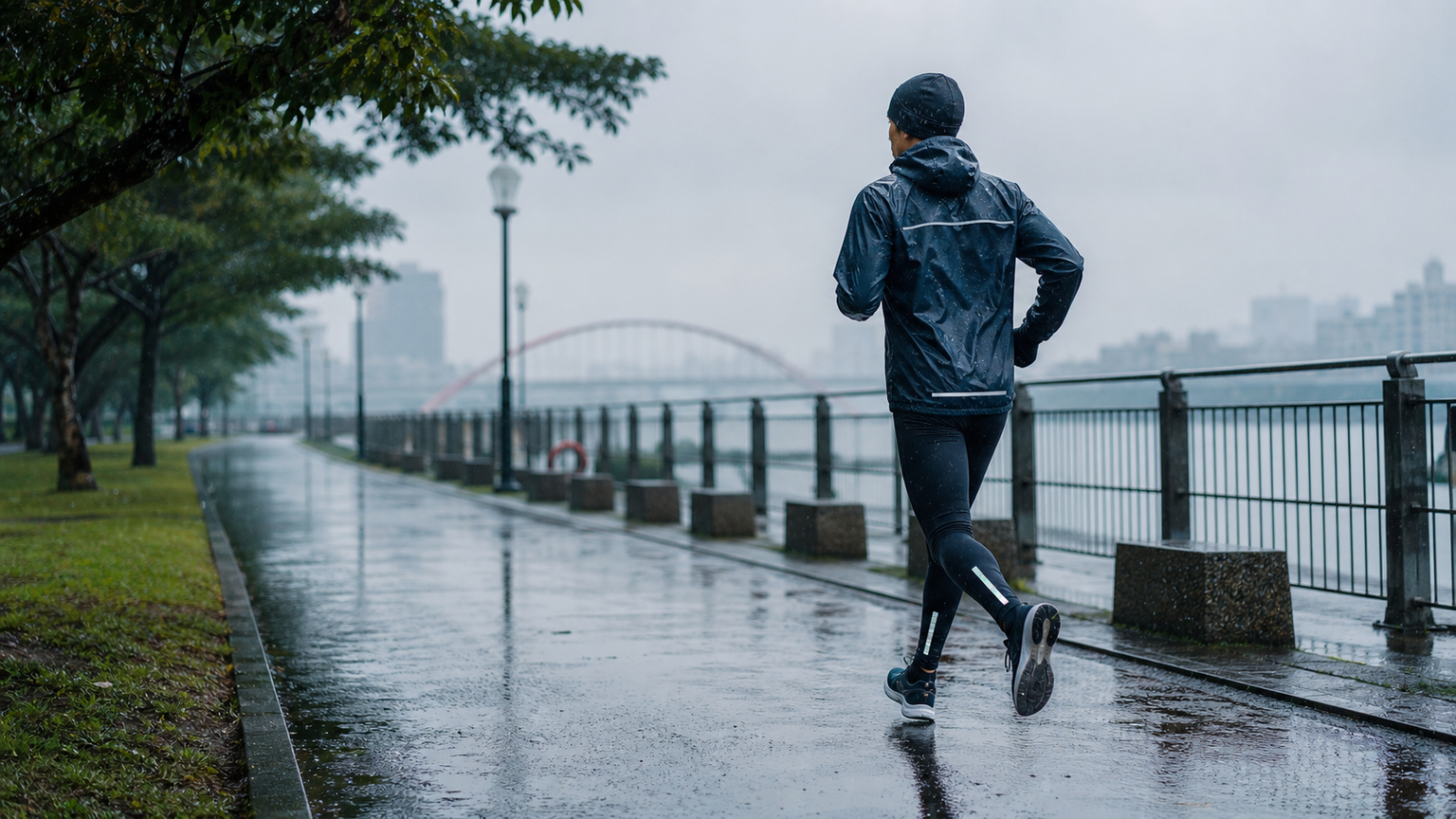
Complete Guide to Running in Rain and Cold Weather: Gear, Safety, and Training Adjustments
Taiwanese runners are no strangers to rain—Taipei experiences over 160 rainy days per year, and the damp cold brought by winter and the northeast monsoon can easily discourage even the most dedicated. But if you skip every rainy day, you could lose up to a third of your annual training volume. Top international runners have a famous saying: “There’s no such thing as bad weather, only bad gear.” This article will teach you how to train safely and effectively in rain and cold weather.
Running in the Rain
The Physiological Challenges of Running in the Rain
Running in the rain isn’t just about “getting wet”—it brings several specific physiological effects:
1. Accelerated Heat Loss
Water conducts heat 25 times faster than air. When clothing becomes soaked through, the rate of body heat loss increases dramatically. Even at around 15°C, a drenched runner can quickly slip into hypothermia after stopping.
2. Skin Softening and Chafing
Skin soaked in water for extended periods becomes soft and fragile, increasing friction coefficients. The most common problems in long-distance rainy runs are blisters and skin chafing—between toes, underarms, inner thighs, and nipples are all high-risk areas.
3. Reduced Visibility
Visibility is poor in the rain, increasing safety risks for both runners and drivers.
Rainy Day Gear Selection
Outer Layer: Waterproof vs. Water-Repellent vs. Breathable
These three concepts are often confused. You need to understand them before choosing gear:
| Feature | Description | Best For |
|---|---|---|
| Water Repellent | DWR coating makes water bead off, but it soaks through in prolonged rain | Light rain, short runs |
| Waterproof | Membrane blocks water penetration, e.g., Gore-Tex | Heavy rain, long runs |
| Breathable | Allows water vapor to escape from inside to outside | All running scenarios |
Key Selection Principle: Running generates a lot of sweat. If your outer layer is fully waterproof but not breathable, you’ll be soaked in your own sweat—“it rains outside, and it rains inside too.” Therefore, running rain jackets must be both waterproof and breathable.
Recommended Fabric Tiers:
- Premium: Gore-Tex Active / Shakedry (waterproof rating 28,000mm+, excellent breathability)
- Mid-range: Pertex Shield / eVent (waterproof rating 20,000mm+, good breathability)
- Entry-level: Brand’s own waterproof-breathable membranes (waterproof rating 10,000-15,000mm, acceptable)
Hat: The Most Underrated Rainy Day Gear
A running cap with a brim is one of the most important pieces of gear for rainy days:
- Blocks rain from hitting your face directly, keeping your vision clear
- Prevents rain from running into your eyes
- Provides a psychological “barrier effect” that helps you stay focused on running
Shoe Strategy
Your shoes will get wet when running in the rain—accept this fact. Don’t wear waterproof running shoes (water gets in and can’t get out, which is worse). Instead:
- Choose running shoes with good drainage (mesh uppers)
- Wear quick-drying synthetic socks (avoid cotton socks)
- Pre-tape or apply Vaseline to blister-prone areas
- Apply Bodyglide or Vaseline to your feet before the run to create a waterproof barrier
Clothing Principles
- Base layer: Synthetic fibers or Merino wool (absolutely avoid cotton)
- No mid-layer needed: Running generates enough heat, unless the temperature is below 10°C
- Outer layer: Waterproof-breathable windbreaker
- Lower body: Compression tights are better than loose pants (less friction surface area)
Rainy Day Safety Precautions
- Wear reflective gear or bright clothing: Visibility is extremely poor in the rain—make sure drivers can see you
- Avoid flooded areas: You don’t know what’s beneath the water—it could be potholes, broken glass, or slippery drain covers
- Be careful with metal surfaces: Manhole covers, railroad tracks, and road markings are extremely slippery in the rain
- Don’t run during thunderstorms: Lightning can strike targets up to 16 kilometers away. If you hear thunder, seek indoor shelter
- Shorten your stride: Slippery surfaces require a more stable gait
Running in Cold Weather
How Low Temperatures Affect Running Performance
Research shows the optimal temperature for running performance is approximately 7-15°C. Below this range:
Decreased Muscle Efficiency:
- Muscle contraction speed drops by about 3% for every 1°C decrease in muscle temperature
- This is why cold weather requires a longer warm-up
Respiratory Irritation:
- Inhaling cold air irritates the bronchial tubes, causing “exercise-induced bronchoconstriction (EIB)”
- Symptoms: coughing, chest tightness, difficulty breathing
- This problem is especially severe when temperatures drop below -10°C
Increased Cardiovascular Strain:
- Cold air causes peripheral vasoconstriction, raising blood pressure
- Runners with a history of cardiovascular disease should be especially cautious when exercising in extreme cold
Layering for Cold Weather Running
Cold weather running uses the onion layering system:
Layer 1 (Moisture-Wicking Layer):
- Material: Merino wool or high-performance polyester
- Function: Draws sweat away from the skin surface
- Absolutely forbidden: Cotton (absorbs water and doesn’t dry, leading to hypothermia)
Layer 2 (Insulation Layer)—add when temperatures drop below 10°C:
- Material: Fleece-lined running top, lightweight insulated vest
- Function: Creates a warm air layer between the base layer and outer layer
Layer 3 (Windproof Layer)—add when it’s windy or below 5°C:
- Material: Lightweight windbreaker
- Function: Blocks cold wind from stripping body heat (wind chill effect)
Temperature Clothing Reference Chart (based on moderate-intensity running):
| Temperature | Upper Body | Lower Body | Accessories |
|---|---|---|---|
| 10-15°C | Long-sleeve moisture-wicking top | Shorts or capris | None |
| 5-10°C | Long-sleeve moisture-wicking top + lightweight jacket | Long pants | Thin gloves |
| 0-5°C | Moisture-wicking base + insulating mid-layer + windbreaker | Fleece-lined pants | Gloves + ear warmer/headband |
| -5-0°C | Moisture-wicking base + insulating mid-layer + windbreaker | Insulated compression tights | Thick gloves + beanie + neck gaiter |
| < -5°C | Full three layers + face mask | Insulated pants + windproof pants | Full set + face mask |
The Pre-Run Clothing Test: Stand outside your door for 2 minutes. You should feel “a bit cold”—because your body temperature will rise 5-10 minutes into the run. If you feel perfectly warm before heading out, you’ll definitely overheat once you start running.
Protecting Extreme Extremities
In low temperatures, the body prioritizes maintaining core organ temperature, sacrificing blood circulation to the extremities:
Fingers: Blood flow to the hands can decrease by 60% during running. Wear gloves below 5°C, and consider mittens below 0°C (warmer than fingered gloves).
Ears: Ear blood vessels are shallow and the surface area is large, making them highly susceptible to frostbite. A headband or beanie is essential.
Neck: A neck gaiter (Buff) can be pulled up to cover the mouth and nose while pre-warming the air you inhale.
Note for male runners: The impact of low temperatures combined with wind chill on the reproductive organs should not be underestimated. In extreme cold, consider wearing windproof running pants.
Warm-Up Strategies for Cold Weather
Winter warm-ups require more dedication:
- Indoor pre-warm-up: Do 5-10 minutes of dynamic stretching and light exercise before heading out (jumping jacks, high knees)
- Extend the warm-up run: Jog at a very easy pace for the first 15-20 minutes
- Avoid static stretching: Static stretching on cold muscles increases injury risk
- Schedule high-intensity work in the middle: Let your body fully warm up before picking up the pace
Winter Training Adjustment Recommendations
- Lower pace expectations: At the same heart rate, your pace will be 10-20 seconds/km slower in cold conditions—this is normal
- Shorten interval recovery time: Long standing recoveries cause body temperature to drop rapidly
- Plan your route: Run loop courses instead of out-and-back routes to avoid cooling down on the return leg into the wind
- Carry your phone and spare change: In case of injury or hypothermia, you’ll need a backup plan for contacting someone or taking transportation
- Change clothes immediately after running: Get into dry clothing within 10 minutes of finishing to avoid hypothermia
Special Scenario: Taiwan’s Damp Winter Cold
The hallmark of winter in northern Taiwan is “not extremely cold, but very damp”—temperatures of 8-15°C combined with 80%+ humidity and the northeast monsoon. This damp cold is more likely to cause hypothermia than dry cold because:
- High humidity reduces the efficiency of sweat evaporation
- Moisture penetrates clothing more effectively than dry cold air
- Wind chill effects are more pronounced in damp cold conditions
Practical Advice for Winter Running in Taiwan:
- Wind protection matters more than insulation—a good windbreaker beats a heavy fleece
- A moisture-wicking base layer is a necessity, not an option
- The 30 minutes after your run are a high-risk period for hypothermia—don’t linger outdoors chatting
Conclusion
You can’t control the weather, but you can control your preparation. The right gear, sensible training adjustments, and awareness of safety risks will allow you to train safely and effectively in any weather conditions. While other runners are lounging on the couch at home, you’re accumulating miles in the rain or biting wind—and that discipline and resilience will pay off on race day.
Related Reading
- Complete Guide to Running in the Rain: Adjusting Shoes, Clothing, and Ground Friction
- Winter Running Training Tips: Maintaining Training Quality in Low Temperatures
- Weather Adaptation for Road Running: Clothing and Timing Choices for Taiwan’s Four Seasons
- Weather Strategies for Road Races: Adjusting for Rain, Heat, and Strong Winds
一日北高前的高裝檢 | 北高 360 | 挑戰11小時的裝備 | 一日雙塔 | 補給
6 年前
單車 一日北高 ( 雙城 ) 肥宅雙人瘋狂行 紀錄片 REACTO
10 年前
下雨天就是要改車 #ceramicspeed #bike
1 年前
#公路車 #Fitting 靠人工智慧APP 幫你調整單車
6 年前
雨戰! 西進武嶺員工旅遊 加料 各路段大數據分析 | 同事端出5公斤的公路車來挑戰!? EP1
4 年前
Zwift 元宇宙單車世界 如何與全世界同步騎車運動
6 年前
[防寒衣體驗] 鐵人魂 三鐵 防寒衣試穿會 於松運 深水游泳池 鯨魚池
8 年前
摔車後補裝備: 好市多新款單車安全帽& Specialized Romin 北高整路屁股都不痛的坐墊 | 一千元居然有MIPS | CT Yeh | 公路車
4 年前