Building Your Pre-Race Routine: A Systematic Approach from Chaos to Control
The night before a race, what are you doing? Some people anxiously pack their gear for the fifth time in a hotel room, some repeatedly check the weather forecast and route map on their phones, and some are on the phone with family while absentmindedly thinking about tomorrow’s pacing strategy.
And top athletes? They are executing a precise, minute-by-minute pre-race routine—the exact same routine as the last race, and the race before that.
This isn’t superstition, and it isn’t OCD. This is one of the most evidence-based performance optimization strategies in sports psychology: the Pre-Performance Routine (PPR).
Why Do Pre-Race Routines Work?
Reducing Cognitive Load
On race day, the brain is in a state of heightened alertness, and any additional decision-making consumes limited cognitive resources. When you have a fixed routine, you don’t need to think about “What time should I eat breakfast?” or “What warm-up should I do first?” before the race—those decisions have already been made in advance.
Steve Jobs wore the same black turtleneck every day, not because he had no other clothes, but to save one decision. Your pre-race routine follows the same logic.
Establishing a Sense of Control
There are too many things in a race you can’t control—weather, opponents, road conditions, mechanical issues. The pre-race routine is an area you can completely control. The very act of executing the routine tells your brain: “Everything is according to plan, everything is under control.”
Triggering an Optimal State
By repeatedly executing the same process, your brain builds a conditioned response linking the routine to a state of “readiness.” When you begin the first step of your routine, your mind and body automatically start shifting into race mode—just like Pavlov’s dogs salivating at the sound of a bell.
Managing Anxiety
A structured routine gives your attention a clear focus. Instead of letting your mind wander freely into anxious thoughts, the routine gives you a series of concrete tasks to execute, effectively blocking the rumination loop of anxiety.
The Time Framework of a Pre-Race Routine
A complete pre-race routine typically covers the following time periods:
One Week Before the Race
The theme of this week is “eliminating uncertainty.”
| Time | Task |
|---|---|
| 7 days out | Confirm transportation and accommodation arrangements. Once booked, make no further changes. |
| 5 days out | Full bike check: tires, brakes, shifting, chain. If repairs are needed, allow sufficient time. |
| 4 days out | Prepare nutrition (energy gels, electrolyte powder, bottles) and spare parts (inner tubes, CO2, tools). |
| 3 days out | Begin increasing carbohydrate intake (carb loading). Confirm the race-day nutrition plan. |
| 2 days out | Easy ride for 30-45 minutes, including 3-4 x 10-second high-intensity openers (to maintain leg feel). |
| 1 day out | Pack all gear completely. Check the final weather forecast. Go to bed early (but don’t force yourself to sleep). |
Key point: During this week, everything that can be decided in advance should be decided in advance. On race day, you shouldn’t need to make any “new” decisions.
The Night Before the Race
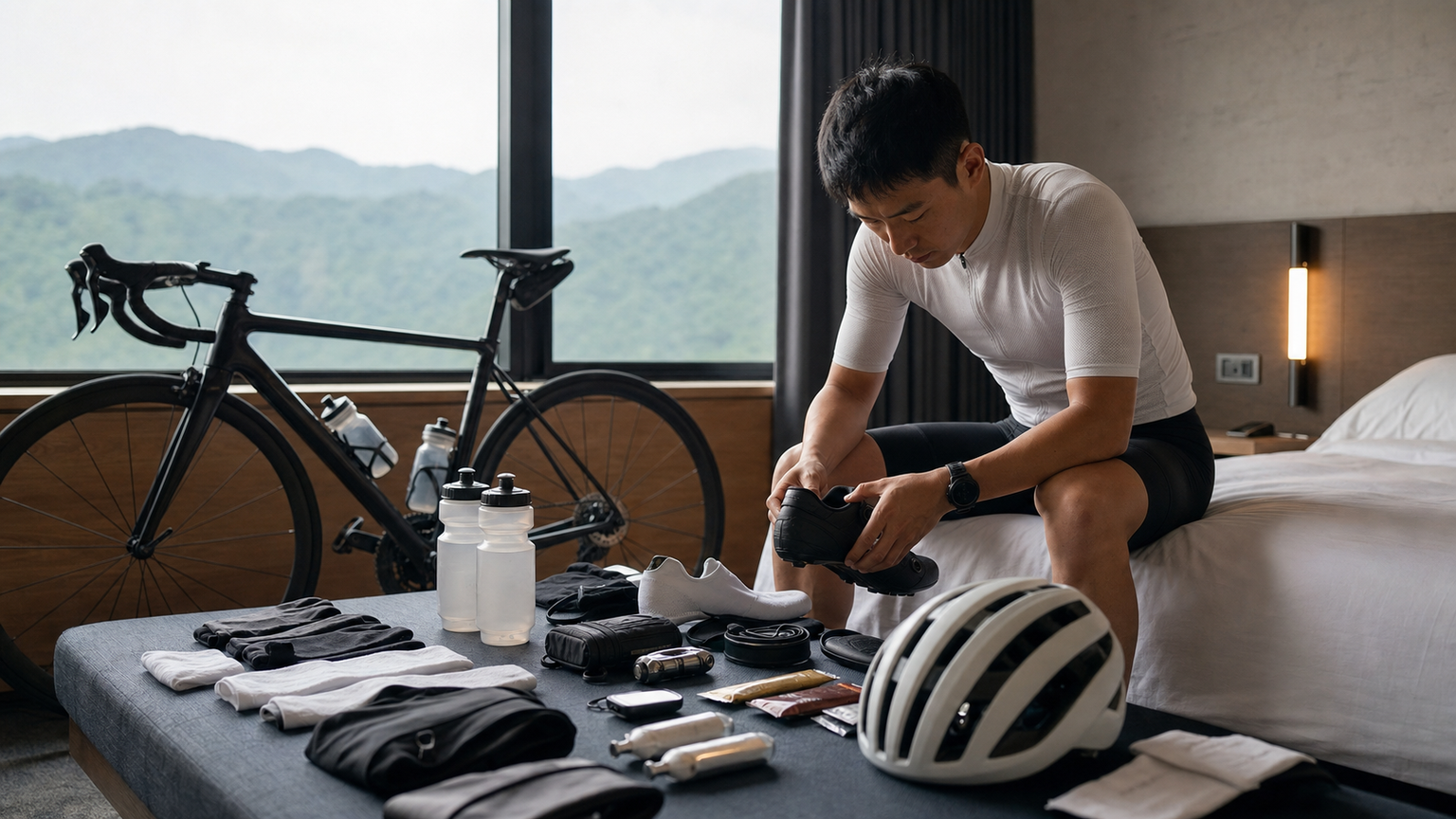
Gear Preparation Checklist:
Arrange all gear in the order you will put it on and use it. Many athletes use a fixed checklist and tick it off every time:
- [ ] Helmet
- [ ] Cycling shoes
- [ ] Jersey (with race number already pinned on)
- [ ] Bib shorts
- [ ] Gloves
- [ ] Sunglasses
- [ ] Arm/leg warmers (depending on weather)
- [ ] Windbreaker (depending on weather)
- [ ] Bike computer charged
- [ ] Heart rate strap battery confirmed
- [ ] Water bottles × 2
- [ ] Energy gels × planned quantity
- [ ] Spare inner tube + tire levers + CO2
- [ ] ID/insurance card
- [ ] Sunscreen
- [ ] Pre-race breakfast ingredients
Mental Preparation:
- Spend 10 minutes doing light imagery training—visualize tomorrow’s warm-up process and the first 15 minutes of the race
- Don’t watch race route analysis videos or other athletes’ results before bed—this will increase anxiety
- Set your alarm (at least 2.5-3 hours before your departure time)
Race Day Morning
Here is a complete morning routine example for an 8:00 AM start:
| Time | Action |
|---|---|
| 5:00 | Wake up. Don’t look at your phone. |
| 5:05 | Drink a glass of warm water + use the bathroom |
| 5:15 | Pre-race breakfast (low fiber, high carb—white toast with jam, banana, one cup of coffee) |
| 5:45 | Wash up, apply sunscreen, put on cycling kit (in a fixed order) |
| 6:15 | Depart for the venue |
| 6:45 | Arrive at the venue, find parking, set up the trainer or find a warm-up route |
| 7:00 | Begin warm-up (detailed warm-up protocol below) |
| 7:30 | Warm-up complete, final bathroom stop, rehydrate |
| 7:40 | Take position in the start area |
| 7:45 | Final mental preparation (breathing technique + cue words) |
| 8:00 | Start |
Warm-Up Protocol
Warming up is not just physical preparation—it’s also the process of switching your mind from “daily mode” to “race mode.”
Cycling Warm-Up Routine (30 minutes):
| Time | Intensity | Action |
|---|---|---|
| 0-10 min | Zone 1-2 | Easy riding, gradually raising heart rate |
| 10-15 min | Zone 2-3 | Moderate intensity, opening up joint mobility |
| 15-20 min | Zone 3-4 | Add 2 x 30-second high-intensity openers (85-90% max heart rate) |
| 20-25 min | Zone 1-2 | Lower intensity, recover |
| 25-30 min | Zone 2 | Steady cool-down, heart rate back below 120 |
Mental tasks during the warm-up:
- First 10 minutes: Notice bodily sensations, assess today’s physical state (not “good or bad,” just “how it is”)
- Middle section: Review key elements of the race plan (pacing targets, nutrition timing, mental cue words)
- Final 5 minutes: Use activation cues to enter race mode
Building Your Own Routine: Four Principles
Principle One: Develop It in Training
Don’t try a completely new routine on race day. Practice and refine your routine during training—especially on quality workout days or race simulation days.
Principle Two: Flexible Structure
Your routine needs structure, but it also needs to adapt to different situations. For example: if the race starts in the afternoon rather than the morning, your breakfast time and warm-up time need adjustment, but the core process (gear check → nutrition → warm-up → mental preparation) remains unchanged.
Principle Three: Incorporate Trigger Points
Design several “trigger points” into your routine to help you shift into different mental states:
- Putting on cycling shoes: “From now on, I’m entering race mode”
- Putting on the helmet: “Ready to go”
- Mounting the bike: “Everything is according to plan”
- Final breath before the start: Activation cue (e.g., “steady,” “enjoy,” “give it everything”)
Principle Four: Record and Iterate
After each race, review your pre-race routine:
- Which parts made you feel calm and well-prepared?
- Which parts increased anxiety or uncertainty?
- Were there any unexpected situations? How can you prevent them next time?
- Was the timing sufficient? Or too rushed?
Through continuous iteration, your routine will become increasingly precise and better suited to your individual needs.
Common Issues with Routines
What If the Routine Gets Disrupted?
This is bound to happen—traffic delays, forgotten gear, sudden weather changes. The key is having a Minimum Viable Routine:
If time is short, at minimum you should complete:
- Eat something
- A 10-minute shortened warm-up
- 1 minute of breathing regulation
What If You’re at an Unfamiliar Race Venue?
- Research the venue in advance (Google Maps, race handbook)
- If possible, visit the venue a day early to scout the warm-up route and parking
- If that’s not possible, allow an extra 30 minutes of “environmental adaptation” time
What If Your Teammates Have a Different Pace?
Your pre-race routine is personal—don’t let teammates who want to chat or warm up together disrupt your rhythm. Politely but firmly say: “I need to finish my own warm-up; let’s meet up before the start.” Protecting your routine is protecting your performance.
Pro Athletes’ Pre-Race Routines
Chris Froome (four-time Tour de France champion):
- Eats breakfast 3 hours before the race
- Does a precise 20-minute warm-up on the trainer
- Puts on headphones and listens to the same warm-up playlist
- In the final 5 minutes, does 2 x 20-second all-out sprints
Chrissie Wellington (four-time Ironman World Champion):
- The day before the race, lays out all gear on the floor in order of use
- First thing after waking up is 5 minutes of mindfulness meditation
- Uses three key cue words during warm-up: “Strong,” “Steady,” “Brave”
Conclusion
A pre-race routine isn’t about turning you into a robot. It’s about creating a controllable, familiar, and safe psychological space within the highly uncertain environment of a race. The more chaotic the outside world, the more valuable your internal routine becomes.
Take the time to build your pre-race routine—test it in training, refine it after every race, and make it your second nature on race day. When the routine becomes automatic, you free up valuable cognitive resources for what truly matters—the race itself.
References:
- Cotterill, S.T. (2010). “Pre-performance routines in sport: Current understanding and future directions.” International Review of Sport and Exercise Psychology, 3(2), 132-153.
- Moran, A.P. (2012). Sport and Exercise Psychology: A Critical Introduction, 2nd Ed. Routledge.
- Singer, R.N. (2002). “Pre-performance state, routines, and automaticity: What does it take to realize expertise in self-paced events?” Journal of Sport & Exercise Psychology, 24(4), 359-375.
Related Reading
- Swimming Pre-Race Routine: The Psychological Stabilizing Function of Pre-Race Rituals
- How to Design a Race-Day Nutrition Plan: A Practical Framework from One Week Out to Every Hour After the Start
- Season Planning for Swimmers: Periodized Adjustments Before Peak Races
- Pre-Race Anxiety Management: Cognitive Restructuring for Sleepless Nights Before Competition