The Complete Guide to Learning to Swim as an Adult: Overcoming Fear of Water and Mastering the Four Strokes
The Complete Guide to Learning to Swim as an Adult: Overcoming Fear of Water and Mastering the Four Strokes
“I never learned to swim as a kid, so isn’t it too late now?” This is one of the most common thoughts adults have. But the truth is, it’s never too late to learn to swim as an adult — in fact, thanks to stronger comprehension and self-discipline, adults can often learn even more efficiently than children.
This article starts with the most basic water adaptation exercises and walks you step by step toward building confidence in the water, eventually helping you master the fundamental strokes.
Why Is Learning to Swim as an Adult Especially Challenging?
The biggest obstacle for adults learning to swim isn’t physical fitness — it’s psychological.
Common Psychological Barriers
- Fear: A deep-rooted fear of water, often stemming from childhood experiences or lack of exposure
- Ego: Feeling embarrassed that an adult is “still” learning to swim
- Perfectionism: Expecting to master it immediately, and wanting to give up the moment things don’t go smoothly
- Physical tension: Nervousness causes the whole body to tense up, which actually makes floating harder
Important mindset: There are countless adults around the world who can’t swim. The moment you decide to start learning, you’re already braver than most people.
Phase One: Water Adaptation (1–2 Weeks)
Before learning any stroke, let your body get used to being in water first.
Exercise 1: Walking in Shallow Water
- Walk back and forth in water at waist depth
- Feel the resistance and buoyancy of the water
- Push water with your hands to experience how it supports your body
Exercise 2: Submerging Your Face
This is the hardest hurdle for many people to get past:
- Start by cupping water with your hands and splashing your face to get used to water touching your face
- Stand in shallow water, take a deep breath, and submerge your face for 3 seconds; repeat
- Gradually extend the time to 5 seconds, then 10 seconds
- Practice blowing bubbles underwater (exhaling while submerged)
Exercise 3: Floating
Floating is the foundation of swimming. The human body is naturally buoyant — the key is relaxation.
Back float practice:
- Stand with your back against the pool wall, holding the edge with both hands
- Slowly lean back and let the water support your back
- Take a deep breath and feel the buoyancy in your chest
- Slowly let go with one hand, then the other
- Keep your breathing steady and let your belly rise slightly
Front float practice:
- Stand in shallow water with both arms extended forward
- Take a deep breath, submerge your face, and lean your body forward
- Gently lift your feet off the bottom and let your body float
- Goal: hold a stable float for at least 10 seconds
Tip: The key to floating is “relaxing” and “inhaling.” With a full breath of air, your body becomes like a balloon and naturally rises to the surface.
Phase Two: Foundational Skills (2–4 Weeks)
Breathing Practice
The single most important skill in swimming is breathing. The principle is simple:
- Exhale through your nose or mouth while your face is in the water
- Inhale through your mouth when your face is out of the water
- Rhythm: exhale (underwater) → inhale (above water) → exhale (underwater) → inhale (above water)
Practice method:
- Stand in shallow water holding the pool wall with both hands
- Take a deep breath, submerge your face, and slowly blow bubbles
- Lift your head above water and inhale through your mouth
- Repeat 20 times per set, and do 3 sets
Kicking
Kicking provides forward propulsion and body stability.
Basic technique:
- Power comes from the hips, not the knees
- Keep your legs slightly bent, not overly bent
- Relax your ankles and let your toes point naturally
- Keep the kick amplitude small — about 30 cm
Practice method:
- Hold the pool wall with both hands, body extended straight
- Kick up and down at a moderate pace
- Avoid making big splashes (big splashes = low efficiency)
- 30 seconds per set × 5 sets
Phase Three: Learning the Strokes
Breaststroke (Best for Beginners)
Breaststroke is the first stroke most people learn, because you can keep your head above water, which makes breathing relatively easy.
Arm movement:
- Extend both arms straight forward, palms facing outward
- Sweep both arms outward simultaneously (as if pushing water apart)
- Bring your palms together and draw them back toward your chest
- Extend your arms forward again
Leg movement:
- Bring both legs up toward your hips at the same time
- Turn your feet outward (like a frog’s feet)
- Kick both legs outward simultaneously, then bring them back together
- Extend your body and glide
Rhythm cue: pull → recover legs → kick → glide
Freestyle (Most Efficient)
Freestyle is the fastest and most efficient stroke, but the breathing timing is harder to master.
Basic movements:
- Keep your body streamlined with your face down
- Alternate arm strokes: entry → catch → push → recovery (elbow lifts out of the water)
- Kick in coordination with your arm movements
- Breathe by turning your head to the side: as one arm pushes through the water, your body naturally rotates, turning your head to the side to inhale
Breathing technique:
- Don’t lift your head straight up to breathe (this causes your lower body to sink)
- Use your body’s rotation to turn your head to the side
- Inhale as soon as your mouth clears the surface — you don’t need to turn your head all the way
Backstroke and Butterfly
Once you’ve mastered breaststroke and freestyle, you can move on to greater challenges:
- Backstroke: Face up, easiest breathing, good for recovery
- Butterfly: The most physically demanding, requiring excellent coordination and core strength
Suggested Training Plan
Swim 2–3 times per week, 45–60 minutes per session
Early stage (Weeks 1–4):
- Water adaptation + floating practice: 15 minutes
- Breathing practice: 10 minutes
- Kicking practice: 10 minutes
- Breaststroke drills: 15 minutes
Middle stage (Weeks 5–8):
- Warm-up: an easy 100 meters (alternating walking and swimming)
- Breaststroke practice: 25 meters × 4–6 reps
- Freestyle drills: 15 minutes
- Cool-down: easy swimming or walking in water
Safety Precautions
- Never practice alone: Even in a pool, make sure a lifeguard or a companion is present
- Don’t push yourself too hard: Rest when tired, and head to the side immediately if you get a cramp
- Know the pool rules: Understand lane direction and fast/slow lane divisions
- Warming up matters: Stretch for 5 minutes before getting in the water
- Progress gradually: Don’t rush from shallow water into deep water
Should You Hire a Coach?
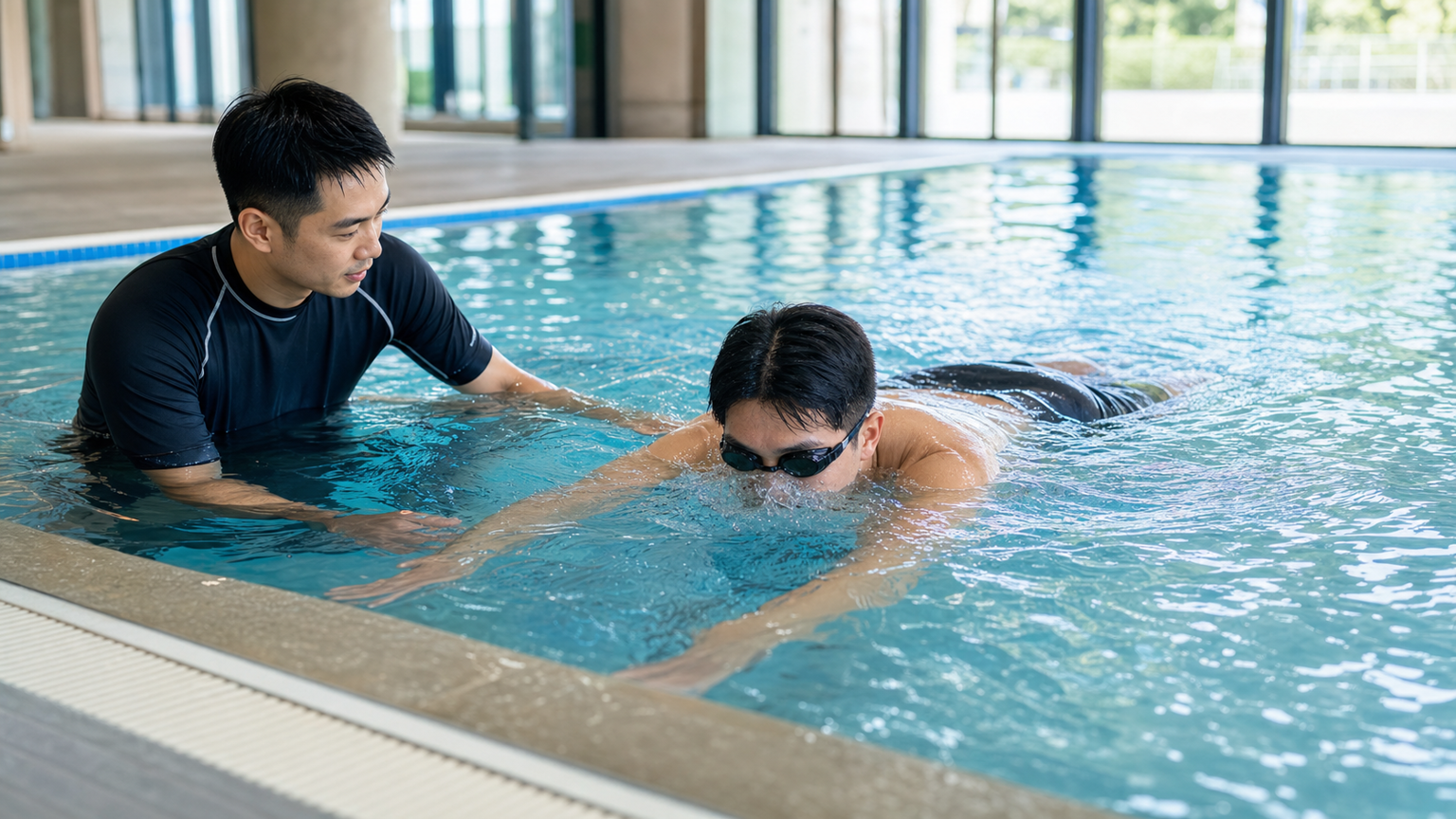
Taking at least 4–8 lessons is strongly recommended. A professional coach can:
- Help you build correct movement patterns and avoid developing bad habits
- Give you targeted guidance on your weaknesses
- Provide a safe learning environment that speeds up overcoming fear
- Significantly shorten your learning time
Adult swim classes are offered at sports centers everywhere, typically costing NT$300–600 per session, with group classes being cheaper.
Debunking Common Myths
| Myth | Fact |
|---|---|
| Heavier people float more easily | Higher body fat does give more buoyancy, but thinner people can absolutely learn to float too |
| Adults’ bones are too stiff to learn | Swimming relies on technique and relaxation, not bone flexibility |
| You have to know how to dive to swim | Not true — many swimming skills can be practiced entirely at the surface |
| You must swim every day to improve | 2–3 times a week is plenty; overtraining actually increases injury risk |
Final Thoughts
Learning to swim is one of the best gifts you can give yourself. It’s not just a sport — it’s a life-saving skill. No matter how old you are, as long as you’re willing to take the first step, the water’s buoyancy will be there to catch you.
Pick a weekend, grab your swimsuit and goggles, and sign up for a trial class at your nearest pool. You’ll find that the world of water is far gentler than you imagined.
Related Reading
- A Beginner’s Guide to Swimming: How a Complete Non-Swimmer Adult Can Learn Freestyle in 8 Weeks
- Psychological Barriers to Learning Swimming as an Adult: A Gradual Approach to Overcoming Fear of Water
- Common Frustrations for Swimming Beginners: Solutions for Fear of Water, Swallowing Water, and Technique Plateaus
- The Developmental Order of the Four Swimming Strokes for Teens: Which Stroke to Master First
一日北高常見問題大集合 | 攻略 | 路線 | 訓練 | 補給 | 自行車 單車 | 一日雙城 | 雙塔 | TWB北高360 | 屁股痛
6 年前
滑雪新手們慘摔學習全紀錄(請開字幕),滑雪好好玩 | Snowboard + Ski | 岩原 スキー場 | 滑雪APP使用 | GoPro Max
6 年前
一日北高/長距離團騎 常見問題補充篇 / 組團或跟團的眉角 / 壯車友容易被瘦車友慢性拉爆 / 原來屁股痛可能是這個原因...? / 風場配速法 / 公路車 / CT Yeh
2 年前
一日北高前的高裝檢 | 北高 360 | 挑戰11小時的裝備 | 一日雙塔 | 補給
6 年前
教學) 如何做出專業 慢動作 影片 Slow Motion 120fps GoPro 7 ActionCam AX700 A99II
7 年前
[教學] Premiere 影片 手震 修正 教學 防抖 單眼 影像 GoPro 穩定 Video Stabilization
8 年前
單車 一日北高 ( 雙城 ) 肥宅雙人瘋狂行 紀錄片 REACTO
10 年前
CT 喇低賽) 武嶺牽車 才是王道 西進牽車四小時內秘訣 攝手位置 如何判斷 防抽筋小秘訣
7 年前