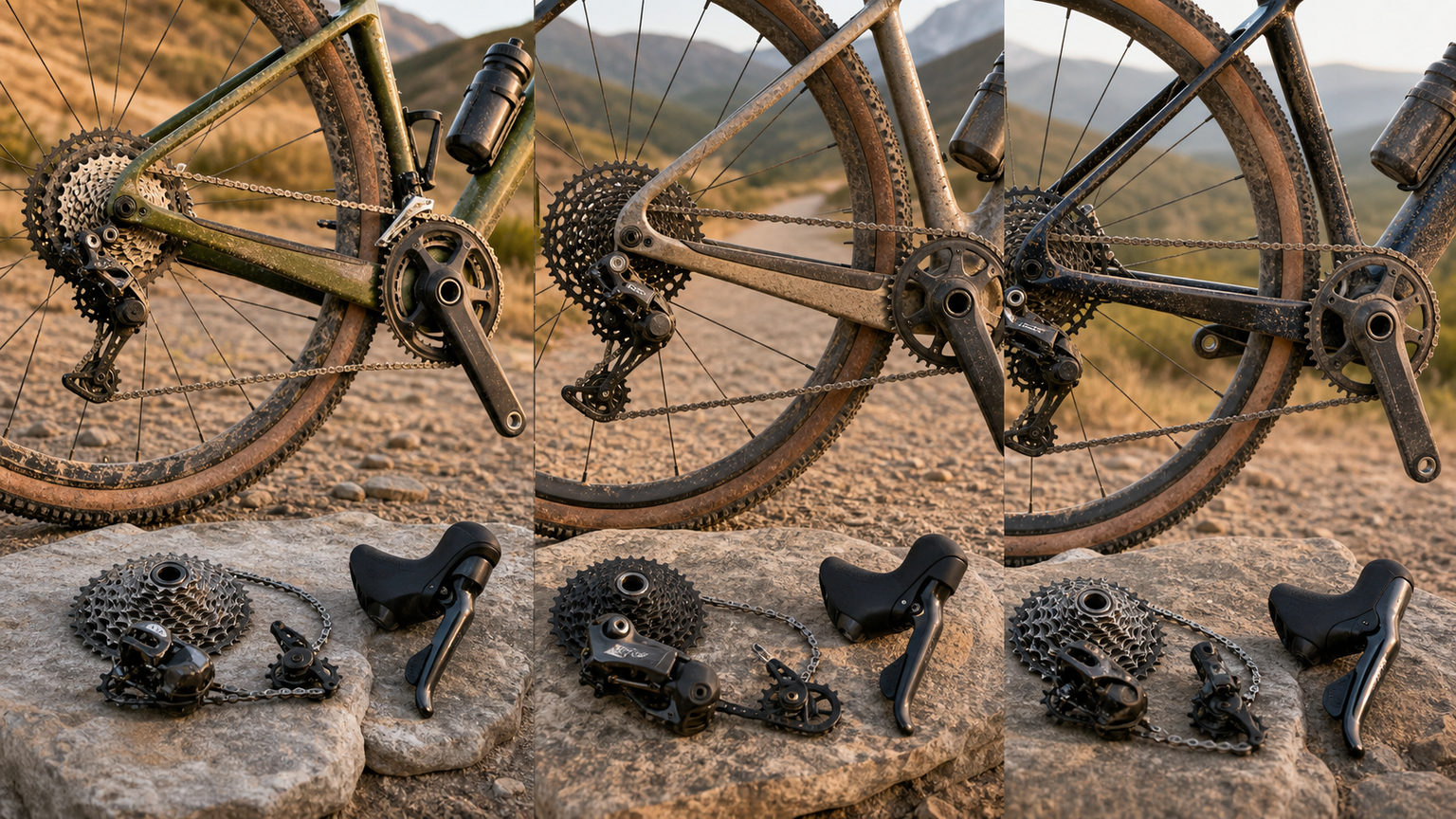
Gravel Groupset Showdown: Shimano GRX vs SRAM XPLR vs Campagnolo Ekar
The drivetrain is the heart of any gravel bike, directly shaping riding efficiency, handling feel, and long-term reliability. The three major drivetrain makers - Shimano, SRAM, and Campagnolo - have all released dedicated gravel groupsets, yet their design philosophies and real-world performance diverge in meaningful ways. This article offers a comprehensive, in-depth comparison.
Overview of the Three Groupsets
Shimano GRX Series
Tiers: GRX Di2 (electronic) / GRX 820 (mechanical, 12-speed) / GRX 610 (mechanical, 12-speed entry-level)
Design philosophy: Built on the foundation of Shimano’s road groupsets (105/Ultegra), specifically optimized for gravel riding. Offers both 1x and 2x configurations, making Shimano the only one of the three brands still seriously championing 2x gravel systems.
Key features:
- A unique Sub Brake Lever mounted on top of the handlebar, providing an extra braking position
- The 2x system delivers the widest gear range of the three
- Di2 electronic shifting offers extremely precise and consistent shift performance
- The Shadow RD+ rear derailleur includes a stabilizing clutch mechanism that prevents chain slap over rough terrain
SRAM XPLR Series
Tiers: Red XPLR AXS (top-tier) / Force XPLR AXS (high-end) / Rival XPLR AXS (mid-range)
Design philosophy: 1x-only, paired with a wide-range cassette to cover all terrain. Every tier is electronic and wireless (AXS system) - there is no mechanical shifting option.
Key features:
- Fully wireless design makes installation and maintenance remarkably simple
- Singular focus on 1x means all R&D resources go into optimizing a single-chainring system
- The AXS system allows button functions to be customized (for example, controlling a dropper post)
- Lower overall weight
Campagnolo Ekar
Tier: Ekar (a single tier, 13-speed)
Design philosophy: A distinctly Italian approach - a 1x 13-speed system, currently the only 13-speed gravel drivetrain on the market. Purely mechanical, with no electronic version available.
Key features:
- The 13-speed cassette offers the most cogs and the tightest gear steps
- Available in 9-42T or 10-44T cassette ranges, the widest gear coverage among 1x systems
- Lightweight design with a highly competitive total groupset weight
- A purely mechanical system that never needs charging
Gear Range Comparison
This is one of the most practical considerations when choosing a groupset.
1x System Gear Range
| Groupset | Chainring | Cassette | Total Range | Lowest Gear | Highest Gear |
|---|---|---|---|---|---|
| Shimano GRX 1x | 40T | 11-51T | 464% | 0.78 | 3.64 |
| SRAM XPLR | 40T | 10-44T | 440% | 0.91 | 4.00 |
| SRAM XPLR (new) | 40T | 10-52T | 520% | 0.77 | 4.00 |
| Campagnolo Ekar | 40T | 9-42T | 467% | 0.95 | 4.44 |
| Campagnolo Ekar | 40T | 10-44T | 440% | 0.91 | 4.00 |
2x System Gear Range (Shimano GRX only)
| Chainrings | Cassette | Total Range | Lowest Gear | Highest Gear |
|---|---|---|---|---|
| 48/31T | 11-36T | 506% | 0.86 | 4.36 |
Gear Range Analysis
Climbing capability (lower is better):
Shimano GRX 1x (40/51 = 0.78) and SRAM’s newer cassette (40/52 = 0.77) offer the best climbing gears. For Taiwan’s steep gravel climbs, a low bailout gear is essential.
Top-end speed (higher is better):
Campagnolo Ekar’s 40/9 = 4.44 leads the pack by a wide margin, making it far less likely you’ll “spin out” on descents or with a tailwind.
Gear step spacing (tighter is better):
Campagnolo’s 13 speeds give it an inherent edge in gear spacing. Both SRAM’s and Shimano’s 12-speed cassettes have larger jumps at the low-gear end, making shift rhythm feel slightly less smooth.
Shifting Feel Comparison
Shimano GRX
Mechanical version: Shimano’s trademark precision and smoothness. Lever throw is moderate with clear tactile feedback. The thumb-down-to-downshift, finger-push-to-upshift logic feels intuitive. In muddy or cold conditions, the mechanical system’s reliability is beyond reproach.
Di2 electronic version: A light button tap completes the shift - no lever throw required. Shifting is extremely fast, especially impressive during multi-gear consecutive shifts. A semi-automatic mode (Synchro Shift) can be configured so front and rear shifting coordinate automatically.
SRAM XPLR AXS
Wireless electronic shifting uses a button-based logic: the right lever button upshifts, the left lever button downshifts, and pressing both simultaneously switches to a specified gear. The control logic is clean and easy to learn.
Shift speed is slightly slower than Shimano Di2, but the difference is negligible in everyday riding. AXS’s biggest advantage is the ease of installation and clean aesthetics that come from a fully wireless design.
Campagnolo Ekar
Purely mechanical operation with Campagnolo’s signature thumb-lever design. The shifting feel sits somewhere between Shimano and SRAM and takes some getting used to. The benefit of 13 speeds is that each step is smaller, letting you dial in the exact gear for the terrain and gradient at hand more precisely.
Ekar’s rear derailleur uses a unique spring-tension design that delivers excellent chain stability over rough terrain.
Braking System Comparison
All three brands’ hydraulic disc brakes deliver plenty of stopping power; the differences mainly lie in feel and adjustability.
Shimano GRX
- Strong, linear braking power
- Clear tactile feedback, allowing precise modulation of braking force
- Consistent bite point that doesn’t shift as pads wear
- Independent free-stroke adjustment for front and rear
SRAM XPLR
- Bleeding Edge technology makes bleeding the brakes much simpler
- Ample braking power, but tactile feedback lags slightly behind Shimano
- A more noticeable “on/off” feel when the pads contact the rotor (less linear than Shimano)
- Braking feel at the Rival tier is noticeably behind Force/Red
Campagnolo Ekar
- Extremely refined feel - Italian build quality shines through here
- Moderate braking power, never overly aggressive
- The single-piston design makes pad-gap adjustment simpler
- The most consistent feel in cold winter temperatures
Weight Comparison
Calculated for a complete 1x groupset (excluding wheels):
| Groupset | Tier | Weight |
|---|---|---|
| SRAM Red XPLR AXS | Top-tier | ~1,620g |
| Campagnolo Ekar | Top-tier (only tier) | ~1,780g |
| Shimano GRX Di2 | High-end | ~1,850g |
| SRAM Force XPLR AXS | High-end | ~1,920g |
| Shimano GRX 820 mechanical | High-end | ~1,980g |
| SRAM Rival XPLR AXS | Mid-range | ~2,150g |
Maintenance Cost and Convenience
Routine Maintenance
Shimano GRX mechanical: The simplest to maintain. Shift cables need periodic replacement (roughly once a year), and brake fluid needs periodic replacement (roughly once a year). No charging required, no battery anxiety.
Shimano GRX Di2: Shifting itself is maintenance-free (electronic system), but periodic charging is required. Battery life is roughly 800-1,000 km, depending on shift frequency. Brake maintenance is the same as the mechanical version.
SRAM XPLR AXS: Front and rear derailleurs each have their own battery, lasting roughly 600-800 km. Batteries are either CR2032 coin cells or rechargeable lithium batteries depending on the tier. The wireless design makes swapping and servicing very convenient.
Campagnolo Ekar: A purely mechanical system with a maintenance pattern similar to Shimano’s mechanical groupsets. However, Campagnolo parts are harder to find in Taiwan, which can push maintenance costs higher.
Considerations for Long-Distance Riding
Best for bikepacking: Shimano GRX mechanical or Campagnolo Ekar. Purely mechanical systems eliminate battery anxiety on long trips, and compatible replacement parts are easier to find in remote areas.
Best for daily riding: SRAM XPLR AXS or Shimano Di2. Electronic shifting’s precision and convenience deliver the best experience for everyday use.
Practical Considerations for the Taiwan Market
Price Ranges (Taiwan market reference, 2024-2025)
| Groupset | Price Range (NTD) |
|---|---|
| Shimano GRX 610 mechanical | 15,000-20,000 |
| Shimano GRX 820 mechanical | 22,000-28,000 |
| SRAM Rival XPLR AXS | 28,000-35,000 |
| Shimano GRX Di2 | 38,000-48,000 |
| SRAM Force XPLR AXS | 40,000-50,000 |
| Campagnolo Ekar | 38,000-48,000 |
| SRAM Red XPLR AXS | 65,000-80,000 |
Parts Availability
- Shimano: Easiest to find in Taiwan - nearly every bike shop keeps stock
- SRAM: Larger shops typically carry stock; smaller shops may need to order
- Campagnolo: The hardest to find, usually requiring a special order with longer lead times
Final Recommendations
Best All-Around Choice: Shimano GRX 820 (mechanical, 12-speed)
The best balance of performance, price, maintenance convenience, and parts availability. The 2x option offers maximum gear flexibility, and the mechanical system is reliable in any condition. Suited to most gravel riders.
Best Tech Experience: SRAM Force XPLR AXS
Wireless electronic shifting delivers the strongest sense of technology and ease of use. The AXS ecosystem’s expandability (dropper post control, customizable buttons) is hard for other brands to match. Suited to riders who want the latest tech and a clean setup.
Best Distinctive Choice: Campagnolo Ekar
Tight 13-speed gear steps and the unique appeal of an Italian brand. Purely mechanical feel and reliability. Suited to riders who value gear precision and brand character.
Best Entry Point: Shimano GRX 610
The lowest barrier to entry, sharing core technology with GRX 820. Parts are inexpensive and easy to find, making it the ideal springboard into the gravel world.
Conclusion
There’s no single right answer when choosing a groupset. All three brands’ gravel groupsets have matured to a highly refined stage, and the real differences come down to personal preference and use case. If you get the chance, test ride bikes equipped with each groupset and let your fingers and legs feel the difference - that will tell you more than any written description ever could.
Keep one principle in mind: the best groupset is the one whose maintenance costs you can comfortably afford, and the one you completely forget is there while you ride.
Related Reading
SRAM FORCE E1 首發!/ 改成短腿了 / 煞車升級有感嗎? / TIME ADH 變速大升級 / 公路車 / CT Yeh
1 年前
Garmin Edge 1050 旗艦車錶 全台首測!/ 環法冠軍指定 / 對比Edge 1040改進哪些? / 公路車 / CT Yeh
2 年前
RAMP FTP Test 直播 究竟能撐到幾瓦 訓練台 Gravat Zwift
6 年前
Garmin Edge 1040 重大韌體更新!! / 1050功能全下放!? / 坡度反應變快了嗎?/ 快速對比實測 / 公路車 / CT Yeh
1 年前
訓練台體驗) 2019台北自行車展 三大家 訓練台體驗 Tacx Neo Flux 2 Xepdo Apx Wahoo Kickr
7 年前
Wilier 盤爺車大升級! SRAM RED D1 升級到 RED E1 新版,爽度、重量有差嗎?/ 你以為只有改這樣嗎XD? / 鈔能力 / 公路車 / CT Yeh
1 年前
首發 Garmin Edge 850 車錶 深入開箱!? / 公路車 / CT Yeh
9 個月前
超開放的自行車錶!可以玩遊戲裝APP!?/ SRAM合併的 Hammerhead Karoo深入開箱!/ 即時爬坡偵測 / 全球導航地圖 / Garmin Bryton / CT Yeh
1 年前