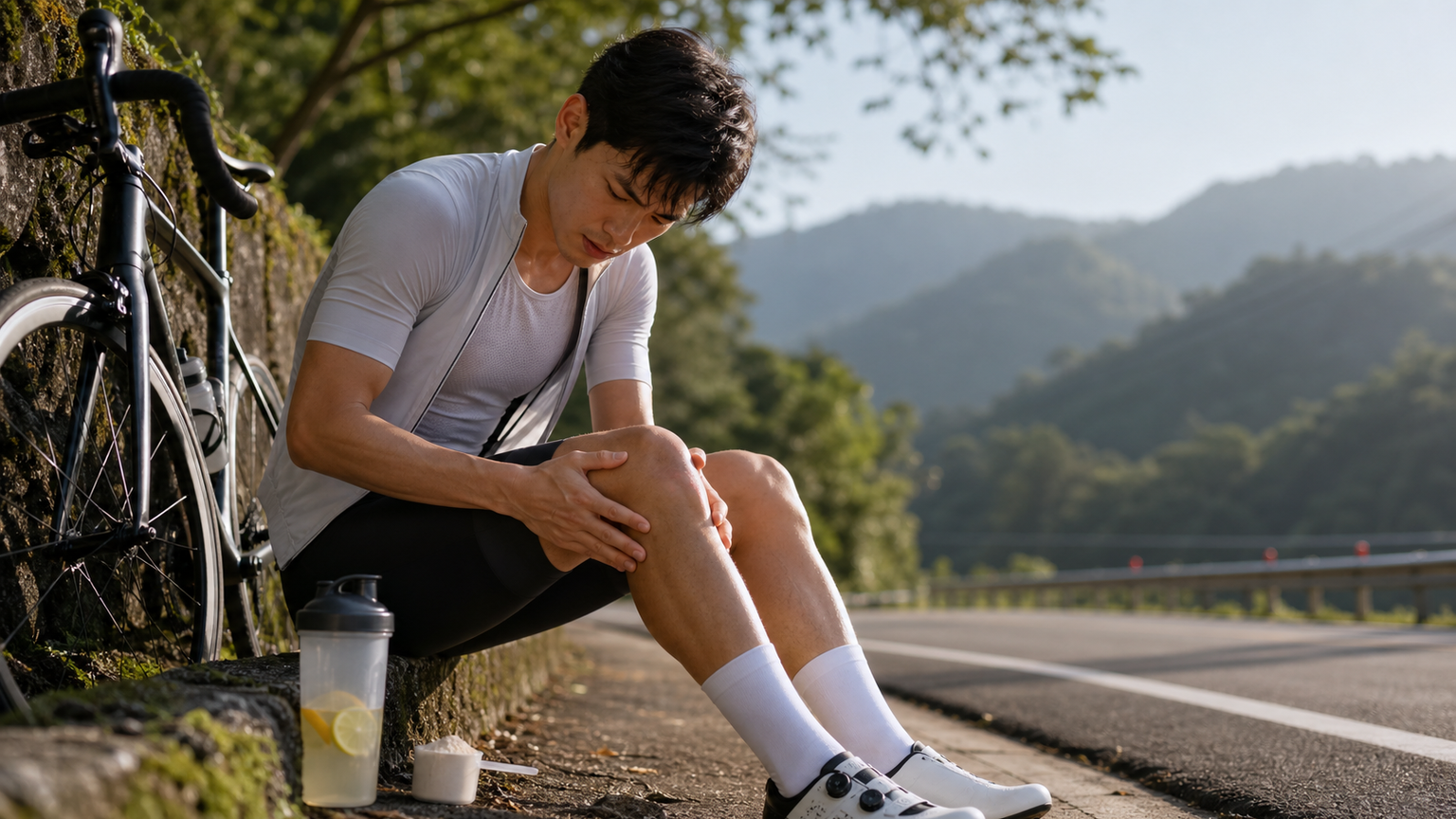
Collagen Peptides and Joint Health: A Long-Term Investment for Cyclists
Introduction
Cycling is considered a relatively joint-friendly sport, but the long-term repetitive motion, stress from aerodynamic positions, and occasional crash impacts still cause cumulative wear and tear on joints, tendons, and ligaments. Collagen peptides, as a supplement of the primary structural protein in connective tissue, have recently transformed from a beauty product into a new focus in sports nutrition.
The Basic Science of Collagen
What Is Collagen?
Collagen accounts for 25-35% of total body protein and is the main structural protein of connective tissue. In exercise-related tissues:
- Joint cartilage: Composed primarily of Type II Collagen
- Tendons and ligaments: Composed primarily of Type I Collagen
- Bone: Collagen provides the elastic framework for bone
- Muscle fascia: Connective tissue that wraps and connects muscles
Digestion and Absorption of Collagen Peptides
Collagen peptides (also known as hydrolyzed collagen) are small molecular fragments produced through enzymatic hydrolysis, typically with a molecular weight of 2000-5000 Daltons (Da). These small peptide fragments have a much higher absorption rate than intact collagen protein.
Research shows that after oral ingestion of collagen peptides:
- They are rapidly absorbed in the small intestine
- They enter the bloodstream in the form of dipeptides and tripeptides
- In particular, proline-hydroxyproline (Pro-Hyp) and hydroxyproline-glycine (Hyp-Gly) fragments can remain in the blood for several hours
- These peptide fragments preferentially accumulate in connective tissue
How Do Collagen Peptides Work?
The function of collagen peptides goes beyond simply “providing raw materials”; more importantly, they act as signaling molecules:
- Stimulating fibroblasts: Promoting fibroblasts to produce new collagen and other extracellular matrix components
- Activating the mTOR pathway: Promoting protein synthesis in tendon and ligament tissue
- Anti-inflammatory effects: Certain collagen peptide fragments can inhibit inflammatory factors
- Stimulating chondrocytes: Promoting the synthesis of proteoglycans in joint cartilage
Sources of Joint Stress for Cyclists
Knee Joint
The knee joint is the most common problem area for cyclists. Although the force generated with each pedal stroke is far lower than the impact of running, the repetitive motion of 5000-6000 times per hour still creates significant cumulative load.
Common issues include:
- Patellofemoral pain syndrome (anterior knee pain)
- Iliotibial band syndrome (lateral knee pain)
- Patellar tendinitis (pain below the kneecap)
Cervical and Lumbar Spine
Maintaining an aerodynamic position for extended periods (especially on time trial and triathlon bikes) places sustained pressure on the intervertebral discs and facet joints of the cervical and lumbar spine.
Wrists and Hands
Pressure on the handlebars and transmitted vibration can lead to carpal tunnel syndrome and ulnar nerve compression.
Achilles Tendon
The repeated plantar flexion during the pedal stroke, especially in high-cadence training, places stress on the Achilles tendon.
Scientific Research Evidence
Keith Baar’s Breakthrough Research
Professor Keith Baar at the University of California, Davis, is a pioneer in research combining collagen supplementation with exercise. His series of studies revealed key findings:
2017 Landmark Study:
- Subjects ingested 15 grams of gelatin (rich in collagen) + 50 mg of vitamin C 60 minutes before exercise
- Followed by 6 minutes of jump rope exercise
- Results: The biomarker for collagen synthesis (PINP) increased 2-fold
- Key insight: The timing of combining exercise and nutrition is critical
Joint Cartilage Research
- Clark et al. (2008): 147 athletes supplementing with collagen hydrolysate for 24 weeks showed significantly reduced joint pain scores
- Zdzieblik et al. (2017): Athletes supplementing with 5 grams of specific collagen peptides daily for 12 weeks experienced a 38% reduction in activity-related knee pain
- Dressler et al. (2018): Long-term collagen peptide supplementation increased knee cartilage thickness
Tendon and Ligament Research
- Praet et al. (2019): Collagen peptide supplementation accelerated recovery from Achilles tendinopathy
- Shaw et al. (2017): Vitamin C combined with gelatin supplementation enhanced the mechanical properties of engineered ligament tissue
Bone Health
- Konig et al. (2018): Postmenopausal women supplementing with 5 grams of collagen peptides daily for 12 months showed a 6.7% increase in bone density
- Although this study did not involve athletes, it holds reference value for older and female cyclists
Optimal Supplementation Strategies
The Baar Protocol (Pre-Exercise Supplementation)
Based on Keith Baar’s research, the optimal supplementation protocol is:
- Timing: 30-60 minutes before exercise
- Dose: 15 grams of collagen peptides (or gelatin)
- Combination: 50 mg of vitamin C (approximately the amount in half a kiwi)
- Exercise stimulus: Perform exercise involving the target tissue after supplementation
The role of vitamin C is critical—it is a necessary cofactor for the hydroxylation of proline and lysine in collagen synthesis.
Daily Supplementation Protocol
| Time | Supplement Content | Purpose |
|---|---|---|
| Before breakfast | 10-15g collagen peptides + vitamin C | Baseline connective tissue repair |
| 30-60 minutes before training | 15g collagen peptides + vitamin C | Maximize exercise-induced collagen synthesis |
| Before bed (optional) | 10g collagen peptides | Support overnight repair |
Key Points for Choosing Collagen Products
- Degree of hydrolysis: Choose hydrolyzed collagen with a molecular weight of 2000-5000 Da
- Source: Bovine hide/bone source (primarily Type I) is suitable for tendons and ligaments; chicken sternal cartilage source (primarily Type II) is suitable for joint cartilage
- Purity: Choose third-party tested products to confirm no heavy metal contamination
- Additives: Prioritize products that already contain vitamin C, or combine them yourself
Collagen vs. Whey Protein
A common question is: Can collagen replace whey protein?
The answer is no. The two have different functions:
- Whey protein: Rich in leucine, it is the best choice for stimulating muscle protein synthesis (MPS)
- Collagen: Rich in glycine, proline, and hydroxyproline, it specifically supports connective tissue synthesis
Collagen’s amino acid profile is incomplete (it lacks tryptophan) and cannot effectively stimulate muscle growth. The best strategy is to use both:
- Before training: Collagen peptides (connective tissue)
- After training: Whey protein (muscle recovery)
Complementary Measures: Comprehensive Joint Protection
Collagen supplementation is part of an overall joint health strategy. Other important measures include:
Bike Fitting
Incorrect bike setup is the leading cause of knee problems. Investing in a professional bike fitting is more effective than any supplement.
Strength Training
Regular lower-body strength training (squats, split squats, deadlifts) can enhance tendon and ligament strength and is the cornerstone of injury prevention.
Progressive Training Load Increase
Connective tissue adapts 2-3 times slower than muscle. Follow the principle of increasing weekly training volume by no more than 10%.
Other Nutrients
- Vitamin C: Essential cofactor for collagen synthesis
- Vitamin D: Supports bone health and immune function
- Omega-3 fatty acids: Anti-inflammatory effects
- Glucosamine and chondroitin: Although the evidence is not as strong as for collagen peptides, some people still report subjective improvement
Conclusion
Collagen peptide supplementation is a joint health strategy backed by a growing body of scientific evidence. For cyclists, it represents a relatively low-cost long-term investment—the health of joints and tendons won’t show noticeable differences in the short term, but after 5 or 10 years, the gap between riders who consistently maintain their joints and those who neglect joint health will be stark.
Remember Keith Baar’s golden formula: Collagen peptides + Vitamin C + 30-60 minutes before exercise = maximized connective tissue adaptation.
Related Reading
- Protein Intake for Cyclists: A Complete Guide to Muscle Recovery and Fitness Maintenance
- Protein Requirements for Cyclists: The Science of Muscle Maintenance and Repair
- Bone Health for Cyclists: The Impact of Low-Impact Exercise on Bone Density and Supplementation Strategies
- Bone Bank: Athletes’ Battle to Preserve Bone Density
3D 列印車褲墊 / 舒適改善? / 無痕 x 分區壓縮 / ATK & Decider系列 / JE22黑科技 / #公路車 #CTYEH
11 個月前
鉅齒紋輪組!? ControlTech MEG-T50 EVO 碳纖維幅條輪組/ 功率對比實驗 / 公路車 / CT Yeh
2 年前
CT暗黑廚房) 車友必備 宇宙無敵鮮蚵湯 幫助訓練恢復 天然食補 好市多 超肥鮮蚵 破PR
7 年前
2025 自行車錶排行榜 兩萬車友大數據 / Garmin Bryton 排名會大洗牌嗎? / 全新的碼表前身分析 /公路車 / CT Yeh
1 年前
滑雪新手們慘摔學習全紀錄(請開字幕),滑雪好好玩 | Snowboard + Ski | 岩原 スキー場 | 滑雪APP使用 | GoPro Max
6 年前
靠單車減肥35公斤 心得分享與整理
7 年前
#PUSHBIKE 原來這麼好玩! 小朋友 滑步車 初體驗 超可愛
6 年前
一日北高/長距離團騎 常見問題補充篇 / 組團或跟團的眉角 / 壯車友容易被瘦車友慢性拉爆 / 原來屁股痛可能是這個原因...? / 風場配速法 / 公路車 / CT Yeh
2 年前