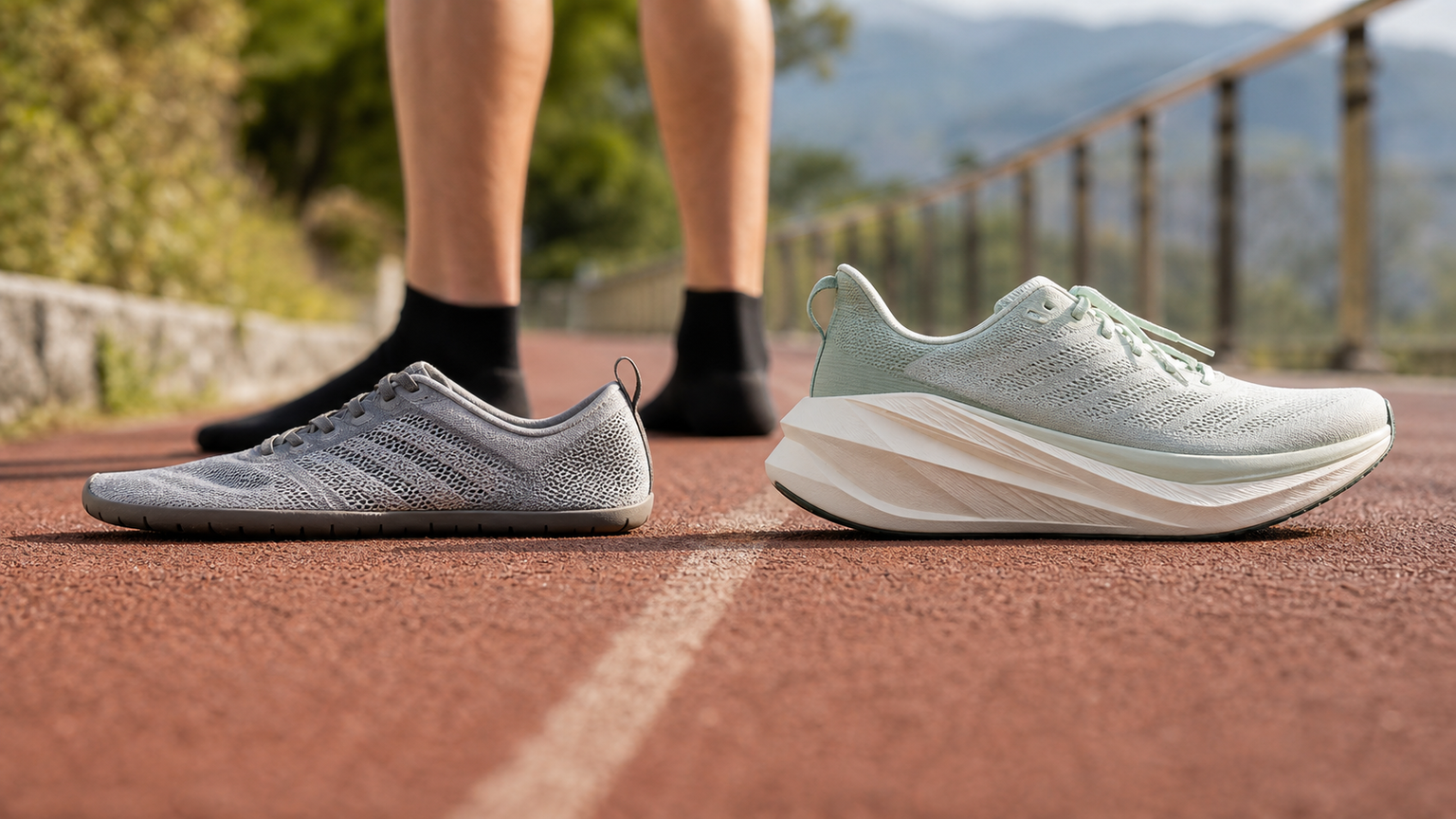
Minimalist vs. Maximalist Running Shoes: The Science and How to Choose
One of the most enduring debates in running shoe design is the tug-of-war between minimalism and maximalism. In 2009, the book Born to Run ignited the barefoot running craze, and Vibram FiveFingers became a sensation. A decade later, Hoka’s thick-soled shoes conquered the ultramarathon world. Now, carbon-plated maximalist shoes are the tool of choice for breaking world records. So which philosophy is actually right? This article uses scientific research and real-world experience to untangle the debate.
What Are Minimalist Running Shoes?
Definition and Characteristics
Minimalist running shoes aim to replicate the barefoot experience. The core design principle is minimizing the shoe’s interference with your natural running gait.
Typical characteristics:
- Heel-to-toe drop: 0-4mm (versus 10-12mm for traditional running shoes)
- Midsole thickness: thin (10-18mm)
- Weight: extremely light (100-180g)
- No motion control or arch support
- Wide toe box that lets toes splay naturally
Representative models:
- Vibram FiveFingers
- Merrell Vapor Glove 6
- Xero Shoes HFS II
- New Balance Minimus
The Theoretical Basis for Minimalism
Proponents argue that:
- Evolutionary design: The human foot evolved over millions of years to run barefoot, and modern running shoes disrupt this natural biomechanics.
- Strengthening foot muscles: Minimalist shoes let the intrinsic foot muscles fully engage, strengthening the arch’s natural support capacity.
- Improved proprioception: A thin sole provides more ground feedback, helping runners naturally adjust their gait and favor a forefoot or midfoot strike.
- Reduced impact force: Barefoot runners naturally adopt a softer landing, lowering peak impact forces with each step.
What Are Maximalist Running Shoes?
Definition and Characteristics
The design philosophy behind maximalist running shoes is using more cushioning material to protect runners and improve efficiency.
Typical characteristics:
- Midsole thickness: 30-40mm (or even thicker)
- Weight: moderately heavy (220-300g)
- Abundant cushioning foam
- Rocker geometry
- Some models feature carbon plates or propulsion plates
Representative models:
- Hoka Bondi 8 / Clifton 9
- Nike Vaporfly 3 / Alphafly 3
- ASICS Gel-Nimbus 26
- New Balance Fresh Foam More v4
The Theoretical Basis for Maximalism
Proponents argue that:
- Modern surfaces are unnatural: We run on asphalt and concrete, and these hard surfaces are what’s actually “unnatural,” requiring extra cushioning protection.
- Energy return: High-tech foams and carbon plates store and return energy, improving running economy.
- Reduced muscle fatigue: Ample cushioning reduces the impact the leg muscles must absorb, delaying fatigue.
- Records don’t lie: In recent years, virtually every major distance world record has been broken in a maximalist carbon-plated shoe.
What Does the Science Say?
Injury Risk
Research on minimalist shoes:
A 2014 study published in Medicine & Science in Sports & Exercise found that runners who switched abruptly to minimalist shoes had a significantly increased risk of bone stress injuries, particularly in the metatarsals and calcaneus. However, another study showed that runners who transitioned gradually into minimalist shoes developed noticeably stronger plantar fascia and calf muscles.
Research on maximalist shoes:
A 2020 study found that runners in maximalist shoes performed worse on ankle stability tests and showed higher lateral instability. But other research has shown that maximalist shoes effectively reduce impact loading on the shin and knee.
Conclusion: Neither shoe type is “zero risk” — they simply shift stress to different body parts. Minimalist shoes increase the load on the feet and calves, while maximalist shoes increase the risk of ankle instability.
Running Economy
There’s no question that carbon-plated maximalist shoes win on running economy. Multiple studies consistently show that carbon-plated shoes like the Nike Vaporfly series reduce energy expenditure by 4-6%. This effect has been observed in both elite and recreational runners.
That said, minimalist shoe advocates point out that long-term training in minimalist shoes can improve running form, which enhances “intrinsic” running efficiency rather than relying on external assistance from the shoe.
Foot Health
A six-month study found that subjects who wore minimalist shoes showed increased arch height and larger cross-sectional area of the intrinsic foot muscles. This suggests minimalist shoes genuinely strengthen foot musculature. But the injury risk during the transition period is also real.
Between the Extremes: A Practical Approach
It’s Not All or Nothing
The wisest approach is to avoid either extreme and instead choose flexibly based on your training purpose:
- Daily training: Choose a moderately cushioned shoe (20-30mm midsole) — extremes aren’t necessary
- Foot strength training: Do 1-2 easy runs per week in thinner-soled shoes on grass or soft ground
- Speed work and racing: Use a responsive lightweight shoe or carbon-plated shoe
- Recovery runs: Use a well-cushioned maximalist shoe to protect tired feet
A Gradual Approach to Minimalism
If you want to try the benefits of minimalist shoes, be sure to follow these principles:
- Transition over at least 3-6 months
- Start with 1-2 short runs per week (2-3km)
- Practice on grass or soft ground
- Pair it with foot strength training (towel scrunches, resistance band exercises)
- Listen to your body — stop immediately at any persistent pain
Making the Most of Maximalist Shoes
Maximalist shoes are especially valuable in the following situations:
- High-mileage training blocks (to reduce cumulative fatigue)
- Race day (to maximize performance)
- Return-to-running after injury (extra protection)
- Long-distance ultramarathons (to delay muscle fatigue)
Future Trends
Interestingly, the running shoe industry is now blending the best of both philosophies. The 2025 trend is incorporating more natural foot shape into maximalist designs — for example, Altra’s zero-drop maximalist shoes and Topo Athletic’s wide-toe-box cushioned shoes. Carbon-plated shoes are also beginning to focus on lower drop heights and more natural forefoot flex.
Conclusion
There’s no absolute winner in the minimalist-versus-maximalist debate. The wonder of the human body lies in its ability to adapt to a variety of stimuli, and the best strategy is to provide diverse stimuli. Treat minimalist shoes as a foot-training tool and maximalist shoes as protective gear for racing and high-load days, and find your own optimal balance between the two. Remember: no shoe can replace good running form and a gradually progressive training plan.
Related Reading
Nepest NOVA 碳條輪組:輕量、空力、舒適一次滿足!/ 公路車 / CT Yeh
7 個月前
再快都跟的上!? 單車跟隨攝影機之王 HOVERAir X1 PROMAX 全面實測 / 唯一!8K畫質&自行車專用模式和跟蹤信標&前後避障 / DJI Neo 可參考/ 公路車 / CT Yeh
1 年前
單車 重低音 藍芽喇叭 音質實測 SoundBot SB525 Real Sound Test
8 年前
大家都在開箱的...單車用藍芽對講耳機真的有幫助嗎? SENA BiKom 20 長距離旅遊 & 海鷗繞圈賽 實際體驗心得 / 公路車 / CT Yeh
9 個月前
Garmin Edge 540/840 Solar 台灣首發開箱!完整車錶功能 道路實測 / ClimbPro 爬坡提示超級牛 / 強大續航實測 / 公路車 / CT Yeh
3 年前
單車元宇宙新霸主?TrainingPeaks Virtual 實測 / Zwift 完美平替? 還是超越?/ 有台灣國旗!前身 indieVelo / 公路車 / CT Yeh
1 年前
Vision Metron RS 37碳幅條輪組 (非SL)官網沒有的 低調開箱 / 這重量太銷魂了 / 公路車 / CT Yeh
6 個月前
CT 喇低賽) 單車 比賽總是沒照片? 攝影師的觀點大公開 姿勢就是力量! 請加速1.25倍收看
7 年前