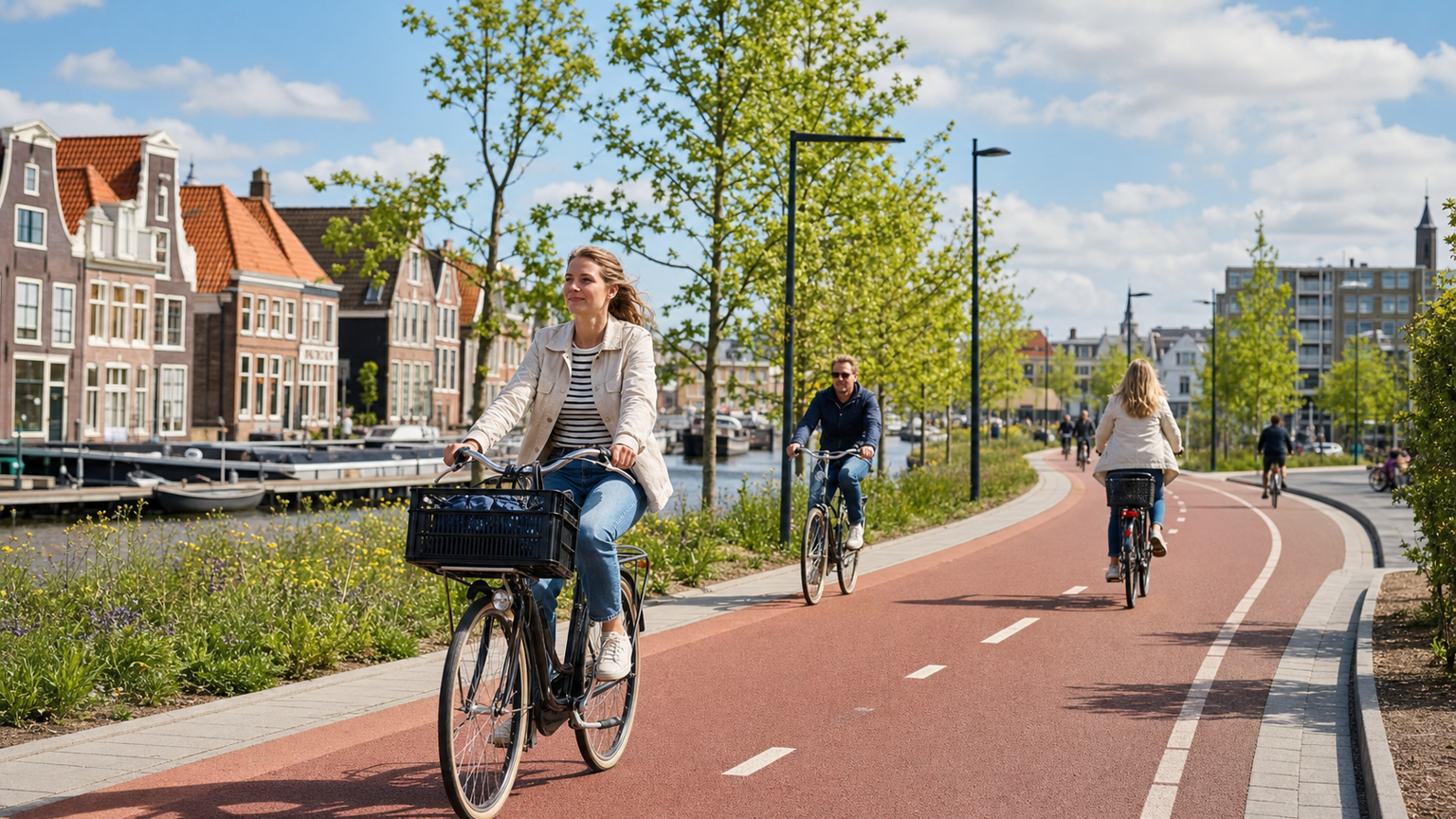
Dutch Cycling Utopia: Experiencing the World’s Most Bike-Friendly Culture
The Numbers Speak for Themselves
Before diving into the cycling routes in the Netherlands, let’s look at some astonishing figures:
- The Netherlands has a population of about 17.8 million, but over 23 million bicycles nationwide
- More than 35,000 kilometers of dedicated bike paths are paved across the country
- The Dutch cycle an average of 2.9 kilometers per day
- 38% of all trips in central Amsterdam are made by bicycle
- Over 15 billion kilometers are cycled nationwide every year
Behind these numbers is a country that has seamlessly integrated the bicycle into urban planning, transportation systems, and daily life. When you come to the Netherlands, you’re not just cycling—you’re experiencing what may be the most ideal form of mobility humans have ever achieved.
The Core of Dutch Cycling Culture
Bicycles Are Not a Second-Class Mode of Transport
In many countries, bicycles are seen as “a means of transport for those who can’t afford a car” or “a weekend leisure activity.” But in the Netherlands, the opposite is true. The Dutch Prime Minister cycles to work, doctors cycle to hospitals, lawyers cycle to court in suits, and mothers use cargo bikes (Bakfiets) to take their kids to school. Cycling requires no professional cycling kit, no helmet (not mandatory under Dutch law), and no special equipment—you just hop on and pedal.
Infrastructure Is Key
The Netherlands’ bike-friendliness is no accident; it’s the result of decades of deliberate urban planning. In the 1970s, the Netherlands also experienced a car-first era, but a series of child traffic deaths sparked the “Stop de Kindermoord” (Stop the Child Murder) movement, which forced the government to completely overhaul its transport policy.
Today, Dutch cycling infrastructure is a global benchmark:
- Separated lanes: Bike paths are fully separated from car lanes, with their own traffic lights and intersection designs
- Priority: At many intersections, cyclists have the right of way
- Parking facilities: Underground parking garages next to major stations can hold thousands of bicycles
- Repair stations: Free bike pumps and basic repair stations are available along the roadside
Must-Ride Routes
LF Icoonroute: Classic Long-Distance Routes
The Netherlands’ national cycling network is extremely well-developed, with the most famous being the LF (Landelijke Fietsroutes, National Cycling Routes) system. Here are a few routes best suited for foreign visitors:
1. The IJsselmeer Loop (Rondje IJsselmeer)
- Distance: Approximately 300 kilometers
- Suggested duration: 4-5 days
- Difficulty: Beginner (almost entirely flat)
Lake IJsselmeer is the largest freshwater lake in the Netherlands, created from a former saltwater bay by the famous Afsluitdijk (Enclosure Dam). The loop around the lake is one of the most popular long-distance cycling routes in the Netherlands, passing through historic fishing villages, windmill clusters, sheep pastures on the dikes, and the 32-kilometer Afsluitdijk—cycling on the dam, with the North Sea’s waves on your left and the calm lake on your right, is a truly unique experience.
2. Windmills and Tulips Route (Bollenstreek)
- Distance: Approximately 50 kilometers
- Suggested duration: 1 day
- Difficulty: Beginner
- Best season: Mid-April to early May
Starting from Leiden, this route crosses the Netherlands’ most famous flower-growing region. April is tulip season, when entire fields are covered in red, yellow, purple, and pink tulips—a sight so spectacular it takes your breath away. The route passes Keukenhof, the world’s largest flower park.
3. The Eleven Cities Cycling Route (Elfstedentocht Fietsroute)
- Distance: Approximately 240 kilometers
- Suggested duration: 3-4 days
- Difficulty: Beginner to intermediate
This route originates from the famous “Eleven Cities Skating Tour”—a traditional race that can only be held when the canals freeze over in winter. The cycling version of the Eleven Cities route connects eleven historic towns in the province of Friesland, passing through typical Dutch pastoral scenery: canals, windmills, black-and-white dairy cows, and red-brick farmhouses.
City Cycling
Amsterdam
Cycling in Amsterdam is a unique experience. The old city center, surrounded by canals, has a dense spiderweb of bike lanes. You can ride through the Red Light District, past the Anne Frank House, and along the Herengracht (Gentlemen’s Canal) admiring 17th-century merchant mansions. But beware—bicycle traffic in Amsterdam is extremely heavy, and Dutch cyclists ride much faster than you might expect.
Utrecht
Considered by many experts to be the world’s best cycling city (surpassing Amsterdam), Utrecht has the world’s largest bicycle parking facility next to its station, accommodating 12,500 bikes. The city’s canals and university-town atmosphere make cycling even more enjoyable.
Bike Rental Information
Almost every train station in the Netherlands has OV-fiets rental services (requiring the Dutch public transport card, OV-chipkaart). For tourists, a more convenient option is the commercial rental shops in each city. Chain rental shops in Amsterdam like MacBike and Black Bikes offer various bike types, with daily rates around 10-15 euros.
If you want a road bike or plan a longer trip, you can rent good-quality touring bikes or e-bikes. Electric bikes (e-bikes) are extremely common in the Netherlands, especially suitable for travelers who want to enjoy long-distance cycling without getting too tired.
The Junction Navigation System (Knooppuntensysteem)
The Netherlands has a genius cycling navigation system: the junction system. The national cycling network is divided into hundreds of numbered junctions, each with signposts pointing to nearby junctions. You only need to plan the sequence of junction numbers before you set off, then simply follow the signs along the way. No phone navigation needed, no map reading—just follow the numbers.
The system’s website (routeplanner.fietsersbond.nl) lets you enter a start and end point, automatically plans the best cycling route, and lists the junction numbers you’ll pass along the way.
Food and Accommodation
The best refueling stops along cycling routes are the Netherlands’ “Pannenkoekenhuis” (pancake houses). These restaurants scattered across the countryside serve all kinds of Dutch pancakes (much larger and thinner than American-style pancakes), topped with syrup, cheese, or bacon—the perfect energy source for cycling.
For accommodation, besides regular hotels, the Netherlands has many B&Bs specifically catering to cycle tourists. These places, known as “Fietscafé” or bearing a “Cyclists Welcome” sign, typically offer secure bike storage, drying facilities, and hearty breakfasts.
Conclusion
Dutch cycling culture is not just a choice of transportation—it represents a set of social values: respect for people, care for the environment, and a commitment to urban livability. When you ride on Dutch bike paths, feeling the sense of safety and freedom that comes from being supported by an entire social infrastructure, you’ll sincerely wish: if only Taiwan could be like this too.
Take that feeling home with you—perhaps one day, our cities will also become cycling utopias.
Related Reading
- The Dutch Cycling Utopia: How the World’s Most Bike-Friendly City Was Built
- Dutch Cycling Infrastructure: The World’s Most Advanced Bicycle Urban Planning
- Report on the Dutch Cycling Paradise: The Social Structure Behind Every Dutch Person Owning 1.3 Bicycles
- The Social Impact of Cycling: How European Cities Reduced Transport Carbon Emissions Through Cycling Culture
荷蘭 Rapha 租公路車 騎 阿姆斯特丹 Amsterdam Rapha Cycling Club Bike Hiring
6 年前
[海外單車] 日本 茨城 霞之浦單車 銀杏 慢遊體驗
7 年前
公路車 | 塔塔加驚險員工旅遊 | 還好手腳快沒被抓交替!
5 年前
多到選擇障礙... 換個單車把帶想一個小時 / BTP / 編織&軟木特有材質超吸睛! / 公路車 / CT Yeh
1 年前
單車 一日北高 ( 雙城 ) 肥宅雙人瘋狂行 紀錄片 REACTO
10 年前
南竿 單車 | 老婆公路車首航 | 偽出國體驗 | 4K 高畫質 | 綠色騎跡低碳輕旅遊 | #公路車
5 年前
日本自助單車旅,茨城絕景路線/ 新手也可以體驗 / 4K空拍絕景 / 機票省錢大法 / 單車友善旅館 / 國家級霞之浦180K自行車道 / feat. 緯緯 / CT Yeh
1 年前
高雄綠園道鐵路自行車道 / 外地人能輕鬆駕馭 還是整路崩潰? / 2025 全線開通 春節實地探索一次!(附GPS連結)/ 公路車 / CT Yeh
1 年前