Carbon Fiber vs Aluminum vs Steel vs Titanium: The Complete Bike Frame Material Comparison
文章導覽
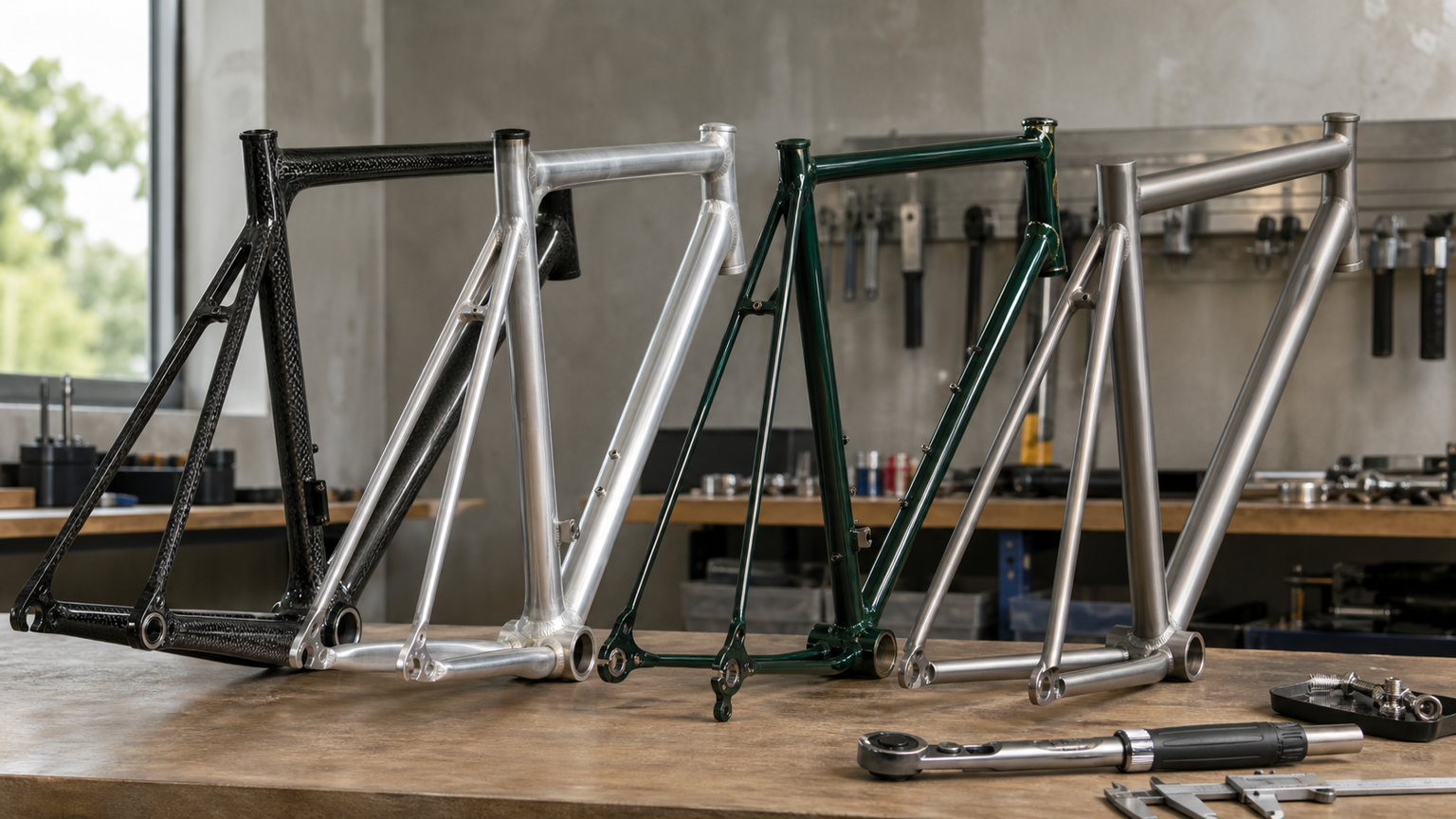
Carbon Fiber vs Aluminum vs Steel vs Titanium: The Complete Bike Frame Material Comparison
The frame is the soul of a bicycle, and the material you choose directly shapes ride characteristics, durability, and price. Carbon fiber, aluminum, steel, and titanium each have loyal fans — and each has drawbacks that can’t be ignored. This article takes an engineering-first approach, combined with real-world riding experience, to give you a thorough and objective comparison.
Basic Properties of the Four Materials
Before diving into the comparison, let’s look at the basic physical properties of each material:
| Property | Carbon Fiber (CFRP) | Aluminum (6061/7005) | Steel (4130 CrMo) | Titanium (3Al-2.5V / 6Al-4V) |
|---|---|---|---|---|
| Density (g/cm³) | 1.5-1.6 | 2.7 | 7.8 | 4.5 |
| Elastic Modulus (GPa) | 70-200+ | 69 | 200 | 105 |
| Tensile Strength (MPa) | 500-2000+ | 240-500 | 500-800 | 800-1100 |
| Fatigue Life | Extremely long (no fatigue limit concept) | Limited (requires design consideration) | Has a fatigue limit (theoretically infinite) | Has a fatigue limit (theoretically infinite) |
| Corrosion Resistance | Excellent | Moderate (needs protection) | Poor (needs paint protection) | Excellent |
What is a fatigue limit? When stress on steel or titanium stays below a certain threshold, they can theoretically endure infinite load cycles without fracturing. Aluminum doesn’t have this property — every load cycle accumulates a small amount of damage, which can eventually lead to fatigue failure.
Carbon Fiber Frames: The Modern Choice for Performance Above All
Advantages
Carbon fiber’s biggest advantage is design freedom. Engineers can vary the direction, thickness, and resin formula of the carbon layup to achieve different stiffness and compliance in different areas of the frame. For example, the bottom bracket area can be made highly stiff for pedaling efficiency, while the seatstays can be designed to be softer to absorb road vibration.
- Weight: Top-tier carbon frames can weigh under 700g; mid-range frames are around 900-1100g
- Stiffness-to-weight ratio: The best of all materials
- Shape freedom: Can produce aerodynamic profiles, complex tube shapes, and more
- Vibration absorption: Excellent comfort achievable through design
Disadvantages
- Vulnerable to point impacts: Carbon fiber has weaker resistance to concentrated impacts — a single crash can cause internal delamination that isn’t visible from the outside
- Difficult damage detection: Internal damage requires ultrasound or X-ray to confirm
- Difficult repairs: While carbon repair technology has matured, costs aren’t low (roughly NT$5,000-20,000)
- Recycling issues: Carbon fiber currently can’t be fully recycled, making it less eco-friendly
- Price: Mid-range frames run about NT$30,000-60,000; top-tier can exceed NT$150,000 (frame only)
Best For
Competitive racers chasing peak performance, weight-conscious climbers, and serious riders with ample budget.
Aluminum Frames: The Practical High-Value Choice
Advantages
Aluminum is currently the dominant material in the entry-to-mid-range market, with mature manufacturing that keeps costs down significantly. Modern aluminum frames use butting technology to keep tube walls thicker where strength is needed and thinner elsewhere to reduce weight.
- Price: The most economical option at the same tier, with frames around NT$8,000-25,000
- Weight: Mid-range aluminum frames weigh around 1,200-1,600g, which is quite respectable
- Stiffness: Direct, clear pedaling feedback
- Repair convenience: Weld repairs are relatively easy and inexpensive
- Recyclability: Aluminum can be fully recycled and reused
Disadvantages
- Comfort: Aluminum’s high stiffness means road vibration transfers directly to the rider
- Fatigue life: Aluminum has no fatigue limit, so fatigue cracks can develop after prolonged use
- Shape limitations: Tube cross-section variation isn’t as free as with carbon fiber
- Stress concentration at welds: Weld joints are the weakest point of the structure
Is Aluminum’s Fatigue Issue Really That Serious?
Many riders worry about aluminum frame fatigue life, but modern designs already account for this extensively. A well-designed aluminum frame usually holds up fine for well over 100,000 km under normal use. That said, if you plan to ride the same bike for twenty years, steel or titanium is the more reassuring choice.
Best For
Entry-level riders, budget-conscious riders who still want good performance, commuting and training bikes, and practical riders who aren’t afraid of the occasional bump.
Steel Frames: A Classic Blend of Romance and Practicality
Advantages
“Steel is real” is a phrase that’s been circulating in cycling circles for a long time. Steel frames’ distinctive ride feel comes from the material’s properties — a high elastic modulus combined with appropriate tube diameter design creates a ride that’s both resilient and supportive.
- Ride quality: Widely regarded as one of the most comfortable materials, with a “springy feel” that’s hard to replicate in other materials
- Durability: Has a fatigue limit, theoretically usable forever
- Easy to repair: Almost any welder can repair a steel frame, anywhere in the world
- Aesthetic value: Thin-tube steel frames with traditional lugs have a distinctive artistic beauty
- Easy to customize: Steel is the most commonly used material for handmade custom frames
Disadvantages
- Weight: The biggest weakness. Even with top-tier tubing (like Reynolds 953), frame weight is still around 1,500-2,000g
- Rust: Steel is vulnerable to water and rust, requiring proper paint protection and regular inspection
- Internal rust prevention: The inside of the tubes needs to be sprayed with a rust inhibitor (such as Frame Saver)
- Lower stiffness: Thin-tube steel frames show noticeable flex under hard pedaling
Common Steel Tubing Grades
| Tubing | Grade | Characteristics |
|---|---|---|
| Hi-Ten (High Carbon Steel) | Entry | Cheap but heavy |
| CrMo 4130 | Mid-range | Best value for money |
| Reynolds 725/Columbus Zona | Upper mid-range | Butted design, lighter weight |
| Reynolds 853/Columbus Spirit | High-end | Heat-treated tubing, approaching titanium-level performance |
| Reynolds 953 | Top-tier | Stainless steel, ultimate lightness |
Best For
Long-distance touring riders, leisure riders who prioritize ride quality, retro bike enthusiasts, and collectors of handmade frames.
Titanium Frames: A Lifelong Companion, Bought Once
Advantages
Titanium is called the “ultimate frame” material for good reason. It combines steel’s comfort with aluminum’s light weight, plus near-total corrosion resistance — a material many veteran riders dream of owning.
- Weight: Between aluminum and steel, around 1,200-1,600g
- Ride quality: Comfort similar to steel, but lighter and livelier
- Corrosion resistance: Titanium barely corrodes at all and doesn’t need paint (many titanium frames are shown bare)
- Durability: Has a fatigue limit plus excellent corrosion resistance — theoretically usable for a lifetime
- Understated aesthetics: The matte silver-gray of bare titanium has a distinctive texture
Disadvantages
- Price: Titanium raw material and machining costs are extremely high; frames typically run NT$50,000-150,000+
- Manufacturing difficulty: Titanium welding must be done under inert gas shielding (argon), making manufacturing more demanding
- Limited stiffness: At the same tube diameter, titanium is less stiff than carbon fiber
- Weight ceiling: Due to material properties, it’s hard to achieve carbon fiber’s extreme lightness
- Small secondhand market: Resale is difficult, and quality varies widely between titanium frames
Best For
Riders seeking a “one bike for life” companion, taste-driven riders with ample budget, and long-term investors who value ride experience over racing performance.
Overall Comparison
Here’s a 1-5 star rating of each material across different dimensions:
| Dimension | Carbon Fiber | Aluminum | Steel | Titanium |
|---|---|---|---|---|
| Weight | ★★★★★ | ★★★ | ★★ | ★★★★ |
| Stiffness | ★★★★★ | ★★★★ | ★★★ | ★★★ |
| Comfort | ★★★★ | ★★ | ★★★★★ | ★★★★★ |
| Durability | ★★★ | ★★★ | ★★★★ | ★★★★★ |
| Price | ★★ | ★★★★★ | ★★★★ | ★ |
| Repairability | ★★ | ★★★★ | ★★★★★ | ★★ |
| Shape Freedom | ★★★★★ | ★★★ | ★★ | ★★★ |
Buying Advice: Decide Based on Your Use Case
- Racing-oriented: Carbon fiber, no question
- Training + commuting: Aluminum, durable and worry-free
- Long-distance touring: Steel or titanium, where comfort and durability matter most
- One bike forever: Titanium, a single investment that lasts a lifetime
- Budget above all: Start with aluminum, upgrade to carbon fiber later
There’s no single “best” frame material — only the one that’s best for you. Take the time to think about your riding style, use cases, and budget, and you’ll make a choice you won’t regret.
Related Reading
- Complete Frame Material Comparison: Carbon Fiber, Aluminum, Titanium, and Steel — Characteristics and Best Fits
- Carbon Fiber vs Aluminum vs Titanium Frames: The Complete 2025 Material Buying Guide
- In-Depth Bike Frame Material Comparison: Aluminum vs Carbon Fiber vs Titanium — Ride Feel, Weight, and Long-Term Investment Analysis
- Road Bike Frame Material Showdown: Carbon Fiber vs Aluminum vs Titanium Buying Decisions