Complete Guide to Disc Brake Frames: From Caliper Mounting to Disc-Specific Frame Design
文章導覽
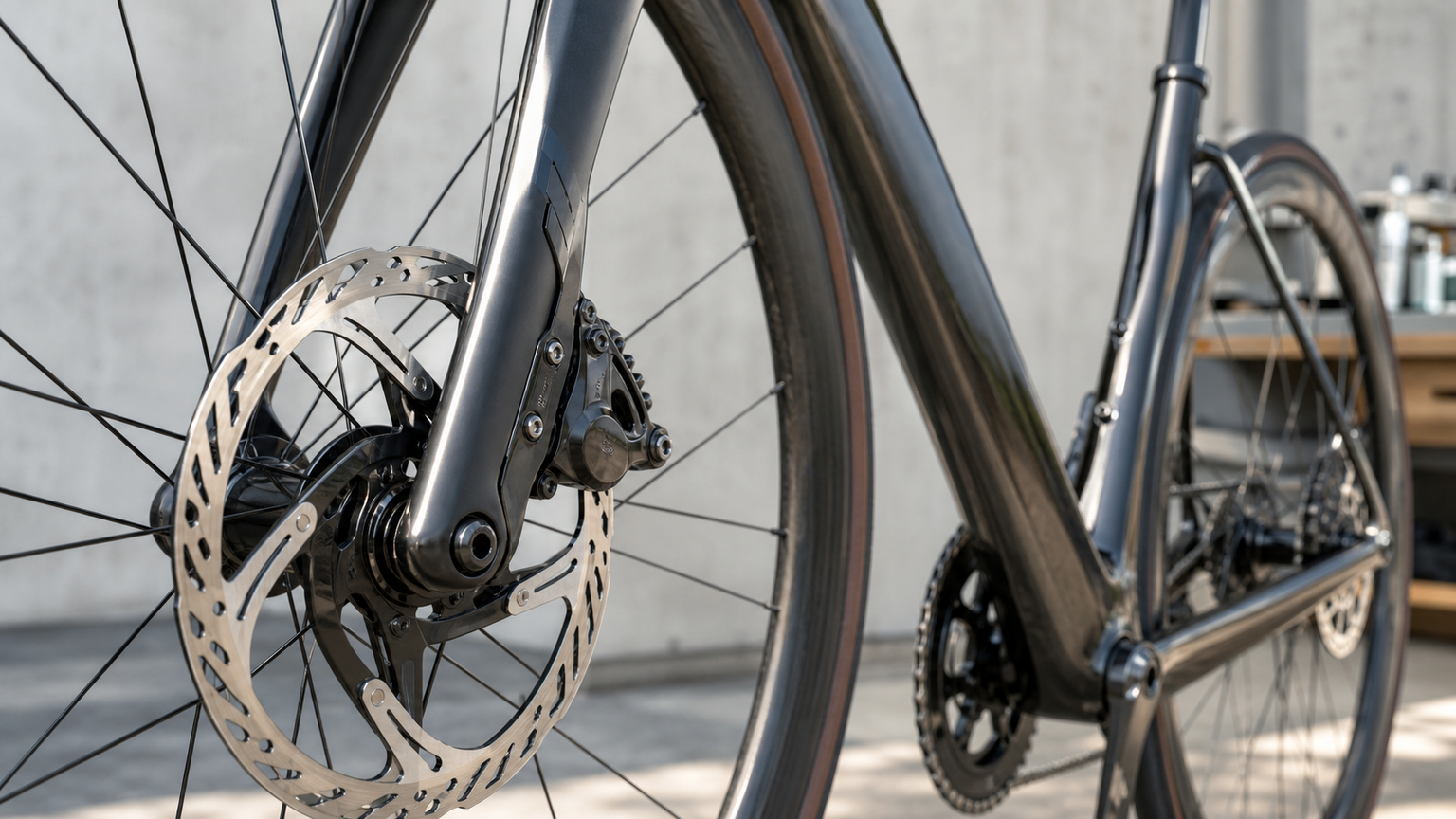
Complete Guide to Disc Brake Frames: From Caliper Mounting to Disc-Specific Frame Design
Disc brakes went from controversial to nearly universal in the road bike world in under a decade. Starting in 2024, almost every brand’s new road bike models are offered only in disc brake versions. But disc brakes are more than just moving the caliper from the rim to the rotor — they fundamentally change the entire design logic of the frame.
Disc Brake Frames vs Rim Brake Frames: Structural Differences
Fork Design
This is where disc and rim brakes differ the most:
Rim brake forks have braking force acting on the top of the rim, with a shorter lever arm. The fork mainly absorbs rearward pulling force.
Disc brake forks have braking force acting on the caliper mount at the bottom of the fork, so the fork must withstand enormous torsional torque during braking. As a result, disc brake forks require:
- Thicker fork legs to withstand torque
- Reinforced crown area structure
- Special reinforcement on the left fork leg (the caliper mounting side)
- Overall weight is typically 50-80g heavier than an equivalent rim brake fork
Rear Triangle Design
The rear brake caliper is usually mounted at the junction of the chainstay or seatstay and the dropout. This results in:
- The chainstay needs a larger cross-section to withstand brake torque
- The non-drive side (usually the left) requires special structural reinforcement
- Stress distribution at the dropout is completely different from rim brakes
Rims and Hubs
Removing the braking function from the rim brought a revolution in rim design:
| Feature | Rim Brake Wheel | Disc Brake Wheel |
|---|---|---|
| Braking surface treatment | Requires machined braking surface | Not required |
| Deep carbon rims | Brake heat dissipation is a concern | No heat dissipation issue at all |
| Rim width | Limited by brake caliper clearance | Can be freely widened |
| Rim lifespan | Gradually thins from brake wear | Theoretically longer-lasting |
| Rim weight | Must retain braking surface thickness | Can be lighter |
Rotor Size Selection
Rotor size directly affects braking power and heat dissipation:
| Rotor Size | Front Wheel Recommendation | Rear Wheel Recommendation | Characteristics |
|---|---|---|---|
| 140mm | - | Riders under 70kg | Lightweight, average heat dissipation |
| 160mm | Most riders | Riders over 70kg / mountain roads | Best overall balance |
| 180mm | Riders over 90kg / long descents | Rarely used | Strongest braking power, heaviest |
Rotor mounting standards:
- Center Lock: Secured with a lockring at the center of the hub, a standard invented by Shimano, currently the most widespread
- 6-Bolt: Secured to the hub with six bolts, more traditional but still common
Most high-end hubs support Center Lock and can use 6-Bolt rotors via an adapter. However, the reverse conversion (mounting a Center Lock rotor on a 6-Bolt hub) is not feasible.
Caliper Mounting Standards
Flat Mount: The Modern Road Bike Standard
Flat Mount is currently the mainstream mounting standard for road bike disc brakes, characterized by:
- The caliper sits flush directly against the frame/fork
- Mounting bolts thread in from below
- More compact and lighter than the older Post Mount standard
- Suitable for 140mm and 160mm rotors (160mm requires an adapter)
Post Mount: Mountain Bikes and Early Disc Brakes
- The caliper is secured on two parallel post-shaped mounts
- Bolt direction is parallel to the rotor
- Can accommodate multiple rotor sizes (via adapters)
- Gradually being phased out in the road bike world
Thru-Axle vs Quick Release
Disc brake frames are almost always paired with thru-axles, replacing the traditional quick release:
| Feature | Thru-Axle | Quick Release |
|---|---|---|
| Front wheel spec | 12×100mm | 9×100mm |
| Rear wheel spec | 12×142mm | 5×130mm (road) |
| Stiffness | Very high | Moderate |
| Installation precision | Very high, consistent every time | Affected by installation force |
| Rotor alignment | Stable and precise | May vary slightly each time |
| Removal/installation speed | Slightly slower (requires unscrewing) | Fast |
The high installation precision of thru-axles is critical to disc brake systems. The clearance between a disc brake caliper and the rotor is only 0.2-0.5mm — if the wheelset installation position has even a tiny deviation each time (a common issue with quick releases), the rotor will rub against the pads and create noise.
Heat Management in Disc Brake Frames
Sustained braking on long descents generates significant heat, making thermal management an important design consideration for disc brake systems:
Heat Dissipation Path
Brake pads → Rotor → Hub → Air (convective cooling)
High-Temperature Risks
- Rotor temperature can exceed 300°C
- Overheating causes “brake fade” in the pads, where braking power drops sharply
- In extreme cases, the brake fluid in the hydraulic lines could boil, causing brake failure
- The hub joint area on carbon fiber wheels may be affected by heat
Preventive Measures
- Choose finned rotors (such as Shimano Ice Tech): sandwich an aluminum cooling layer in the middle
- Use metallic pads: better heat dissipation than resin pads
- Alternate braking on descents: avoid continuous heat buildup on a single rotor
- Choose a larger rotor: 160mm has 30% more surface area for heat dissipation than 140mm
Weight Considerations for Disc Brake Frames
Disc brake systems are indeed heavier than rim brake systems, but the gap is narrowing:
| Component | Disc Brake System (typical) | Rim Brake System (typical) | Difference |
|---|---|---|---|
| Frame | +30-80g | Baseline | Disc brakes need reinforcement |
| Fork | +50-80g | Baseline | Disc caliper mount |
| Caliper | +50-100g | Baseline | Hydraulic system is heavier |
| Rotor | +200-300g | 0 (no rotor) | Largest source of difference |
| Thru-axle | +30-50g | Baseline (quick release) | Thru-axle is heavier |
| Rim | -30-50g | Baseline | Disc brake rims can be lighter |
| Total | +330-560g | Baseline | About the weight of a bottle of water |
What to Check When Buying a Disc Brake Frame
Confirm Rotor Compatibility
- Does the fork support 160mm rotors, or only 140mm?
- Is the rear brake caliper mount design Flat Mount?
- Do you need to purchase an adapter separately?
Confirm Thru-Axle Specifications
- Front 12×100mm is the road bike standard
- Rear 12×142mm is the road bike standard
- Confirm the thru-axle’s thread direction and length
Cable/Hose Routing
Hydraulic hose routing on disc brake frames is an important consideration:
- Fully internal routing looks clean, but greatly increases the difficulty of future maintenance (bleeding, hose replacement)
- Confirm that the hydraulic hose routing path inside the frame is smooth — sharp bends will affect lever feel
- Some frames have very limited routing space at the head tube
Adjusting Pad Clearance
Disc brake calipers need precise alignment to avoid rotor rub:
- Loosen the caliper mounting bolts
- Squeeze the brake lever (this lets the caliper self-center)
- Tighten the mounting bolts (alternate tightening to avoid misalignment)
- Spin the wheel to confirm there’s no rubbing noise
Disc brakes are now an irreversible trend. Understanding the design logic and usage considerations of disc brake frames will give you more confidence when shopping and riding, letting you fully enjoy the all-weather reliable braking performance that disc brakes provide.
Related Reading
- Choosing a Road Bike Braking System: A Comprehensive Comparison of Disc Brakes vs Rim Brakes
- Road Bike Brake Upgrades: The Difference Between Mechanical and Hydraulic Disc Brakes
- The Final Showdown: Disc Brakes vs Rim Brakes — Which Should You Choose for Your 2026 Road Bike?
- The Evolution of Road Bike Braking Systems: Mechanical Disc vs Hydraulic Disc vs Caliper Rim Brakes