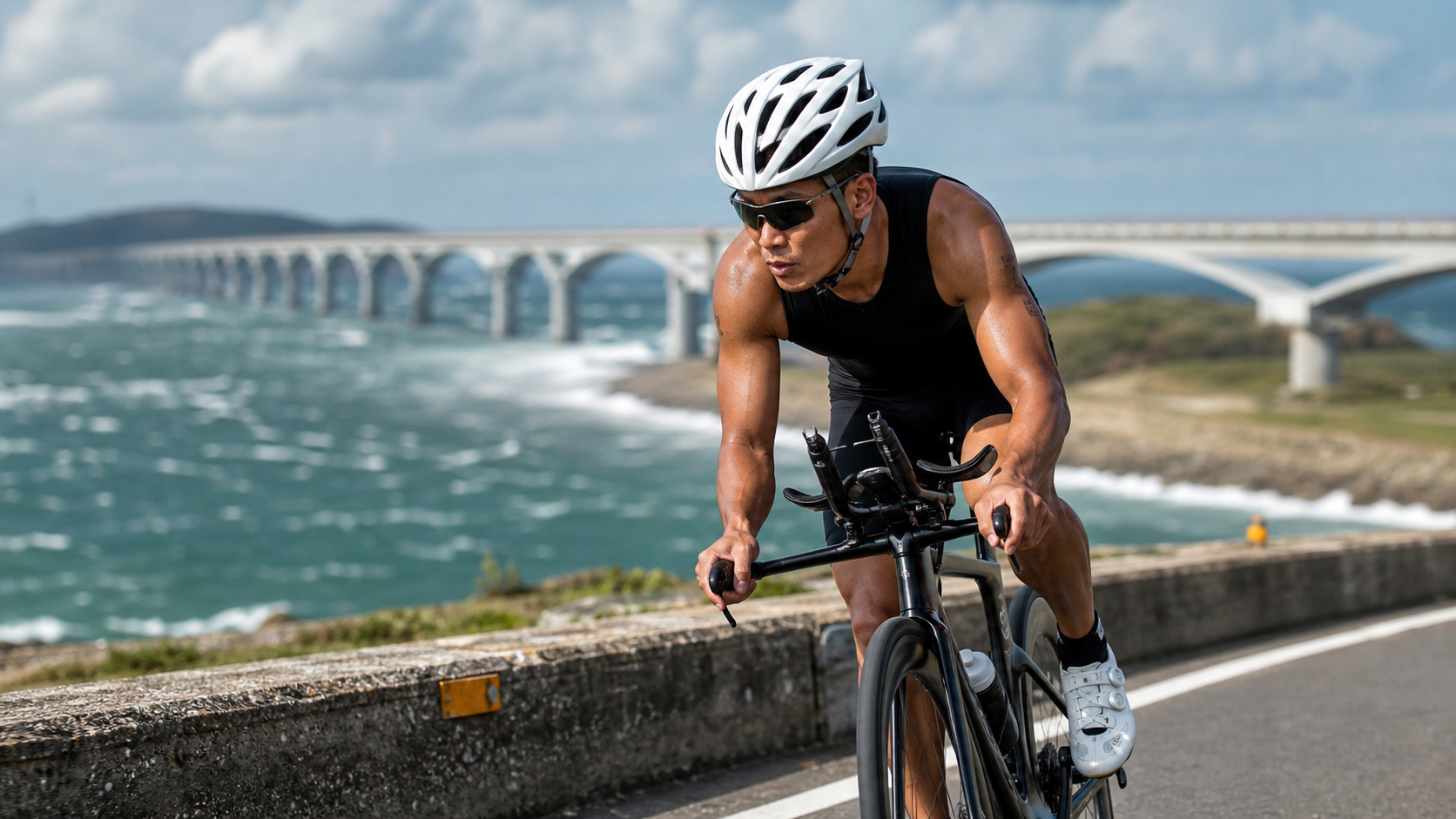
Coach’s Opening: That Athlete Walking at Kilometer 32 Actually Biked Too Fast
Every year watching IRONMAN Taiwan by the Lively Lake in Taitung, the image that sticks with me most isn’t the finish line—it’s that “marching column” on the later stretch of the run. The sun is brutal, the asphalt bounces heat back at your calves, and a crowd of people transitions from running form to race-walking, then to hands-on-hips strolling. They’re not lacking effort—quite the opposite: they tried too hard in the swim and on the bike.
One athlete I coached, A-Zhe, on his first attempt at a full 226, swam a personal best, hammered the tailwind section through Guanshan and Chishang on the bike at an average of 34 km/h, and came back to T2 with a huge smile. And then? The first 10 km of the run had beautiful pacing, the pace started dropping at kilometer 15, and after kilometer 28 he was basically moving on willpower alone—the final marathon took him nearly 5 hours and 40 minutes. The first thing he said to me after the race was: “Coach, I had no idea legs could feel that empty.”
That “legs feeling empty” is the core problem this article addresses. An IRONMAN 226 (3.8 km swim, 180 km bike, 42.195 km run) is never a race of “who’s fastest”—it’s a race of “who allocates best.” About 80% of your overall result depends on whether you’re willing to “deliberately ride slower” on the bike. That sounds counterintuitive, but it’s exactly the dividing line between elite athletes and everyone else.
In this article, I’ll use the practical tone I use with my athletes and lay out three things clearly: bike intensity control (IF), hourly calorie and carbohydrate intake, and run segment strategy. By the end, you’ll have numbers, comparison tables, and a training framework you can copy directly, so your next 226 doesn’t repeat A-Zhe’s first-year mistakes. Pacing, when you get down to it, is a whole discipline of “hold back first, enjoy later”—and now, let’s break it down step by step.
Conceptual Foundation: Why “Riding Too Hard” Destroys Your Marathon
The Physiological Reality of Long-Course Triathlon
For a typical age-group athlete, a full 226 finish time falls between 11 and 16 hours. That means your body has to keep producing energy for nearly an entire working day. At that scale, what determines success isn’t VO2max or sprint ability—it’s three things:
- Glycogen stores and replenishment rate—whether your engine’s fuel tank is big enough and refills fast enough.
- Thermoregulation—especially in Taiwan’s summer, losing control of core temperature is a silent killer.
- Mechanical muscle fatigue—the lower-body load accumulated over 180 km of riding directly eats into your running legs.
Why is riding too hard fatal? Because when you push intensity on the bike, your body shifts dramatically from “fat-dominant burning mode” to “glycogen-dominant.” The harder you burn glycogen, the emptier your tank is when you hit T2. And the marathon—especially the marathon in the back half of a long-course race—is precisely the phase that needs glycogen the most.
Quantifying “Effort” with IF (Intensity Factor)
Here I’ll introduce the core metric from power-based training: IF (Intensity Factor). IF is your ride’s Normalized Power divided by your FTP (Functional Threshold Power).
In simple terms:
- IF = 1.0 means you rode the entire segment at FTP intensity (which you can only sustain for about an hour).
- IF = 0.7 means your equivalent intensity is 70% of FTP.
According to the general consensus in the power-training community and among long-distance triathlon coaches, the target IF for a full IRONMAN bike leg should fall between 0.70 and 0.75, and most age-group athletes should even err conservative at 0.68 to 0.72. This range isn’t something I made up off the top of my head—it’s a principle long supported by practice and research: the goal of the bike isn’t to post the fastest split, but to post a split that still lets you finish the marathon (see references at the end of the article).
There’s a saying I often tell my athletes, and it’s an old adage in this circle: “Roughly nine out of ten competitors don’t execute their bike pacing, so they ride much harder than they should, and then blow up on the run.” A-Zhe’s first failure was a textbook case of this—when we later reviewed his power file, his IF spiked to 0.82 on that tailwind section, far above the appropriate range.
VI: Don’t Overlook “Pacing Smoothness”
Besides IF, there’s another often-overlooked metric called VI (Variability Index), which is Normalized Power divided by Average Power. The closer VI is to 1.0, the smoother you ride and the less you surge and ease off.
For long-course triathlon biking, I require my athletes to keep VI within 1.05, ideally between 1.0 and 1.03. Why? Because every time you stomp the pedals to chase someone down, every climb you surge over the top, every hard acceleration from a red light—you’re quietly making withdrawals from your glycogen account. Riding smooth is saving money for the run.
Practical Method One: Power and Heart-Rate Pacing on the Bike
No Power Meter? Use Heart Rate and Perceived Exertion
Not everyone has a power meter, and that’s totally fine. When I coach first-time triathletes and duathletes, many of them pace using heart rate + RPE (Rate of Perceived Exertion, on a 1 to 10 scale).
Here’s a comparison table I commonly use, translating the IF concept into language you can use without a power meter:
| Target IF | Corresponding FTP % | Heart Rate Zone (relative to threshold HR) | RPE Feel | What You Should Feel |
|---|---|---|---|---|
| 0.68–0.70 | 68–70% | Mid Zone 2, about threshold HR -25–30 bpm | 3–4 | “Bored enough to fall asleep,” can talk easily in full sentences |
| 0.70–0.73 | 70–73% | Upper Zone 2, about threshold HR -20–25 bpm | 4–5 | Can speak full sentences, still breathing through your nose |
| 0.73–0.75 | 73–75% | Lower Zone 3, about threshold HR -15–20 bpm | 5 | Starting to need breaths between sentences, suitable for experienced athletes |
| > 0.78 | > 78% | Zone 3 and above | 6+ | ⚠️ Danger zone, the run will definitely suffer |
Key principle: for the entire bike leg, your feel should be “deliberately riding slower than you want to.” If you feel great mid-ride, want to overtake people, and feel like you’re in incredible form, then 99% of the time you’re riding too hard. Proper pacing feels a bit boring—it even makes you wonder if you’re slacking off.
Race-Day Pacing for Taiwan’s Course
Take IRONMAN Taiwan (Taitung) as an example: the bike course has several long gradual climbs and strong coastal winds. My instructions to athletes are usually:
- On climbs: Cap your power hard. Rather lose speed than let power exceed the upper edge of your target IF (e.g., if target is 0.72, don’t spike above 0.80 on climbs). Use the strategy of “limit power on climbs, relax and coast on descents.”
- Into headwinds: Same—lock your power and accept the slower speed. Hammering into a headwind is the most common mistake beginners make; you’re burning glycogen for a tiny bit of speed, and it’s a terrible trade.
- With tailwinds / on descents: This is the only place you can “pick up speed”—hold power or even ease off slightly, let the wind accelerate you, and steal back some average speed.
The essence of this logic is: anchor with power, let speed float with the terrain. Not the other way around—anchoring with speed and letting power surge.
From the Swim to T1: The First Domino of Overall Pacing
Many people only talk about pacing starting from the bike leg, but in reality, the swim is the first domino of overall pacing. If you swim the 3.8 km too hard, blow up your heart rate, and exit the water gasping and dizzy, then the first 30 minutes of your T1 transition and getting on the bike will be spent “paying off the debt”—your body will be busy recovering from the lactate and oxygen debt created by the swim, making it impossible to execute your bike pacing cleanly.
The swim instruction I give my athletes is simple: Swim at a “easy to moderate” pace, and when you exit the water, you should feel like you “could do another lap,” not “finally, it’s over.” At the start, with the crowd and splashing, don’t rush to fight for position and sprint out. Treat the first 200 meters as a warm-up, find your own stroke rhythm, and stay to the side to avoid the brawl zone. Save all that energy for the 9 to 10 hours ahead.
Don’t underestimate the T1 transition either. A frantic transition will spike your heart rate again. Practice your “T1 ritual”: exit the water → unzip your wetsuit (if wearing one) → put on your helmet → grab your bike → after mounting, spend the first 5 minutes spinning at low intensity, breathing smoothly, and taking your first nutrition, then gradually bring your power up to the target range. Don’t stomp on the pedals the moment you get on the bike—that’s the most classic first mistake for beginners.
Be “More Conservative” in the Early Section
For the 180 km bike leg of a 226, I ask my athletes to split it into three mental segments:
- First 60 km: Go 0.02–0.03 lower than your target IF. This is when your body feels freshest and it’s easiest to overdo it. Actively hold back.
- Middle 60 km: Return to your target IF and push steadily.
- Final 60 km: If nutrition is on point and you feel good, you can hold the upper end of your target IF; if fatigue is already setting in, decisively drop to the lower end to protect your running legs.
Practical Method 2: The Fueling Project of Hourly Calories and Carbohydrates
Why Fueling Is the “Fourth Discipline”
There’s a saying in the triathlon world: “Fueling is the fourth discipline of triathlon.” This isn’t a joke. Over a full 226, your body may need to process thousands of kilocalories in and out, and if your fueling strategy is wrong, no amount of fitness will save you.
According to sports nutrition research and practical guidelines, for endurance exercise lasting over 2 hours, the recommended carbohydrate intake is 60 to 90 grams per hour; well-trained athletes with adapted guts can try pushing above 90 grams (see references at the end). A commonly cited rule of thumb is: about 1.2 grams of carbohydrate per kilogram of body weight per hour, which for a 65 kg athlete works out to roughly 78 grams per hour—right in the 60–90 gram window.
Why Mix Carbohydrates: Glucose + Fructose
Here’s a physiological limit many people don’t know: the human gut’s absorption ceiling for glucose alone is about 60 grams per hour. If you swallow more pure glucose gels than that, the excess won’t be absorbed—it’ll just sit in your stomach causing nausea and bloating.
The solution is mixing glucose and fructose—they use different intestinal transport pathways. Research shows the body can handle roughly 30 to 80 grams of glucose per hour, plus 20 to 60 grams of fructose per hour, and combining them breaks through the single-carb ceiling, safely pushing total intake to 90 grams per hour (see references at the end). This is the principle behind commercial products touting “2:1” or “1:0.8” glucose-to-fructose ratios.
Let’s Calculate It with Real Numbers
No matter how much theory I throw at you, nothing beats running the numbers. Suppose a 65 kg athlete targets a 6-hour bike leg and a 5-hour run, totaling about 11 hours (excluding transitions). Here’s how I’d help them estimate total fueling:
- Carbohydrate target: 75 grams per hour for the bike leg, and 60 grams per hour for the run since gut function declines.
- Bike: 75g × 6 hours = 450 grams
- Run: 60g × 5 hours = 300 grams
- Total: about 750 grams of carbohydrates, equivalent to roughly 3000 kcal of fueling energy.
- What this means: One energy gel has about 22–30 grams of carbs, and a bottle of commercial sports drink has about 30–40 grams. You can do the math yourself—the bike leg alone requires the equivalent of about 15 gels, spread across liquids and solids. This is why “just eating a couple of gels” is absolutely not enough.
- Fluids: Estimate 500–800 ml per hour, going higher in hot weather; over the whole race, you might need to process 6 to 8 liters or more of liquid.
- Sodium: 600 mg per hour × 11 hours ≈ 6600 mg of sodium, and more for heavy sweaters.
Write these numbers on a fueling sticker and put it on your top tube or fork. On race day, follow the plan, and you won’t miss feedings by “going by feel.” Fueling by feel is the same as blowing up by feel.
A Fueling Schedule You Can Copy Directly
Below is a fueling framework I designed for an intermediate athlete of about 65 kg, planning a 6-hour bike leg and a 4.5-hour run (values are ranges; adjust based on your individual gut tolerance):
| Phase | Duration | Hourly Carb Target | Hourly Fluids | Hourly Sodium | Example Fueling Forms |
|---|---|---|---|---|---|
| Pre-swim | 2–3 hours before race | One-time 100–150g | 400–500ml | — | Rice / steamed bun / energy drink |
| Early bike | 0–2 hours | 60–70g | 500–700ml | 400–700mg | Energy drink + banana |
| Mid-to-late bike | 2–6 hours | 70–90g | 600–800ml | 600–800mg | Sports drink + energy gels + small amounts of solids |
| Early run | 0–2 hours | 50–70g | 400–600ml | 500–700mg | Energy gels + aid station cola / sports drink |
| Late run | After 2 hours | Based on what your gut can absorb | Small, frequent sips at aid stations | Keep taking sodium | Cola, salt tablets, sugary drinks |
A few practical key points:
- The bike leg is your golden window for solids and high carb intake. Because your gut is relatively stable on the bike, unlike the jostling of running. Be sure to “get ahead of the curve” during the bike and take in the energy you’ll need for the run.
- Gut absorption declines during the run, especially in the later stages. At that point, focus on liquids and gels, and make good use of aid station cola (flat cola is a godsend in long-distance triathlon—easy to absorb and a pick-me-up).
- Don’t forget sodium. Taiwan’s summer sweat rates are staggering; hydrating without sodium can lead to hyponatremia, with symptoms ranging from nausea to cramping, and in severe cases, it can be fatal. 500 to 800 mg of sodium per hour is a common range, with more for heavy sweaters.
Fueling Practice in Taiwan’s Convenience Store Environment
Taiwan has a great advantage: the highest convenience store density in the world. I often tell my athletes to “practice fueling at convenience stores” during long training rides—stop at a 7-Eleven mid-ride and practice eating rice balls, bananas, and onigiri with sports drinks to test whether your gut can handle solids during exercise. This is a hundred times more useful than just crunching numbers in Excel in an air-conditioned room.
The biggest fueling mistake is trying something new on race day. Everything you plan to eat on race day must be rehearsed at least 3 to 5 times in training to confirm your gut won’t protest. “Nothing new on race day” is the iron rule.
Practical Method 3: Run Leg Segmentation Strategy
The Moment You Cross the Start Line, You’re Already in Debt
When you hit T2 and start running, your legs have already ridden 180 kilometers, your body has lost a significant amount of fluid and electrolytes, and much of your glycogen is gone. The key mindset at this point is: The money you saved earlier, you’re now spending; but don’t blow it all at once.
I break the Ironman marathon into three segments to manage:
Segment 1 (0–10 km): Hold back, slow down
Fresh off the bike, many people experience a “false high”—switching muscle groups, feeling excited, and pacing too fast. This is a major trap. My instruction is: For the first 10 km, deliberately run 15 to 30 seconds per kilometer slower than your target pace. Let your body smoothly transition from cycling mode, and give your gut time to digest the energy you just took in.
Segment 2 (10–30 km): Find your rhythm engine
This is the core zone that determines success or failure. By now, you should be in a steady “cruise pace,” driven by rhythm and fueling, not willpower. Treat every aid station as a checkpoint: drink water, take sodium, pour water to cool down, take a gel. Break the marathon into small segments of “aid station to aid station,” and your brain won’t be crushed by the number 42.
Segment 3 (30–42 km): This is where the real race begins
Everyone is suffering here; the difference is who falls apart less. If you paced and fueled correctly on the bike, you’ll find you can “still run” here—while the people around you who rode too hard are turning into a death march. That feeling of “reeling people in” is the reward for correct pacing.
Walk-the-Aid-Station Method
Here’s a highly practical tip for mid-to-back-of-the-pack athletes: deliberately walk through every aid station. Walk for 20 to 30 seconds, properly drink your water, eat your fuel, douse yourself to cool down, then start running again.
This sounds like it would slow you down, but in practice—athletes who disciplinedly walk through aid stations often end up much faster than those who run the whole way but blow up at 30 km. Because the former maintain the quality of fueling and cooling, avoiding that catastrophic “death march.” It’s trading a small discipline for enormous stability.
Mental Pacing: Cut the Elephant into Bite-Sized Pieces
42 km is a number that can crush your mind in the latter stages of an Ironman. I teach my athletes a mental trick: Never think about “how many kilometers are left,” only think about “the next aid station.” Break the entire marathon into small “aid station to aid station” tasks, and give yourself a small internal affirmation each time you complete one.
This isn’t just motivational fluff; it’s evidence-based attention management. When your brain is flooded with “25 km to go,” the pain is amplified; when you only need to “make it to that orange tent ahead,” the task becomes executable. A large part of elite athletes’ mental toughness is this ability to “cut the elephant into bite-sized pieces.”
Also, here’s a little mantra I learned from a veteran and have passed on to every athlete: “Steady, fuel, cool, move.” When you’re in so much pain your mind goes blank, repeat these four words, and they’ll pull you back to a manageable action list instead of letting your emotions drag you into a meltdown.
Cooling Strategies for Taiwan Summers
For races like IRONMAN Taiwan and Challenge Taiwan, the run segment often falls in the heat of late morning to afternoon. Thermoregulation is a matter of life and death here. My cooling checklist for athletes:
- Pour water over your head, neck, and thighs at every aid station.
- Stuff ice into your cap or bandana (aid stations sometimes provide it).
- Tuck sponges under your shoulders and at the back of your neck.
- If you feel dizzy, get goosebumps, or stop sweating—these are warning signs of heat exhaustion. Walk immediately, cool down, find medical staff, and don’t push through.
Common Mistakes and Fixes
After all these years of coaching, the patterns of blowing up are highly repetitive. Here are the most common ones, with corrections:
| Common Mistake | Why It’s Fatal | Fix |
|---|---|---|
| Following others’ surge pace on the bike | Their FTP isn’t yours; you’re burning your own glycogen | Lock in your own power/heart rate, ignore everyone around you |
| Pushing power into headwinds or climbs | Spending huge energy for tiny speed gains, extremely inefficient | Cap power on climbs and headwinds, accept slower speed, make it up on tailwinds and descents |
| Skipping fueling early, cramming later | Your gut has already shut down by then; you can’t get it in or absorb it | Start regular fueling from the first hour on the bike |
| Only drinking water, no sodium | Hyponatremia—cramps, nausea, even danger | 500–800mg sodium per hour, carry salt tablets |
| Running the first 10 km too fast | A borrowed false high, leaving debt for the later stages | Deliberately slow down 15–30 sec/km for the first 10 km |
| Trying new fuel products on race day | Your gut hasn’t adapted, and it throws a tantrum mid-race | Nothing new on race day; rehearse everything in training first |
| Refusing to walk through aid stations | Poor quality of fueling on the run—not enough fuel, not enough cooling | Disciplined 20–30 second walks, execute your fueling properly |
Actionable Advice for Athletes of Different Levels
First-timers / Those Attempting Their First 226
Your only goal is to finish, and to finish with dignity, not to chase a time.
- Target an IF of 0.65–0.70 on the bike; err on the conservative side. You’ll think “this feels way too slow”—hold back.
- Fuel primarily with liquids and gels your gut can handle, starting at 50–60g of carbs per hour.
- On the run, embrace a run-walk strategy (e.g., run 9 minutes, walk 1 minute) from the very start—don’t wait until you’ve blown up to walk.
- Mindset: Treat “finishing” as victory. You’ll pass plenty of “fast guys” who are marching in the later stages.
Advanced / Chasing a PB or Age-Group Result
- Target an IF of 0.72–0.75 on the bike, but you must first simulate this intensity followed by a run in training (Brick workouts).
- Push fueling toward 80–90g of carbs per hour, and train your gut to handle it (gut training).
- Aim for a negative split on the run: try not to run the second half much slower than the first.
- Execute precisely with a power meter, then review your IF and VI post-race to keep refining.
Why the Brick Workout Is the Core of Pacing Training
If there’s only one workout you remember from this article, let it be the Brick (ride immediately followed by a run). The name comes from the fact that after riding, your legs feel as heavy as bricks.
The value of Brick training isn’t just physical—it’s a rehearsal of the neural and pacing decisions. Your body needs to repeatedly experience that strange “heavy-leg start” so it doesn’t panic and blow your pacing on race day. More importantly, the Brick is the only place where you can truly test your fueling strategy under race-like fatigue—you’ll discover that some gels that are fine in regular training make you nauseous after 3 hours of riding. Only the Brick can give you that information.
I have three principles for scheduling Bricks with my athletes:
- Real intensity: The ride segment must be at your target IF; you can’t slack off at easy intensity, or you won’t get a true response.
- Fuel like race day: Use the same fuel products and timing as your race day—treat it as a dress rehearsal.
- Short but precise run segment: You don’t need to run long every time; the focus is on “feeling the heavy legs and holding your pace for the first 10 minutes.” Quality over quantity.
Advanced Brick Workout Example (6–8 Weeks Pre-Race, Once a Week)
This is a “pacing-focused” Brick workout I give to advanced athletes. The goal is to teach the body to remember “running at race pace after riding at IF 0.73”:
| Segment | Content | Intensity | Focus |
|---|---|---|---|
| Bike Warm-up | 20 minutes | IF 0.6, progressive | Wake up the body, start fueling |
| Bike Main Set | 2.5–3 hours | Steady IF 0.72–0.74 | Practice locking in power, practice fueling rhythm |
| Transition | Within 5 minutes | — | Simulate T2, quick change |
| Run Main Set | 40–60 minutes | Target marathon pace | Deliberately slow for the first 10 minutes, feel the “heavy legs” |
| Cool-down | 10 minutes | Easy | Cool down, stretch |
The point isn’t how fast you ride or run, but practicing your pacing and fueling decisions under fatigue. Do this workout 5 to 8 times, and race day won’t rattle you.
Frequently Asked Questions (FAQ)
Over the years of coaching athletes, these are the questions I get most often in the week before a race:
Q1: I don’t have a power meter. Can I still pace well?
Yes, but you’ll need to rely more on heart rate and perceived exertion. Use the “IF reference chart” from earlier and lock your target into a Zone 2 rhythm where you can “speak in full sentences and still breathe through your nose.” The downside is that heart rate can “drift” due to dehydration, heat, and fatigue—later in the ride, your heart rate will run higher at the same intensity. So don’t stare at the heart rate number; use perceived exertion (RPE) as a second layer of insurance: no matter what your heart rate does, if you feel like “it’s starting to take effort,” back off a step.
Q2: If I pace the bike so conservatively, won’t my overall time be slower?
This is the biggest mental hurdle for most people. The answer is: for the vast majority of age-group athletes, the run time you gain from conservative biking far outweighs the few minutes you save on the bike. A-Zhe’s case is the perfect example—he dropped his bike IF from 0.82 to 0.71, lost about 10 minutes on the bike, but gained 90 minutes on the marathon. No matter how you do the math, it’s worth it. Only truly elite athletes have the luxury of pushing IF to the upper edge of 0.75.
Q3: What if I feel nauseous or want to throw up during the race?
This is usually caused by “fueling too concentrated, too fast” or “intensity too high, blood all going to the muscles, gut shutting down.” Three steps to handle it: first lower the intensity (let blood flow return to the gut), switch to plain water to dilute, stop solid food and switch to small sips of liquid. Once your stomach feels settled, gradually resume fueling. This is also why you can’t ride too hard—your gut is offline at high intensity.
Q4: Can I keep going if I cramp?
Common causes of cramping in long-distance triathlon are electrolyte loss plus muscle fatigue. In the moment, you can slow down, stretch, and take in sodium (salt tablets or sodium-containing drinks). But if cramping keeps recurring and getting worse, that’s your body sending an alarm—don’t push through it. Finishing is important, but no race is worth sacrificing your health.
Q5: It’s so hot in Taiwan in the summer. Do I need to adjust my pacing?
Yes. High heat makes your heart rate higher at the same power output and accelerates dehydration. My advice: when it’s hot, lower your bike IF target by 0.02–0.03, aim for the upper end of fluid and sodium intake, and be thorough with cooling measures. Pushing pace in the heat is one of the most dangerous things you can do in an ultra-distance triathlon.
Q6: Do I really have to use a run-walk strategy? It feels embarrassing.
Ask yourself this: is “blowing up at 30 kilometers and crawling the rest of the way” more respectable, or is “disciplined run-walking and steadily picking people off to the finish” more respectable? Even elite athletes walk through aid stations. The run-walk strategy isn’t a compromise for the weak; it’s a tool for the smart. Save your pride for the moment you cross the line.
Conclusion: Pacing Is a Practice of Delayed Gratification
Back to A-Zhe’s story. In his second year, I forced his bike IF down from 0.82 to 0.71. He complained the whole way—too slow, people passing him. But in that race, he ran a 4:10 marathon—a full 90 minutes faster than the year before. His overall time improved dramatically, and he picked off a bunch of people in the latter half of the run. After crossing the line, he told me: “Coach, it turns out my legs don’t have to be empty.”
That’s the essence of ultra-distance triathlon pacing: it’s a practice of delayed gratification. You hold back on showing off in the swim and bike, you resist the urge to push hard, you fuel on schedule bite by bite, and you bank all that “fun”—then on the final marathon, you cash it all out at once, running steadily toward the finish instead of lying by the roadside waiting for the sag wagon.
Remember the three pillars of this article: keep bike IF between 0.70–0.75, consume 60–90 grams of carbs per hour, and run in three segments with a deliberately slow start. Get these three things right, and your final marathon won’t become a death march—it’ll become the proudest chapter of your entire race.
The sun in Taitung is just as brutal, and the shore of Living Water Lake is just as hot, but next time, I hope you’re the one still smiling and picking people off at the 35-kilometer mark.
This article is for educational purposes and does not replace individual assessment by a physician, physical therapist, or nutritionist. Please adjust fueling and training intensity according to your personal health condition and professional guidance.
References
- Intensity Factor (IF): The Secret to Perfect Ironman Pacing — https://triathlonpace.com/articles/the-triathletes-guide-to-intensity-factor-your-pacing-secret-weapon
- The Long Course Triathlon Execution Seminar, Lesson #3 — Bike Pacing and Hills, Endurance Nation — https://www.endurancenation.us/the-ironman-triathlon-execution-seminarlesson-3/
- How much carbohydrate do athletes need per hour? — Precision Hydration — https://www.precisionhydration.com/performance-advice/nutrition/how-much-carbohydrate-carbs-athletes-per-hour/
- Triathlon Carbohydrate Intake: How Much is Enough? — https://alltriathlon.com/triathlon-carbohydrate-intake/
Related Reading
Live) 備戰2019彰化經典百K 賽前攻略 (已完賽請看新影片
7 年前
西進武嶺 免費訓練分析服務 Intervals | 練不夠還是練過頭?你哪一種類型選手?AI模型告訴你! | 備戰神器 | 公路車 訓練 | CT Yeh
4 年前
2019 夏季KOM 5小 完賽心得 準備攻略 東進武嶺 夏季登山王之路 Taiwan KOM Challenge
7 年前
Never Stop 西進武嶺 前後雙機 完整全程錄影 訓練台 實境
8 年前
福隆鐵人團練隨拍
8 年前
#公路車 #Fitting 靠人工智慧APP 幫你調整單車
6 年前
CT 喇低賽) 武嶺牽車 才是王道 西進牽車四小時內秘訣 攝手位置 如何判斷 防抽筋小秘訣
7 年前
西進武嶺 世界紀錄挑戰!破2:30 ?!一群人推著一個夢上山 直播精華版 / ft. 張翰允 & 台視主播魏于恬 & KPLUS / #cycling 公路車 CT Yeh
2 個月前