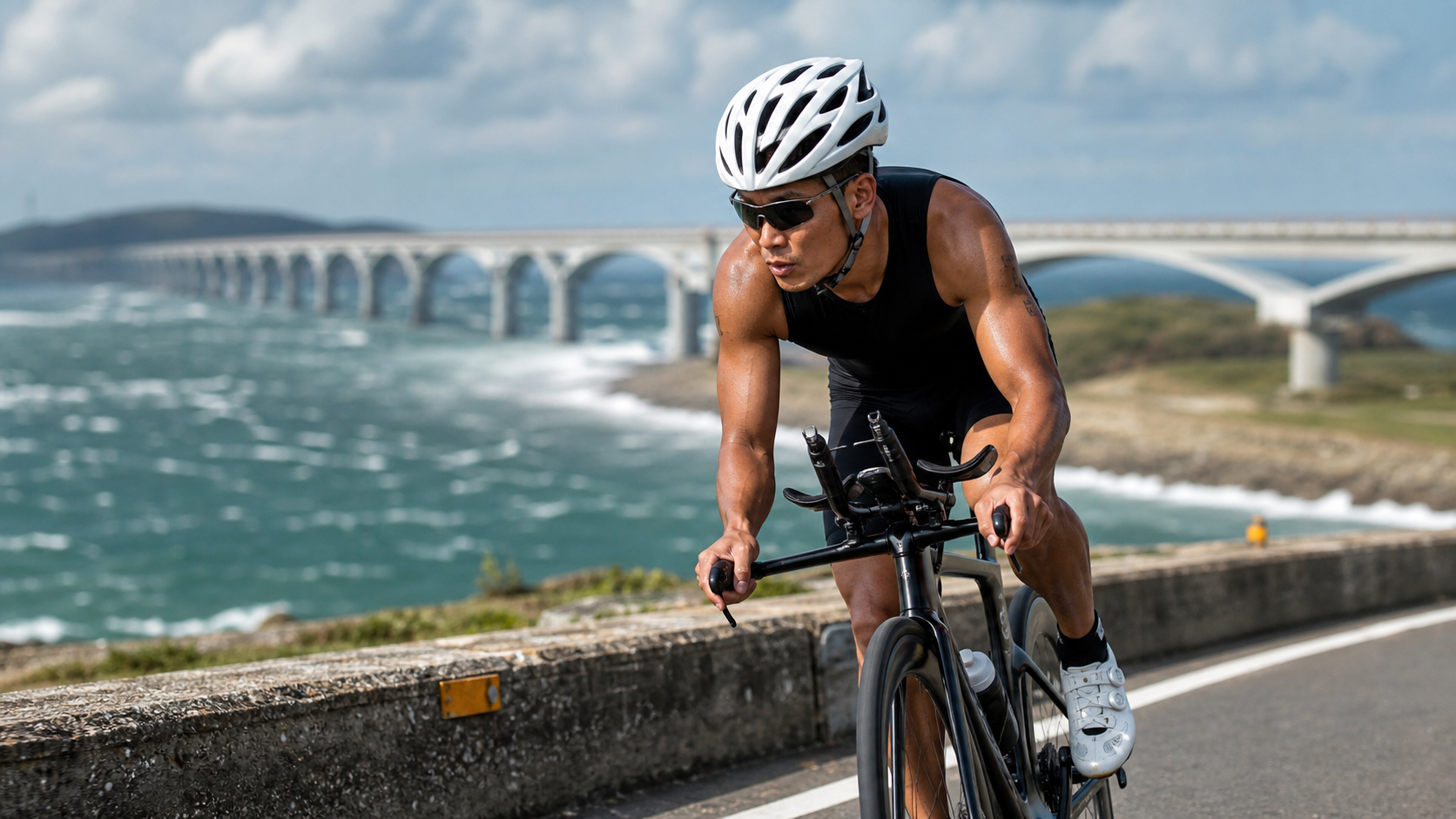
Coach’s Opening: In Penghu, You’re Not Racing the Course—You’re Negotiating with the Wind
I’ve been coaching triathletes for fifteen years now, working with everyone from office workers aiming to finish their first triathlon to genuine hard-chargers who eventually earned Kona slots. Over all these years, if I had to pick one Taiwanese race venue that “teaches the harshest lessons,” I’d say without hesitation: Penghu.
When athletes first talk to me about the Penghu race, they usually ask about course elevation, aid station spacing, or the open-water swim temperature. All important, but none of them are the real point. I usually fire back with a question: “Have you ever ridden an aero bar across a 2.5-kilometer bridge in a 30 km/h crosswind?”
Most people freeze. Because training on the Taiwan mainland, we’re used to the logic of “climbs hurt, flats feel great”—Wuling is tough, but at least the wind is predictable; the North Coast has wind, but you can hide behind windbreaks to catch your breath. Penghu gives you no such leeway. This is an archipelago of over ninety islands and reefs sitting right in the middle of the Taiwan Strait, with wind blowing for more than half the year. The local saying that “Penghu’s wind can blow a cow away” isn’t hyperbole—it’s just life.
So in this course guide, I’m not going to list a bunch of distance numbers you can already find on the official website. What I want to talk about is one thing: In Penghu, the wind IS the course itself. How you understand the wind, how you negotiate with it, and how you keep your power and heart rate from collapsing in its face—that determines whether you run smiling into the finish line or get blown into questioning your existence on that bridge.
This article is for three kinds of people: first-timers and mid-level athletes who are nervous about tackling Penghu; veterans who want to set a PR here but keep falling apart in the second half of the run; and science nerds who just want to understand “how crosswinds actually eat your watts.” Let’s go through it section by section.
1. First, Understand: Why Penghu’s Wind Is “Another Kind of Climb”
Crosswind Isn’t Headwind, but It’s Just as Deadly
Most people’s understanding of wind stops at “headwind is tiring, tailwind is fun.” That’s true for flat training on the mainland, but what really tortures you in Penghu is the crosswind.
The physics of crosswind are completely different from headwind. Headwind is frontal resistance—you drop your head, shrink your frontal area, and you can reduce the loss. Crosswind cuts in from the side, creating something called yaw angle. Wind tunnel studies show that the lateral force on a bike and rider increases nearly linearly with yaw angle—the larger the angle, the more it not only pushes you sideways but also increases your overall aerodynamic drag. In other words, a wind blowing in at thirty degrees from the rear-side does two bad things at once: it shoves your bike toward the shoulder, forcing you to expend energy on “corrective steering,” while secretly adding to your aerodynamic drag, making you inexplicably lose speed on sections that “don’t feel that windy.”
That’s why I always tell my athletes: In Penghu, crosswind is another kind of climb. Your power meter reads 200 watts, but your pace is only what you’d normally do at 170—that’s not your imagination; the crosswind is genuinely stealing your efficiency.
Deep-Section Wheels: A Weapon on the Mainland, a Liability in Penghu
Here’s the most classic equipment trap at the Penghu race, and the one that trips up the most people: deep-section wheels.
In flat time trials, deep rims or even disc wheels do reduce drag and chase ultimate aerodynamics. But deep rims have a fatal weakness: their large side profile acts like a sail in crosswinds. When the yaw angle gets big, the lateral force caught by that “sail” can instantly shove your front wheel off line—especially when you pass building gaps, breakwater openings, or between bridge piers, where gusts suddenly change direction and the bike “jumps” in your hands.
I’ve seen too many athletes with a perfectly good set of deep rims trained on the mainland get their bars knocked around by a gust on the Penghu bridge, nearly drifting past the white line. In that instant, you’re not thinking about pacing—you’re thinking “am I going to crash.” And fear makes your whole body tense up, you unconsciously slow down, your heart rate spikes—one scare can destroy your rhythm for the next half hour.
So my equipment advice is straightforward:
| Wind Conditions | Front Wheel Suggestion | Rear Wheel Suggestion | Notes |
|---|---|---|---|
| Forecast gusts < 25 km/h | 40-50mm mid-section | 50-60mm deep-section | Balances aero and handling; for experienced riders |
| Gusts 25-35 km/h | 30-40mm shallow-to-mid | Mid-section (avoid disc) | Most common Penghu scenario; stability first |
| Gusts > 35 km/h | Shallow (under 30mm) | Mid-section or lower | Survival first; don’t fight the wind for aero gains |
Remember this: In Penghu, a mid-section wheel you can ride steadily will always beat a deep rim that scares you into not pedaling. The few watts you save on aero are nowhere near the confidence and rhythm you lose from one crosswind scare.
2. Aimen Beach Swim: Lateral Swell Is Worth Training More Than Water Temperature
This Isn’t a Pool—It’s a Sea with a Sense of Direction
The swim leg of the Penghu race takes place in the waters around Aimen. A lot of people preparing for the swim only think about “what’s the water temperature, should I wear a wetsuit.” Water temperature matters, of course, but I want to flag something more critical and much harder to train: lateral swell.
The biggest difference between open water and a pool isn’t the lack of lane lines—it’s that the water moves, and it has a direction. Penghu’s waters are influenced by monsoons and tides, and there’s often swell coming from the side. As you swim straight toward the buoy, the side swell keeps pushing you sideways. If you don’t correct, when you lift your head to sight halfway through, you’ll often find “how did I drift so far off,” and then to get back on course, you end up swimming several hundred meters more than the 1.9 km—before you’ve even gotten on the bike, you’ve already wasted energy and time.
Three Things I Make My Athletes Practice
For a swim with side swell like Penghu’s, I require athletes to complete at least a few open-water sessions before race day, focusing on these three things:
- Sighting: Every 6 to 9 strokes, lift your head to spot the buoy. Just a quick horizontal glance—don’t lift your whole head out of the water (that sinks your lower body and adds drag). Like a crocodile, just get your eyes above the surface.
- Lateral swell correction: Practice using “asymmetric strokes” to fine-tune your direction after being pushed off—if pushed to the left, put a bit more power into your right-hand pull to steer your body back on course. This needs repeated practice in real open water; you can’t train it in a pool.
- Flexible breathing rhythm: When a side swell hits, breathing toward that side can make you swallow water. You need to practice bilateral breathing—if the swell comes from the left, breathe to the right, keeping your rhythm steady.
A Real Lesson from an Athlete
I once coached an athlete with excellent swimming fundamentals—nobody in the pool could beat him at 1500 meters. But his first Penghu swim nearly made him cry. The reason: he only trained in the pool and had zero open-water experience. Once in the water, the side swell pushed him around until he was dizzy, his sighting was shaky, and he swam a zigzag pattern. He came out of the water nearly eight minutes slower than expected, and because he kept swallowing water, his heart rate was all over the place, which dragged down his bike leg afterward.
After that, I set a rule: If you’re going to Penghu, you need at least three open-water training sessions before race day. No negotiation. The sea won’t be gentle with you just because you’re fast in a pool.
Coach’s Cheat Sheet: If you can’t easily find safe open water in your area, a fallback is to deliberately practice in the pool “not looking at the lane line—close your eyes, swim three strokes, then sight” to train finding your target. At least get your body used to swimming straight without relying on visual guide lines.
3. The Cross-Sea Bridge: The Course’s Power Ceiling Is Right There in Those 2.5 Kilometers
Why This Section Is the Easiest to Fall Apart
If Penghu has one “boss level,” it’s definitely the 跨海大橋 (the bridge section between Xiyu and Baisha, i.e., the area commonly known as the Penghu跨海大橋). This bridge stretch is about two and a half kilometers long, spanning the sea between two islands with absolutely no shelter whatsoever. Wind from the Taiwan Strait blasts in from the side without any obstruction, with gusts that can approach or even exceed thirty kilometers per hour.
This section is the easiest to fall apart because it’s a double whammy of mental and physical pressure:
- Crosswinds cripple your power efficiency. As mentioned earlier, crosswinds simultaneously increase drag and handling burden. At the same pace, you might need to push 15% to 25% more watts just to hold your speed.
- Fear makes you pedal harder. Many people, when the wind knocks their handlebars around, instinctively think “get across as fast as possible” and surge. The result is your heart rate spikes straight into the anaerobic zone, and you burn all your matches before you’re even off the bridge.
The collapse script I’ve seen is almost always the same: athletes, due to nerves and crosswinds on the bridge, unconsciously push their power far beyond planned levels. By the time they’re off the bridge, their legs are half-dead, their pace for the rest of the ride falls apart, and they end up walking the final half marathon. This bridge isn’t meant to be charged; it’s meant to be managed.
Power Management: Treat the Bridge Like a “Speed-Limited Climb”
My core teaching to athletes is just one sentence: On the跨海大橋, hold your power ceiling, not your speed.
Because crosswinds make your speed unreliable—at the same wattage, a gust hits and your speed drops. If you’re staring at your computer trying to hold speed, you’ll only end up pedaling harder. So shift your focus from “speed” to “power” and “breathing.”
Here are the power management principles I give athletes of different levels for the跨海大橋 section (expressed as a percentage of FTP, Functional Threshold Power):
| Athlete Level | Overall Ride Target Zone | Bridge Section Ceiling | Notes |
|---|---|---|---|
| First-timer / Just aiming to finish | FTP 60-65% | No more than FTP 70% | Better slow than blown; save the legs for the marathon |
| Intermediate / Racing for a time | FTP 68-75% | No more than FTP 80% | Brief surges allowed in crosswind sections, but stay out of anaerobic |
| Advanced / Competing for AG podium | FTP 75-82% | No more than FTP 85% | Only execute with solid crosswind racing experience |
Key move: shift down and get low before the bridge. Before entering the bridge section, if the crosswind is significant, move your upper body from the aero bars to the hoods—your hands can react faster to crosswind pushes and reduce the risk of being blown over. At the same time, proactively shift down one or two gears and use a higher cadence with lower pedaling force to maintain power. This way, even if a gust disrupts your rhythm, the impact on your leg muscles is smaller.
Watch Your Heart Rate Too
Power is “what you put out”; heart rate is “what your body costs.” In Penghu’s crosswind sections, I have athletes watch both. A practical rule:
- If your heart rate is more than 10 to 15 bpm higher than the zone corresponding to your planned pace, but your power isn’t actually over target, that means the wind “scared” you—your body is burning energy on nervous tension. What you need to do isn’t speed up; it’s breathe deeply, relax your shoulders, loosen your grip, and bring the heart rate back down.
- Your heart rate will naturally run a few beats higher in Penghu’s heat and humidity than in cooler conditions. This is normal cardiac drift—don’t panic just because you see a high number.
四、Pacing Discipline in the Headwind Sections: The Ultimate Mental Test of the Course
The Tailwind High Comes with a Bill
The Penghu course is mostly a multi-loop circuit around the main island, with total elevation gain roughly between 1,100 and 1,300 meters depending on the wind-eroded terrain (varies slightly by year’s course configuration). This “rolling but not mountainous” terrain, combined with the omnipresent wind, creates a trap that catches many: the illusion of the tailwind section.
A multi-loop course means if you have a tailwind on the way out, you’ll have a headwind on the way back; or one section feels gloriously fast with the wind, and the next turn you’re grinding straight into it. Many people get too excited in tailwind sections, hammering out impressive paces, only to turn into a headwind and realize the energy they just overspent has to be paid back with interest.
I often tell athletes a metaphor: Penghu’s wind is like a credit card. Tailwind sections are swiping the card—it feels great, but the bill (the headwind section) always comes. If you max out the card on the tailwind today, the headwind on the return is the high-interest debt chasing you down.
The Right Pacing Philosophy: Watch Power, Not Speed
This is the same logic as the跨海大橋, but it needs to carry through the entire ride:
- Tailwind sections: hold your power ceiling, enjoy the speed but don’t add more. With a tailwind, the same watts will produce more speed. That’s a gift from the heavens—take it, but don’t pedal harder just because it “feels easy.” Every extra watt you push is borrowing from the version of you on the way back.
- Headwind sections: hold your power floor, don’t panic and add more just because speed drops. In a headwind, speed will drop. That’s physics, not a lack of strength. Keep your eyes on the power and stay in your planned zone, let the speed fall naturally, and tell yourself “this section is supposed to be slow, everyone is slow here.”
Let’s put a concrete number on it: an intermediate athlete who holds their power steadily around 70% of FTP, without crossing the line in either tailwind or headwind, will have a beautifully smooth Normalized Power over the whole ride. In contrast, an athlete who surges in tailwinds and grinds in headwinds, at the same average power, will have a much higher Variability Index (VI). The metabolic cost to their body is far greater, and their legs will be in significantly worse shape when they get off the bike to run.
In Penghu, the smoother you pace, the better you run. Tattoo that on your heart.
五、The Run: A Triple Threat of Heat, Sea Breeze, and the “Bike Bill”
Many people think Penghu’s difficulty is all in the bike, but in reality, the run is where the real separation happens, and its difficulty is “stacked”: the unpaid bill from the bike leg, the midday heat, and the sea breeze that dries your sweat and makes you underestimate dehydration—all three come to collect at once.
Why Penghu’s Half Marathon Is Especially Brutal
First, the state of your legs the moment you dismount is decided by the bike leg. All the talk about pacing discipline earlier isn’t for nothing—if you surged on the跨海大橋 and maxed out the credit card on the tailwinds, your quads are half-dead when you start running, and you’ll feel the pain within the first three kilometers. Conversely, an athlete who held their power beautifully all ride, with smooth normalized power, will have legs that are still “alive” and can settle into a running rhythm steadily.
Second, the run course has little shade and strong sun. The coastal route is beautiful, but direct sunlight plus radiant heat off the asphalt makes the perceived temperature several degrees higher than the actual air temperature. Once your core temperature climbs, your pace will unconsciously drop while your heart rate keeps drifting up.
Third, the “dry comfort illusion” of the sea breeze is the most dangerous. During the run, the sea breeze feels great and your sweat dries instantly, making you think “I’m not sweating much today.” Wrong. The sweat is evaporating, not not happening. This is exactly the situation where dehydration is most underestimated. Then, in the later stages, your calves and quads suddenly cramp up and your pace collapses.
Pacing and Fueling Discipline for the Run
The core of the run strategy I give athletes is “aim for a negative split, but prioritize stability over speed first”:
- Deliberately hold back for the first 5 kilometers. Fresh off the bike, nerves are still high, and with the urge to “make up time from the bike,” many people run too fast out of T2. Deliberately run the first 5K slightly slower than what feels comfortable, letting your body transition from cycling to running and letting your core temperature stabilize.
- Don’t pass a single aid station empty-handed. In Penghu’s heat, aid stations are your lifeline. At minimum: drink water or sports drink, use the sponge or ice water on your head and neck to cool down, and take salt tablets as needed. Lowering your core temperature is just as important as hydrating.
- Use “head and neck dousing” to cool down. Pouring water over your head, back of the neck, and wrists—areas near major blood vessels—effectively helps dissipate core heat, keeping your pace from collapsing due to overheating.
Run Segment: Hydration and Cooling Reference
| Situation | Action to Take | Common Mistakes |
|---|---|---|
| Every aid station | Water/sports drink + pour water over head and neck to cool down | Skipping because you don’t feel thirsty, or only drinking plain water without sodium |
| When you start feeling hot, heart rate drifting high | Proactively slow down, increase cooling with water | Pushing the pace through it, core temperature spirals out of control and you blow up completely |
| Early signs of calf/thigh cramping | Immediately take sodium, slow down, walk briefly if necessary | Gritting through the pain, cramping up until you can’t move |
| Still feeling good with 5 km to go | Gradually accelerate, unleash the energy saved earlier | Blowing up earlier, reduced to walking the final stretch |
Coach’s Note: Taiwanese triathletes often agonize before the race over “whether to switch to carbon-plated running shoes,” but on Penghu’s high-heat course, the impact of your cooling and fueling strategy on performance far outweighs that tiny bit of rebound from the shoes. Take care of not getting heatstroke, not dehydrating, and not cramping first; then talk about advanced gear.
T2 Transition: Don’t Fumble Around Here
Many people underestimate the transition area, especially after such a hard bike leg—your head is still spinning when you enter T2. Here are some practical reminders:
- Before dismounting, “wiggle your ankles and loosen your quads” to pre-activate the muscle groups switching from pedaling to running.
- Walk through the transition area route before the race, memorize your gear location and the exit direction. Penghu is windy; secure small items like race belts and caps so they don’t blow away.
- Prepare your fuel and cooling supplies before leaving T2 (salt tablets, gels stashed away), don’t run out and realize you forgot them.
VI. Pre-Race “Wind Sense” Training and Physical Preparation
Bike Fit: Two Things to Pay Extra Attention to in Penghu
Penghu’s crosswinds will amplify the flaws in your bike fit. Two key points:
- Retreatability of the aerobar. You need to be able to switch from being tucked on the aerobars to holding the top of the handlebars within a fraction of a second. If your fit is too aggressive or your transition is too slow, you won’t react in time when a gust hits, greatly increasing the risk. Before the race, confirm that moving between your aerobars and shift levers is smooth.
- Core stability. Maintaining your position and direction in crosswinds relies on your core. In the weeks before the race, incorporate core exercises like planks and dead bugs into your routine. It doesn’t take much extra time, but it will help you “stay steady” on the bridge.
Don’t Overlook “Heat Acclimation”
If you’ve been training long-term in air-conditioned or cool environments and fly straight to Penghu for the race, your body’s tolerance for high heat won’t be sufficient, making heatstroke during the run segment highly likely. Two to three weeks before the race, do some heat acclimation: deliberately choose the hotter parts of the day for a few low-to-moderate intensity sessions, teaching your body to sweat more effectively and regulate core temperature. You don’t need to do this many times, but the difference between having done it and not is huge on race day.
VII. Common Mistakes and Fixes: The Traps I’ve Seen the Most People Fall Into in Penghu
Mistake 1: Using Mainland-Taiwan Equipment Thinking for Penghu
Symptoms: Bringing deep-section or disc wheels for ultimate aerodynamics, then spending the entire race on edge due to crosswinds.
Fix: Closely monitor the Central Weather Administration’s Penghu wind forecast the week before the race. If gusts look strong, decisively switch to mid-section wheels. Staying safe and stable always trumps theoretical aero numbers.
Mistake 2: Only Training for the Ocean Swim in a Pool
Symptoms: Fast in the pool, swimming a zigzag in the ocean, getting dizzy from side swells, swallowing water, heart rate spiking.
Fix: At least three open-water practice sessions before the race, focusing on sighting with your head up and bilateral breathing. If you can’t find open water, practice swimming in a straight line with your eyes closed in the pool.
Mistake 3: Sprinting Across the Bridge
Symptoms: Nervous and mashing the pedals on the bridge, heart rate spikes into the anaerobic zone, legs are dead after the bridge, and the second half falls apart.
Fix: Before entering the bridge, lower your posture (move to the top of the handlebars), shift to an easier gear and increase cadence, hold your power ceiling, and treat the bridge like a “speed-limited climb.”
Mistake 4: Hammering the Pace on Tailwind Sections
Symptoms: Getting excited and pushing extra watts in the tailwind, paying it back with interest in the headwind, normalized power spikes, and you can’t run after dismounting.
Fix: Watch power, not speed, the entire race. Accept the gift of the tailwind without adding more, and hold your lower limit in the headwind without panicking.
Mistake 5: Underestimating Hydration and Electrolytes
Symptoms: Penghu’s high heat, intense sun, and sea breeze drying your sweat makes you “feel like you’re not sweating much,” leading to severe dehydration without realizing it, and cramping on the run.
Fix: The sea breeze accelerates sweat evaporation, causing you to underestimate your fluid loss. Don’t rely on thirst to decide when to drink; replenish on a set schedule. A general guideline is about 500 to 800 ml of fluid per hour (adjusted for body weight and sweat rate), paired with electrolyte supplementation. Sodium intake should range from a few hundred to nearly a thousand milligrams per hour depending on how salty your sweat is. During prolonged exercise in high heat, relying solely on plain water can lead to hyponatremia—make sure to take sodium.
VIII. Four Weeks Out: A “Wind Sense” Training Plan You Can Follow
Concepts alone aren’t enough. Here’s a four-week pre-race training focus designed specifically for Penghu’s crosswind characteristics. This isn’t a complete periodized plan (that needs to be customized to your individual situation), but rather “additions” to your existing training to build the capabilities Penghu demands most.
Core Training Addition Principles
| Week | Bike Focus | Swim Focus | Purpose |
|---|---|---|---|
| 4 weeks out | Deliberately go out on windy days to practice crosswind handlebar reactions; include a 20-minute steady segment at 70% FTP in the middle of a long ride | 1 open-water sighting practice session | Build crosswind handling confidence + steady power ability |
| 3 weeks out | Simulate “multiple tailwind/headwind loops”: find an out-and-back route, cap power on the way out, hold the lower limit on the way back, practice watching only power, not speed | Bilateral breathing + side-swell correction practice | Pacing discipline + ocean swim direction control |
| 2 weeks out | One “bridge simulation”: find a long, flat bridge or dike road, hold your power ceiling the entire way, use high cadence and low force | 1 full-distance open-water simulation swim | Practical power ceiling management |
| 1 week out (taper week) | Significantly reduce volume, keep 2-3 short but intense “wake-up” sessions, no long rides | Easy swimming, find the feel of the water, no intensity | Eliminate fatigue, store energy, maintain neural activation |
A Specific “Bridge Simulation” Session Example
If you want to be more specific about training your power ceiling management, here’s how (using a mid-level athlete as an example):
- Warm-up: 15 minutes, gradually building to 60% FTP, maintaining cadence above 90 rpm.
- Main set: Find a flat, mostly exposed road (seawall or river dike is best) with about 3 to 5 km each way. Do 4 out-and-back loops, strictly holding your power on every loop without exceeding your set bridge ceiling (e.g., 80% FTP for a mid-level athlete). Deliberately hold back when you “feel like accelerating in the tailwind,” and don’t panic and add watts when “speed drops in the headwind.”
- Key observations: After each loop, record your average power, average heart rate, and average speed. You’ll notice a big difference in speed between tailwind and headwind, but as long as you hold your power, your heart rate won’t spiral. That’s the ability Penghu demands.
- Cool-down: 10 minutes of easy spinning.
Master this routine, and you won’t panic on Penghu’s跨海大橋. Because your body will already know what it feels like to “hold power, don’t chase speed when the crosswind hits.”
IX. Actionable Advice for Athletes of Different Levels
If You’re a “First-Time Penghu, Just Want to Finish”
- Mindset: Penghu isn’t the place to prove your speed; it’s where you learn to “coexist with the wind.” Set your goal as safe, steady, and finishing with a smile.
- Equipment: Choose stable mid-section wheels; don’t risk handling for theoretical aero numbers.
- Pacing: Hold your power at 60-65% FTP the entire race, and don’t exceed 70% on the跨海大橋. Better to be slow than to blow up.
- Ocean swim: You must have open-water experience before the race, even if it’s just having a coach take you into the sea a few times to get familiar.
- Fueling: Replenish water and sodium on a set schedule, don’t wait until you’re thirsty.
If You’re “Someone Who Has Done a Few Races and Wants to Set a PB in Penghu”
- Mindset: Your enemy isn’t anyone else—it’s yourself, the one who can’t resist accelerating on the tailwind sections. Pacing discipline is your weapon.
- Equipment: Choose between mid-profile and mid-deep rims based on wind conditions, and test your handling confidence before race day.
- Pacing: Hold power at 68-75% of FTP, monitor normalized power and variability throughout, and aim for smoothness.
- Technique: Practice the bridge-crossing posture drop and gear-down maneuver until it becomes muscle memory.
- Running: Save your power on the bike leg—the second half of the Penghu marathon is where the real gaps open up in the heat.
If You’re “Chasing an Age-Group Podium or Even a Qualification Slot”
- Mindset: You already understand pacing. Penghu tests your risk judgment—when to push up and when to hold back.
- Equipment: You have the ability to handle mid-deep rims, but you must still respect gusty winds. Be sure to test the actual wind conditions on-site before the race.
- Pacing: FTP 75-82%, with tactical short surges up to 85% allowed in crosswind sections, but never dip into anaerobic territory.
- Details: Fine-tune your heat dissipation, hydration, and sodium replenishment strategy down to every single aid station.
- Decisive Factor: While others get their rhythm disrupted by the wind or get lured into blowing up on tailwinds, you hold your plan steady. In Penghu, the steadiest rider is usually the fastest.
10. FAQ
Q1: Should I use a disc wheel for the Penghu race?
A: Unless the forecast clearly calls for rare windless, perfect weather, I strongly advise against general athletes using a rear disc wheel in Penghu—and definitely not a deep-section front wheel. In crosswinds, the handling risk of deep rims far outweighs the few watts they save. Stable handling lets you push hard and hold power, and that’s what truly makes you fast.
Q2: My heart rate spikes as soon as I hit the bridge. Is my fitness lacking?
A: Not necessarily. In most cases, it’s “anxiety-induced heart rate elevation”—you’re spooked by the crosswind, your shoulders tense up, you grip the bars too hard, and your body is burning energy without going anywhere. Take a deep breath, relax your shoulders, loosen your grip, and your heart rate will usually come back down. If your power isn’t over target but your heart rate is soaring, the problem is often mental, not physical.
Q3: The side swell pushes me off course during the ocean swim. What should I do?
A: The key is “sight frequently, correct constantly.” Every 6-9 strokes, lift your head to spot the buoy. If you’ve drifted, use an asymmetrical stroke to make micro-adjustments back to your line. You can’t train this skill in a pool—you have to practice in the open water.
Q4: It’s hot in Penghu. How should I manage my hydration and sodium?
A: The biggest trap is the sea breeze drying your sweat, making you underestimate your losses. Hydrate on a schedule, not by thirst. Aim for about 500-800 ml of fluid per hour with electrolytes. For sodium, supplement anywhere from a few hundred to nearly a thousand milligrams per hour depending on how salty your sweat is. Drinking only plain water for long periods carries a risk of hyponatremia—make sure you’re taking in sodium.
Q5: What should I do in the final week before the race?
A: Taper. Cut your training volume significantly, keeping only a few short, sharp wake-up sessions to let your body clear fatigue and store energy. You can’t build new fitness in this week—you’ll only accumulate fatigue. Trust the months of training you’ve already put in.
Conclusion: Learn to Negotiate with the Wind, and You’ll Tame the Island of Chrysanthemums
Having coached athletes for so many years, my favorite moment is seeing students who were terrified of Penghu at first tell me after crossing the finish line: “Coach, today on the bridge, I wasn’t nervous at all.”
That’s the moment they truly understand—Penghu was never trying to defeat you. It was asking you to learn a more mature kind of riding wisdom: acknowledge the things you can’t control (the wind), then put your energy into the things you can (your power, your heart rate, your breathing, your rhythm).
The wind won’t die down because you’re nervous, and the waves won’t flatten because you’re anxious. But when you stop fighting it head-on and start negotiating with it, you’ll discover that Penghu is actually one of Taiwan’s most captivating triathlon venues: the azure sea, the unbeatable coastline, and that bridge standing tall in the wind will all become unforgettable scenes of your life—not nightmares.
Hold your power steady, keep your mind calm, and treat every crosswind as practice rather than a threat. When you do all this, you won’t just have finished a triathlon—you’ll have tamed the wind on the island of wind.
The wind of the Island of Chrysanthemums is waiting for you. This time, it’s your turn to negotiate with it.
This article is for educational purposes and does not replace individual assessment by a physician, physical therapist, or nutritionist. Please adjust your actual training and nutrition plan according to your personal health condition and professional evaluation.
References
- Race course information and crosswind characteristics of the跨海大橋 (Penghu Transoceanic Bridge): IRONMAN Penghu Training Plan & Race Guide (FE26)
- 2026 Fubon IRONMAN Penghu race introduction: don1don
- Effects of crosswind aerodynamics and yaw angle on drag/lateral force: Fighting crosswinds in cycling: A matter of aerodynamics (ResearchGate)
- Cycling speed and power correction under crosswind conditions: Cycling speeds in crosswinds, Phys. Rev. Fluids
Related Reading
- Penghu Transoceanic Bridge Riding Challenge: A Test of Willpower in the Sea Breeze
- IRONMAN 70.3 Taiwan Kenting: A Home-Turf Guide for Local Athletes
- Challenge Taiwan Taitung Course Complete Analysis: Three-Segment Guide to Living Lake, East Coast, and Forest Park, Plus Coping with Humid Heat
- Penghu Transoceanic Marathon: Complete Race Management Skills for Island Wind Conditions and Summer Heat
JJSC南台灣單車走春三日行 DAY 1 / 強度 x 美食 x 節慶體驗 / 公路車 CT Yeh
5 個月前
大武山後門26%歡樂陡坡!JJSC南台灣單車行Day2 / 被颱風追著跑 / 公路車 / CT Yeh
2 年前
CT 喇低賽) 武嶺牽車 才是王道 西進牽車四小時內秘訣 攝手位置 如何判斷 防抽筋小秘訣
7 年前
一日北高前的西濱集訓 | 跟著11小時軍團 | 300W踩不動的大逆風 | 輪車破風差幾瓦?
6 年前
2023桃園團體繞圈賽 / 海鷗繞圈賽 | 全程空拍數據版 | 公路車 | CT Yeh
2 年前
2019 夏季KOM 5小 完賽心得 準備攻略 東進武嶺 夏季登山王之路 Taiwan KOM Challenge
7 年前
#東進武嶺 全程實況錄影 5小時半 #夏季KOM #太魯閣 Taiwan KOM Challenge Reality Video Taroko scenery
7 年前
水金九不厭五分 10度寒流冷到不願停!feat. 卡卡 / 公路車 / CT Yeh
6 個月前