LAVA TRI Dapeng Bay Station Analysis: The Home Turf of Southern Taiwan Triathletes, the Peloton Risks of a Flat Loop, and the Science of Pacing in High Heat and Humidity
Coach’s Opening: The Time-Trial Bike That Rode Itself Into the Ground at Dapeng Bay
Let me paint you a picture. Two years ago at the LAVA Dapeng Bay race, I was watching one of my athletes—let’s call him A-Kai—ride into T2 from the transition area. His average speed for the first 20 kilometers was almost too good to be true, well above the target power we’d set in his training plan, and he had a grin on his face that said, “I’m feeling amazing today.” But then he got off the bike and hadn’t even run 3 kilometers before he fell apart. His heart rate spiked with seemingly no ceiling, his pace dropped from the planned 5:30 per kilometer all the way down to 6:40, and he spent the last 7 kilometers shuffling between running and walking just to make it to the finish.
After the race, he asked me: “Coach, isn’t Dapeng Bay the flattest, easiest course out there? I felt like I was riding easy—how did my run blow up that badly?”
That question is exactly what this article aims to answer. The difficulty of the Dapeng Bay course isn’t in the climbs or the technical corners—it’s in the fact that it “looks too easy to ride,” combined with that stifling, humid air of southern Taiwan, which lures you into triathlon’s two classic mistakes: letting the pack and the terrain pull you into overspeeding on the bike, and underestimating the penalty that heat and humidity exact on your pacing and fueling.
I’ve been coaching triathletes for 15 years, from first-timer finish programs all the way to athletes who’ve earned Kona slots, and I’ve been back and forth to Dapeng Bay more times than I can count. It’s the home turf of southern Taiwan triathletes, a lucky ground for many people’s first triathlon or personal bests—but it’s also a course that “punishes greed.” Today, I’ll break this course down for you from start to finish from a coach’s perspective.
1. Getting to Know the Course: What Kind of Course Is Dapeng Bay, Really?
Taiwan’s Only Flat Loop on a Closed Expressway
The LAVA TRI Dapeng Bay race is held in the Dapeng Bay National Scenic Area in Donggang, Pingtung, and it’s a very special stop on Taiwan’s triathlon calendar. Its biggest selling point is that the bike leg closes off a section of Provincial Highway 88, making it one of the rarest—arguably the only—event in Taiwan where triathletes can ride on a closed expressway-grade road surface. What does that mean? Wide roads, excellent pavement, no traffic lights, no oncoming cars—theoretically, it’s a “pedal flat-out” paradise of a course.
The event offers multiple distance categories, with the main event being the standard 51.5 km (1.5 km swim, 40 km bike, 10 km run). There’s also a 50.3 km entry-level category with a 0.3 km swim, a duathlon category, and ultra-short distances like the mini-tri and kids’ tri for beginners or families. I’ve verified the distance information, and it’s listed in the references at the end of this article.
Terrain Characteristics of the Three Disciplines
Let me organize the course characteristics of Dapeng Bay into a table for you—this is the checklist that runs through my head when I scout a course with my athletes:
| Discipline | Terrain Characteristics | Coach’s Key Point |
|---|---|---|
| Swim (Sailing Base / Lagoon Waters) | Enclosed bay, relatively calm waves, but water temperature runs high and visibility is average | Easy to swim but easy to go out too fast; an excessively high heart rate exiting the water will drag down the whole race |
| Bike (Closed Expressway) | Extremely flat, excellent road surface, loop with turnarounds | The biggest trap zone: flat roads + pack-induced overspeeding |
| Run (Park Roads) | Flat, little shade, asphalt glare | The main battleground for heat and humidity; the highest-risk zone for pace collapse |
See the key point? All three disciplines at Dapeng Bay are flat—nowhere forces you to “slow down whether you like it or not.” On a course with climbs, the hills force you to throttle back; but at Dapeng Bay, throttling back is 100% dependent on your own discipline. That’s the real difficulty here.
2. Concepts and Scientific Foundation: Why “Flat + Hot + Humid” Is a Pacing Killer
The Flat-Road Trap: No Natural Brakes
I often tell my athletes: “Hilly courses rely on your legs; flat courses rely on your brain.”
In places like Wuling or Yangmingshan with big climbs, even if you want to surge, you can’t surge for long—the gradient itself forces your power back into a reasonable range. But Dapeng Bay is pure flat. There’s no terrain to remind you how hard you’re pushing or how high your heart rate is climbing. Many athletes (especially those with some cycling background) get onto that closed expressway, see the wide, straight road, get a rush of adrenaline, and treat the bike leg like a time trial—burning up the “legs” they’ll need for the run before they even get there.
The cruel reality of triathlon is this: the two or three minutes you save on the bike often cost you five minutes or more on the run—or even a complete collapse into walking. Dapeng Bay is a prime example.
Pack Risk: The Hidden Danger of a Flat Loop
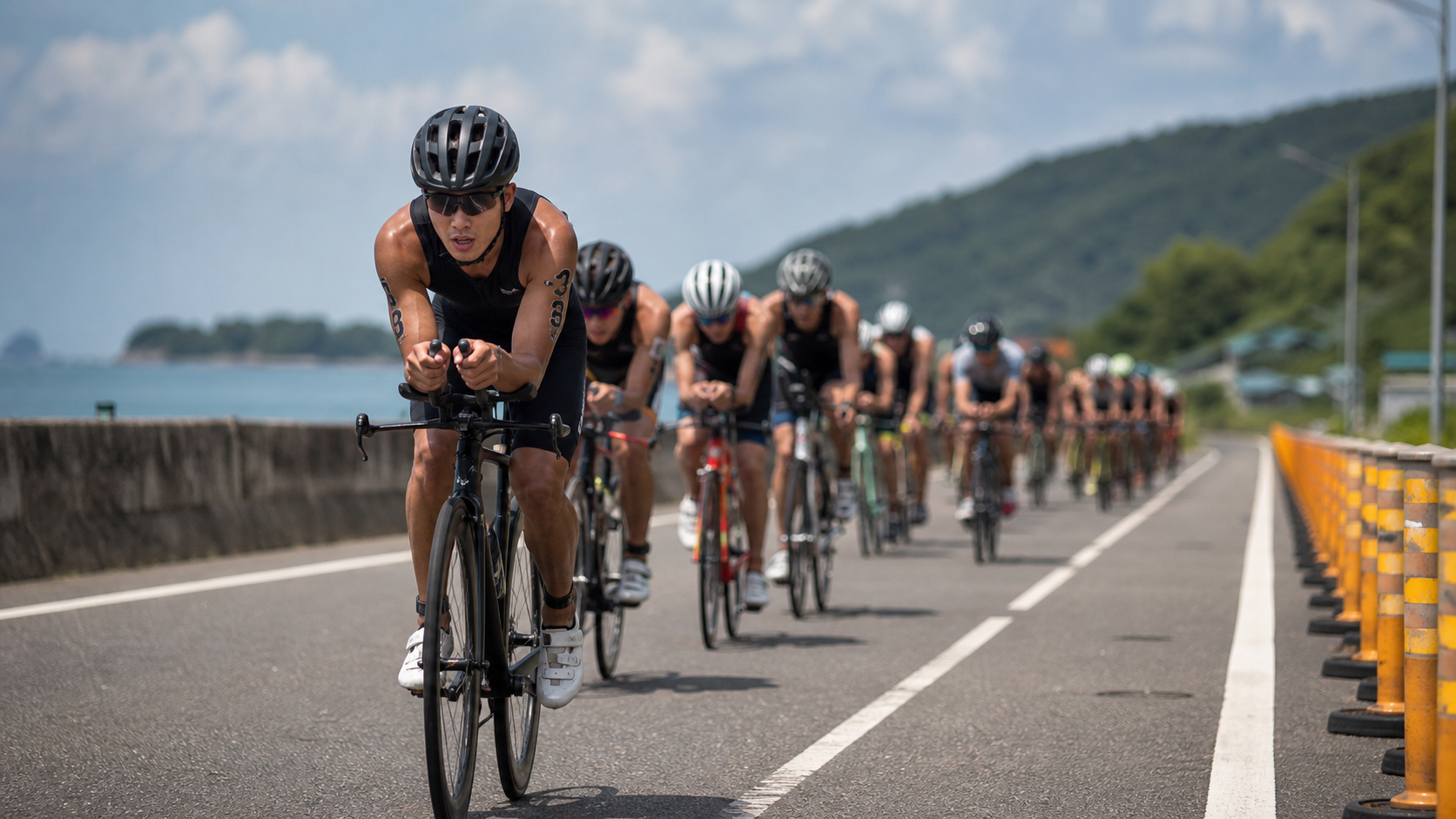
This is an issue at Dapeng Bay that deserves special attention. Because the course is flat, the roads are wide, and it’s a loop or out-and-back format, athletes tend to bunch up into packs on the bike leg. This creates two risks:
The first is a rules risk. Most standard triathlons enforce a “no-drafting” rule, requiring a set distance between bikes (commonly a 10-to-12-meter gap). On flat roads, everyone’s speed is similar, so riders easily string together in a line, and before you know it, you’re hit with a drafting penalty. I’ve had athletes penalized exactly this way on flat loop courses, losing places for nothing.
The second is a pacing risk. Even setting aside the rules, when you’re riding in a group, your rhythm easily gets carried away by others. Someone in front accelerates, and you unconsciously follow; someone cuts a line, and you’re forced to react. This state of “being pulled along by the pack” makes your power output fluctuate wildly, which is far more energy-draining than steady output. On flat roads, steady power is worth far more than high peak power.
The Physiological Penalty of Heat and Humidity
This is the toughest hurdle at Dapeng Bay—and at all southern Taiwan races. The LAVA Dapeng Bay race is usually held in the warmer seasons, and even outside high summer, southern Taiwan’s humidity runs high year-round. And humidity, not temperature, is the triathlete’s invisible killer.
When we exercise, our bodies dissipate heat primarily through “sweat evaporation.” Sweat has to evaporate to carry heat away. But when the air humidity is very high, sweat beads up on your skin and won’t evaporate—you’re drenched in sweat, yet you’ve gained almost no cooling effect. That’s why muggy weather feels worse than dry heat, and why your heart rate inexplicably spikes.
The sports science literature quantifies this clearly. Based on the research I’ve verified (URLs at the end):
- For every 1% of body weight lost (dehydration), core body temperature rises approximately 0.12 to 0.25°C, and heart rate rises approximately 3 to 5 bpm. This means a 70 kg athlete who dehydrates down 2 kg (about 2.8% of body weight) could see core temperature rise by nearly 0.5 to 0.7°C, and heart rate jump by over ten extra beats per minute at the same pace.
- High humidity significantly impairs time-trial performance, with literature showing roughly a 3.4% performance decrement; under hot conditions, self-paced performance decrement can reach 3.6% to 6%.
Stack these two together: Dapeng Bay’s flat roads make it easy to ride too hard (increasing heat production), high heat and humidity prevent you from dissipating that heat (core temperature rises), and dehydration further pushes heart rate up—this is a vicious cycle that snowballs. A-Kai’s run collapse that day was, at its core, the end product of this cycle.
2.5 The Overlooked First Leg: Heart Rate Management Coming Out of the Swim
Before I talk about pacing on the bike and the run, I want to insert something many people skip but is absolutely critical: the swim.
The swim at Dapeng Bay takes place in a sheltered inner bay (sailing base / lagoon waters), where the waves are relatively calm—a very friendly stretch of water. And precisely because it’s easy to swim, the most common mistake athletes make is—swimming too hard.
Remember, the swim takes up only a tiny fraction of your total time in a sprint triathlon, but it determines “the state you’re in when you get on the bike.” If you blow up your heart rate to save 30 seconds in the swim and exit the water redlined, your heart rate won’t come down through T1 and the first part of the bike—you’ll be paying off that debt the whole time. That’s why I always emphasize to my athletes: the goal of the swim is not to swim the fastest, it’s to exit the water with a steady heart, using the most efficient effort possible.
In practice, here’s what I recommend:
- Deliberately ease off and shorten your kick in the final 100 meters before exiting. Your legs are needed for the bike and run ahead; kicking hard in the swim is the least cost-effective way to spend energy.
- Don’t sprint into T1 after getting out of the water. Jog lightly, use deep breaths to bring your heart rate down, while unzipping your wetsuit and taking off your goggles.
- In T1, take a sip of water and spin easy for a few dozen seconds to let your body transition from “horizontal swimming” to “vertical pedaling” before settling into your target power.
The easy swim at Dapeng Bay is an opportunity for you to “swim conservatively, swim smart”—not a stage for “swimming all-out.” Treat the swim as the warm-up for the whole race, and you’ll find the next two legs feel much easier.
3. Practical Approach: How to Adjust Pacing and Nutrition for Dapeng Bay
Now that the concepts are covered, let’s talk about execution. This is the most important section of the article—I’ll give you specific pacing strategies, a segment-by-segment pacing chart, and a race-prep training plan.
Bike Leg: Restrain Yourself with a “Power or Heart Rate Ceiling”
On a flat course, you need an “external brake,” because the terrain won’t brake for you. That brake is a power ceiling or heart rate ceiling.
If you have a power meter, this is the most precise approach. Based on your FTP (Functional Threshold Power), for the bike leg of a 51.5 sprint triathlon, I typically set the target at 75% to 85% of FTP (i.e., an IF of 0.75–0.85), fine-tuned according to your running ability. If running is your weakness, lean toward the lower end; if you’re a strong runner, you can push toward the upper end.
For athletes without a power meter, use heart rate instead: keep your average heart rate on the bike below your lactate threshold heart rate (LTHR), roughly 8 to 12 bpm lower. A practical self-check: you should still be able to speak in short sentences while riding. If you’re so breathless you can only answer in single words, you’re pushing too hard.
At Dapeng Bay, the iron rule I give my athletes is: for the first half of the bike leg, keep your power/heart rate at the lower edge of the target zone. Because the closed expressway is so easy to ride fast on, and the pack will pull you along, almost everyone unconsciously overspeeds in the first half. If you can hold back in the first half and only let out a little more in the second half based on how you feel, you’ve already beaten a large portion of the field.
Pacing Adjustment Principles in High Heat and Humidity
Many people think “hot conditions” just mean drinking more water, but your pacing itself also needs to be actively dialed back. Here’s my adjustment framework:
First, start the run deliberately conservative. The run at Dapeng Bay has little shade and the asphalt radiates heat—it’s the hottest segment of the entire race. In the first 2 km after getting off the bike, your heart rate will be elevated from the ride. If you start at your usual target pace, you’ll likely blow up around kilometer 5 or 6. I require my athletes to run the first 2 km 10 to 20 seconds per kilometer slower than target pace, then gradually pick it up once the body adapts to the “running posture” and “heat-dissipation rhythm.”
Second, adjust by “feel” rather than stubbornly sticking to your watch pace. On hot, humid days, your target pace should be revised downward overall. Research shows that when humidity rises from 30% to 70%, running pace may be forced to slow by about 10%. So if race day is especially muggy, don’t compete with the PB pace you trained in cooler weather—the reasonable pace for that day is the reasonable pace for that day.
Third, use every aid station to cool down. At Dapeng Bay’s aid stations, don’t just think about drinking. Grab a cup of water and pour it over your head, the back of your neck, and the inside of your wrists. These areas have blood vessels close to the skin surface, so physical cooling is very direct and can genuinely help push your core temperature down a bit.
An Easy-to-Read Segment Pacing Chart (Example: 51.5 Sprint Triathlon, Advanced Age-Grouper Targeting Sub-3:00)
The chart below is the Dapeng Bay pacing blueprint I designed for an age-group athlete targeting a sub-3-hour finish. The numbers are example scenarios—you should adjust them to your own abilities. The key is the “allocation logic”:
| Segment | Target Pace/Intensity | Heart Rate Zone | Nutrition Focus |
|---|---|---|---|
| Swim 1.5K | Steady cruise, no sprint exit | Upper aerobic | Deep breaths before exit, stabilize heart rate |
| T1 Transition | Calm and unhurried, take a sip of water | — | Take a sip before riding, don’t rush to hammer |
| Bike 0–20K | IF 0.75–0.80, hold lower edge | LTHR −10 bpm | Hydrate every 15–20 min, small amounts of electrolytes |
| Bike 20–40K | Ease up to 0.80–0.85 as conditions allow | LTHR −8 bpm | Drink extra in the final 5 km to prep for the run |
| T2 Transition | Quick but composed | — | Pour water to cool down, grab salt tabs/gels |
| Run 0–2K | 10–20 sec/km slower than target | Gradually building | Pour water at every station, sip fluids |
| Run 2–7K | Settle into target pace | Lower threshold | Electrolytes + carbs based on heat |
| Run 7–10K | Give whatever you have left | Can reach threshold | Final push, hold form |
The soul of this chart is one sentence: hold back early, push late. Dapeng Bay rewards those who understand delayed gratification.
Nutrition Rhythm: Quantitative Recommendations for Hot Weather
I always give ranges rather than false precision for nutrition, because sweat rates and body weights vary greatly between individuals. Here’s a general starting point for a hot-weather sprint triathlon:
- Fluids: Roughly 500 to 800 ml per hour in hot weather, taken in small sips to avoid GI distress from gulping too much at once.
- Electrolytes (mainly sodium): For heavy sweaters, roughly 500 to 1000 mg of sodium per hour, from sports drinks, salt tabs, or electrolyte gels. Southern Taiwan is muggy and you’ll sweat a lot, so sodium needs run high.
- Carbohydrates: Roughly 60 to 90 g of carbs per hour, primarily during the bike leg (easier on the stomach), with the run relying mainly on gels plus water.
- Timing: Don’t wait until you’re thirsty to drink, or hungry to eat. Thirst is already a sign of mild dehydration.
A practical self-calibration method: weigh yourself before and after training sessions. The weight difference is roughly the fluid you lost during that time (1 kg ≈ 1 liter). Knowing your own sweat rate tells you how much to take in on race day, rather than copying someone else’s numbers.
4. Race-Prep Training Plan: Tuning Your Body to Handle the Heat
Knowing pacing isn’t enough—you need to build your body up over the weeks before the race to handle this environment. Here’s the Dapeng Bay prep direction I give my athletes, using an 8-week pre-race window as an example:
| Week | Training Focus | Key Workout Example |
|---|---|---|
| Weeks 8–7 | Build aerobic base | Long ride 2–3 hrs steady aerobic; long run 90 min Zone 2 |
| Weeks 6–5 | Add specific intensity | Bike threshold intervals 4×8 min @ 90% FTP; run tempo sessions |
| Weeks 4–3 | Heat adaptation + transition practice | Brick workouts (ride then immediately run); deliberately train in the hot midday hours |
| Week 2 | Race-intensity simulation | One combined rehearsal at near-race pace |
| Race week 1 | Taper | Reduce volume, keep intensity, prioritize sleep and hydration |
Here I want to zoom in on two key workouts specific to Dapeng Bay.
Heat Acclimatization
This is the most overlooked yet most effective tactic for races in southern Taiwan. The human body can be “trained” to handle heat. When you exercise in hot conditions for about 10 to 14 consecutive days, your body adapts: you start sweating earlier, your sweat becomes more dilute (retaining sodium), plasma volume increases, heart rate is lower at the same pace, and core temperature is more stable.
Practical approach: About 2 weeks before the race, deliberately schedule several training sessions during the midday or afternoon heat (intensity doesn’t need to be high—the key is exposure to heat). If you live in a cooler area or the weather happens to turn cold before the race, you can also create heat stimulus by wearing extra layers or riding indoors in a stuffy environment. Athletes who complete heat acclimatization will feel like someone turned on the air conditioning at Dapeng Bay—in the same weather, your perceived effort and data will both be noticeably better.
Brick Transition Training
A Brick is a combination workout of “ride immediately followed by run.” For those first few hundred meters after getting off the bike, your legs feel stiff and foreign—many beginners are startled by this “jelly legs” sensation and lose control of their pacing. The solution is to practice—run immediately after riding, letting your body memorize this transition. Because it’s easy to push too hard on the bike leg at Dapeng Bay, Brick training has an additional benefit: it will honestly tell you how miserable your run will be if you ride too aggressively. This is the best discipline lesson there is.
4.5: Deep Dive into Packs and Wind: The Physics of Flat Loops
I want to break down the “pack risk” issue even further, because the course format at Dapeng Bay (loop/out-and-back) makes this especially worth studying.
Why Loop and Out-and-Back Courses Cause Everyone to Clump Together
Loop or out-and-back courses inherently “compress” athletes of different speeds along the time axis. Imagine: at the start, everyone is still in one long line, but after the turnaround, fast riders catch up to slow ones, and slow ones get lapped by fast ones, so the originally dispersed crowd regroups at certain sections. If you don’t proactively manage this, you’ll find yourself sandwiched among a group of people at similar speeds, stuck with no easy way in or out.
This is a major taboo in draft-legal triathlons where “no drafting” rules apply. Officials are especially prone to penalizing in these congested sections because it’s hard to maintain gaps. My advice: rather than passively staying in a pack and praying you won’t be penalized, proactively create your own gaps. If you see a cluster of riders bunched up ahead, it’s better to ease off slightly to create a safe gap, or decisively pass the entire group in one go and then settle back into your own rhythm—either is better than staying glued inside.
Wind: One of the Few Variables at Dapeng Bay That Requires Thought
Although Dapeng Bay is flat, it’s coastal and a loop course, so “wind” is one of the few elements that requires strategic thinking. An out-and-back course means you’ll inevitably have a tailwind section and a headwind section.
A common beginner mistake is: pedaling hard for fun in the tailwind, then fighting hard into the headwind. That’s exactly backwards.
The correct logic is—
- Headwind section: accept that you’ll be slower; keep power/heart rate within your plan, and don’t blow up your heart rate trying to hold your bike computer’s speed. The cost of fighting a headwind is disproportionately high.
- Tailwind section: this is where you get speed “for free”; maintain steady power and let the wind earn you extra speed. No need to push harder just because you’re going fast.
In other words, on windy flat roads, what you defend is “power/perceived effort,” not “speed.” Speed will naturally fluctuate with the wind—that’s normal, so don’t fight it. Athletes who conserve in tailwinds and stay steady in headwinds will have a much smoother energy curve throughout, leaving plenty in reserve for the run.
5: Common Mistakes and Fixes: Six Traps at Dapeng Bay
These are the most frequent and most painful mistakes I’ve seen at Dapeng Bay over years of coaching athletes. Check how many you’ve fallen into.
Mistake 1: Blasting Off in the First Half of the Bike Leg
Symptoms: Getting too excited on the closed expressway, with power/heart rate far exceeding plan in the first 20 km.
Fix: Use a hard power or heart rate ceiling to restrain yourself; let people pass you in the first half. Remember A-Kai’s story.
Mistake 2: Getting Drawn into a Pack’s Rhythm, or Even Taking a Drafting Penalty
Symptoms: Riding within a crowd, speed fluctuating, or getting penalized for not maintaining distance.
Fix: Proactively find open space; it’s better to ride alone at a steady pace than to stay glued to a pack. Maintain your bike gap.
Mistake 3: Underestimating Humidity and Under-Fueling
Symptoms: Drinking the same amount as on a cool day, then cramping, feeling dizzy, or losing heart rate control on the run.
Fix: Proactively increase intake in hot weather, especially sodium. Pour water over yourself at every aid station.
Mistake 4: Starting the Run Too Fast
Symptoms: Leaving T2 and starting at target pace or faster, then blowing up after 5 km.
Fix: Deliberately run 10–20 seconds/km slower for the first 2 km to let your heart rate and cooling stabilize first.
Mistake 5: Skipping Heat Acclimatization Entirely
Symptoms: Training in air conditioning or cool hours, then failing to adapt to southern Taiwan’s heat.
Fix: Schedule heat-environment training 10–14 days before the race so your body gets “acquainted” with the weather first.
Mistake 6: Unprepared Gear and Sun Protection
Symptoms: No cap/sun protection, no sunscreen, dark clothing absorbing heat—extra energy drain during the race.
Fix: Light-colored breathable jersey, sun cap or visor, sunglasses, sunscreen. Dapeng Bay has little shade; these details accumulate into a significant difference in perceived effort.
6: Action Plans for Athletes of Different Levels
The same course calls for different strategies depending on your level. Here are my specific directions by athlete tier.
First-Timer Finish Group (Goal: Finish safely and happily)
- The primary goal is finishing, not speed. Dapeng Bay is flat and actually a very friendly first-timer venue—enjoy it.
- Ride the entire bike leg at an intensity where you can still hold a conversation; don’t chase anyone.
- Use a run-walk strategy on the run (e.g., run 4 minutes, walk 1 minute)—that’s completely fine. Walking isn’t shameful; walking is strategy.
- Stop at every aid station to drink and pour water; treat cooling down as a mission.
- Do at least one or two Brick transitions before race day so you get to know the jelly legs.
Advanced Age-Group Group (Goal: Set a PB or compete for an age-group podium)
- Strictly enforce power/heart rate ceilings; riding the lower edge in the first half of the bike leg is your biggest weapon.
- Seriously complete 10–14 days of heat acclimatization—at Dapeng Bay, this is an investment that directly converts into minutes saved.
- Quantify your fueling: calculate your sweat rate, follow the plan during the race, and don’t improvise your drinking.
- Practice maintaining an independent rhythm within a pack, and protect your bike gap to avoid time penalties.
- Use a “negative split” mindset on the run (second half faster than first); hold back for the first 2 km no matter what.
Elite/Target-Time Group (Goal: Stand on the podium or earn a ticket to higher-level races)
- Use power files for precise pacing distribution, factoring in how wind affects each direction of the loop.
- Make heat acclimatization more systematic, possibly combined with a pre-race hydration/electrolyte loading strategy.
- Practice transition zone flow, mounting/dismounting, and shoe changes until you waste zero seconds.
- Be highly attuned to integrating heart rate and perceived effort; in high heat, read your body’s warning signals and know when to ease off a bit more and when you can let go.
7: One Week Before and Race Day: A Practical Checklist
Finally, here’s a condensed action checklist you can follow directly:
One week before the race:
- Enter the taper week—reduce training volume but keep a bit of intensity feel.
- Complete your final heat exposure session, then rest well.
- Check your gear: light-colored breathable jersey, sun cap, sunglasses, sunscreen, and nutrition—all prepared and tested.
- Prioritize sleep; being well-rested matters far more than squeezing in one more workout.
- In the days before the race, steadily maintain hydration and electrolytes; don’t suddenly binge-drink.
Race day:
- Arrive early and familiarize yourself with the transition zone flow and entry/exit directions.
- Don’t sprint the swim; stabilize your heart rate as you exit the water.
- Ride the lower edge in the first half of the bike leg, maintain your bike gap to avoid time penalties, and drink extra water before dismounting.
- Deliberately run slow for the first 2 km, and pour water over yourself at every aid station.
- Use feel to calibrate throughout; the reasonable pace for that day is the reasonable pace for that day.
7.5: Local Fueling in Practice: Eating Out in Southern Taiwan and Pre-Race Nutrition
Here’s something very practical for athletes traveling to Dapeng Bay or living in the south—pre-race nutrition, especially how to eat in Taiwan’s eating-out environment.
The Night Before the Race: A Taiwanese Take on Carb Loading
Many people hear “carb loading” and immediately think of pasta, but in Taiwan, you have more local options that work just as well. The goal the night before the race is to top off your muscle glycogen stores, focusing on high carbs, moderate protein, and low fat and fiber (to avoid stomach issues the next day).
Great local Taiwanese options include:
- White rice, congee, salty rice porridge — Donggang’s local seafood porridge is a great choice, but avoid anything too oily or spicy.
- Noodles — Dry noodles, soup noodles, and rice noodles are all good; the key is to avoid pairing them with overly oily braised dishes.
- Sweet potatoes, steamed buns, toast — Easily digestible carbohydrate sources.
Things to avoid: overly fried foods (Taiwanese fried chicken, fried snacks), overly spicy foods, too many high-fiber vegetables (the night before the race is not the time for a salad; too much fiber can send you running to the bathroom the next day), and alcohol. If you want to perform well at Dapeng Bay, don’t drink to celebrate the night before.
Race Morning Breakfast: Allow Enough Digestion Time
On race morning, I recommend finishing your breakfast 2.5 to 3 hours before the start, giving your stomach enough time to digest. The content should again focus on easily digestible carbs: toast with jam, bananas, white rice, and energy bars are all fine. Avoid high-fat, high-protein foods (which digest slowly) and any new foods you haven’t tried—race day is absolutely not the day to experiment; everything should be something you’ve tested in training and know your stomach can handle.
Gear Adjustments for the Heat at Dapeng Bay
Given the heat of southern Taiwan, here are a few small gear details worth investing in:
| Gear | Hot Weather Recommendation | Reason |
|---|---|---|
| Running Top | Light-colored, breathable, moisture-wicking | Dark colors absorb heat; light colors reflect sunlight |
| Head | Sun visor or ventilated cap | Provides shade and is easy to douse with water for cooling |
| Nutrition | Carry salt tablets, mix energy gels with water | High humidity means heavy sweating and rapid sodium loss |
| Sunscreen | Water-resistant sunscreen | Less shade, prolonged sun exposure |
| Sunglasses | Sunglasses | Reduces glare from asphalt, protects eyes and reduces fatigue |
Individually, these seem like small things, but in a hot, humid standard-distance triathlon, they’ll gradually reduce your perceived effort, and cumulatively, they can be the extra breath you have on the run.
8. FAQ
These are the questions I get asked most often by athletes I coach for Dapeng Bay. Let me answer them all at once.
Q1: Is Dapeng Bay really the “easiest to finish” triathlon venue?
In terms of terrain, yes—it’s completely flat with no hard climbs, making it very beginner-friendly. But “easy to finish” doesn’t equal “easy to PR.” Its difficulty lies in pacing discipline and the high heat and humidity. Many capable athletes actually fail here because they underestimate it. Friendly terrain plus harsh conditions—that’s the complete picture of Dapeng Bay.
Q2: How do I control my cycling intensity without a power meter?
Use heart rate and perceived exertion. Keep your heart rate about 8–12 bpm below your lactate threshold, and maintain an effort level where you can still speak in short sentences. If you don’t even have a heart rate monitor, rely purely on feel: always hold back about 30% on the bike leg. When you feel like “I could actually go a little faster,” that’s the right intensity. That extra energy is meant to be saved for the run.
Q3: It’s so hot in southern Taiwan—how much should I drink on race day?
There’s no single number that works for everyone, which is why I don’t like giving you false precision. The general principle is about 500–800 ml per hour in the heat and about 500–1000 mg of sodium per hour, but the most accurate method is to measure your own sweat rate: weigh yourself before and after training; the weight you lose is the fluid you’ve lost. Knowing your own numbers is more reliable than copying anyone else’s.
Q4: I usually live in a cooler place. Will I be at a big disadvantage racing at Dapeng Bay?
It will have an impact, but it can be mitigated. The key is heat adaptation—deliberately training in hot conditions for 10–14 days before the race triggers a series of adaptations in your body (sweating earlier, more dilute sweat, more stable heart rate). With proper heat adaptation, you can shrink the environmental gap between you and athletes who grew up in the south by a huge margin.
Q5: What if I feel like I’m getting heatstroke on the run?
First, slow down immediately or even switch to walking—don’t push through it. Second, at every aid station, pour water over your head, the back of your neck, and your wrists to cool down. Third, if you experience warning signs of heat injury like dizziness, nausea, goosebumps without sweating, or confusion, stop immediately, get to the shade, and seek medical help. A race result is never more important than your health. There is no room for compromise on this.
Q6: How many times a week should I do brick training?
During the build-up phase, one brick session per week is usually sufficient; the key ones are in the 3–4 weeks before the race. Its main purpose isn’t to build fitness, but to teach your body to remember the “transition,” while also honestly calibrating your cycling intensity. It’s not a workout where more is better—quality over quantity.
Conclusion: Dapeng Bay Rewards Discipline, Not Courage
Let’s go back to A-Kai’s story. The next year, he returned to Dapeng Bay. This time, he taped his power ceiling to his aerobars. He got passed so much in the first half that he started to doubt himself, but he held back. When he got off the bike to run, he told me it was the first time he felt like “his legs were still his own.” He set a personal best that day and even moved up a few places in his age group.
What he did wasn’t getting stronger—it was getting disciplined.
Dapeng Bay is the home turf of southern Taiwan’s triathletes—a course that looks gentle on the outside but is strict on the inside. It’s so flat it tempts you to surge, and so humid and hot that it punishes every greedy decision. It doesn’t reward courage; it rewards discipline. Whoever can resist blowing up on the fastest bike section, and stick to their pacing and nutrition plan in the hottest part of the day, is the one who gets to smile across the finish line at Dapeng Bay.
Next time you stand at the start line at Dapeng Bay, remember this: hold back early, push hard late. This course will repay your self-control with a beautiful result.
The sun in southern Taiwan is intense, but as long as you learn to work with it, Dapeng Bay is your home turf. See you at the finish line.
This article is for educational purposes and does not replace individual assessment by a physician, physical therapist, or nutritionist.
References
- 2025 LAVA TRI Dapeng Bay Triathlon Race Info (Sports Note): https://running.biji.co/index.php?q=competition&act=info&cid=12398
- LAVA TRI Dapeng Bay Triathlon (IRONMAN Store TW): https://www.ironmanstoretw.com/pages/lava-dapeng-bay-pingtung-triathlon
- Delineating the impacts of air temperature and humidity for endurance exercise (PMC): https://pmc.ncbi.nlm.nih.gov/articles/PMC10103870/
- Elevated Humidity Impairs Evaporative Heat Loss and Self‐Paced Exercise Performance in the Heat (PMC): https://www.ncbi.nlm.nih.gov/pmc/articles/PMC11922688/
- Predicting body core temperature at the end of a 10 km self-paced run under heat stress (PMC): https://pmc.ncbi.nlm.nih.gov/articles/PMC10988464/
Related Reading
- Challenge Taiwan Taitung Course Full Analysis: Three-Section Guide to Living Water Lake, East Coast, and Forest Park, Plus Coping with Humid Heat
- Pingtung Dapeng Bay Circuit Route: Flat Bay Cycling at Taiwan’s Southern Tip
- IRONMAN 70.3 Taiwan Penghu Station Course Guide: The Wind Is Everything
- The Science of Heat Adaptation: Teaching Your Body to Dissipate Heat in Two Weeks
嘉義大埔、阿婆灣挑戰賽,美到以為在日本!ft. 環騎5 Cool 西拉雅188 / 公路車 / CT Yeh
7 個月前
#公路車 #西進武嶺 配速配瓦實驗 坡度分析 四小時內攻略 建大盃 NeverStop #西進武嶺攻略
6 年前
大禹嶺 到 武嶺牌樓 全程前後實況錄影 | 北進武嶺 | 東進武嶺 | KOM | 訓練台 | 坡度分析 | Taiwan KOM Last 10 km HARD | 公路車
6 年前
大武山20%魔王陡坡【JJSC南台灣遊騎Day2】!屁股真的要裂開了...凡士林抹滿也沒用?神秘金教堂還有超便宜夜市
3 個月前
昇陽SYB車隊 & Fuji 菁英選手們的趣味經驗分享,長知識了!市民車友必看~ 一路被拉爆後才給問 | 戀戀197 武嶺 凸台經驗分享 | 公路車 | CT Yeh
4 年前
備戰 戀戀197 賽前關門點分析 西濱團練 #公路車 4K高畫質
6 年前
大武山後門26%歡樂陡坡!JJSC南台灣單車行Day2 / 被颱風追著跑 / 公路車 / CT Yeh
2 年前
彰化經典百K 多視角衝刺實錄 | 范老師高鐵 NEKO's Fun Eva | 公路車
5 年前