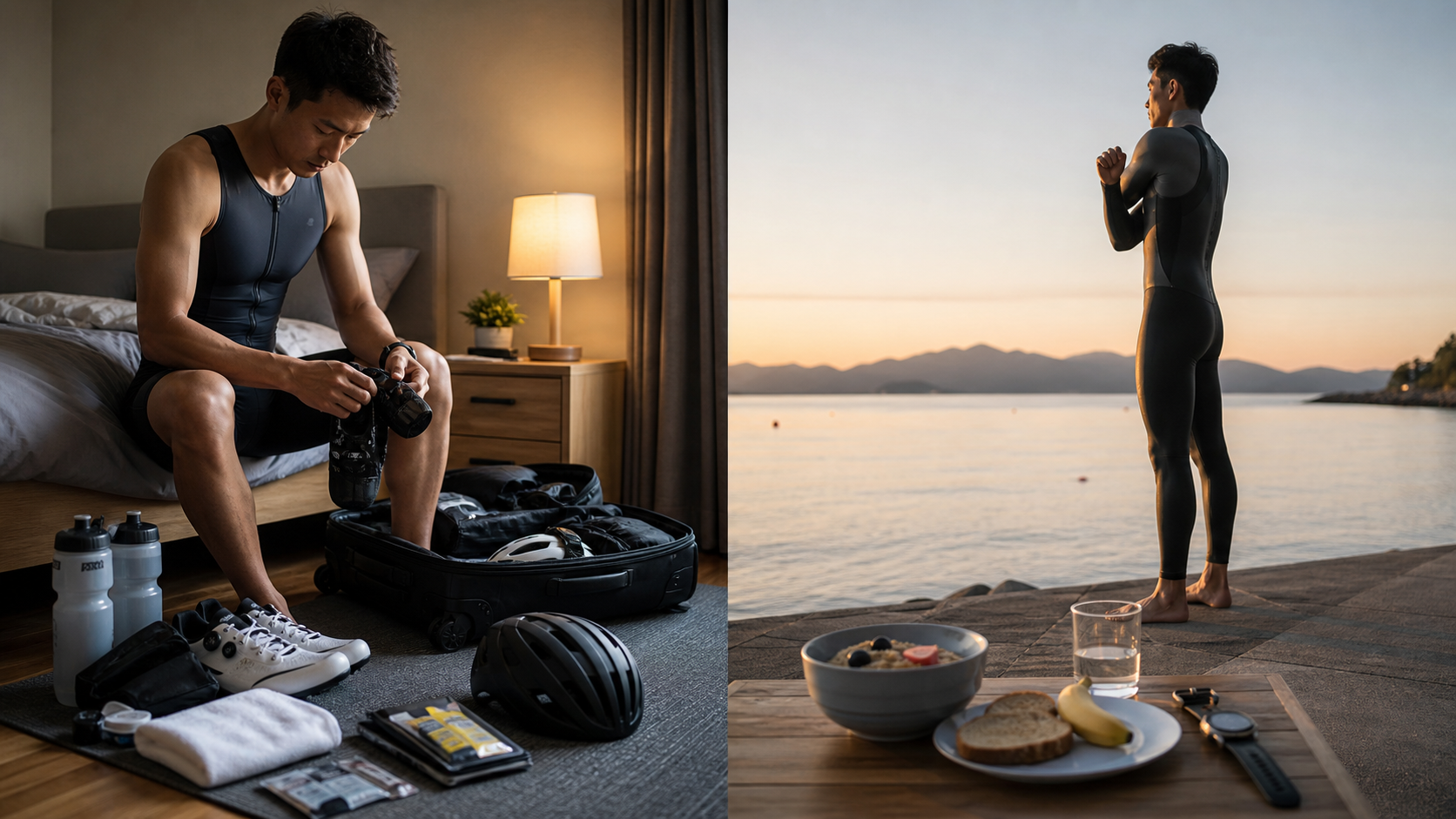
Coach’s Opening: The Race Isn’t Decided at the Starting Gun
I’ve coached athletes for 15 years, from first-time office workers tackling a 51.5 sprint triathlon thinking “I just want to finish,” to veterans who eventually earned a Kona slot. Over the years, I’ve learned one thing: most athletes lose points in the final 24 hours before the race, and they have no idea it’s happening.
No matter how well you’ve structured your training blocks, whether your FTP is dialed in at 280 watts or your threshold run pace is down to 4:30 per kilometer, those are assets built up over months. But in the day before the race, you can wipe out all of those assets with a few stupid mistakes—ordering spicy stir-fried lamb you never eat for dinner, scrolling your phone until 2 a.m. because you’re nervous, eating breakfast too late on race morning so your gut is still digesting when you hit the water, or rushing through your warm-up and lining up with your heart rate spiking near max in the first 10 minutes.
I had an athlete—let’s call him A-Kai—who trained an entire season for the Plum Lake triathlon. His fitness was among the best I’ve seen at that level. But the night before the race, he went out with a group of cycling buddies for a spicy hot pot dinner to “celebrate finally racing.” At 4 a.m. he was already running to the bathroom, and by the time the swim leg was over, he was completely depleted. He finished nearly 25 minutes slower than his training projections. It wasn’t a fitness problem. It was a process problem.
So this article isn’t about training. It’s about the final 24 hours before the race—starting with the pre-race dinner and walking you through every step to the starting gun. I’ll break it down into a schedule you can copy directly, and I’ll also explain the science behind each step so you know why you’re doing it. This isn’t voodoo; it’s a repeatable, executable process design.
Conceptual Foundation: What You Want to “Accumulate” and What to “Avoid”
Before we get to the schedule, let’s lock in the concepts. The goal of the 24 hours before the race can be summed up in one sentence: fill your glycogen stores to the brim, keep your body and mind relaxed rather than fatigued, have your gut empty and stable at the starting gun, and get your body properly warmed up. We want to actively accumulate the first three while avoiding any surprises that cost us points.
Sleep: The “Two Nights Before” Matter More Than the “Night Before”
This is a concept I repeat to athletes every single season. Many people put all their pressure on “I absolutely must sleep well the night before the race,” only to lie awake from anxiety, then spiral further with the thought “I’m ruined, I didn’t sleep enough.”
In fact, sports science generally agrees that the sleep quality of the 2 to 3 nights before the race matters more than the night immediately before. The body needs roughly 48 to 72 hours for energy systems and hormones to return to baseline. In other words, if you sleep poorly the night before the gun because of nerves, as long as you were well-rested in the preceding nights, the actual impact on performance is limited (sources: Outside and Advnture reports linked at the end).
Going further, sports sleep research has proposed the concept of “sleep banking”: in the 7 to 10 days before the race, deliberately add 30 to 60 minutes of sleep per night by going to bed earlier, waking slightly later, or adding daytime naps. Research shows this approach helps maintain endurance performance even when subsequent sleep is insufficient (e.g., pre-race anxiety, travel nights), and the longer the event, the greater the benefit—which is especially meaningful for half-distance triathlons and beyond (source: TrainingPeaks report linked at the end).
So my sleep strategy for athletes is always: put the pressure on the week before, not the night before.
Glycogen: Why You Should Load Up on Carbs Before the Race
For endurance events longer than 90 minutes, glycogen (carbohydrates stored in muscle and liver) is your main fuel tank. A sprint triathlon typically falls in the 2.5 to 3.5 hour range, and a 113 half-ironman easily runs 5 to 6 hours—both far beyond the 90-minute threshold, making carbohydrate loading genuinely meaningful.
The research-backed carbohydrate loading recommendations look roughly like this: elite athletes consume 10 to 12 grams of carbs per kilogram of body weight per day in the 36 to 48 hours before the race. If that amount sounds intimidating, you can also stretch it out—around 7 to 8 grams per kilogram per day combined with a taper in training volume achieves a similar effect (sources: USU Extension and Athlete Training and Health materials linked at the end).
Take a 65 kg athlete as an example: 8 grams per kilogram means roughly 520 grams of carbs per day—a substantial amount. That’s a deliberate, planned effort to eat rice, noodles, toast, and fruit throughout the day; it’s not a number you’ll hit by just “eating until full.” This is exactly why loading needs to be “designed,” not left to feel.
Gut: The #1 Landmine on the Final Day Before the Race
A-Kai’s hot pot disaster was fundamentally a gut issue. In those 24 hours before the race, your gut has a simple job: store the carbs smoothly, then stay “empty and stable” at the starting gun. Anything that irritates the gut, causes bloating, or lingers in the intestines is a landmine.
This is also why pre-race loading should focus on refined carbs and deliberately reduce fiber. White rice, white noodles, white toast, peeled fruit, and sports drinks—these low-residue, easily digestible foods are your friends. Whole wheat, brown rice, big raw salads, beans, spicy and oily foods—all enemies. No matter how health-conscious you are in daily life, please temporarily set aside your “clean eating” obsession on this one day before the race.
Practical Method: The Complete 24-Hour Pre-Race Schedule
The table below is the general template I give sprint/half-ironman athletes. I’m basing it on a Taiwan triathlon with a 6:30 a.m. start (classic events like Plum Lake, Dapeng Bay, and Penghu typically start between 6 and 7 a.m.), and you can shift the times according to your actual start time.
Day Before the Race (Day -1) Schedule
| Time | Task | Key Point |
|---|---|---|
| 07:00 | Wake up, normal breakfast | Stick to your usual routine; don’t sleep in and disrupt your circadian rhythm |
| 08:00–09:00 | 15–20 min very easy activity (walk or light ride) | Keep neural activation without creating fatigue |
| 09:30 | Final gear check, pack transition bags | Get it done the day before; never hunt for gear on race morning |
| 12:00 | Lunch: carb-focused meal | White rice/noodles with easily digestible protein; keep fiber and fat low |
| 14:00–15:00 | Race check-in, inspect transition area, review the swim course | Familiarize yourself with the flow to reduce race-day uncertainty |
| 16:00 | Afternoon snack (banana, toast, sports drink) | Keep topping off carbs; avoid cramming everything into one big meal |
| 18:00 | Pre-race dinner | The most critical meal of the day; detailed in the next section |
| 20:00 | Hydrate, lay out everything for tomorrow morning | Race number, timing chip, nutrition, gear—arrange by zone |
| 21:00 | Stop using screens, dim the lights | Reduce blue light exposure so melatonin secretes normally |
| 21:30–22:00 | Lights out | Even if you can’t sleep, lie down with your eyes closed; don’t anxiously scroll your phone |
Pre-Race Dinner: What to Eat, How Much, and When
My ironclad rule for the pre-race dinner comes down to three words: familiar, easily digestible, and carbohydrate-focused.
When should you eat? I recommend having dinner 3 to 4 hours before bedtime. For example, if you sleep at 22:00, finish dinner before 18:00. This gives your stomach enough time to digest, so you won’t have trouble sleeping due to bloating or acid reflux when lying down.
What to eat? In Taiwan, this is actually quite easy to solve because there are so many carbohydrate-rich dining-out options. Here are the pre-race dinner examples I often give to athletes:
| Meal Combo | Carb Source | Protein Source | Pitfalls to Avoid |
|---|---|---|---|
| Chicken rice + blanched vegetables (small portion) | White rice | Chicken | Too much braising sauce, excessive fried shallots |
| Japanese oyakodon | White rice | Chicken, egg | Heavy sauce, pairing with fried sides |
| Tomato pasta (light flavor) | Pasta | Small amount of chicken | Cream sauce, lots of cheese, spicy flavor |
| Udon soup + one onigiri | Udon, white rice | Egg, tuna | Overly salty broth, tempura fried items |
| White rice + steamed fish + miso soup | White rice | Fish | Sashimi (food safety risk), pickled side dishes |
How much? The key is not “eat until stuffed,” but “eat until just full, but not bloated.” I often remind athletes: Eat to about 70–80% full at the pre-race dinner; get the remaining carbs in gradually during the day, rather than cramming everything into one dinner. Eating too much at once increases digestive burden and disrupts sleep.
Three absolute taboos that I reiterate every season:
- Never try new foods or new restaurants. Pre-race is not the time for culinary exploration; your gut only recognizes what you eat regularly.
- Never eat spicy, fried, or large amounts of raw cold seafood. Akai’s spicy hot pot, sashimi, and Taiwanese fried chicken all fall into this category.
- Never drink alcohol. Alcohol disrupts sleep architecture, causes dehydration, and impairs glycogen synthesis. Save the “celebration” for after you cross the finish line.
Race Morning Schedule
Using a 6:30 AM start as an example, here is my standard morning routine. The core logic is: finish breakfast 3 hours before the start, giving carbs time to be absorbed and the stomach time to empty.
| Time | Task | Key Point |
|---|---|---|
| 03:30 | Wake up | Wake up 3 hours before the start to give the body ample time to fully awaken |
| 03:45 | Pre-race breakfast | Focus on easily digestible carbs; see next section |
| 04:15 | Sip water, take electrolytes | Small amounts frequently; don’t chug too much at once |
| 04:30 | Depart for the race venue | Allow time for traffic and parking, especially for popular Taiwan races |
| 05:00 | Check-in, set up transition area | Arrange nutrition and gear in T1/T2 order |
| 05:20 | Bathroom visit (first) | Get it done early before the crowds |
| 05:40 | Begin warm-up (see warm-up timing section) | Progress gradually; don’t sprint from the start |
| 06:00 | Final small carb intake (gel or drink) | 20–30 minutes before the start to stabilize blood sugar |
| 06:10 | Bathroom visit (second), put on wetsuit | Final emptying before entering the water |
| 06:25 | Enter start/swim area, mental preparation | Deep breaths, review race plan |
| 06:30 | Start gun | Follow pacing plan; don’t get swept up by the crowd |
Race Morning Breakfast: Portion and Timing
The general rule in sports nutrition is: for a pre-race meal (1 to 4 hours before the start), consume 1 to 4 grams of carbs per kilogram of body weight (source: USU Extension data listed at the end). The closer to the start, the smaller and more digestible the portion should be, to avoid starting exercise while the gut is still busy digesting.
Take a 65 kg athlete as an example: if eating breakfast 3 hours before the start, aim for the midpoint of about 2 grams per kilogram, which is roughly 130 grams of carbs. Practical examples:
- 2 slices of white toast + 1 banana + one sports drink
- One bowl of white rice + a small amount of lean meat + warm water
- Cereal porridge (low fiber) + honey + banana
Then, 20 to 30 minutes before the start, take one more small gel or sports drink to stabilize blood sugar. Same ironclad rule: all of this must be something you’ve eaten during training and confirmed your gut can handle. I require athletes to do a full dress rehearsal of their race-morning breakfast during at least 2 to 3 long-distance training sessions, turning “race day” into “just another familiar morning.”
Warm-Up Timing: Bringing Your Body to Just the Right “Ready” State
The warm-up is where I see the most athletes make mistakes—either doing too little or too much. Too little, and your body is still cold at the gun, causing heart rate to spike in the first 10 minutes and lactate to accumulate prematurely; too much, and you burn through glycogen and tire your legs before the race even starts.
The goal of the warm-up is: raise core temperature, elevate heart rate and breathing to near-race intensity, activate the neuromuscular system, but without creating fatigue. When a good warm-up ends, you should feel “slightly sweaty, breathing a bit faster, and warmed up,” not “already a little breathless and tired.”
Triathlon warm-ups are more complex than single-sport events because you have to deal with “swimming first.” Here’s the warm-up timing template I give athletes (counted back from a 6:30 AM start):
Warm-Up Timing Template (Starting 50 Minutes Before the Gun)
| Time (Pre-Race) | Content | Duration | Purpose |
|---|---|---|---|
| T-50 min | Dynamic stretching, joint mobility (arm circles, leg swings, jumping jacks) | 8 min | Activate joints and nervous system; no prolonged static holds |
| T-40 min | Easy jog (if venue allows) | 8 min | Raise core temperature, bring heart rate to low-mid zone |
| T-30 min | 3–4 short strides, progressively faster | 6 min | Activate fast-twitch muscles, briefly push heart rate up then down |
| T-20 min | Small carb intake, final bathroom visit | — | Stabilize blood sugar, empty the gut |
| T-15 min | In-water warm-up (if race permits): easy 100–200 m swim | 5 min | Acclimate to water temperature, find stroke feel, reduce cold-water shock |
| T-8 min | Onshore light jumps, deep breathing, review race plan | — | Maintain body temperature, enter focused state |
| T-0 | Start gun | — | Follow pacing plan; control the early stages, don’t surge |
A few practical tips specific to Taiwan:
- Many Taiwan races do not allow a full in-water warm-up, or only allow a very short one. In this case, I have athletes do more arm rotations and breathing drills onshore, and deliberately slow down for the first 200 meters after the start, letting the body adapt at lower intensity—effectively deferring the “in-water warm-up” to the early part of the race.
- For summer races (e.g., Penghu, Dapeng Bay), morning temperatures can already exceed 28°C with very high humidity. The warm-up volume should be slightly reduced to avoid overheating the core and losing fluids prematurely before the race. Conversely, for winter or mountain-area mornings (e.g., some northern races) with low temperatures, do a more thorough warm-up to avoid cold muscles.
- If your heart rate before the start is already above 75% of your max, it means you’ve over-warmed-up or you’re too nervous. Do a few long exhale breaths to bring your sympathetic nervous system back down.
Hydration and Electrolytes: “Hydrating, Not Chugging” in the 24 Hours Before Race Day
Many athletes think of hydration as “chugging a huge bottle on race morning,” which either leads to water intoxication or constant urges to pee before the start. The correct hydration strategy actually begins the day before the race, and the core concept is even, small, and frequent.
The day before the race, I ask athletes to maintain regular fluid intake throughout the day and watch one simple indicator: urine color. If your urine is pale straw-colored (like diluted lemonade), you’re well-hydrated; if it’s dark yellow and scant, you’re still dehydrated and need to drink more. Conversely, if your urine is nearly clear and colorless all day with frequent bathroom trips, you’re overhydrating, which dilutes your electrolytes. Taiwan’s summer heat and humidity mean athletes can easily be in a state of chronic mild dehydration the day before the race without realizing it—this urine indicator is the most practical self-check.
Electrolytes—especially sodium—are particularly critical in Taiwan’s high-heat, high-humidity environment. We sweat heavily and saltily; replacing water without sodium risks dilutional hyponatremia, which is actually dangerous. In practice, I recommend:
| Timing | Hydration/Electrolyte Approach | Reminder |
|---|---|---|
| All day before race day | Drink regularly; meals with normal salt content | Watch urine color; don’t deliberately chug |
| Night before, before bed | One small glass of water is enough | Drinking too much means middle-of-the-night bathroom trips, disrupting sleep |
| After waking on race day | 300–500 ml of electrolyte drink | Small and frequent; split into two or three servings |
| 1 hour before start | Stop heavy drinking; only small sips to moisten the throat | Give your body time to eliminate excess fluid |
| 20 minutes before start | One final small sip of sports drink | Covers both carb and sodium intake |
A special note: If you regularly consume caffeine and have validated it in training, you can maintain it; but don’t suddenly load up on new caffeine before race day. Caffeine does have performance-enhancing effects, but it’s also a diuretic and can irritate sensitive stomachs. The principle remains the same: “Never try anything new on race day that you haven’t practiced.”
Mental Preparation: Turning Anxiety into the Steadiness of “Following the Schedule”
After all this physiology and logistics, I need to spend a section on the mental side, because the hardest thing to manage in the 24 hours before a race is often the noise in your head.
I’ve coached countless athletes with top-tier fitness who scared themselves into poor performances before race day. Anxiety itself isn’t bad—moderate nervousness keeps you focused and maintains appropriate adrenaline levels. The real problem is “uncontrolled anxiety,” which keeps you awake, kills your appetite, spikes your heart rate during warm-up for no reason, and leaves you gasping for air after the swim start.
My core method for handling pre-race anxiety is shifting attention from “outcome” to “process.” When an athlete is consumed by thoughts like “I must hit a PB, I’m afraid of getting bumped in the swim, I’m afraid of cramping,” anxiety only snowballs. But if they focus on “right now I need to lay out my gear in T1 order” and “next is the first block of dynamic stretching in warm-up,” checking off tasks one by one, anxiety gets diluted by concrete actions. This is why I emphasize the schedule so much—the schedule isn’t just a logistics tool; it’s the best stabilizer there is.
Three mental techniques I often teach athletes:
- Box Breathing: Inhale for 4 seconds, hold for 4 seconds, exhale for 4 seconds, hold for 4 seconds, repeat several rounds. This effectively pulls back an overactive sympathetic nervous system, especially useful right before the swim start.
- Race Plan Visualization: Mentally rehearse the key segments of the race—how to pace the swim, how to transition in T1, where to fuel on the bike, how to distribute effort on the run. The more specific the rehearsed imagery, the calmer you’ll be in the moment.
- Turn “if” into “when”: Don’t think “what if I cramp?” Instead, think “when my legs feel tight, I’ll ease off, stretch, and take sodium.” Convert uncertain fear into a prepared response plan.
Common Mistakes and Corrections
In this section, I’ve compiled the most common 24-hours-before-race mistakes I’ve seen over 15 years, each with a correction. Treat this as your pre-race self-check checklist.
Mistake 1: Betting Everything on “A Full Night’s Sleep”
Symptoms: Lying in bed the night before staring at the ceiling; the more you try to sleep, the more awake you get; the more awake you get, the more anxious you become.
Correction: Cognitive reframing. Tell yourself, “What really matters is the previous two nights—I’ve already slept well.” This statement alone reduces anxiety. Also, move the sleep-banking work to the week before the race. If you can’t sleep the night before, just lie still with your eyes closed; quiet rest itself has recovery value. Don’t scroll on your phone and make yourself more alert.
Mistake 2: “One More Training Session for Peace of Mind” the Day Before
Symptoms: Even after tapering, you can’t resist riding 40 km the day before to “find the feel,” only to fatigue your legs.
Correction: The day before the race, do only very short, very easy activity (15 to 20 minutes, heart rate in a very low zone). The goal is to maintain neural activation, not to train. You cannot get any fitter on this day—only more tired.
Mistake 3: Carb Loading Turns into “Binge Eating”
Symptoms: You’ve heard about carb loading, so you gorge yourself the day before, pairing it with lots of high-fiber vegetables and fried foods, and your gut rebels the next day.
Correction: Loading means “deliberately consuming refined carbs in divided portions,” not eating until stuffed. Spread carbs across three meals plus snacks, focusing on white rice, white noodles, toast, and fruit, while deliberately reducing fiber and fat. Remember the scale of 7 to 8 grams per kilogram of body weight, achieved in divided portions across the day.
Mistake 4: Race-Day Breakfast Too Late or Too Large
Symptoms: To sleep in, you delay breakfast until 1 hour before the start and eat a huge bowl; your gut is still churning at the swim start.
Correction: Finish breakfast a fixed 3 hours before the start, with easily digestible portions. Better to wake up 30 minutes earlier than to compress digestion time. If you want more sleep, go to bed earlier the night before.
Mistake 5: Warm-Up Rushed or Overdone
Symptoms: Either you skip warm-up entirely and stand on the start line, with your heart rate spiking near max in the first 10 minutes; or you run 5 km in warm-up and your legs feel heavy before the race even starts.
Correction: Follow the warm-up sequence template above. At the end, you should feel “warmed up, lightly sweating, breathing slightly elevated but not breathless or fatigued.” Use heart rate as the objective measure; don’t keep adding volume based on feel.
Mistake 6: Hunting for Gear at the Last Minute on Race Morning
Symptoms: Frantically searching for your timing chip, race number, and nutrition at dawn, emotionally unraveled before you even leave the house.
Correction: Lay out everything in designated zones and take a photo by 8:00 PM the night before. On race morning, the only action is “pick it up and walk out the door.” Mental calm is part of performance.
Actionable Advice for Athletes of Different Levels
The same framework applies to everyone, but athletes at different levels should prioritize different aspects. Here’s my priority order for three tiers.
First-Timers (First Triathlon/Half Marathon): Focus on “Not Making Mistakes”
If this is your first or second race, don’t think about optimizing performance—think about avoiding rookie errors. Your action list has only three items:
- Have a familiar, easily digestible carb dinner the night before; absolutely no new foods, absolutely no alcohol. This single rule will help you avoid most beginner disasters.
- Lay out all gear the night before and take a photo. Reduce morning chaos.
- Follow the warm-up template and deliberately slow your early pace. The most common beginner mistake is getting swept up in the starting crowd and surging, blowing up early and fading late.
For you, process stability matters far more than any physiological optimization. Getting through the day “boringly, step by step” is success.
Age-Group Veterans: Start Getting the Details Right
If you’ve finished several races and want to improve, implement the details above one by one:
- Execute carb loading seriously, using the 7 to 8 grams per kilogram scale in divided portions, and rehearse your race-day breakfast during training.
- Incorporate sleep banking into your pre-race week plan, adding 30 to 60 minutes of sleep each night.
- Precision-tune your warm-up sequence, using heart rate monitoring to ensure your body is just warmed up and your heart rate is in the ideal zone at the gun.
- Adjust for race conditions: For summer races, plan warm-up volume and hydration strategy earlier; for cooler mountain races, make sure warm-up is thorough.
Athletes Chasing Kona Slots / PB: Treat the Entire Process as a Replicable System
For elite athletes, the 24 hours before a race should be a standard procedure so rehearsed you could execute it with your eyes closed. What you need to do:
- Turn the entire schedule into a personalized checklist, follow it for every race, and review and fine-tune it afterward.
- Establish your own data baseline: how many hours you slept the night before your best performance, what you ate for breakfast, how your heart rate changed during warm-up—record all of it to form a replicable model.
- Customize for the specific conditions of your target race: when traveling abroad to race, factor jet lag, travel sleep debt, and local food availability into the plan. The value of banking sleep is especially high during long trips.
The gap between elite and average athletes often isn’t about how hard they push on race day, but whether they can consistently bring their best form to the starting line, every single time.
A Checklist You Can Copy Directly
Finally, I’ve condensed the entire article into a 24-hour pre-race checklist you can print out and tape to your gear bag:
One Week Before the Race
- [ ] Start banking sleep; add 30–60 minutes per night
- [ ] Confirm that both your pre-race dinner and race-morning breakfast have been practiced during training
The Day Before the Race
- [ ] Only 15–20 minutes of very easy activity
- [ ] Consume refined carbs in multiple portions (about 7–8 g per kg of body weight)
- [ ] Pre-race dinner: familiar, easy to digest, finished 3–4 hours before bed, 70–80% full
- [ ] No spicy, no fried, no raw seafood, no alcohol
- [ ] Lay out gear by zone and take a photo before 20:00
- [ ] Stop using 3C devices and dim the lights by 21:00
- [ ] Go to bed at 21:30–22:00; even if you can’t sleep, rest with your eyes closed
Race Day
- [ ] Wake up 3 hours before the start and eat breakfast
- [ ] Breakfast focused on easily digestible carbs (about 1–2 g per kg)
- [ ] Hydrate and take electrolytes in small, frequent amounts
- [ ] Allow time for travel and parking
- [ ] Set up the transition area in T1/T2 order
- [ ] Start warming up 50 minutes before the start, building gradually
- [ ] Take your last bite of carbs 20–30 minutes before the start
- [ ] Use the restroom one last time before entering the water
- [ ] Control your pace in the early stages after the gun; don’t surge
FAQ
These are the questions I’ve been bombarded with over the years in pre-race briefings and athlete Line groups. Here’s a consolidated answer.
Q1: I really can’t sleep at all the night before the race. What should I do? Should I take sleeping pills?
Take a deep breath and remember the concept from earlier: What truly matters is the two or three nights before. As long as you sleep well those nights, a poor night’s sleep right before the race has limited practical impact on performance. If you can’t sleep, just lie quietly with your eyes closed. This kind of “quiet rest” has recovery value in itself, far better than getting up and scrolling your phone. As for sleeping pills, I strongly advise absolutely never trying any sleep aid for the first time the night before a race—you don’t know if it will leave you groggy the next day or affect your heart rate. Always consult a physician about any medication, and never use it for the first time on race day.
Q2: I have a sensitive stomach. Should I just eat less the day before to avoid diarrhea?
That’s a dangerous idea. Eating less means insufficient glycogen loading, and you’ll likely “hit the wall” and run out of energy in the later stages of the race. The right approach isn’t to eat less, but to eat the right things—choose refined carbs that are familiar to your stomach, low in fiber, and easy to digest, and spread the intake across multiple meals. Athletes with sensitive stomachs should strictly avoid spicy, oily, raw/cold, and high-fiber foods, and must repeatedly rehearse the same eating plan during long training sessions before the race to find a combination their gut can tolerate.
Q3: During those carb-loading days, I seem to have gained weight. Is that normal?
Completely normal, don’t worry. Every 1 gram of glycogen stores about 3 grams of water along with it, so gaining 1–2 kg when loading successfully is common—that’s water and glycogen, not fat. In fact, it’s evidence that your tank is full. As you burn glycogen once the race starts, that water is also released and utilized. Don’t suddenly diet because of the number on the scale before the race; that would ruin the entire loading process.
Q4: My race starts in the afternoon or evening. How do I adjust the schedule?
Just shift the entire logic. The core principles stay the same: finish your main meal 3–4 hours before the start, only take easily digestible snacks 1–2 hours before, and have your last bite of carbs 20–30 minutes before the start. The advantage of an afternoon start is that you can sleep in and wake naturally, eat carbs normally for breakfast and lunch, and the pressure is actually lower than a dawn start. Just avoid napping so long that you feel groggy, and pay attention to your hydration rhythm in the afternoon.
Q5: I’m racing abroad. How do I handle jet lag and travel sleep debt?
This is exactly the scenario where “banking sleep” has the highest value. Start adding 30–60 minutes of sleep each night for the week before departure to bank that sleep. After arriving, adjust to local time as quickly as possible and get plenty of daylight exposure to help reset your circadian rhythm. A poor night’s sleep on the long flight is inevitable, but if you’ve banked sleep in advance and know that the two or three nights before the race are what really matter, you can significantly reduce anxiety. For food, research ahead of time what familiar carb sources are available locally, and if necessary, bring your own energy gels, oats, or onigiri substitutes. Don’t experiment with new foods only after you arrive.
Q6: Should I warm up in the water? Many Taiwanese races don’t allow a water warm-up.
Getting in the water is of course ideal—even a short 100–200 meter swim lets you adapt to the water temperature, find your stroke rhythm, and greatly reduce the “cold water shock” and rapid breathing when you start. But if race rules don’t allow it, use two alternatives: first, do more arm circles on shore, use resistance bands to simulate the stroke, and practice box breathing; second, accept that “the first 200 meters is your in-water warm-up”—deliberately swim at lower intensity after the start, get your breathing settled, and only then move into race pace once your body is warmed up. Don’t skip upper-body and breathing preparation entirely just because you can’t warm up in the water.
Conclusion: Make the Final Day a Familiar Rehearsal
I often tell athletes: the best day before a race is a “boring” day. No surprises, no experiments, no panic—every step is a move you’ve rehearsed. When everything is as expected, your mind and body can save all their energy for the actual race.
A-Kai learned his lesson. The following year at the same Plum Lake triathlon, he ran the pre-race process according to this exact schedule—the familiar dinner, gear laid out, the practiced breakfast, the timed warm-up. That race, he set a new personal best, nearly 40 minutes faster than the year before. His fitness hadn’t changed that much; what changed was the process.
Training determines your ceiling, but the 24-hour pre-race process determines whether you can actually bring that ceiling to the finish line. May you be in your best state exactly at the moment the gun goes off.
This article is educational content and does not replace individual assessment by a physician, physical therapist, or nutritionist.
References
- Utah State University Extension, “Prioritizing Carbohydrates: A Guide for Endurance Runners”: https://extension.usu.edu/nutrition/research/prioritizing-carbohydrates-a-guide-for-endurance-runners
- Athlete Training and Health, “Carbohydrate Loading: Fuel Yourself”: https://athletetrainingandhealth.com/carbohydrate-loading-fuel-yourself/
- TrainingPeaks, “Should You Bank Sleep Before Your Next Ultramarathon?”: https://www.trainingpeaks.com/blog/should-you-bank-sleep-for-ultramarathon/
- Outside Online, “How Important Is Sleeping the Night Before a Race?”: https://www.outsideonline.com/health/training-performance/how-important-sleeping-night-race/
- Advnture, “Mythbusting: is sleep two nights prior to a race really more crucial than the night before?”: https://www.advnture.com/feature/mythbusting-two-nights-sleep-rule
Related Reading
- Triathlon Race-Day Gear Checklist and Inspection Flow: One Table to Avoid Every Disaster
- The Complete Guide to Off-Season Planning: Rest, Rebuild, and Shore Up Weaknesses to Take Your Next Season Up a Notch
- The Golden 24 Hours Before Race Day: A Complete Process from Gear Check to Mental Preparation
- Post-Race Recovery Nutrition: An Eating Plan from the Finish Line to 48 Hours
FTL 與 SYB 車隊專訪 西進武嶺 實用攻略分享! 2小時 如何練?!你不知道的眉角!新手準備武嶺必看 EP1 | 實力派女車友 | 精華版 | 公路車 | CTYeh
4 年前
西進武嶺 自製新版AI配速表產生器 x 賽前攻略 抱佛腳! 沒有功率計也可以產生配速表嗎?有什麼其他眉角賽前要注意的呢? | 西進武嶺 / 東進武嶺 KOM 攻略 | 公路車 | CT Yeh
4 年前
Live) 備戰2019彰化經典百K 賽前攻略 (已完賽請看新影片
7 年前
CT 喇低賽) 武嶺牽車 才是王道 西進牽車四小時內秘訣 攝手位置 如何判斷 防抽筋小秘訣
7 年前
#公路車 #西進武嶺 配速配瓦實驗 坡度分析 四小時內攻略 建大盃 NeverStop #西進武嶺攻略
6 年前
富士山KOM 賽事篇 VLOG!/ 小野田出沒!/ 完整路段分析 / 武嶺要騎多快才能拿環?/ 台灣選手 第20回Mt.富士ヒルクライム 参加!/ 公路車 / CT Yeh
2 年前
2019 夏季KOM 5小 完賽心得 準備攻略 東進武嶺 夏季登山王之路 Taiwan KOM Challenge
7 年前
西進武嶺 免費訓練分析服務 Intervals | 練不夠還是練過頭?你哪一種類型選手?AI模型告訴你! | 備戰神器 | 公路車 訓練 | CT Yeh
4 年前