Core Training for Triathlon: Beyond Planks — A Complete Exercise Library for Anti-Rotation and Anti-Extension
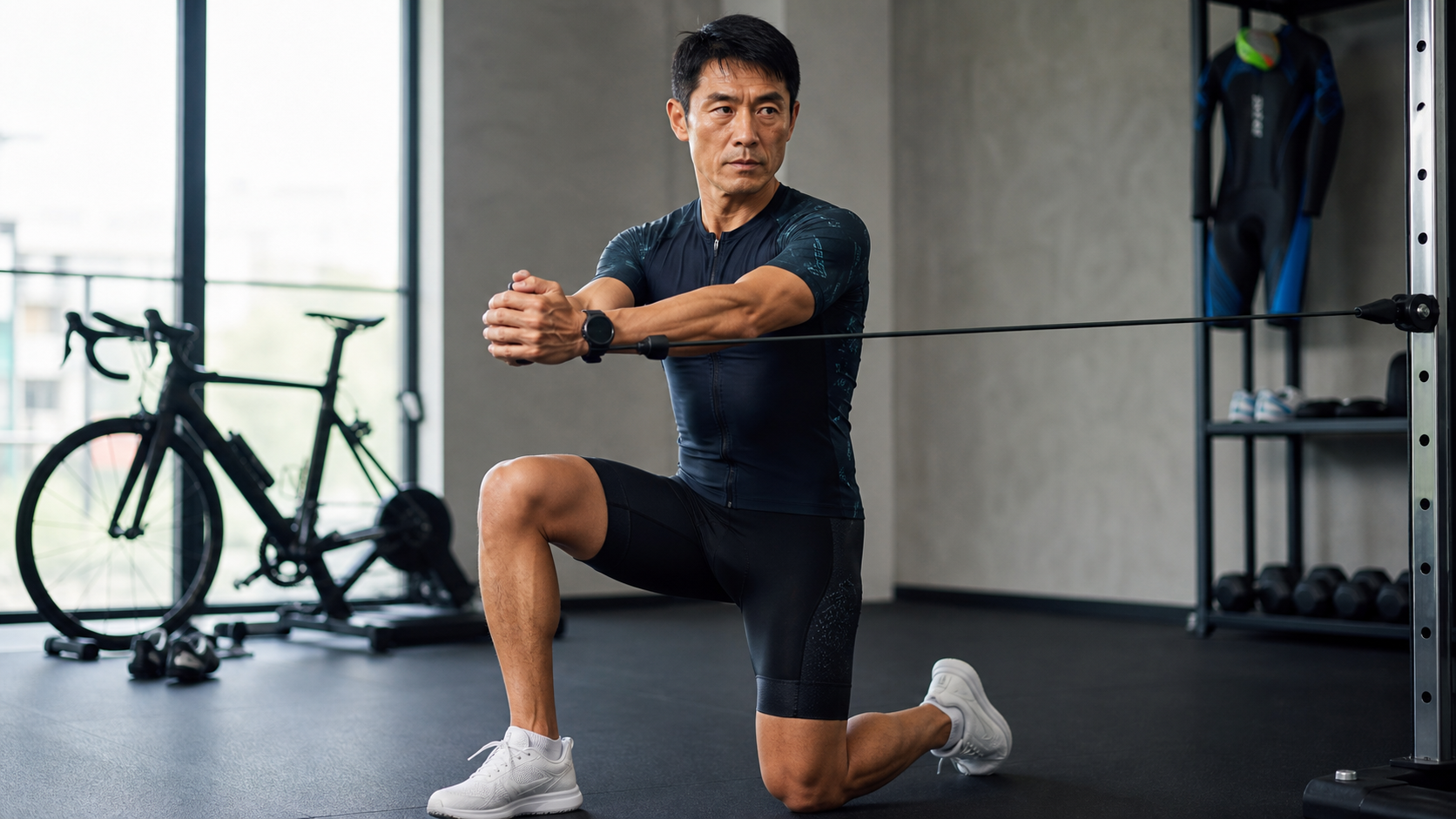
Coach’s Opening: The Athlete Who Could Hold a Plank for Three Minutes but Fell Apart on the Run
Let me start with a real scenario (the data is his; I’ve changed the details to protect his privacy).
A few years ago, I coached an athlete with an engineering background—let’s call him A-Kai. He was very dedicated. Every morning he’d hold a plank for three minutes without taking a breath, and side planks for two minutes on each side. Everyone at the gym thought his core was rock solid. But in his first 113 half-ironman (1.9 km swim, 90 km bike, 21 km run), he deflated like a punctured balloon in the latter part of the run—not because of a lack of fitness, but because his pelvis couldn’t stay stable. After 15 km, every step had him swaying side to side, his right knee started caving inward, and his pace dropped from 5:20 per kilometer to 6:40.
When I watched his running form video, the problem was obvious: his core was great at “holding still” (anti-extension was excellent), but it had zero ability to “resist rotation.” Running is a sport of constant single-leg support where your torso is forced to want to rotate. The planks he practiced never prepared him for that.
That’s the topic I want to discuss with you. Core training is absolutely not just planks. The three disciplines—swimming, cycling, running—demand completely different things from your torso. If all you do is lie down and hold planks, you’ve trained only one dimension but expect it to support you in three vastly different scenarios. In this article, I’ll combine 15 years of coaching observations with sports science evidence into a system you can start today.
Foundational Concepts: What Is the Core Actually Doing?
Let’s bust a myth first. Many people think core = six-pack abs (rectus abdominis). Wrong. For endurance athletes, the core’s real job is “force transfer” and “posture maintenance,” not producing big movements.
The core is a three-dimensional cylinder, including:
- Front: Rectus abdominis, external obliques, internal obliques, transversus abdominis
- Back: Erector spinae, multifidus, quadratus lumborum
- Top: Diaphragm
- Bottom: Pelvic floor muscles
- Key links connecting upper and lower body: Gluteus maximus, gluteus medius, latissimus dorsi
For triathletes, the core’s value isn’t in “how many sit-ups you can do,” but in when your limbs are outputting like crazy, can your torso act like a stable drive shaft, transferring power from legs to pedals, from hips to stride, from torso to stroke? Once the core loosens, power leaks, speed drops, and injury risk rises.
I often tell athletes this analogy: the core is like a boat’s keel. Your arms and legs are the oars and sails, but if the keel is soft and twists around, no matter how hard you row, the hull wastes energy absorbing that twisting, and forward efficiency plummets. Conversely, a rigid keel converts every ounce of force into forward propulsion. In a sport like triathlon—long-duration, high-repetition—a tiny energy leak multiplied by tens of thousands of pedal strokes, tens of thousands of steps, and thousands of strokes is the difference between night and day.
I also want to specifically highlight the transversus abdominis. It’s the deepest core muscle, like a natural corset wrapping your midsection. When it contracts appropriately, it creates “intra-abdominal pressure,” supporting the spine from within and turning your torso into a stable power platform. Many triathletes with chronic lower-back tightness don’t have weak superficial muscles—their deep transversus abdominis simply doesn’t fire at the right time. That’s why I’ll keep emphasizing “breathing” later—because breath control is the key to waking up the transversus abdominis.
What Does Science Say?
Here I’m citing a study I’ve actually verified. A study published in PLOS ONE put male university athletes through an 8-week core training intervention. The core training group did 3 extra core sessions per week, and the results showed: in the first 3 stages of a treadmill incremental test, the core training group had lower heart rates than before training; at the highest intensity stage, oxygen uptake (VO₂) also decreased compared to before training. In other words, at the same pace, a stronger core made running more “economical” (improved running economy). I’ve put the study link in the references at the end.
This matters enormously for triathletes. Triathlon is an endurance sport—any change that lets you use less oxygen and beat fewer heartbeats at the same speed, accumulated over 113 or 226 km, is a massive time difference. Core training isn’t for looks; it’s for making your engine more efficient.
How the Three Disciplines Differ in Core Demands
This is the heart of the article. If you remember only one thing, remember this: swim, bike, and run demand different directions of core work, so your exercise library must cover multiple directions—not just plank until the end of time.
Here’s a comparison table:
| Discipline | Primary Core Demand | Movement to Resist | Why It Matters |
|---|---|---|---|
| Swimming | Anti-rotation + torso rotation control | Excessive torso twisting during strokes, legs kicking wildly | Freestyle relies on body roll to drive the stroke; a stable core transfers power to the hands while maintaining a streamlined shape to reduce drag |
| Cycling | Anti-extension + pelvic stability | Excessive lumbar extension in aero position, pelvis rocking side to side | In prolonged forward-leaning positions, the core holds the pelvis so the hips and legs can pedal effectively, avoiding lower-back compensation and soreness |
| Running | Anti-rotation + anti-lateral flexion | Pelvis dropping during single-leg support, torso swaying | Running is continuous single-leg hopping; every step the torso wants to rotate and the pelvis wants to drop to the opposite side of the support leg. A stable core prevents power leaks and knee injuries |
See the pattern?
- Swimming requires you to “control rotation”—you need to both rotate (body roll) and maintain core tension through that rotation so the lower body doesn’t flail.
- Cycling most needs “anti-extension”—that’s the direction planks train, which is why many people feel planks help cycling (correct, they do help cycling).
- Running most needs “anti-rotation” and “anti-lateral flexion”—exactly what A-Kai was missing.
So if you only train planks (anti-extension), you’re taking care of the cycling side well, but swimming’s rotation control and running’s anti-rotation and anti-lateral flexion are completely untrained. That’s why A-Kai had a strong plank but fell apart on the run.
The Four Categories of Core Exercises (The Exercise Library)
Sports science classifies core training into four categories based on the “direction of resistance.” This classification is the skeleton of how I program for athletes—please make sure you understand it:
1. Anti-Extension
Resisting the force that wants to arch your body backward and overextend the lumbar spine.
Representative exercises:
- Plank: Yes, the plank is anti-extension, not a cure-all.
- Dead Bug: Lying on your back, extending opposite arm and leg while keeping the lower back on the floor. This is my favorite beginner exercise—safe and effective.
- Ab Wheel Rollout: Advanced; don’t attempt without sufficient strength.
This category helps cycling the most.
2. Anti-Rotation
Resisting an external force that wants to twist your torso—your job is to “resist,” not “produce” rotation.
This is the category most triathletes lack, and the one I most want to promote. I’m citing verified data: the Pallof press is a classic anti-rotation exercise; during execution, the internal and external obliques are highly activated, working to resist the force trying to rotate the shoulder or hip. In contrast, the plank is an anti-extension exercise. The two train completely different abilities, and most people need both (source at the end).
Representative exercises:
- Pallof Press: Using a resistance band or cable, stand sideways, press the handle forward and resist the force pulling you back into rotation.
- Bird Dog: On all fours, extend opposite arm and leg while keeping the pelvis from rotating.
- Suitcase Carry: Walk while carrying a weight in one hand, resisting the body’s tendency to lean to one side.
This category helps running and swimming the most.
3. Anti-Lateral Flexion
Resisting the force that wants to tip your body sideways.
Representative exercises:
- Side Plank: A classic, but don’t just hold it for three minutes.
- Single-arm Farmer’s Carry: Trains anti-rotation and anti-lateral flexion simultaneously—excellent value for the effort.
This category is especially critical for running (keeping the pelvis stable so it doesn’t drop to the opposite side of the support leg).
4. Rotation / Power
Actively generating rotational force.
Representative exercises: Medicine ball rotational throws, cable woodchops. This has lower priority for triathlon; swimmers can add a little, but beginners should first get the first three categories solid.
Exercise Priority: How Should Triathletes Allocate?
Many people ask me: “If I need to train all four categories, how much time should I spend on each?” My rule of thumb is this allocation (works for beginner to advanced):
- Anti-rotation: ~40%—This is what most people lack and is the most critical piece for running and swimming.
- Anti-extension: ~30%—Takes care of the aero position on the bike and overall spinal stability.
- Anti-lateral flexion: ~20%—Stabilizes the pelvis for running.
- Rotation/Power: ~10%—The icing on the cake; swimmers can bump this up a bit.
Note that this ratio is a major adjustment compared to the average person who only trains anti-extension (planks). Most triathletes currently sit at 90% anti-extension and 10% everything else—which is precisely the structural reason their running falls apart. Shifting more weight toward anti-rotation is often the fastest way to see results.
Why Is “Anti-Rotation” Especially Important for Triathletes?
Let me spend a bit more time on anti-rotation, because it’s the blind spot I most often correct with athletes.
Running is essentially “continuous single-leg hops.” With every foot strike, only one leg supports you, and your pelvis wants to drop to the other side (imagine how your pelvis feels when standing on one leg), and your torso wants to rotate. If your anti-rotation and anti-lateral flexion capacity is insufficient, you’ll see:
- Hip drop: The pelvis on the opposite side of the support leg drops—this is a killer for running economy.
- Knee valgus: The knee caves inward. The sources I’ve verified indicate that core training (including anti-rotation) can improve lower-limb biomechanics and reduce knee valgus, which is one of the major risk factors for ACL (anterior cruciate ligament) injuries.
- Compensatory upper-body sway: Arms flailing, torso wobbling side to side—wasting energy that should be propelling you forward on lateral rocking instead.
A-Kai’s problem was the classic hip drop plus knee valgus. I changed his training from “three minutes of plank every day” to a program emphasizing anti-rotation with anti-extension as a supplement. Six weeks later, his running form video was noticeably more stable. The following year at the same 113 race, his pace drop in the second half of the run narrowed from 80 seconds per kilometer slower to just 20 seconds slower. When the core is stable, power doesn’t leak.
The Core of Swimming Is “Dynamic Rotational Control”
The significance of anti-rotation for swimming is more nuanced and deserves its own section. Many people assume swimming requires “flexibility and relaxation,” which sounds contradictory to core stability. It isn’t.
A large part of freestyle propulsion comes from body roll—your shoulders and hips roll side to side along the long axis of your body, allowing a longer, more powerful pull. But the key is: this roll must be “core-driven and controlled,” not loose flailing. When someone with a weak core rolls, the lower body follows and whips around, the kick rhythm falls apart, and the whole body writhes like a snake, drastically increasing drag.
So the core goal for swimmers is: maintain tension in the abdomen and glutes while the torso rotates, so that the upper-body roll doesn’t translate into uncontrolled lower-body movement. This is precisely “dynamic anti-rotation”—you are rotating, but your core is controlling the quality of that rotation. Exercises like the Pallof press and bird dog teach you exactly this ability to “allow controlled movement under tension.” That’s also why I have swimmers with weak swimming put a small amount of medicine ball rotational throws into their land-based core work—to train the neural pattern of “controlling rotation.”
Practical Approach: A 10-Minute Daily Core Program
Alright, enough theory—let’s get to something you can put into practice.
Three principles I use when designing core programs:
- Do it every day, but keep it short. Core muscles have high endurance qualities and recover quickly. Rather than one exhausting session per week, I recommend 10 minutes daily, treated like brushing your teeth.
- Cover multiple directions. You must include anti-extension, anti-rotation, and anti-lateral flexion—not just one type.
- Quality over quantity. A shaky three-minute plank is worse than a perfect 40-second one.
Daily 10-Minute Foundation Program (Suitable for Most Athletes)
This requires no equipment and can be done at home or in a hotel room. Do two rounds, resting 15–20 seconds between each exercise.
| Exercise | Category | Time/Reps | Coaching Cue |
|---|---|---|---|
| Dead Bug | Anti-extension | 8 each side | Lower back pressed to floor, slow, exhale as you extend the leg |
| Bird Dog | Anti-rotation | 8 each side | Pelvis stays level—imagine a cup of water on your back that must not spill |
| Side Plank | Anti-lateral flexion | 30 sec each side | Body in a straight line, hips don’t drop |
| Plank | Anti-extension | 40 sec | Squeeze glutes, brace abs, lower back doesn’t sag |
| Bodyweight Pallof Press (no band) | Anti-rotation | 30 sec each side | Half-kneeling, press both hands forward against an imaginary rotational force |
Two rounds take about 10–11 minutes. If you have a resistance band, swap the last exercise for a real Pallof press for even better results.
A few more coaching details for each exercise:
- Dead Bug: Lie down and first “flatten” your lumbar spine toward the floor—maintain that floor contact throughout. When reaching your arm and opposite leg out, if your lower back arches off the floor, you’ve reached too far—pull back a bit. Better to have a smaller range of motion with a stable lower back than a large range with a sagging back.
- Bird Dog: Start on all fours, hands under shoulders, knees under hips. As you extend the opposite arm and leg, imagine a straight line from head to heel. The most common mistake is the pelvis rotating toward the lifted leg—place a small water bottle or your phone on your lower back; if it falls off, you’ve rotated.
- Side Plank: Elbow directly under the shoulder, body in a straight line from head to feet. The key is the hips must not drop. Can’t hold 30 seconds? Do the knee-down regression first—quality first.
- Plank: It’s not about holding longer. Squeeze the glutes, lightly brace the abs, tuck the chin slightly—feel like a rigid board. Stop as soon as your lower back starts to sag; that means the core has given up.
- Bodyweight Pallof Press: In a half-kneeling position (one knee down, one foot planted), press both hands forward from your chest at shoulder height while imagining someone trying to pull your hands to the side—resist that twisting force. That “imagined tension” is the essence of anti-rotation.
Advanced Program (For Athletes with a Foundation Who Want More Triathlon-Specific Work)
Do this 3–4 times per week, using a resistance band or appropriate load.
| Exercise | Category | Sets x Reps | Target Discipline |
|---|---|---|---|
| Pallof Press (band) | Anti-rotation | 3 x 10 each side | Running, swimming |
| Single-arm Farmer’s Carry | Anti-rotation + anti-lateral flexion | 3 x 20 m each side | Running |
| Ab Wheel or Weighted Dead Bug | Anti-extension | 3 x 8 | Cycling |
| Side Plank with Leg Raise | Anti-lateral flexion | 3 x 30 sec each side | Running |
| Medicine Ball Rotational Throw (wall) | Rotation/Power | 3 x 10 each side | Swimming |
When to schedule it: I usually have athletes place core work after a run or bike session as part of the cool-down, or on a completely separate rest-day morning. Never put it before a key long session or interval workout—if the core is fatigued first, movement quality in the main session drops, increasing injury risk.
Common Mistakes and Fixes
This section covers the pitfalls I’ve seen the most over my 15 years and the ones I most want to help you avoid.
Mistake 1: Only doing planks, and holding them longer and longer
Problem: Planks only train anti-extension in one direction, and after holding for more than 60 seconds, the training benefits diminish—you’re mostly practicing “endurance” rather than “stability.”
Fix: Break long planks into multiple 40-second sets, adding anti-rotation and anti-lateral-flexion work. Breadth of directions matters far more than the duration of a single movement.
Mistake 2: Compensating with the neck and lower back
Problem: When doing core work, your neck juts forward and your lower back arches, leaving your back sorer afterward. This means your deep core isn’t activating—superficial muscles are doing all the work.
Fix: Learn to “breathe” before every movement. On the exhale, gently draw your navel in and pull your ribs down (imagine pulling your belly button slightly toward your spine). This activates the transversus abdominis, your natural “corset.” When your breathing is right, the effectiveness of core training jumps up a level.
Mistake 3: Holding your breath during core work
Problem: Many people hold their breath when they exert force. This spikes blood pressure, and the core you build is “stable only when breath-holding”—but you can’t hold your breath while swimming, cycling, or running.
Fix: Practice “maintaining core tension while breathing normally.” This is called breathing under tension, and it’s the most essential ability for endurance athletes. The Pallof press is especially good for training this.
Mistake 4: Making core the main course, draining energy from swim-bike-run
Problem: Some athletes get so into core training that they can’t perform their main sessions the next day.
Fix: Core is a supporting role in triathlon—it’s an aid to make your swim, bike, and run more efficient. Ten minutes, low fatigue, high frequency—that’s the right approach. Your main training focus should always be swimming, cycling, and running themselves.
Mistake 5: Only training in the gym, never applying it to race positions
Problem: No matter how well you train your core, if you don’t transfer it to actual sport-specific positions, it’s wasted effort.
Fix: After core work, do a set of sport-specific integration. For example, after bird dogs, go run a few short strides and deliberately feel pelvic stability; after Pallof presses, get in the water and feel torso tension control during body roll. Let your nervous system carry “stability” into actual movement. This “integration” step is the most commonly skipped, yet it’s the critical bridge that turns gym results into race-day performance. When I coach athletes, I even include two bird dogs and two Pallof presses in the dynamic warm-up of run sessions—after the core is “switched on,” running stability changes immediately.
Mistake 6: Ignoring breathing rhythm, turning core work into a “breath-holding contest”
Problem: This deserves its own emphasis. Too many people stay tensed up through entire core sessions, forget to breathe, and finish red-faced. This kind of stability is useless in real sport—what you need while swimming, cycling, and running is “breathing hard while maintaining core tension.”
Fix: Deliberately use nose-in, slow mouth-out breathing in every core movement, keeping a steady rhythm. During planks, count your breaths while holding to force yourself not to hold your breath. When you can breathe freely under tension, your core is truly “usable.”
Actionable advice for athletes at different levels
Everyone starts from a different point, so I’ve split the advice into three tiers.
First-time triathletes / beginners
What you need most right now is that daily 10-minute foundation routine. No resistance bands, no gym—just make “core every day” a habit first.
- Focus on dead bugs and bird dogs—learn breathing and pelvic control first.
- Don’t rush into long planks; prioritize movement quality.
- Goal: four consecutive weeks without skipping, making core training part of your daily routine.
Intermediate athletes / have completed a standard-distance or 113
You can start adding targeted work for your weaknesses.
- If your form collapses late in runs or your pelvis wobbles, add more anti-rotation and anti-lateral-flexion (Pallof press, single-arm farmer’s carry).
- If your lower back aches on long rides, add more anti-extension and glute activation.
- If your legs feel like dead weight during the swim pull, add torso rotation control and some rotational power work.
- Intermediate: 3–4 times per week, placed in cool-downs or rest days.
Racing for results / chasing a PB or 226 full-distance
At this level, core training must align with your periodized plan.
- Base phase: High frequency, all directions covered, build the foundation.
- Build phase: Add load and sport-specific integration, convert stability into output.
- Race / taper phase: Cut volume and intensity, only maintain stimulus, avoid extra fatigue.
- I strongly recommend having a professional coach or physical therapist do a movement assessment to identify your personal weak link—everyone leaks power in different places.
To give athletes chasing results a more concrete framework, I’ve organized a typical 12-week pre-race core periodization into a table. This assumes your target race falls at the end of week 12, with the core plan running alongside your main swim-bike-run sessions:
| Phase | Weeks | Core Training Focus | Frequency | Load |
|---|---|---|---|---|
| Base | Weeks 1–4 | Movement learning, breathing control, all four directions | 10 min daily | Bodyweight primarily |
| Build | Weeks 5–8 | Add bands/load, sport-specific integration, heavier anti-rotation | 4x per week | Moderate load |
| Specific | Weeks 9–10 | Highly simulate swim-bike-run positions, maintain stability under fatigue | 3x per week | Moderate-to-high load |
| Taper | Weeks 11–12 | Only maintain stimulus, cut volume significantly, preserve neuromuscular memory | 2x per week | Low load, short duration |
The taper phase is where most athletes go wrong. Some people get more anxious as race day approaches and add extra core work, showing up on the start line fatigued. Remember: the purpose of core training in the taper is only to “remind the nervous system not to forget how to stabilize”—not to add more stimulus. Less is more.
Real-world scenarios for athletes in Taiwan
Finally, let’s look at some local situations to make this article more relevant to us.
Popular Taiwanese races like LAVA Dapeng Bay, CT113, and the Taitung PUYUMA Triathlon often have the run leg in the afternoon heat. Taiwan’s summers are humid and hot, with perceived temperatures easily exceeding 35°C. In the later stages of the run, your muscles fatigue more and your core is more likely to give out. Athletes with good core stability see their form deteriorate more slowly under the double assault of fatigue and heat—that’s the difference in finish times.
Climbing routes like Eastbound Wuling and Fengguizui—if used for cycling training—demand long periods of low-cadence grinding, which is a severe test of pelvic stability and anti-extension. Athletes with weak cores rock their pelvis side to side dramatically when out of the saddle, leaking power everywhere. I often remind athletes: out-of-the-saddle climbing isn’t about swinging your body to generate force. Efficient climbing is “locking the pelvis with your core and letting your body weight press into the pedals”—this requires strong anti-extension and anti-lateral-flexion. If your lower back gets progressively sorer and your power (watts) drops fast on Wuling’s long climbs, the problem may not be weak legs—it’s that your core can’t hold, turning your pelvis into a leaking pivot point.
Open-water challenges: In Taiwan, open-water races like Dapeng Bay, Penghu, and Sun Moon Lake often have currents, swells, or jostling from other swimmers. This unstable environment demands far more dynamic core stability than a pool—you need to maintain stroke rhythm and a streamlined position while being pushed by waves and bumped by others. Once your core gives out, you swallow water and lose your rhythm. Those who train anti-rotation on land are noticeably more composed in rough water.
The hidden test of T1 and T2 transition zones: One often-overlooked part of triathlon is transitions. Sprinting from the water to your bike, then dismounting and taking off on the run—in these moments your center of gravity shifts dramatically and your head is still spinning. Core stability determines whether you can transition smoothly without falling or cramping. Many finish times are lost bit by bit in the chaos of transition.
A note for those who eat out frequently: Eating out is convenient in Taiwan, but many athletes train their core diligently yet can’t lower their body fat—the six-pack stays hidden. Let’s be honest here—core strength and core aesthetics are two different things. Core training builds stability and force transfer; it doesn’t burn fat for you. If you want visible abs, nutrition management (controlling refined carbs, increasing protein, watching total calorie intake in kcal) is the key. But for triathlon performance, you don’t need visible abs at all—you need a core you can “put to use.”
FAQ
Q: Do I have to go to the gym for core training?
A: Not at all. The 10-minute daily routine above can be done with just your body weight. If you really want to progress, a single resistance band (a few hundred NT$) is enough for Pallof presses—an excellent return on investment.
Q: Can I only do core work on rest days?
A: You can, but I’d recommend doing a short session every day instead. Core muscles recover quickly, and high-frequency, low-dose training tends to work better than cramming it into one session a week. It’s also easier to build a habit.
Q: Will core training make me heavier or hurt my pace?
A: No. Core training focuses on stability and endurance, so it won’t add noticeable muscle mass. What it delivers is improved efficiency (better running economy), which is a plus for your pace.
Q: Should I still do planks?
A: Yes, but the plank is just one exercise in the toolbox, not the whole toolkit. Planks train anti-extension, which helps on the bike, so keep them—but you must pair them with anti-rotation and anti-lateral-flexion movements.
Q: How long until I feel results from core training?
A: Neural adaptation takes about 2–4 weeks before you feel your movements are more “connected.” Noticeable improvements in running and cycling posture stability usually require 6–8 weeks of consistent training. Be patient—this is a long-term investment.
Q: I have a lower back injury. Can I still train my core?
A: Core training can actually help many lower back issues, but only if the movements are performed correctly and after a professional assessment. If you have disc or nerve-related symptoms, certain exercises (e.g., ab wheel rollouts, large-range rotations) may not be suitable. Always consult a physical therapist or physician first to tailor the program. Don’t guess on your own.
Q: Does core training conflict with strength training (squats, deadlifts)?
A: No conflict—they complement each other. Big compound lifts like squats and deadlifts already require core stability, so they can be viewed as “core training in a standing position.” I usually suggest treating the 10-minute core routine like daily brushing your teeth, and scheduling strength training separately 1–2 times per week. Together, they complete your force-transfer chain.
Q: Can I do these exercises during pregnancy or postpartum?
A: This requires individual assessment, especially regarding diastasis recti. Some anti-extension exercises may need to be avoided or modified. Be sure to consult your OB-GYN and a physical therapist specializing in postpartum care—don’t just follow this article’s program as-is.
Q: I really have very little time. What if I can’t even squeeze out 10 minutes?
A: Then do 5 minutes. Pick three exercises: “bird dog + side plank + Pallof press.” They cover anti-rotation and anti-lateral flexion, which are exactly the directions most people lack. Doing something is always better than doing nothing. Frequency and consistency matter more than a single perfect session.
Conclusion: The Core Is the Hidden Engine of Triathlon
Back to A-Kai’s story. He later became the biggest advocate for core training in our training group, because he experienced firsthand the feeling of “once my core is stable, my running no longer falls apart.”
What I want to tell you is this: Core training isn’t about visible abs for photos—it’s about not leaking power in your swim rotation, not feeling sore in your bike’s forward lean, and not wobbling on every running stride. It’s the driveshaft connecting your swim, bike, and run. You can’t see it, but without it, your power never reaches where it needs to go.
Remember the four directions: anti-extension, anti-rotation, anti-lateral flexion, and rotational power. Stop doing only planks. Start with today’s 10-minute foundational routine, do it daily, and make it as natural as brushing your teeth. Three months from now, at that point in the race where everyone else is falling apart, you’ll thank the version of yourself who started today.
See you at the training ground.
This article is educational content and does not replace individual assessment by a physician, physical therapist, or nutritionist. If you have lower back pain, disc issues, or any other injury history, consult a qualified medical professional before starting any core training program.
References
- Hung, K.-C., et al. Effects of 8-week core training on core endurance and running economy. PLOS ONE. https://journals.plos.org/plosone/article?id=10.1371%2Fjournal.pone.0213158
- PMC full text: https://www.ncbi.nlm.nih.gov/pmc/articles/PMC6407754/
- Comprehensive Approach to Core Training in Sports Physical Therapy (includes discussion of anti-rotation, lower-limb biomechanics, and valgus collapse risk). PMC. https://pmc.ncbi.nlm.nih.gov/articles/PMC10399110/
- Pallof Press vs. Plank (explains the functional difference between anti-rotation and anti-extension). Fitness Volt. https://fitnessvolt.com/pallof-press-vs-plank/
Related Reading
- Anti-Rotation and Anti-Lateral-Flexion Core Training for Endurance Athletes: From Planks to a Functional Force-Transfer Chain
- What Does the Core Actually Do? The Right Way for Endurance Athletes to Train Their Core
- Core Training for Triathletes: The Key to Prone Holding and Maintaining Form While Running
- Core Training for Runners: Anti-Rotation, Anti-Lateral Flexion, and Pelvic Stability
西進武嶺 免費訓練分析服務 Intervals | 練不夠還是練過頭?你哪一種類型選手?AI模型告訴你! | 備戰神器 | 公路車 訓練 | CT Yeh
4 年前
Never Stop 西進武嶺 前後雙機 完整全程錄影 訓練台 實境
8 年前
實景訓練台) 彰化經典百K 高強度喵團 90分鐘 跟著一起練功 2019 Indoor workout Changhua Classic 100 Taiwan
7 年前
Live) 備戰2019彰化經典百K 賽前攻略 (已完賽請看新影片
7 年前
福隆鐵人團練隨拍
8 年前
2019 柯P 超越北高 第一集團實錄 (11小時實錄請參考另一部影片) 一日雙城 一日北高 NeverStop Taiwan Long Distance Cycling Challenge
7 年前
CT 喇低賽) 武嶺牽車 才是王道 西進牽車四小時內秘訣 攝手位置 如何判斷 防抽筋小秘訣
7 年前
[教學] Premiere 影片 手震 修正 教學 防抖 單眼 影像 GoPro 穩定 Video Stabilization
8 年前