Triathlon Common Injury Map: Early Warning Signs of Swimmer's Shoulder, Runner's Knee, and Lower Back Pain, and When to Seek Medical Attention
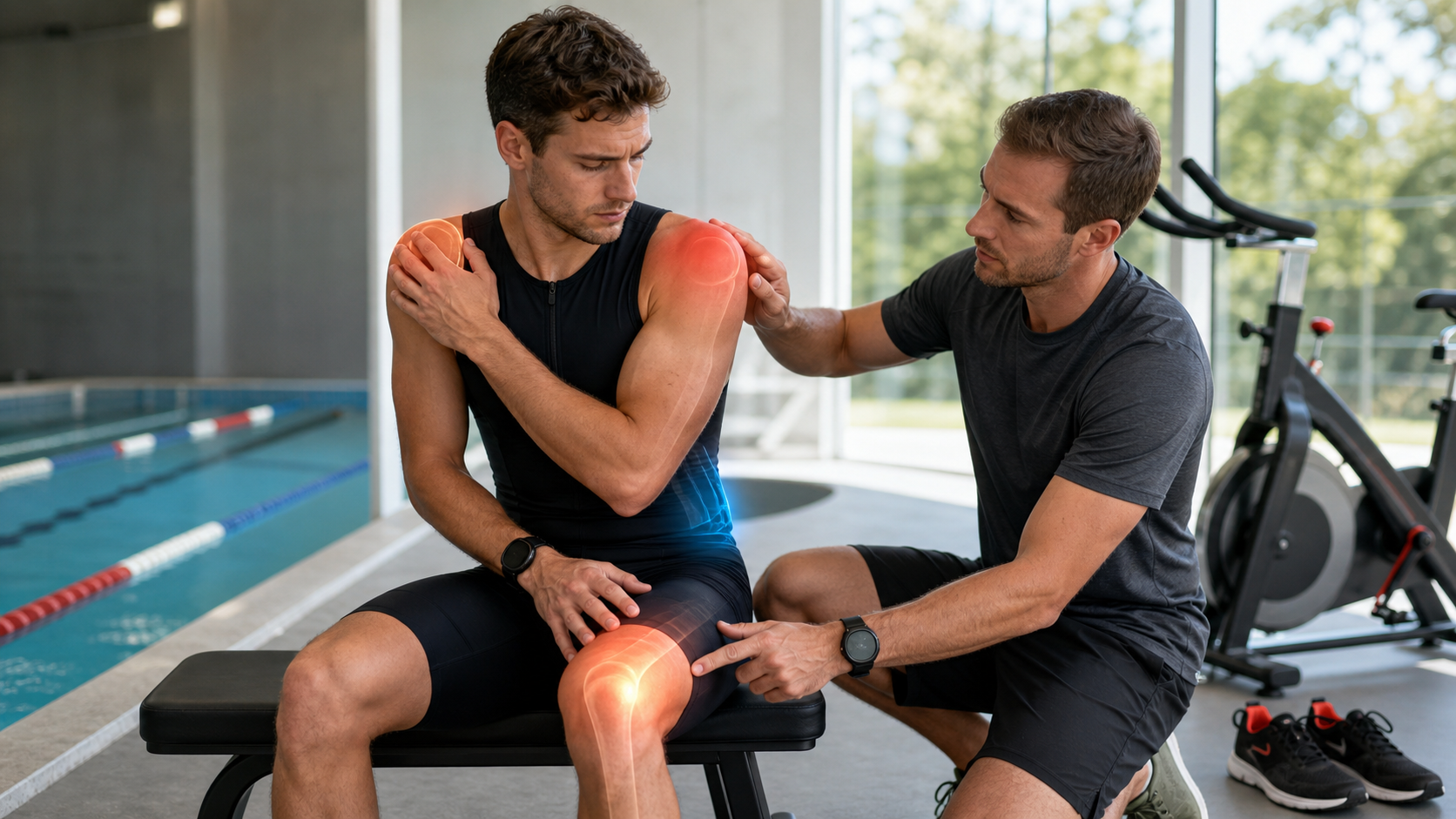
Coach’s Opening: I’m Not Trying to Scare You, I Want You to Train Longer
Let me start with a real situation I’ve coached through (details adjusted, but the story is true). There was a student in his early forties—let’s call him A-Hong—an engineer preparing for his first 113 half-distance ironman. He was dedicated, ramping his weekly training volume from 5 hours all the way up to 11, covering swimming, cycling, and running without skipping a beat. Eight weeks before race day, he texted me: “Coach, my right shoulder gets sore at the end of the swim set, but it’s fine after a day of rest. Should be okay, right?”
I replied with four words: Stop swimming first.
He thought I was overreacting. He dragged it out another three weeks, and that “fine after a day of rest” turned into “it hurts even when I comb my hair.” The final diagnosis was swimmer’s shoulder with tendinitis. He was forced to completely stop swimming for six weeks before the race, swapping it for water kicking and land-based rehab. He still finished, but the swim leg was a mess—he was shaky on his feet coming out of the water.
I’ve coached triathletes for fifteen years, from helping people finish their first sprint to sending athletes to qualify for Kona (Ironman World Championship). I’ve seen too many cases of “early signals dismissed as normal fatigue.” The cruelest thing about triathlon is this: it’s three sports stacked on top of each other—a minor injury in any one discipline gets amplified by the training load of the other two. You have swimmer’s shoulder pain, and the aero position on the bike tugs at your shoulder again. Your runner’s knee flares up, and the pedal stroke repeatedly compresses your knee. In triathlon, injuries don’t stay put—they spread.
In this article, I want to draw you a “triathlon injury map.” We’ll focus on the three most classic, highest-incidence areas: the swimmer’s shoulder, the runner’s knee, and the lower back that runs through all three disciplines. For each one, I’ll cover three things clearly: where it typically occurs, what the early warning signs look like, and how much pain warrants immediate medical attention. This isn’t about turning you into a hypochondriac patient—it’s about teaching you to tell the difference between “normal training soreness” and “your body asking for help.”
Foundational Concepts: The Scientific Picture of Triathlon Injuries
Why Triathlon Injuries Are Almost Always “Overuse” Type
Let’s establish a core concept first. Sports injuries broadly fall into two categories: acute injuries (falls, sprains, strains—happening in an instant) and overuse injuries (accumulated from repeated micro-trauma).
The vast majority of triathlon problems fall into the latter. According to a systematic review of long-distance triathletes, the incidence rate of overuse injuries ranges from 37% to 91%, while acute injuries sit around 24% to 27% (PMC / A Systematic Review of Long-Distance Triathlon Musculoskeletal Injuries). In other words, what you’re most likely to encounter on the triathlon path isn’t the dramatic crash on the bike—it’s the kind of injury that “creeps up on you, and you can’t pinpoint when it started.”
The cause of these injuries almost always traces back to the same root: load exceeding the tissue’s repair capacity. When training volume, intensity, or frequency ramps up faster than tendons, cartilage, and ligaments can adapt, micro-damage doesn’t get repaired in time before the next session tears it open again. Day by day, it accumulates into a clinical injury.
The “Hot Zone Map” of Triathlon Injuries
The same review and related studies have mapped out the most common overuse injury sites in triathletes. The top spots are: knee around 25%, lower leg around 23%, lower back around 23%, with the shoulder also being a major hot zone (PMC / Triathlon Injury Systematic Review).
Mapping this onto the three disciplines makes it very clear:
| Discipline | Primary Load-Bearing Areas | Most Common Injury | Triggering Movement |
|---|---|---|---|
| Swimming | Shoulder, neck | Swimmer’s shoulder (impingement, rotator cuff issues) | Repeated overhead pulling, catch and pull phase |
| Cycling | Knee, lower back, neck, wrist | Patellofemoral pain, lower back tightness | Prolonged aero position, poor pedal alignment |
| Running | Knee, lower leg, ankle, lower back | Runner’s knee, shin splints, plantar fasciitis | Repeated impact loading, insufficient hip stability |
Notice this: the knee and lower back are load-bearing areas for both cycling and running. That’s why their incidence rates are especially high in triathletes—they get bombarded by two disciplines. And while the shoulder primarily comes from swimming, the aero position on the bike slows its recovery. This is the essence of “cross-contamination” in triathlon injuries.
Environmental Variables in Taiwan
Bringing the scene back to Taiwan, we have several local variables that increase injury risk:
- Hot, humid climate: Taiwan summers routinely hit 32°C or higher with 80% humidity. Dehydration and electrolyte loss make muscles more prone to cramping and fatigue-related injuries. At events like Challenge Taiwan (Taitung Living Lake), where May weather can already be scorching, injury risk climbs when hydration and pacing go off the rails.
- Open-water swimming: In open-water venues like Taitung Living Lake or Sun Moon Lake, the sighting motion adds extra strain on the neck and shoulders—a different movement pattern from pool training.
- Eating out with high oil and salt: Taiwan’s food culture is convenient but heavy on refined carbs and sodium. Chronic low-grade inflammation and poor weight management indirectly increase joint and tendon load.
This isn’t meant to make you anxious—it’s a reminder: at the same training volume, under Taiwan’s heat, humidity, and lifestyle, your body’s margin for error is smaller than in temperate countries.
A Key Concept: Pain Isn’t the Enemy—It’s the Dashboard
I love using the “dashboard” analogy with my athletes. When your car engine overheats, the dashboard lights up red—you wouldn’t tape over the light and keep driving, right? But many triathletes treat their bodies exactly that way: shoulder hurts, slap a patch on it, pop a painkiller, keep swimming.
The physiological meaning of pain is your body telling you, “The load here exceeds repair capacity.” It’s a protective mechanism, not something out to get you. When you learn to treat pain as information rather than an obstacle, you shift from “fighting your body” to “working with your body.” This mindset shift often does more to keep you out of major injury than any single strength exercise.
And triathlon injuries have a particularly troublesome quality: their signals are often gradual, vague, and tolerable. Unlike a rolled ankle where “you know it’s bad instantly,” overuse injuries are like boiling a frog—each day it hurts a little more, and your brain keeps rationalizing: “It’s probably fine,” “It’ll be better tomorrow.” By the time the pain becomes impossible to ignore, it often requires weeks or even months to repair. That’s why “early identification” in triathlon injuries is worth far more than any treatment technique.
Injury Map #1: Swimmer’s Shoulder
Common Sites and Mechanism
Swimmer’s shoulder is the most classic and best-documented issue in the swimming discipline. In studies of competitive swimmers, the shoulder is the most common site of musculoskeletal pain. A review compiling a large body of research notes that the proportion of studies addressing shoulder injuries is strikingly high (PMC / Epidemiology of Injuries in Competitive Swimmers).
The pain typically sits on the front to outer side of the shoulder, sometimes radiating down the upper arm. The mechanism goes like this: lap after lap of freestyle overhead pulling, the shoulder joint repeatedly passes through positions of elevation and internal rotation. The rotator cuff tendons beneath the acromion (especially the supraspinatus) and the bursa get repeatedly impinged. Add in the rounded upper back and tight pectoralis minor common in triathletes, and scapular mobility worsens, narrowing the subacromial space even further—making the impingement worse.
Triathletes also have an extra risk that pure swimmers don’t: the aero position on the bike. Aero bars keep your shoulders protracted and your neck extended for long stretches. This posture itself compresses the front of the shoulder space—meaning you’re “grinding your shoulder even when you’re not swimming.”
Early Warning Signs: How Your Body Talks to You
Swimmer’s shoulder rarely strikes suddenly; it gives you signals in stages. I’ve organized this into a “traffic light chart” that I actually use with my athletes:
| Light | Symptoms | My Recommended Action |
|---|---|---|
| 🟢 Green | Shoulder feels “sore” after heavy training, recovers after one night’s rest, pain-free and able to pull normally the next day | Normal training fatigue; maintain the plan, increase stretching and foam rolling |
| 🟡 Yellow | Pain starts in the front of the shoulder mid-to-late in a session, especially noticeable during the recovery phase; eases only after warming up the next day | Reduce volume, fix stroke technique, pause high-intensity sprinting, begin scapular stabilization work |
| 🔴 Red | Pain during daily activities on land (getting dressed, combing hair, reaching for something overhead); wakes you up at night when pressure is applied; shoulder feels weak and can’t lift high | Stop swimming, seek medical evaluation as soon as possible |
Ah-Hong’s mistake was treating the yellow-light stage (soreness late in a session) as a green light (normal fatigue), and pushing through until it became a red light before dealing with it.
When to See a Doctor
If any of the following appears, don’t say “let’s wait and see” — go directly to a sports medicine or rehabilitation physician, or a physical therapist:
- Night pain: Waking up from pain when rolling onto the shoulder in your sleep — this is a classic sign of tendon/bursa inflammation.
- Daily weakness: Noticeably struggling or feeling pain when raising your arm to comb your hair or reaching for something on a high shelf.
- Pain lasting more than two weeks without improvement despite reducing volume.
- Joint catching or clicking accompanied by pain, feeling like something is stuck and won’t move through.
Injury Map #2: Runner’s Knee
Common Location and Mechanism
“Runner’s knee” clinically most often refers to Patellofemoral Pain Syndrome (PFPS). It is the most common running-related injury, with a high prevalence among runners — approximately 19% to 30% in female runners and 13% to 25% in male runners, and the incidence in women is roughly twice that in men (PMC / Incidence and prevalence of patellofemoral pain). It accounts for up to 13% to 30% of medical consultations for running injuries.
The pain location is very characteristic: around or behind the kneecap (patella). Many athletes will trace a circle around the front of their knee with their palm and say, “It’s this whole ring.” The mechanism is a problem with the tracking of the patella within the femoral groove, combined with repetitive compressive load during running foot strikes, which irritates the cartilage behind the patella and surrounding tissues.
The key point: the problem often isn’t the knee itself. The upstream factors of PFPS are mostly in the hip and gluteal muscles. When the gluteus medius is weak and hip abduction/external rotation control is insufficient, the knee collapses inward on landing (dynamic valgus, knee valgus), pulling the patellar tracking off course. Many athletes keep massaging their knee without realizing the real culprit is a weak butt.
Early Warning Signs
Runner’s knee signals are highly recognizable. Remember these “situational triggers”:
- Pain with stairs and downhill running: Especially going downstairs or downhill, a dull ache in the front of the knee — this is a very early sign.
- Pain when standing up after prolonged sitting: Knee stiffness and pain after watching a movie or sitting at a desk for a long time, easing only after walking a few steps (clinically nicknamed the “cinema sign”).
- Pain only in the mid-to-late portion of a run: No pain at the start; it begins after a certain mileage (e.g., after 6 km) and eases when you stop.
- Pain with squatting or deep squats: Compressive pain when the knee bends to a certain angle.
Here’s a key distinction: runner’s knee pain is usually dull, diffuse, and aching. If your knee has sharp stabbing pain, swelling, catching that prevents full extension, or severe pain after an audible “pop”, it may not be simple PFPS but rather a structural issue like a ligament or meniscus injury, which requires more urgent attention.
When to See a Doctor
| Situation | Assessment |
|---|---|
| Improvement after 2–3 weeks of reduced volume and glute strengthening | Likely functional PFPS; can self-manage with continued monitoring |
| Visible knee swelling or warmth | Recommend seeing a doctor; possible inflammation or effusion |
| Knee catching, unable to fully extend or bend | Seek medical attention promptly; suspected structural issue |
| Pain with walking or stairs, affecting daily life | Seek medical evaluation |
| Pain persisting over six weeks without improvement | See a doctor; re-evaluate training and biomechanics |
A Real-World Case: The Misunderstood “Knee”
Let me share another athlete’s story. Xiao-Ya, 30 years old, three years of running experience, just entered her second year of triathlon. She had a dull ache on the front of her left knee while running, starting after 5 km and especially noticeable on downhills. She initially thought her running shoes needed replacing, so she bought new ones; no improvement. Then she suspected an old injury and tried massage and kinesiology taping; still no improvement. She’d been in pain for nearly two months.
I asked her to do a simple test: a single-leg squat while I watched her knee. The result was obvious at a glance — as soon as she squatted, her left knee visibly collapsed inward, with the knee almost tracking inside her big toe. This is classic dynamic valgus, meaning her gluteus medius wasn’t doing its job at all. She’d been treating her knee, but the culprit was in her hip.
The treatment was simple: cut her running volume in half, do clamshells, lateral band walks, and single-leg deadlifts daily to wake up the glutes, and always do a glute warm-up before running. Four weeks later she reported that the knee pain had almost completely disappeared, and she felt “more power in her butt” on climbs. I tell this case over and over to drive home the point: the answer to runner’s knee is often not in the knee.
Injury Map #3: Lower Back Pain
Common Location and Mechanism
Lower back pain is a silent killer for triathletes, accounting for approximately 23% of overuse injuries (PMC / Triathlon injury systematic review), and its most insidious aspect is that all three disciplines can trigger it.
- Swimming: Freestyle body rotation and butterfly undulation both require core stability; when the core is weak, the lumbar spine compensates.
- Cycling: This is the biggest source of lower back pain in triathlon. Spending long hours in an aero position with anterior pelvic tilt and sustained lumbar flexion, combined with a core that can’t hold up for the entire race, leads to overworked and tight lower back muscles. Poor bike fitting (saddle too high, handlebars too far or too low) significantly worsens it.
- Running: After the bike, the lower back is already fatigued; then running’s repetitive impact forces the lumbar spine to absorb shock if the core and glutes are weak.
Most triathlon lower back pain is non-specific, musculofascial — meaning muscle tightness and strain rather than structural disc or nerve problems. This is good news: it can usually be improved with core strengthening, bike fitting adjustments, and stretching.
Early Warning Signs and Red Flags
Signals of general lower back pain:
- Tightness and soreness in the muscles on both sides of the lower back after long rides or races, easing with rest.
- Morning stiffness that improves with activity.
- Worsening after prolonged sitting or standing, with some relief from changing positions.
These are mostly functional and will resolve with proper management. But lower back pain has a set of “red flags” — if any one of them appears, seek medical attention immediately, no delays:
- Pain radiating down the leg, traveling along the thigh, calf, or even into the foot (sciatic nerve symptoms).
- Numbness or weakness in the foot, or the foot feeling strange when stepping on the ground.
- Bowel or bladder control issues (incontinence or inability to void) — this is an emergency; seek care immediately.
- Numbness in the saddle area (perineum, between the buttocks) — same as above, an emergency.
- Pain at rest or while lying down, waking you at night, or accompanied by unexplained weight loss or fever.
Memorize this set of red flags. Functional muscle soreness you can manage yourself, but once neurological symptoms appear, that’s your body sounding the alarm — it’s not something stretching and foam rolling can fix.
Practical Approach: Training and Programming for Prevention Over Cure
Now that we’ve covered the map, let’s talk about prevention. My core philosophy is just one sentence: Injuries aren’t cured — they’re prevented. Here’s the prevention framework I actually give to my athletes.
Principle 1: Control the Rate of Training Load Progression
The root cause of overuse injuries is load increasing too quickly. A practical, conservative guideline is: weekly training volume (time or distance) should not increase by more than about 10% per week, and every three to four weeks, schedule a deload week to let your body absorb and adapt. This isn’t a hard rule, but it’s an excellent guardrail for age-group athletes. Triathlon deserves extra attention here because you’re summing three sports, and total volume can easily spike without you noticing.
Principle 2: Build “Preventive Strength” into Your Weekly Schedule
Many triathletes only train swim, bike, and run, doing zero strength work—this is a breeding ground for injury. For the three major injuries covered in this article, the most valuable preventive strength work is as follows:
| Target Injury | Key Muscle Groups | Representative Exercises | Weekly Recommendation |
|---|---|---|---|
| Swimmer’s Shoulder | Scapular stabilizers, rotator cuff | YTWL, band external rotation, rows | 2 times × 2-3 sets each |
| Runner’s Knee | Gluteus medius, gluteus maximus | Clamshells, lateral walks, single-leg deadlifts, Bulgarian split squats | 2-3 times × 2-3 sets each |
| Lower Back Pain | Deep core, transversus abdominis | Dead bugs, bird dogs, planks, side planks | 3 times × 2-3 sets each |
These exercises require no equipment and don’t take long—15 to 20 minutes per session is effective. I often tell my athletes: the 45 minutes you save by skipping one swim, spend 20 of them on these exercises—the return on investment is far higher.
Example: A Weekly Integrated Prevention Schedule for an Age-Group Triathlete
Below is a sample weekly schedule designed for an age-group athlete “preparing for a 113 half-ironman with about 8-10 training hours per week.” The key is weaving preventive elements into daily training, not adding extra sessions on top:
| Day | Main Workout | Integrated Preventive Elements |
|---|---|---|
| Monday | Rest or easy 40-min swim (technique) | Pre-swim scapular warm-up, post-swim shoulder stretching |
| Tuesday | 8 km run intervals (incl. warm-up) | 10-min pre-run glute activation (clamshells, lateral walks) |
| Wednesday | 60-75 min bike + core | Core circuit (dead bugs, bird dogs, side planks) 20 min |
| Thursday | 45-min swim + upper-body strength | YTWL, band external rotation 15 min |
| Friday | Rest / active recovery (walking, stretching) | Full-body foam rolling, lower back stretching |
| Saturday | Long ride 2-3 hrs (incl. aero position) | Stand and stretch lower back 30 sec every 30 min |
| Sunday | Brick session (bike then 3-5 km run) | Pre-run glute activation, post-run calf release |
The point isn’t to copy this schedule exactly, but to understand the logic: before and after each sport, add a warm-up or cool-down targeting the area most prone to injury in that sport.
Principle 3: Technique and Equipment Fitting
- Swimming: Have a coach correct your pull trajectory to avoid “crossing the midline” with your hand. Change your sighting from a high head lift to a low “crocodile eye” to reduce strain on the neck and shoulders.
- Cycling: Spending money on a professional bike fit is absolutely worth it. Saddle height, handlebar position, and aero pad width directly determine the fate of your lower back and knees. Many bike shops and sports science centers in Taiwan offer this service.
- Running: Avoid overstriding with a low cadence and long stride. Moderately increasing your cadence (many people find that going from too low to roughly 175-185 steps/min feels more efficient and reduces impact) can effectively reduce knee load.
Common Mistakes and Corrections
Having coached athletes for so many years, I’ve seen the same mistakes countless times. I’ve listed them here, hoping you can avoid them:
Mistake 1: Treating “One Day Off Is Enough” as No Big Deal
Correction: If one day off is enough, it means your tissue is already on the edge of damage—it’s just still holding up. This is a yellow light, not a green light. Reduce your load and find the cause, rather than continuing to pile on volume as if nothing happened.
Mistake 2: Only Treating the “Painful Spot”
Correction: Massaging the knee for runner’s knee or slapping a patch on the lower back often treats the symptom, not the cause. The real culprit is usually upstream—for runner’s knee, look at the glutes; for lower back pain, look at core strength and bike fit. The pain site is the effect, not the cause.
Mistake 3: Doing No Strength Training at All
Correction: “I spend all my time swimming, biking, and running—when would I have time for weights?”—this is the most expensive way to save time. Preventive strength work two to three times a week, 20 minutes per session, is the highest-return insurance policy you can buy.
Mistake 4: Panic-Loading Training Before a Race
Correction: Panic-spiking your training volume four to six weeks before a race is a peak injury period. What you should do is taper systematically, letting your body recover to its best state, rather than cramming at the last minute. The volume you pile on at the last minute won’t become race fitness—it will only become injury.
Mistake 5: Training Through Pain with Painkillers
Correction: Suppressing pain with anti-inflammatories and continuing to train is like turning off your body’s alarm system. Not feeling pain doesn’t mean the injury is gone; it just means you’re adding more damage on top of the existing injury.
Actionable Advice for Athletes at Different Levels
First-Time Triathletes (Year One, Goal: Finish)
Your biggest risk is enthusiasm outpacing your body’s ability to adapt. It’s easiest to pile on training volume too quickly when you’re excited.
- Strictly adhere to the ~10% weekly increase guardrail. Better to go a little slower.
- Treat preventive strength as a required course, not an elective.
- Learn to distinguish red, yellow, and green lights. At any red-light signal, stop immediately and seek professional help.
- Your goal is to “finish healthy,” not “train as hard as possible.” The ones who cross the finish line are the ones who didn’t get injured.
Advanced Age-Group Athletes (Chasing Times, Aiming for PBs)
Your risk is intensity and volume rising simultaneously, keeping your body on the edge of high load for extended periods.
- Take deload weeks seriously. Don’t treat deloading as slacking off.
- Get regular fittings and technique check-ups. Your high training volume will amplify any small form flaw into an injury.
- Keep a “body log” recording sleep, fatigue, and soreness, monitoring overtraining with data.
- Experience doesn’t make you immune—in fact, it makes you more prone to complacency because “I’ve always been fine doing this.”
Elite / Kona Qualifier Hopefuls
Your training volume is already near the limits of human capacity, and any injury is zero-tolerance.
- You need a team: regular intervention from a coach, physical therapist, and athletic trainer to nip problems in the bud.
- Recovery (sleep, nutrition, massage, stretching) is as important as training—if not more so.
- Have an almost obsessive sensitivity to early warning signs. Address the slightest abnormality immediately.
A Self-Checklist You Can Print Out
After each week of training, take two minutes to ask yourself these questions. If you answer “yes” to any of them, take one step closer to a professional evaluation:
- [ ] Does your shoulder hurt during daily movements (getting dressed, combing your hair)?
- [ ] Does sleeping on your shoulder wake you up with pain?
- [ ] Does the front of your knee hurt when going downstairs or downhill?
- [ ] Does your knee feel stiff and painful when standing up after sitting for a long time?
- [ ] Does your lower back pain radiate into your leg, or come with numbness or weakness in your foot?
- [ ] Is there any pain that doesn’t ease even with rest or lying down?
- [ ] Has any pain lasted more than two weeks without improvement?
For the last three questions—especially “foot numbness or weakness” and “pain at rest”—don’t hesitate. Seek medical attention right away.
Conclusion: Slow Is Fast, Longevity Is Strength
Back to A-Hong from the beginning. After that injury, he changed. Now he always does his scapular warm-up before every session, and the moment his shoulder shows a yellow-light signal, he reports it to me immediately. Last year, he not only completed a 226 full-distance ironman injury-free, but also swam a personal best on the swim leg. He told me: “Coach, it turns out that slowing down to listen to my body actually made me train faster.”
That’s the message I want to leave you with. Triathlon is a long conversation with time, not a short sprint. The ones who stay in this sport for the long haul aren’t the fiercest—they’re the ones who get injured the least. Learning to read your body’s red, yellow, and green lights today is how you pave the road for the next ten or twenty years of your triathlon life.
The injury map isn’t meant to scare you—it’s meant to put a map in your hands so you can go further, with more peace of mind. See you at the finish line.
Extended FAQ: The Questions My Athletes Ask Me Most Often
Q1: How do you actually tell soreness and injury apart?
This is the most confusing one for people. Here’s a practical set of criteria to help you judge:
- Soreness is usually symmetrical on both sides (e.g., both legs are sore), located in the belly of the muscle rather than the joint, improves after warming up, and naturally subsides within 48 to 72 hours. This is delayed onset muscle soreness (DOMS)—it’s a good thing, meaning your body is adapting.
- Injury is usually one-sided, concentrated at one specific point (joint, tendon attachment site), doesn’t improve or even hurts more after warming up, and gets worse day by day.
Remember this mantra: “Symmetrical soreness is a badge of honor; pain at a single point is an alarm.”
Q2: If I’m injured, do I have to stop moving completely and lie in bed until it heals?
For most overuse injuries, the answer is “relative rest” rather than “absolute rest.” Take swimmer’s shoulder, for example: you stop swimming, but you can keep running, cycling (in positions that don’t trigger shoulder pain), doing lower-body strength work, and even kicking in the water. Take runner’s knee: you might not be able to run, but swimming and cycling (within a pain-free range) can still maintain your aerobic fitness.
Maintaining fitness in ways that don’t hurt is far smarter than completely lying flat. Lying flat completely will cause a major loss of fitness, and when you come back and rush to make up for it, you just create the next round of injury. Of course, red-flag warnings or acute structural injuries are exceptions—those require following medical professional advice.
Q3: Do I definitely need to see a doctor? Are physical therapists and athletic trainers okay?
It depends on the nature of your problem. If you have clear red-flag warnings (neurological symptoms, night pain, fever, etc.) or suspect structural damage (meniscus, ligaments), see a physician first (sports medicine, orthopedics, or rehabilitation) for diagnosis and any necessary imaging. If it’s confirmed to be a functional overuse issue, physical therapists and athletic trainers can often provide more detailed help than a doctor’s clinic visit when it comes to movement correction, strength rebuilding, and return-to-training planning. Ideally, all three work together as a team.
Q4: In Taiwan’s hot, humid weather, is hydration related to injury?
It’s indirectly related. Dehydration and electrolyte imbalance make muscles more prone to fatigue and cramping, reduce movement quality, and increase compensation, indirectly raising injury risk. For summer training in Taiwan, it’s recommended to hydrate about 500 to 800 ml per hour (adjusted based on sweat rate and body size), and for longer sessions, pair it with electrolytes—don’t just drink plain water. For popular races like Challenge Taiwan and Puyuma Ironman, doing heat acclimatization and practicing your fueling plan before race day is itself a form of injury prevention.
Q5: I’m getting older (starting at 40+). Am I especially prone to injury?
As you age, tendon elasticity and recovery speed do decline, but that doesn’t mean you can’t do triathlon—I’ve coached students who started in their 50s and 60s and finished full-distance ironman races healthily. The key is that you need to respect recovery more, prioritize strength more, and be more conservative with training increases. Younger people can push through on raw talent; mature athletes have to manage with wisdom. Deload weeks matter more to you, sleep is more critical for you, and preventive strength training isn’t an option for you—it’s a necessity.
Condensing the injury map into one sentence
If there’s only one thing you remember from this article, I hope it’s this condensed table—the “identify at a glance + act immediately” guide for the three major injuries:
| Injury | One-line warning sign | What to do immediately |
|---|---|---|
| Swimmer’s shoulder | “Pain when combing your hair on land, or when pressure is applied at night” | Stop swimming, work on scapular stability, seek medical evaluation |
| Runner’s knee | “Pain at the front of the knee when going downstairs or standing up after sitting long” | Cut running volume, strengthen glutes, observe for two to three weeks |
| Lower back pain | “Pain radiating down the leg, or foot numbness/weakness” | This is a red flag—seek medical attention immediately |
Save it on your phone, or print it out and stick it in the garage or next to your trainer. When your body sends a signal, you won’t panic, because you have a map. And those who have a map in hand always travel farther and more steadily than everyone else.
This article is educational content and does not replace individual assessment by a physician, physical therapist, or nutritionist.
References
- A Systematic Review of Long-Distance Triathlon Musculoskeletal Injuries — PMC
- Epidemiology of Injuries and Prevention Strategies in Competitive Swimmers — PMC
- Incidence and prevalence of patellofemoral pain: A systematic review and meta-analysis — PMC
Related Reading
- Triathlon Recovery and Injury Prevention: Managing Cross-Discipline Stress Across Three Sports
- The Complete Guide to Shoulder Pain: Swimmer’s Shoulder and Rotator Cuff Impingement, from Strengthening to Avoiding Aggravation
- IRONMAN Injury Prevention: The Three Weak Points of Swimmer’s Shoulder, Cyclist’s Knee, and Runner’s Foot
- The 15 Most Common Race Mistakes Beginners Make in Triathlon and How to Fix Them: A Coach’s Step-by-Step Breakdown
一日北高常見問題大集合 | 攻略 | 路線 | 訓練 | 補給 | 自行車 單車 | 一日雙城 | 雙塔 | TWB北高360 | 屁股痛
6 年前
[防寒衣體驗] 鐵人魂 三鐵 防寒衣試穿會 於松運 深水游泳池 鯨魚池
8 年前
一日北高/長距離團騎 常見問題補充篇 / 組團或跟團的眉角 / 壯車友容易被瘦車友慢性拉爆 / 原來屁股痛可能是這個原因...? / 風場配速法 / 公路車 / CT Yeh
2 年前
Never Stop 西進武嶺 前後雙機 完整全程錄影 訓練台 實境
8 年前
小野田真的存在!日本赤城山爬坡公路賽 台灣首發團完全實錄 | 頭文字D真實賽道! | 看完東奧自行車賽後好想再去騎一次啊! | 公路車 | CT Yeh
4 年前
2019 夏季KOM 5小 完賽心得 準備攻略 東進武嶺 夏季登山王之路 Taiwan KOM Challenge
7 年前
2026 輪霸西濱200K 挑戰VLOG / 第一集團 / 首次參加..經驗不足、膀胱不足 /死守6H內 / AI戰鬥力顯示系統 / 公路車 / CT Yeh
4 個月前
西進武嶺 免費訓練分析服務 Intervals | 練不夠還是練過頭?你哪一種類型選手?AI模型告訴你! | 備戰神器 | 公路車 訓練 | CT Yeh
4 年前