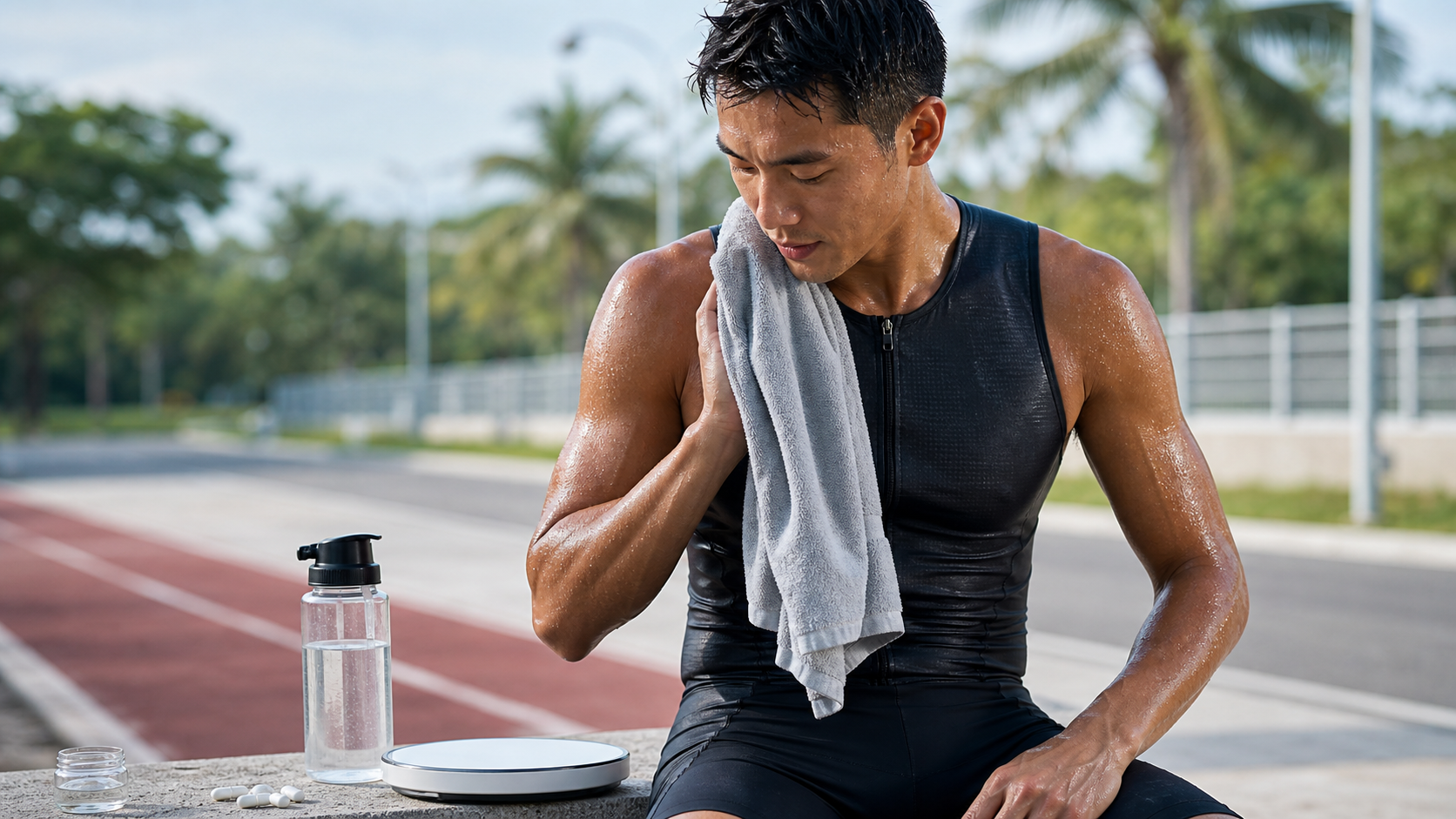
Among the athletes I’ve coached, the ones who keep me up at night aren’t those who can’t train hard or hit their paces—it’s those who “hydrate themselves into trouble.” A few years ago, an athlete training for the Taitung Puyuma Ironman triathlon got lectured by me for three months before the race: “Drink more water, drink more water.” He took it to heart. At every aid station during the marathon leg, he downed two cups of water. By the 30-kilometer mark, he started feeling dizzy, nauseous, and his speech became incoherent. After crossing the finish line, he was carried into the medical tent. A blood test showed his sodium at 129 mmol/L—a textbook case of Exercise-Associated Hyponatremia (EAH). He wasn’t dehydrated; he was water-intoxicated.
After that incident, I completely overhauled how I manage athletes’ fueling. In this article, I want to distill 15 years of hydration and electrolyte strategies—accumulated from first-time triathletes to Kona-qualifying athletes—into a system you can start using today. And its starting point isn’t buying expensive supplements; it’s a towel, a scale, and one serious sweat rate self-test.
Let me be clear upfront: this is not a sponsored post telling you which brand of supplements to buy. The electrolyte products on the market are endless, but until you know what your body actually needs, buying the most expensive product is like groping in the dark. True professionalism means measuring yourself first, then figuring out what and how much to replenish. This is the order I’ve insisted on with athletes all these years—measure first, then strategize, and only then choose products. Reversing that order is the root cause of most people’s fueling failures.
Let’s Bust a Myth First: Dehydration Isn’t Your Only Enemy
Taiwan’s endurance sports community has long been held hostage by the “drink more water” dogma. That advice isn’t wrong, but it only tells half the story. The real question is—how much water have you actually lost? How much sodium have you lost? Is what you’re putting back in the right amount?
Fluid imbalance in endurance sports goes in two directions:
- Dehydration: Sweat loss exceeds fluid intake. Body weight drops too much, blood thickens, heart rate drifts upward, perceived temperature rises, and your pace falls apart. This is the enemy everyone knows.
- Dilutional Hyponatremia: Fluid intake exceeds sweat loss, or you’re only consuming plain water / low-sodium drinks, diluting the sodium in your blood. A blood sodium level below 135 mmol/L qualifies as hyponatremia, and it may not manifest until up to 24 hours after exercise ends.
According to the Wilderness Medical Society’s definition and the clinical review compiled by the American Academy of Family Physicians (AAFP), the threshold for EAH is blood sodium below 135 mmol/L, and its most common cause is precisely “over-hydration with hypotonic fluids (plain water or sports drinks).” In other words, many people think they’re doing the right thing (drinking like crazy) when they’re actually pushing themselves toward danger.
I often tell athletes: “A hydration strategy isn’t about drinking as much as possible—it’s about drinking just the right amount.” And ‘just the right amount’ is something you can’t know without measuring.
What Exactly Does Sodium Do in Your Body?
Before we go further, let’s understand why sodium is so critical in the simplest terms. Sodium is the primary electrolyte in bodily fluids. It maintains blood osmotic pressure, controls the distribution of water inside and outside cells, and participates in nerve transmission and muscle contraction signaling.
When you sweat heavily and only replace it with plain water, the sodium in your blood gets diluted and its concentration drops. To balance osmotic pressure, water moves into cells—including brain cells. Once brain cells swell, you get headaches, nausea, confusion, and in severe cases, seizures and coma. That’s the dangerous physiological essence of hyponatremia. It’s not just “losing electrolytes makes you weaker”—it’s a potentially fatal fluid imbalance.
Conversely, an adequate sodium concentration helps your body actually “retain” the water you drink and deliver it where it’s needed, and it also aids the gut in absorbing water and carbohydrates. So sodium in your fueling isn’t just replacing losses—it’s the key to making your hydration more efficient. Understanding this, you’ll see why I insist so strongly on “always pair water with sodium” rather than just chugging water.
Conceptual Foundation: Sweat Rate and Sodium Concentration Are Highly Individual Numbers
How Much Individual Variation Is There in Sweat Rate?
Here’s a wake-up call. In a study of trained endurance athletes, sweat rates ranged from 0.6 to 2.6 liters per hour, while sodium concentrations ranged from 13 to 103 mmol/L—a variation far greater than what was previously seen in untrained individuals.
Do you see it clearly? At the same intensity and in the same environment, one person sweats 0.6 liters per hour while another sweats 2.6 liters—a fourfold difference. If you follow the generic online advice of “drink 500 to 750 ml per hour,” it could be severely excessive for the former and a drop in the bucket for the latter.
Taiwan’s climate amplifies this even further. Racing in Kenting or Taitung in summer, humidity often exceeds 80%. Sweat simply can’t evaporate, it feels muggy, and sweat rates tend to be far higher than in dry, cool conditions. When I’ve trained athletes in July and August, I’ve measured cases of over 2 liters lost per hour—something rarely seen on cool European courses.
Sodium Concentration: An Individual Spectrum from “Freshwater” to “Saltwater”
Sweat sodium concentration is equally broad a spectrum. Combining multiple literature reviews and real-world measurements from marathon runners:
- Whole-body sweat sodium concentration falls roughly between 10 and 70 mmol/L, while local (skin patch) measurements can range from 10 to 90 mmol/L.
- One large marathon runner study measured an average sweat sodium of about 43 mmol/L (standard deviation ~19), with a range from 7 to 95.5 mmol/L.
- The coefficient of variation between individuals is as high as 37% to 47%—an enormous difference.
Sports science commonly uses a rough classification:
| Sweat Sodium Type | Sweat Sodium Concentration (Approx.) | Intuitive Characteristics |
|---|---|---|
| Low-salt sweater | Below 30 mmol/L | Sweat dries with almost no white residue, not very salty |
| Typical sweater | 30–60 mmol/L | Hat brim and clothing occasionally show faint salt stains |
| Salty sweater | Above 60 mmol/L | Dark jersey crusts with white frost, sweat stings badly when it runs into eyes, skin feels gritty to the touch |
Why does this classification matter? Because it directly determines how much sodium you need to replenish. A salty sweater losing 2 liters of sweat per hour can lose over 2 grams of sodium in an hour; a low-salt sweater losing 1 liter per hour might lose only around 0.7 grams. The fueling strategies for the two are worlds apart—using the same chart for both is a recipe for disaster.
I once coached an athlete who suffered from chronic cramping—no matter how he trained, his calves would lock up in the second half of every race. He always assumed it was a strength issue. Then I had him do a sweat rate test and observed the thick layer of white salt frost on his jersey after exercise—a textbook salty sweater. After we increased his sodium intake, his cramping problem improved dramatically. It wasn’t that he wasn’t strong enough; his sodium was perpetually in deficit.
Practical Core: A Sweat Rate Test You Can Do at Home
The good news is—you don’t need a lab, and you don’t need to spend a fortune to measure the most important number for you: sweat rate (how many milliliters you lose per hour). True lab-grade sweat sodium analysis is harder to self-test, but sweat rate is the foundation of all fueling calculations, and all it requires is a scale.
Standard Sweat Rate Self-Test Protocol (The Golden SOP)
The principle is simple: your body weight change before and after exercise, minus what you drank, plus what you urinated out, equals the fluid lost through sweat.
The calculation formula:
Sweat volume (liters) = (pre-exercise body weight − post-exercise body weight) + fluid consumed − urine output
Sweat rate (mL/hour) = sweat volume (mL) ÷ exercise duration (hours)
(Conversion: every 1 kg of body weight lost ≈ 1 liter of fluid lost; 1 kg = 1000 mL)
Step-by-step testing procedure:
- Before exercise: Empty your bladder, then weigh yourself wearing only underwear or minimal clothing. Record the number (accurate to 0.1 kg; a home body composition scale is fine).
- Track fluid intake: Prepare a bottle of water/sports drink with a known volume (e.g., a 750 mL bottle with marked graduations). Drink only from this bottle during the entire session. After finishing, check how much remains to calculate exactly how many milliliters you consumed.
- Control intensity and duration: Do a 60-minute ride or run at an intensity close to your race pace (an indoor trainer or treadmill is ideal for a stable environment). Do not use the restroom mid-session; if you must urinate, measure and record it separately.
- After exercise: Wipe off the sweat, remove wet clothing, and weigh yourself again in the same minimal clothing.
- Plug the numbers into the formula.
Example: Athlete Xiao Lin weighs 70.0 kg before exercise, rides for 60 minutes, drinks 500 mL of water, weighs 69.2 kg afterward, and does not urinate mid-session.
- Sweat volume = (70.0 − 69.2) × 1000 + 500 = 800 + 500 = 1300 mL
- Since the session was 60 minutes, sweat rate = approximately 1300 mL per hour
This means: at this intensity and in these conditions, Xiao Lin loses 1.3 liters of sweat per hour. If he only replaces 500 mL during a race, he accumulates an 800 mL deficit every hour. After two hours, he would be down more than 2% of his body weight, and a pace collapse would be almost inevitable.
You Must Test Under “Race Conditions”
Sweat rate is not a fixed number; it varies significantly with environment and intensity. That’s why I require athletes to test in at least three scenarios and build their own personal sweat rate chart:
| Test Scenario | Environmental Conditions | Recommended Intensity | Purpose |
|---|---|---|---|
| Cool conditions | Indoor A/C or early morning, 20–24°C | Race pace | Baseline for winter races and cool courses |
| Standard conditions | Typical sunny day, 26–30°C | Race pace | Baseline for most flat races in Taiwan |
| Hot & humid conditions | Summer midday / humidity >75% | Race pace | Kenting, Taitung, summer long-distance triathlon |
When I prepare athletes for IRONMAN Taiwan (Penghu / Taitung courses), I always schedule at least one hot-and-humid test session, because the sun-exposed, salty, and shelterless environment of Penghu produces a sweat rate that is completely different from what you’d measure on a gym trainer. Using cool-condition numbers to race in hot, humid conditions is like bringing the wrong map to the battlefield.
How to Estimate Sweat Sodium? You Don’t Need a Lab
An accurate sweat sodium value requires professional sweat analysis (patch collection or commercial sweat testing services), but if you can’t do that yet, you can make a rough estimate using “behavioral observation + symptom inference”:
- Check salt stains: The more visible the white crystals on dark clothing, hat brims, or shoelaces after exercise, the more likely you are a salty sweater.
- Check your eyes: If sweat stings your eyes noticeably or you taste a distinct salty flavor at the corner of your mouth, you lean toward being a salty sweater.
- Check cramping history: Repeated muscle cramps in the latter half of long efforts that don’t improve with hydration point to a high probability of sodium deficiency.
- Check your skin: If your skin feels noticeably rough or gritty after sweat dries, you lean toward being a salty sweater.
These can’t replace lab data, but they’re enough to place you into one of three broad categories—“light / typical / salty”—which, combined with your sweat rate, lets you calculate a reasonable starting intake plan that you can fine-tune through real-world racing.
From Numbers to Strategy: A Practical Formula for Hydration and Sodium Intake
Once you have your sweat rate, the next step is translating it into “how much to drink per hour and how much sodium to take in.”
Principles for Fluid Intake
My principle is not “replace 100%,” but rather “control the deficit without chasing zero.” Replacing 100% of fluid loss during exercise is often difficult, and your gut may not tolerate it. In practice, keeping body weight loss within 2% of your pre-race weight is enough to maintain good performance.
- Target fluid intake ≈ 60% to 80% of your sweat rate (adjust based on gut tolerance).
- Upper limit warning: Never exceed your sweat rate. Consistently drinking more than your sweat rate is the breeding ground for hyponatremia. This is a non-negotiable rule.
- Listen to your thirst: One of the core recommendations from the Wilderness Medical Society and related clinical reviews is “drink to thirst”—avoid forcing fluids on a fixed schedule. Thirst is your body’s most direct signal; don’t override it.
Estimating Sodium Intake
Sodium needs = sweat rate × sweat sodium concentration. Use the categories above for a rough estimate:
| Sweat Type | Assumed Sweat Sodium | Sweat Rate 1.0 L/hr | Sweat Rate 1.5 L/hr | Sweat Rate 2.0 L/hr |
|---|---|---|---|---|
| Light sweater | 25 mmol/L | ~0.6 g sodium/hr | ~0.9 g sodium/hr | ~1.2 g sodium/hr |
| Typical sweater | 45 mmol/L | ~1.0 g sodium/hr | ~1.6 g sodium/hr | ~2.1 g sodium/hr |
| Salty sweater | 65 mmol/L | ~1.5 g sodium/hr | ~2.2 g sodium/hr | ~3.0 g sodium/hr |
(Conversion: 1 mmol sodium ≈ 23 mg; 1 g sodium ≈ 2.5 g salt. The table above is an estimate range, not exact values; adjust based on your own testing.)
In practice, you don’t need to replace 100% of sodium loss every hour—your body can buffer short-term sodium deficits. But for efforts longer than 3 hours (half-ironman, ironman, ultramarathon), you must take it seriously. I typically recommend replacing 60% to 100% of losses, leaning toward the higher end the hotter and longer the race.
How to Choose Your Products?
Common options available in Taiwan and my recommendations:
- Commercial sports drinks: Sodium content is usually low (typically in the 10–20 mmol/L range after conversion). They’re sufficient for light sweaters on short distances, but far from adequate for salty sweaters on long distances.
- Electrolyte tablets / salt tablets: Allow precise control of sodium intake. Check the sodium content in milligrams per tablet before calculating. This is my go-to for salty-sweater athletes.
- Energy gels with sodium: Some energy gels come in sodium-added versions, letting you take in carbs and sodium simultaneously—suitable for long distances.
- Local folk remedies: Many veteran cyclists in Taiwan carry “salt candy” or “dried salted plums.” These can help in a pinch, but the sodium content is hard to quantify, so I usually treat them only as a backup.
A Two-Week “Fueling Rehearsal” Plan You Can Follow
Numbers alone are useless; fueling must be “trained.” Below is a two-week fueling rehearsal template I give to athletes preparing for half-Ironman and Ironman distances. The focus isn’t on workout intensity, but on deliberately automating your fueling rhythm and gut tolerance during every long session. Assume a typical salty sweater with a standard-condition sweat rate of about 1.4 L/hour:
| Day | Workout Content | Hydration Target | Sodium Target | Rehearsal Focus |
|---|---|---|---|---|
| Monday | Rest / Dynamic stretching | Drink to thirst daily | Normal diet | Check morning urine color, weigh yourself upon waking as a baseline |
| Tuesday | 90 min bike (race pace) | ~900 ml per hour | ~1.0 g sodium per hour | Practice “drinking while riding” without slowing down |
| Wednesday | 60 min easy run | Drink to thirst | No special intake for short distance | Measure run sweat rate, cross-reference with cycling numbers |
| Thursday | Interval session (with high intensity) | ~800 ml per hour | ~0.9 g sodium per hour | Observe gut tolerance under high intensity |
| Friday | Rest | Daily hydration | Normal diet | Review this week’s fueling log, fine-tune the formula |
| Saturday | 3.5 hr long ride (race simulation) | 900–1000 ml per hour | 1.2–1.5 g sodium per hour | Full race-day fueling protocol rehearsal + weigh before/after to verify |
| Sunday | 90 min brick (bike to run) | ~850 ml per hour | ~1.0 g sodium per hour | Practice transition-area fueling and gut response during the run |
In week two, extend Saturday’s long ride to 4.5–5 hours, keeping everything else the same. Repeat the sweat rate verification after every long session (subtract before/after body weight). You’ll notice the numbers shift gradually as heat adaptation progresses—that’s the dynamic data you want to capture.
I want to emphasize the value of Saturday’s “race simulation long ride”: it’s your only chance to fully rehearse the fueling protocol before race day. From when you take your first sip, how often you refuel, when you take salt tablets, how much water you pair with each gel—run through it all exactly as you will on race day. Train until you don’t have to think, until your body reacts automatically, so race day won’t be chaotic.
Heat Acclimation: The Hidden Variable That Changes Your Fueling Numbers
This is a factor many Taiwanese athletes overlook, but it’s absolutely critical. After 1–2 consecutive weeks of training in hot conditions, the body undergoes heat acclimation: plasma volume increases, the core temperature threshold for sweating lowers, and—the sweat glands become more efficient at “reabsorbing sodium,” making sweat less salty.
What does this mean?
- After heat acclimation, you may start sweating earlier at the same intensity, and your sweat rate may even be higher (more efficient cooling).
- But at the same time, sweat sodium concentration may drop, changing the proportion of sodium lost.
- So the numbers you measure early in the summer season may differ from those after heat acclimation is complete mid-season.
When I prepare athletes for summer races in Taitung or Penghu, I deliberately schedule a 10–14 day progressive heat acclimation block beforehand (e.g., training during the warmest part of the afternoon, gradually extending heat exposure time), and measure sweat rate both “before” and “after” heat acclimation. This is why I always say fueling numbers aren’t “measure once, use forever”—they’re alive, changing with your body’s state and training phase.
Heat acclimation is also a safety strategy. Going straight into a hot, humid race without acclimation carries a much higher risk of heatstroke and dehydration—that’s what truly puts you in danger.
Check the Weather Before Race Day, Make Real-Time Adjustments During the Race
No matter how complete the plan, it must adapt to the actual conditions on race day. Taiwan’s race weather can vary greatly, so I require athletes to start monitoring the forecast 48 hours out and prepare two to three fueling versions:
- Cool version (start temp below 24°C, cloudy): Use the cool-condition sweat rate; scale both hydration and sodium down.
- Standard version (26–30°C, partly cloudy to sunny): The default for most flat races in Taiwan.
- Hot-humid version (above 30°C, high humidity, strong sun): Increase sweat rate and sodium intake, and combine with water dousing for cooling and slowing your pace.
During the race, you must learn to read your body’s signals and adjust on the fly. If you feel stuffy and hot, sweating unusually heavily, or your heart rate is elevated at the same pace, proactively increase fluid and sodium intake. Conversely, if your stomach feels bloated or you feel nauseous, cut back and slow down to let your gut catch up. The plan is a map, but your body is the real-time navigation. I often remind athletes: the plan is meant to be executed, not to be stubbornly endured. Adjusting to the current situation is what makes a truly mature fueling strategy.
Taiwan’s summer races in the east and on outlying islands (around Taitung and Penghu) especially test this on-the-fly ability—that kind of sun-baked, muggy, nearly shade-less environment often forces you to bump up your intake mid-race. Thinking ahead about “how I’ll add more if it’s scorching hot” is far safer than panicking and guessing on the spot.
Common Mistakes and Fixes: Pitfalls I’ve Seen in Athletes
Mistake 1: Treating “Drink More Water” as a Free Pass
This is the most dangerous and most common one. Many people think that as long as they keep drinking, nothing will go wrong—only to end up with hyponatremia from overhydrating.
Fix: Measure your sweat rate first. Cap your fluid intake at 60–80% of your sweat rate and adjust based on thirst. Better a small deficit than an excess.
Mistake 2: Only Replacing Water, Not Sodium
Drinking only plain water over long distances dilutes your blood sodium further, inviting cramps, nausea, and even dangerous hyponatremia.
Fix: Any exercise over 90 minutes must include sodium. In hot-humid conditions or for salty sweaters, start earlier and take in enough.
Mistake 3: Copying Someone Else’s Fueling Plan
“My friend does it this way and is fine”—but your friend might be a light sweater while you’re a salty sweater, with sweat rates differing by double. Copying their plan is asking for trouble.
Fix: Fueling is highly individual. Build your own sweat rate and sweat type profile first, then create a personalized plan.
Mistake 4: Trying Fueling Products for the First Time on Race Day
Your gut needs training. Suddenly slamming unfamiliar electrolyte drinks and gels on race day can cause your stomach to shut down, leading to diarrhea or vomiting.
Fix: Rehearse all fueling products and timing until they’re second nature in training. This is called “gut training.” Never try anything new on race day.
Mistake 5: Ignoring the Hidden Sodium in Taiwanese Restaurant Food
This one is very local. Taiwanese eating out (braised snacks, fried chicken, bento boxes, noodle soup broths) is naturally salty, so daily sodium intake is usually not low. This is a health concern for “non-exercise time,” but for immediate replacement during exercise, sodium from the dinner table cannot substitute for real-time fueling during the workout—you still need to replenish during exercise.
Fix: Understand that “daily dietary sodium” and “sodium during exercise” are two different things. Don’t use the former as an excuse to slack off on fueling during the race.
Mistake 6: Directly Transferring Indoor Trainer Numbers to Outdoor Racing
Many people measure their sweat rate on a home trainer, thinking it’s convenient and done. The problem is that trainers are usually in an air-conditioned room with no wind resistance for cooling, while outdoors you have solar radiation, reflected ground heat, and humidity changes—sweat rates can differ significantly.
Fix: Treat trainer numbers only as a “cool-condition” reference. For outdoor races, you must test separately under conditions close to the race environment, especially on those muggy, windless summer afternoons in Taiwan.
A Comparative Case: Two Athletes Who Finished Together but Fueled Completely Differently
I once coached two athletes preparing for the same IRONMAN 70.3, with similar builds and similar fitness. A was a light sweater with a standard-condition sweat rate of about 1.0 L/hour; B was a salty sweater with a sweat rate as high as 1.9 L/hour.
What would happen if they used the same fueling plan? If B followed A’s amounts, B would accumulate nearly 1 liter of fluid deficit plus a massive sodium deficit every hour, almost guaranteeing cramps, dehydration, and slowing in the latter half. Conversely, if A followed B’s amounts, A would likely overhydrate, get a bloated stomach, and struggle to run—with a risk of hyponatremia.
The plan I ultimately gave them was: A took in about 700 ml and 0.6 g sodium per hour; B took in about 1400 ml and 2.4 g sodium per hour. Their fueling amounts differed by a full factor of two, yet both set personal bests. That’s what “individualization” really looks like—there’s no one-size-fits-all fueling chart, only the one that’s yours.
Actionable Advice for Athletes of Different Levels
Beginners / Just Getting Started
- Do a standard-condition sweat rate test this week, and record the numbers in your phone’s notes app.
- For short distances (51.5 standard triathlon, within 90 minutes), first master your hydration rhythm: aim for 60–70% of your sweat rate, and drink according to thirst.
- Choose a sports drink that goes down smoothly and doesn’t upset your stomach, and use it consistently in training.
- The key is to build the habit of “quantifying” — stop drinking water based on feel alone.
Intermediate / Preparing for Half-Ironman or Ironman
- Build a three-condition sweat rate chart (cool / standard / hot-humid), and make sure to add the hot-humid condition.
- Determine your sweat type. If you’re a salty sweater, be sure to use salt tablets / electrolyte tablets, and calculate your hourly sodium intake.
- Practice your full fueling rhythm during long sessions (3+ hours) to train your gut.
- For Taiwan’s hot, humid summer races (such as summer Ironman or Kenting events), add extra sodium and cooling strategies.
Targeting an Age-Group Podium / Kona Slot
- Consider getting a professional sweat analysis to obtain precise sweat sodium values and minimize estimation error.
- Build a fueling matrix for different temperatures and paces, and even customize it by race segment (swim, bike, run).
- Retest regularly — heat acclimation training changes your sweat sodium concentration, so a single test doesn’t stay valid forever.
- Write your fueling plan into a race-day checklist, and even rehearse your actions at aid stations.
FAQ
Q: Can I use urine color to judge my hydration status?
A: You can use it as a rough reference. Light pale yellow usually means adequate hydration, while dark, concentrated urine suggests dehydration. But it reflects your overall hydration status and cannot replace a sweat rate test for planning “during-exercise” fueling amounts. The color of your first morning urine is a good daily monitoring point.
Q: Should I “load up” on water before exercise (hyperhydration)?
A: Just hydrate normally before the race; there’s no need to deliberately drink until your stomach is bloated. Over-hydrating before a race actually increases the risk of hyponatremia and causes gastrointestinal discomfort. Drinking regularly 2 to 3 hours before the race and using the restroom to void the excess beforehand works well.
Q: Is cramping always caused by sodium deficiency?
A: Not necessarily. Exercise-associated muscle cramps have complex causes, including neuromuscular fatigue, sodium and electrolyte loss, and other multiple factors. Sodium deficiency is one common correctable factor. If you’re a salty sweater, cramps tend to occur in the latter half, and hydration doesn’t help, sodium supplementation is worth trying. But if cramps persist despite sodium supplementation, you should revisit your muscular strength and fatigue management.
Q: Do I have to buy expensive electrolyte products?
A: Not necessarily. The key is “whether the sodium amount is right,” not whether the brand is expensive. Read the sodium milligrams on the ingredient label and calculate the amount that fits your needs — that’s what matters. Cheap salt tablets work just as well as long as the dosage is calculated correctly.
Q: What warning signs of hyponatremia should make me stop immediately?
A: Headache, nausea and vomiting, confusion, unexplained swelling (rings feeling tighter, shoes feeling tighter), and weight that increases instead of decreases — these should raise high alert when they occur during prolonged exercise. Severe hyponatremia is a medical emergency. Seek medical assistance on-site immediately and stop drinking more water.
Q: In cold winter weather, I don’t feel like I sweat much. Do I still need to hydrate and take sodium?
A: Yes, just in smaller amounts. Sweat rate does drop in cold temperatures, but you still lose water and sodium continuously during prolonged exercise. Plus, thirst sensation is less noticeable in winter, making it easier to under-hydrate. For winter races, plan using your “cool condition” sweat rate numbers — don’t skip fueling entirely just because it doesn’t feel hot. Even in Taiwan’s flat winter events (like early-morning cycling activities), you should still carry enough fuel.
Q: Do caffeine and alcohol affect hydration status?
A: Moderate caffeine has limited diuretic effects in habitual users, so a cup of coffee before a race usually isn’t a concern. Alcohol, on the other hand, clearly has diuretic effects and impairs recovery — it’s not recommended the night before a race or after high-intensity training. The core variables that truly affect hydration status are still your sweat volume and fluid intake — don’t focus your attention on the wrong things.
Q: How often should I retest my sweat rate?
A: At least once per season change, because temperature, fitness, body weight, and heat acclimation status all change. If you’re losing weight, significantly changing training volume, or racing in a completely different climate, you should retest. Treat it like a routine check similar to weighing yourself, not a one-time task.
Q: How should I combine energy gels, hydration, and sodium so my stomach doesn’t have issues?
A: The core principle is “don’t make carbohydrate concentration too high, and keep up with water.” When taking an energy gel, be sure to drink enough water to dilute it; otherwise, the high-concentration sugar sits in your stomach and causes discomfort or even nausea. Sodium actually helps with water and carbohydrate absorption, so properly combined sodium-containing fuel can actually make your gut run smoother. All of this presupposes — you’ve practiced it in training and found a rhythm your stomach can handle.
Conclusion: Measure First, Then Talk Strategy
In 15 years of coaching athletes, my deepest insight is this — fueling in endurance sports has never been about who drinks more or fuels harder, but about who understands their own body better. That athlete who was carried into the medical tent at the Puyuma Ironman finished comfortably the following year on the same course with a fueling plan tailored to his personal sweat rate and sweat type, smiling and telling me, “So this is what a comfortable race feels like.” The difference wasn’t that he had gotten much stronger — it was that he had finally replaced guesswork with numbers.
The self-administered sweat rate test costs nothing and can be done today. It’s the foundation of your entire fluid and electrolyte strategy. Once the foundation is solid, you can build on it with hydration volume, sodium intake, and product selection. Stop drinking water based on feel — go measure once, and you’ll be surprised how wrong you’ve been.
May every race you enter be fueled just right.
This article is educational content and does not replace individual assessment by a physician, physical therapist, or nutritionist.
References
- Exercise-Associated Hyponatremia: Updated Guidelines from the Wilderness Medical Society (AAFP): https://www.aafp.org/pubs/afp/issues/2021/0215/p252.html
- Sweating Rate and Sweat Sodium Concentration in Athletes: A Review of Methodology and Intra/Interindividual Variability (PMC): https://pmc.ncbi.nlm.nih.gov/articles/PMC5371639/
- Interindividual variability in sweat electrolyte concentration in marathoners (PMC): https://www.ncbi.nlm.nih.gov/pmc/articles/PMC4966593/
Related Reading
- Hydration and Electrolytes for Long-Distance Riding: Dehydration, Hyponatremia, and Personalized Hydration Rates
- Summer Hydration and Electrolyte Strategies in Taiwan: How to Calculate Sweat Rate, Sodium’s Role, and How Real the Hyponatremia Risk Is
- Exercise and Hyponatremia: Drinking Too Much Water Is Actually More Deadly Than Dehydration
- Water Intoxication and Overhydration in Athletes: The Invisible Killer of Hyponatremia — How to Hydrate Correctly
雨戰! 西進武嶺員工旅遊 加料 各路段大數據分析 | 同事端出5公斤的公路車來挑戰!? EP1
4 年前
西進武嶺 免費訓練分析服務 Intervals | 練不夠還是練過頭?你哪一種類型選手?AI模型告訴你! | 備戰神器 | 公路車 訓練 | CT Yeh
4 年前
CT 喇低賽) 武嶺牽車 才是王道 西進牽車四小時內秘訣 攝手位置 如何判斷 防抽筋小秘訣
7 年前
CT暗黑廚房) 車友必備 宇宙無敵鮮蚵湯 幫助訓練恢復 天然食補 好市多 超肥鮮蚵 破PR
7 年前
洗單車神器 吹水機! 實際洗車用用看 暴力洗鍊條大法 | 公路車 | CT Yeh
4 年前
水金九不厭五分 10度寒流冷到不願停!feat. 卡卡 / 公路車 / CT Yeh
6 個月前
Never Stop 西進武嶺 前後雙機 完整全程錄影 訓練台 實境
8 年前
自助洗車場 洗單車 50元有找 清鍊條大法 居然還有小小兵
7 年前