Meal Planning for Triathletes Who Eat Out: A Practical Guide to Convenience Stores and Buffet-Style Cafeterias
Coach’s Opening: Eating Out Isn’t an Excuse for Not Training
In my 15th year coaching triathletes, from office workers tackling their first 51.5 distance to veterans gunning for a Kona slot, when I sit down with athletes to discuss training, eight times out of ten the conversation veers off to food. And nearly every new athlete asks me the same question: “Coach, I eat almost all my meals out, alternating between convenience stores and buffet-style restaurants. Can I still train effectively?”
Let me give you the bottom line first: Yes, you can, and outdoor diners aren’t at a disadvantage at all. The ones who truly lose out are those who think “eating out = eating carelessly” and leave their fueling entirely to chance. Taiwan’s dining environment is actually a hidden advantage for triathletes—within a three-minute walk, there’s a 24-hour convenience store, and a pay-by-weight buffet restaurant is just around the corner. The variety of choices and the ease of access to protein and carbohydrates would be a luxury in many countries. The problem has never been “is there food available,” but “do you know how to put a meal together.”
I once coached an engineer working in the Hsinchu Science Park; let’s call him A-Kai. When he first came to me, he grimaced and said his “nutrition must be terrible” because 12 of his weekly meals came from convenience stores. I asked him to show me a week’s worth of photos from his phone. After looking through them, I laughed: he wasn’t eating badly; he was eating without logic—after a morning swim, he’d have an iced milk tea and a pineapple bun; after a long evening ride, he’d only down a bowl of braised pork rice with a cola. The ingredients themselves weren’t the problem; it was that the timing and proportions were all wrong. Three months later, he was still eating out, still at the same convenience stores and buffet restaurants, but his finish at a CTF (half-distance triathlon) across swim, bike, and run was better than the six months he’d spent cooking for himself.
This article is the meal-planning logic I’ve refined with A-Kai and a long line of outdoor-dining athletes since. I won’t tell you to cook, I won’t tell you to stock up on meal replacements. I’ll only teach you how to put together the right meals before, during, and after training at the convenience stores and buffet restaurants you already visit.
Foundational Concepts: First, Understand What a Triathlete Actually Needs
Before you walk into a convenience store, you need to know what you’re looking for. The nutritional needs for triathlon training boil down to three pillars: carbohydrates (fuel), protein (repair), and fluids/electrolytes (function). All the skills of meal planning for eating out revolve around adjusting the proportions and timing of these three pillars.
Carbohydrates: Your Primary Fuel, Don’t Fear Them
Many beginners have been influenced by the low-carb trend and treat rice and noodles as enemies. But triathlon is a long-duration, moderate-to-high-intensity endurance sport, and carbohydrates are your primary fuel. The sports science consensus on carbohydrate intake “during exercise” is quite clear: general recommendations for endurance exercise are about 30 to 90 grams of carbohydrates per hour, with the exact number depending on exercise duration and intensity—training under 1 hour usually doesn’t require extra carbs; 1 to 2 hours suggests 30 to 60 grams per hour; and beyond 2 hours, you can increase to 60 to 90 grams per hour; advanced athletes who have trained their gut, using a mix of glucose and fructose, can even push up to 120 grams per hour (see the endurance carb intake guide compiled by Precision Hydration, link at the end of the article).
This set of numbers is highly practical because it directly tells you: a full-distance triathlon (226 distance) often involves 7 to 8 hours or more of riding and running, and your total carbohydrate needs are calculated in the “hundreds of grams.” You can’t cram that in through regular meals alone; fueling must run through the entire training session and race.
Protein: The Key to Repair and Adaptation
Protein is the raw material that turns training stimulus “into progress.” Regarding single-serving intake, there’s a widely cited range in sports nutrition: about 20 to 40 grams of quality protein per meal effectively stimulates muscle protein synthesis. One study on whole-body resistance training found that consuming 40 grams of whey protein triggered a greater muscle protein synthesis response than 20 grams (study link at the end of the article). For larger athletes, or those who’ve just finished a highly damaging session (such as after a long run), leaning toward 30 to 40 grams of protein per meal is reasonable.
Another keyword outdoor diners should remember is leucine. It’s the “trigger” that activates the muscle-building signal; it’s generally believed that reaching about 2 to 3 grams of leucine per meal effectively activates the synthesis pathway. Whey, eggs, chicken breast, tuna, and soy milk—all readily available at convenience stores and buffet restaurants—have good leucine content. That’s why I’ll keep telling you to grab protein later on.
Fluids and Electrolytes: The Hidden Killer of Taiwan’s Summer
This pillar is especially critical in Taiwan. Training in Tainan or Kaohsiung in summer, with perceived temperatures often exceeding 35°C, losing one to two liters of sweat on a long ride is par for the course. Sweat takes away not just water, but also electrolytes like sodium and potassium. The advantage for outdoor diners is that sports drinks, electrolyte tablets, and salty snacks (seaweed, nuts, even a tea egg) are easy to find at convenience stores. The downside is that many people only focus on replacing water, not sodium, leading to hyponatremia, dizziness, and cramps after long sessions.
Estimating Your Fluid and Sodium Needs by Sweat Loss
There’s no one-size-fits-all answer for how many electrolytes to take, but there’s a simple self-check outdoor diners can do—weigh yourself before and after training. Weigh yourself without gear and after wiping off sweat before and after training; the difference roughly equals the fluid you lost (each 1 kg lost equals about 1 liter of sweat). For example: if you drop 1.5 kg before and after a 2-hour long ride, that means you lost about 1.5 liters of sweat, and that doesn’t include the water you drank during the session—your actual sweat loss is higher.
The table below gives you a rough fueling reference for long sessions, helping outdoor diners get a feel for it (adjust based on your individual sweat rate and weather):
| Training Duration/Weather | Suggested Water Intake per Hour | Sodium Focus | Available Outdoor Sources |
|---|---|---|---|
| Under 1 hour, cool | Drink to thirst, about 400-600 ml | Usually no extra needed | Plain water is fine |
| 1-2 hours, warm | About 500-750 ml | Start adding sodium | Half sports drink + plain water |
| Over 2 hours, hot | About 600-900 ml | Must continuously add sodium | Sports drink + salt tablets + tea egg |
| Salty sweater, midsummer | Increase based on sweat loss | Actively add sodium | Electrolyte tablets + salty fuel |
This isn’t about calculating milliliters while riding in a race; it’s about building a bodily sense of “how much I need to drink and how much sodium to add” during regular long sessions. When training in Taiwan’s summer, it’s better to err on the side of slightly more sodium than to risk the danger of hyponatremia.
Convenience Store Meal Planning: Turning the 24-Hour Shelves into Your Fuel Station
Taiwan’s convenience store density is the highest in the world, making it the home turf for outdoor-dining triathletes. I categorize the convenience store’s role into three types: the pre-training refueling station, the mid-training mobile aid station, and the post-training recovery station. What you grab for each is different.
Convenience Store Shelf Classification Map
Let me first translate the shelves into nutritional language, so you can scan and know what to grab the moment you walk in:
| Shelf Area | Representative Items | Main Provides | Triathlon Scenario |
|---|---|---|---|
| Rice balls/Onigiri | Tuna, salmon, grilled meat rice balls | Carbs primary + small protein | 60-90 minutes before training |
| Bread section | Toast, bagels, bread | Quick carbs | Pre-training, quick mid-session fuel |
| Bento boxes/Main meals | Chicken leg bento, steamed chicken meal box | Balanced carbs + protein | Post-training main meal |
| Tea eggs/Boiled eggs | Tea eggs, soft-boiled eggs | High-quality protein | A godsend for adding protein anytime |
| Sous-vide chicken breast/Chicken packs | Ready-to-eat chicken breast | High protein, low fat | Post-training recovery |
| Unsweetened soy milk/Milk | Soy milk, fresh milk, yogurt | Protein + fluids | Breakfast, late-night snack, recovery |
| Bananas/Fruit cups | Bananas, mixed fruit | Quick carbs + potassium | Pre/mid-training, prevents cramps |
| Sports drinks/Electrolytes | Pocari Sweat, electrolyte water | Fluids + sodium/potassium | Mid-training, hot days |
| Nuts/Seaweed | Mixed nuts, seaweed | Healthy fats + sodium | Non-training days, sodium replenishment |
Pre-Training: Refuel, Don’t Burden the Gut
The pre-training principle is: easily digestible carbs as the base, moderate protein, and minimal fat and fiber. Why minimize fat and fiber? Because they digest slowly. You’re about to ride or run, and if your gut is still grinding through that fried chicken cutlet, you’ll only get side stitches and acid reflux.
The formula I gave A-Kai for morning rides is simple: one tuna rice ball + half to one banana + a small carton of unsweetened or lightly sweetened soy milk. This combination provides roughly 50 to 70 grams of carbs with over 10 grams of protein—easy to digest, has electrolytes (potassium from the banana), and won’t leave you overly full. If you’re training after work in the evening, and there’s enough of a gap between lunch and training, you can swap the rice ball for the rice from a bento box, but I’d still suggest leaving half of any fried main dish behind.
Mid-Training: Mobile Fueling, Convenience Stores Can Sustain Long Sessions
Many people think mid-training fueling requires expensive energy gels. In reality, a long ride that loops past convenience stores is the most luxurious fueling strategy for Taiwanese athletes. For a long ride over 3 hours, I have athletes consume about 30 to 60 grams of carbs every 40 to 60 minutes. Here’s how to rotate at convenience stores:
- Stop 1: Half a bread roll + a sip of sports drink
- Stop 2: One banana + one tea egg (adds sodium and a bit of protein)
- Stop 3: A small pack of gummy candy or a small rice ball + electrolyte water
The key is small portions, spread out, and consistent. Don’t wait until you’re starving and then cram in a huge amount; your gut’s ability to process large quantities of food decreases during exercise. On hot days, the sodium from sports drinks and tea eggs can often save you from the brink of cramping more than energy gels can.
Post-Training: The Golden Recovery Window, Carbs with Protein
The moment training ends, your body is especially sensitive to replenishment. The principle is carbs to restore glycogen, protein to kickstart repair. An easy-to-remember convenience store recovery combo: one ready-to-eat sous-vide chicken breast (about 20-25 grams of protein) + one rice ball or the rice from a bento box (carbs) + a bottle of unsweetened soy milk or fresh milk. This easily lands you in the 30 to 40 gram protein range and replenishes carbs. If you’ve just finished a long run with significant muscle damage, I’d have athletes add an egg or a serving of yogurt to the protein to hit the synthesis signal.
Buffet-Style Restaurant Meal Planning: The Golden Ratio at the Weigh Station
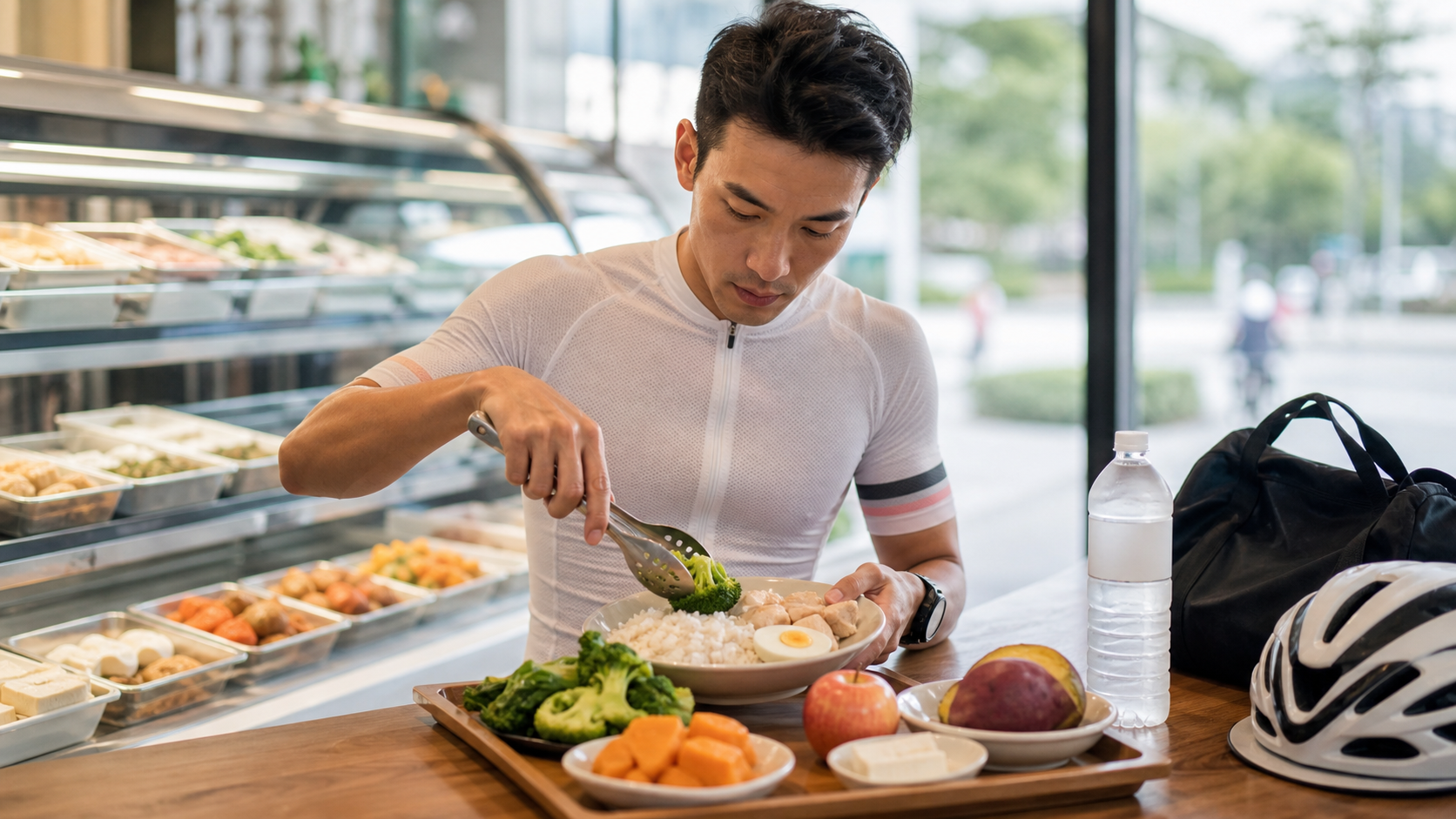
If convenience stores are the arsenal for precise fueling, then buffet-style restaurants are the home turf for balanced main meals for triathletes. Taiwan’s pay-by-weight buffet restaurants and bento shops offer a wide variety of dishes and free combination, making them the best place for outdoor diners to get diverse nutrition. Unfortunately, most people pick dishes purely by taste, resulting in either an overload of starch, zero vegetables, or a mountain of fried food.
The “Quarter Plate Method” I Teach Athletes
I don’t want athletes calculating kcal at the buffet counter until they’re overwhelmed—that’s unrealistic. What I give them is a visual rule they can execute with their eyes—the Quarter Plate Method:
| Plate Section | Proportion | What to Grab | Purpose |
|---|---|---|---|
| Main staple section (rice/noodles) | About 1/4 to 1/3 | White rice, brown rice, noodles | Refuel carbs, fill glycogen |
| Protein section | About 1/4 | Skinless braised chicken leg, steamed fish, braised tofu, steamed egg | Repair muscle |
| Vegetable section | About 1/3 or more | Various colored greens, mushrooms, gourds | Micronutrients, fiber, satiety |
| Healthy fats/Garnish | Small amount | A little braising sauce, a few nuts | Fat-soluble vitamins, flavor |
There are only three key actions: moderate staple portions without overloading, make sure to fill a full serving of protein, and aim for a variety of colors in vegetables. Just doing these three things puts your plate ahead of 90% of the customers in any buffet restaurant.
Plus and Minus Points for Choosing Dishes at Buffet Restaurants
At the same buffet restaurant, choosing right versus wrong makes a big difference. Here’s a table athletes can keep handy:
| Plus Choices (Grab More) | Minus Choices (Grab Less/Avoid) |
|---|---|
| Braised chicken leg (skinless), steamed fish, white cut chicken | Fried chicken cutlet, fried pork chop, sweet and sour dishes |
| Braised tofu, braised egg, steamed egg | Fried tofu puffs, thickened soup |
| Blanched greens, lightly stir-fried vegetables, mushrooms | Heavy-oil stir-fries, thickened vegetable dishes |
| Brown rice, multigrain rice, moderate white rice | Fried rice, fried noodles (high oil absorption) |
| Clear soup, miso soup, radish soup | Creamy soups, fried items |
Post-training main meals are especially well-suited for buffet restaurants: a skinless braised chicken leg plus a steamed egg easily hits your protein target; fill up on white rice for carbs; and grab two or three vegetable dishes for micronutrients. The completeness of this meal far surpasses a pork chop bento from a bento shop.
How to Choose at a Buffet Restaurant Before Training
If you’re eating at a buffet restaurant after work and training afterward, your dish selection strategy needs a slight adjustment: staples can be normal or even slightly more, protein moderate, and vegetables and fats should be somewhat restrained—you don’t need too much fiber and fat slowing down digestion before training. A skinless braised chicken leg, a good serving of white rice, and one serving of blanched vegetables is enough. Save the fried and thickened dishes for non-training days.
Common Mistakes and Corrections: The Landmines I Catch Most Often
Having coached athletes for years, the error patterns among outdoor diners are highly repetitive. These are the ones I have to re-emphasize with every group:
Mistake One: Eating Too Much Fat and Too Many Varieties Before Training
Many people interpret “eat well before training” as “eat a big, rich meal,” and end up with a fried chicken leg bento that leaves their stomach churning halfway through the ride. Correction: 60 to 90 minutes before training, focus on easily digestible carbs (rice balls, bananas, toast), moderate protein, and keep fat and fiber in check. The closer you get to training, the simpler and smaller your food should be.
Mistake Two: Only Replacing Water, Not Sodium
During Taiwan’s summer long sessions, chugging plain water without electrolytes actually dilutes blood sodium, making you dizzier and more prone to cramping the more you drink. Correction: On hot days and long sessions, use sports drinks or electrolyte water alongside plain water, and periodically have a tea egg or a small handful of nuts for sodium. For heavy sweaters, sodium replacement is more life-saving than sugar.
Mistake Three: Only Eating Carbs After Training, Forgetting Protein
A-Kai’s earliest problem was exactly this—after a long ride home, he’d only eat braised pork rice with a cola: carbs were perfect, protein was zero. Glycogen was replenished, but the raw materials for muscle repair weren’t provided. Correction: Every post-training meal needs a clear protein source, aiming for the 20 to 40 gram range. Choose from chicken breast, chicken leg, eggs, soy milk, or fresh milk in any combination.
Mistake Four: Carb-Loading at Every Regular Meal, but Skimping When It’s Time to Fuel
Some people binge on fried rice and noodles on non-training days, yet on the morning of a long session, they only drink black coffee to “save calories.” This completely reverses the fuel timing. Correction: Let carbs follow your training—eat more carbs on high-volume days, and return to balanced, moderately reduced starches on rest days. This is a simplified version of “carb periodization,” and outdoor diners can do it too.
Mistake Five: Treating Supplements as a Panacea, Ignoring Real Food
Energy gels and whey protein are good tools, but they shouldn’t replace real meals. Correction: Real food is always the foundation. The diverse nutrition that convenience stores and buffet restaurants can provide is something a single supplement can’t offer. Save supplements for mid-training and those times when you’re in a hurry.
How to Know If Your Meal Planning Is Working: A Few Self-Monitoring Signals
The biggest fear for outdoor diners is “eating by feel and guessing by feel.” In reality, your body gives you feedback. Learning to read these signals is more practical than memorizing any nutrition chart:
- Loss of pace and motivation in the latter part of training: If you inexplicably run out of energy and want to quit in the second half of every long session, it’s likely insufficient carb intake and depleted glycogen. Try increasing and advancing your carb intake to see if it improves.
- Recovery feeling the next day: If you properly replenish carbs and protein after training, you usually have less muscle soreness the next day and the energy to take on the next session. If you’re always exhausted and unable to train the next day, check whether the protein in your post-training meal was adequate.
- Cramps and dizziness: Frequent cramping and dizziness during hot-weather training almost always points to inadequate fluid and electrolyte replacement, especially sodium.
- Long-term trends in weight and how you feel: Short-term weight fluctuations over a day or two are mostly water; don’t worry. But if you’re inexplicably losing weight long-term and feeling weaker despite training, it may be chronic under-eating of total calories—outdoor diners can easily eat too little without realizing it.
- Gastrointestinal reactions: Repeated bloating, cramping, or diarrhea during training usually means you ate too much, too varied, or too late before a session, or chose the wrong texture of fuel. Adjust the type and timing of food.
Treat these signals as your dashboard—you should learn to read them before buying any expensive wearable device.
Actionable Advice for Athletes at Different Levels
The same meal-planning logic needs fine-tuning for athletes at different stages. Here are plans you can execute starting tomorrow, based on your level.
Beginner Finisher Group (Goal: Successfully Complete 51.5)
At this stage, what you need most isn’t obsessing over grams, but building three habits:
- Eat before training, and eat the right things (easily digestible carbs like rice balls/bananas).
- Have a clear source of protein in every post-training meal.
- Proactively replenish electrolytes during hot-weather training.
Just doing these three things consistently will noticeably improve your training quality and recovery. Don’t aim for perfection; first aim to “stop making basic mistakes.”
Advanced Age-Group Group (Goal: Set a PB, Play at Half-Distance)
You need to make your meal planning more precise:
- Periodize carbs with your training schedule: Deliberately load carbs the night before and the morning of long sessions; taper on rest days.
- Train your gut: During long sessions, eat according to your race fueling rhythm (starting at 30-60 grams of carbs per hour) to get your gut used to absorbing while moving. Don’t try high fueling rates for the first time on race day.
- Protein distribution: Spread protein across 3 to 4 meals a day, 20 to 40 grams per meal, which is more effective than cramming it all into one meal.
Challenger Group/Long-Distance Veterans (Goal: 226, Qualifying Slots)
Your training volume and race duration mean fueling is your “fourth discipline”:
- Total quantity mindset: For a 7-8 hour race, total carb needs are in the hundreds of grams. During regular long sessions, you need to practice taking in 60 to 90 grams per hour, or even higher, using a mix of glucose and fructose sources to improve absorption.
- Convenience stores as aid stations: Plan your long ride routes as loops that pass convenience stores, fueling at each stop. This saves on energy gel costs and closely mimics real race conditions.
- Individualization and monitoring: Gut tolerance and sweat sodium concentration vary greatly between individuals. Long-distance athletes must record their fueling responses during training to find their own formula—this goes beyond general rules and requires individual adjustment.
A One-Week Outdoor Dining Example (For You to Copy Directly)
Finally, here’s a practical one-week skeleton so you can see what a day looks like for an outdoor diner. This isn’t a rigid rule; it’s a starting point:
| Time | Regular Training Day | High-Volume Day (Long Ride/Long Run) |
|---|---|---|
| Breakfast | Rice ball + soy milk + fruit | Increased: Rice ball + toast + banana + soy milk |
| Pre-Training | Banana or half a bread roll | Onigiri + banana |
| Mid-Training | (Usually not needed for short sessions) | Every 40-60 min: bread/banana/tea egg + electrolyte water |
| Post-Training | Sous-vide chicken breast + rice + fresh milk | Buffet: skinless braised chicken leg + steamed egg + full rice + vegetables |
| Lunch/Dinner | Balanced plate using the Quarter Plate Method | Balanced plate + an extra serving of protein |
| Late-Night Snack (if needed) | Unsweetened yogurt or boiled egg | Soy milk + one egg |
Pre-Race Carb Loading for Outdoor Diners
Many age-group athletes have heard of “glycogen supercompensation” before a race but don’t know that outdoor diners can execute it easily. The concept of pre-race carb loading is to gradually increase carbohydrate intake one to three days before the race while reducing training volume, filling muscle and liver glycogen stores so you don’t “hit the wall” too early in the latter part of a long-distance race.
The execution for outdoor diners is very intuitive: in the days before the race, increase the portion size of your staples (rice, noodles, bread) at each meal, while moderately reducing fat and excess fiber (to avoid gut burden on race day). At a buffet restaurant, fill up the white rice and add a serving of easily absorbed starches like sweet potato or pumpkin; at a convenience store, add an extra rice ball or a bread item. Note that carb loading doesn’t mean “eat and drink to excess.” The focus is on increasing the proportion of carbs, not bingeing on fried, heavy-flavored foods, which would only add gut burden and weight. At the same time, training volume must be reduced (the taper) so the carbs can actually be stored.
I want to specifically remind you here: the exact number of days and amounts for pre-race carb loading and tapering vary greatly between individuals. Especially for athletes with sensitive guts or chronic conditions, you must practice this during regular simulation races or long sessions first. Don’t try it for the first time at an actual race, and it’s also advisable to consult a sports nutrition professional.
Budget and Convenience for Outdoor Diners: Balancing Wallet and Training
Some athletes worry: won’t eating like this every day be expensive? In reality, outdoor meal planning can actually help control costs. Energy gels and imported supplements are what really burn money, while convenience store tea eggs, soy milk, bananas, and rice balls, and buffet restaurant chicken legs and vegetables, all have low unit prices but solid nutritional density.
A few practical tips for outdoor diners to save money and hassle:
- Replace energy gels with convenience store real food for long-session fueling: A tea egg plus a banana costs far less than an imported energy gel, and the sodium and potassium are more complete.
- Make good use of convenience store loyalty points and buffet regular customer perks: If you go to the same places and buy the same items, the long-term costs add up. Instead, pick a few stores near home and work with a good selection as your bases.
- Prepare the next morning’s pre-training fuel the night before: Buy it the previous evening to avoid scrambling in the morning and grabbing something unhealthy.
- Don’t sacrifice protein to save money: Many outdoor diners save money by eating only starches, which is the least cost-effective way to save—the damage from training has no raw materials to repair, making the training pointless. You must spend that money on protein.
Ultimately, outdoor meal planning isn’t about spending a lot on supplements; it’s about spending the money you’re already spending on meals on the right items at the right times. With the same daily meal budget, someone who understands meal planning eats their way to training adaptation, while someone who doesn’t eats their way to fatigue and injury. The difference lies in having that logic.
Outdoor Dining Nuances for Each Discipline: Swim, Bike, and Run Each Have Their Own Meal Planning Focus
Triathlon is three sports, and each presents different challenges to the gut and fueling, so outdoor meal planning should adjust accordingly. This is a detail many athletes overlook.
Swim Training: Don’t Swim on an Empty Stomach, but Don’t Overeat Either
Many people head to the pool or open water (like Sun Moon Lake or Chengcing Lake) for early morning swims, accustomed to going on an empty stomach. Fasting is fine for short technical sessions, but for aerobic sessions over 60 minutes, fasting can lead to a drop in pace and dizziness in the latter part. I recommend eating a little easily digestible carbs 45 to 60 minutes before getting in the water: half a banana, a few sips of soy milk, or a small slice of toast is enough. Avoid eating too much—your body is horizontal in the water, your abdomen is compressed, and swimming on a full stomach is very uncomfortable. After the swim, it’s usually close to a meal time, so a balanced plate from a buffet restaurant will replenish you nicely.
Bike Training: The Discipline Where Eating While Riding Is Easiest
Cycling is the easiest of the three to fuel—you have space on the bike, your body is stable, and you can eat while riding. That’s why I say Taiwanese athletes looping their long rides past convenience stores is a luxurious fueling strategy. Eat at fixed intervals of every 40 to 60 minutes during the ride, using convenience stores as aid stations, and this is also where you develop your race fueling rhythm. On hot days, cycling produces the most sweat, so your water bottles must contain electrolytes.
Run Training: The Most Gut-Unfriendly Discipline
When running, your internal organs bounce with each stride, and blood is heavily shunted to the limbs, making the gut the most temperamental of the three disciplines. The pre-run meal especially needs to be simple and eaten early—leave at least 60 to 90 minutes before the start, focusing on pure carbs with as little fat and fiber as possible. Many people’s side stitches and nausea during runs stem from eating too much, too varied, or too late before the run. Fueling during a long run should also be in smaller bites and more frequent; liquid or gel forms of carbs are usually easier to get down than solid food.
A Real Fueling Correction Case: From Cramping DNF to Finishing
Let me share another athlete’s story to show you the real power of correcting meal planning. This woman, let’s call her Mei-Hui, was an age-group mom in her forties. Before coming to me, she suffered bilateral leg cramps in the latter part of the bike leg at a 113 half-distance triathlon and ultimately couldn’t run, resulting in a DNF (Did Not Finish). She was very frustrated and thought her fitness was insufficient.
When I looked at her fueling record, I found the problem wasn’t fitness at all: she drank only plain water the entire race, ate only two energy gels, and took in almost no sodium. And she was a “salty sweater”—her clothes would be crusted with white salt after sweating. At a 113 in Taiwan’s summer, her fueling approach was essentially working against her own blood sodium; cramping was almost inevitable.
We didn’t overhaul her training. We only did three things that any outdoor diner can execute:
- Switch to sports drinks as the base for long sessions instead of plain water, and regularly eat salty fuel during long sessions (tea eggs, a small handful of salty chips).
- Deliberately carb- and sodium-load at a buffet restaurant the day before the race, filling up on staples and choosing a salty clear soup.
- During the race, consume at least 60 grams of carbs per hour and continuously replenish sodium, no longer relying only on plain water.
Three months later, at a race of the same level, she not only finished but went through the entire bike-to-run transition without a single cramp. One thing she said to me afterward stuck with me: “So I wasn’t weak enough—I was racing hungry, thirsty, and salt-deprived the whole time.” Outdoor diners, remember this: fueling mistakes often disguise themselves as a lack of fitness.
Practical Outdoor Fueling at Taiwan’s Race Venues
Taiwan’s triathlon events, from the Puyuma Ironman, Challenge Taiwan (Taitung’s Living Water Lake), to IRONMAN 70.3 Taiwan (Kenting), have fairly abundant aid stations, but you shouldn’t outsource your fueling entirely to the race organizers. Scouting the venue and bringing your own supplies beforehand is where age-group athletes create separation.
Staying in the race area a day or two before the event, the nearby convenience store is your supply center. I have athletes shop at the convenience store the night before for the next morning’s pre-race breakfast (rice balls, bananas, soy milk) and small transition-area fuel (small packs of gummy candy, salt tablets). In race areas like Taitung and Kenting, hot food options are limited in the early morning, so the 24-hour convenience store is your lifeline. As for during the race, use the aid station bananas, cola, and sports drinks as they come, but your core fueling rhythm (how many carbs per hour, when to take sodium) should be practiced beforehand and executed on schedule during the race—don’t improvise on the spot.
Common Questions FAQ
Over the years, these are the questions outdoor diners repeatedly ask me. Here’s a one-shot FAQ:
Q: I’m trying to lose weight. Do I still need to eat carbs at every meal?
A: Weight loss and carb intake aren’t in conflict; the key is timing. Concentrate carbs around training (when your body most needs fuel and recovery), and moderately reduce starches during non-training periods and rest days. Rather than going low-carb all day and letting training quality collapse, it’s better to place carbs in the right spots. For weight management, please be sure to get professional assessment—don’t starve yourself.
Q: Convenience store ready-to-eat chicken breast is high in sodium. Can I eat it every day?
A: For endurance athletes who sweat heavily, moderate sodium is actually needed; you don’t need to fear sodium like a sedentary person would. But you don’t have to eat only chicken breast. Tea eggs, soy milk, fresh milk, and steamed fish or braised eggs from buffet restaurants can all be rotated. A variety of sources is better.
Q: I’m really hungry after training, but it’s not meal time yet. What should I do?
A: This is exactly where the convenience store recovery combo shines. Have a chicken breast or a bottle of soy milk plus a rice ball first to cover the recovery window, then eat a normal meal later. Don’t let yourself get so hungry that you binge-eat at the next meal.
Q: How can vegetarian/ovo-lacto vegetarian triathletes get protein when eating out?
A: Taiwan’s vegetarian dining environment is quite good. Soy milk, tofu, dried tofu, steamed eggs (for ovo-lacto), edamame, chickpeas, and the variety of soy products at vegetarian buffet restaurants are all great sources. The key remains getting 20 to 40 grams of protein per meal. Plant proteins can be combined from multiple sources to hit the amino acid and leucine targets.
Q: I need to train at 5 AM and don’t have time for a proper meal. What should I do?
A: Buy your pre-training fuel for the next morning at the convenience store the night before (banana, rice ball, soy milk). Eat a little easily digestible carbs before heading out. If you truly can’t, at least down half a banana and a few sips of sports drink—don’t go into a long session completely fasted.
Conclusion: The Outdoor Diner’s Advantage Is a Weapon You Haven’t Learned to Use Yet
Back to A-Kai. He’s still an outdoor diner, alternating between convenience stores and buffet restaurants, but he long ago stopped asking “can I train effectively like this?” Because he now understands: eating out was never the obstacle; eating out without knowledge was. Taiwan’s dense convenience stores and diverse buffet restaurants are a fueling environment that athletes in many countries can only envy. What you lack isn’t food; it’s a logic for putting together the right meals before, during, and after training.
What this article gives you is that logic. Starting with that one rice ball tomorrow morning, put it together right. You don’t need to cook, you don’t need to stock up on meal replacements. Just, at the stores you already go to, when your eyes scan the shelves and the food counter, let the three pillars—“carbs, protein, electrolytes”—come to mind, and get the proportions and timing right. The ones who train successfully are never the best cooks; they’re the ones who best understand meal planning.
This article is educational content and cannot replace individual assessment by a physician, physical therapist, or nutritionist. Please adjust actual training and dietary plans according to your personal health status, race goals, and professional advice.
References
- Precision Hydration, “How much carbohydrate do athletes need per hour?”: https://www.precisionhydration.com/performance-advice/nutrition/how-much-carbohydrate-carbs-athletes-per-hour/
- Macnaughton et al., “The response of muscle protein synthesis following whole-body resistance exercise is greater following 40 g than 20 g of ingested whey protein” (PMC): https://www.ncbi.nlm.nih.gov/pmc/articles/PMC4985555/
Related Reading
- The Athlete’s Guide to Eating Out: How to Build Meals at Convenience Stores and Buffet Restaurants Without Compromising Training Recovery
- The Daily Diet Framework for Triathletes: Eating Right Without Weighing Your Food
- The Vegetarian Triathlete’s Guide: A Complete Plan for a Plant-Based Diet
- The Athlete’s Meal Prep Playbook: A Complete Guide to Efficiency, Nutritional Balance, Storage, and Variety
CT暗黑廚房) 車友必備 宇宙無敵鮮蚵湯 幫助訓練恢復 天然食補 好市多 超肥鮮蚵 破PR
7 年前
全運會彰化大朋神的高強肚魷魚遊戲早餐團 (惡搞版)週間廢片小劇場 | 雙崎部落 | 公路車 | GoPro 10 & iPhone 13 Pro 拍攝 | CT Yeh
4 年前
一日北高/長距離團騎 常見問題補充篇 / 組團或跟團的眉角 / 壯車友容易被瘦車友慢性拉爆 / 原來屁股痛可能是這個原因...? / 風場配速法 / 公路車 / CT Yeh
2 年前
單車 一日北高 ( 雙城 ) 肥宅雙人瘋狂行 紀錄片 REACTO
10 年前
一個測試有沒有認真練車的方法😂 #公路車
10 個月前
JJSC一槍北港 百K團實錄!跟團技巧分享 ft. Roden / 中部練車新選擇 / 開箱全台最便宜早餐店!/ 公路車 / CT Yeh
1 年前
浪漫 #臺三線 #單車 員工旅遊 桃園到台中 老少咸宜 環台賽 路線探索
6 年前
靠單車減肥35公斤 心得分享與整理
7 年前