Preventing GI Issues on Race Day: What to Do When You Feel Like Throwing Up Mid-Run? A Coach Walks You Through the Mechanisms and On-Site Management
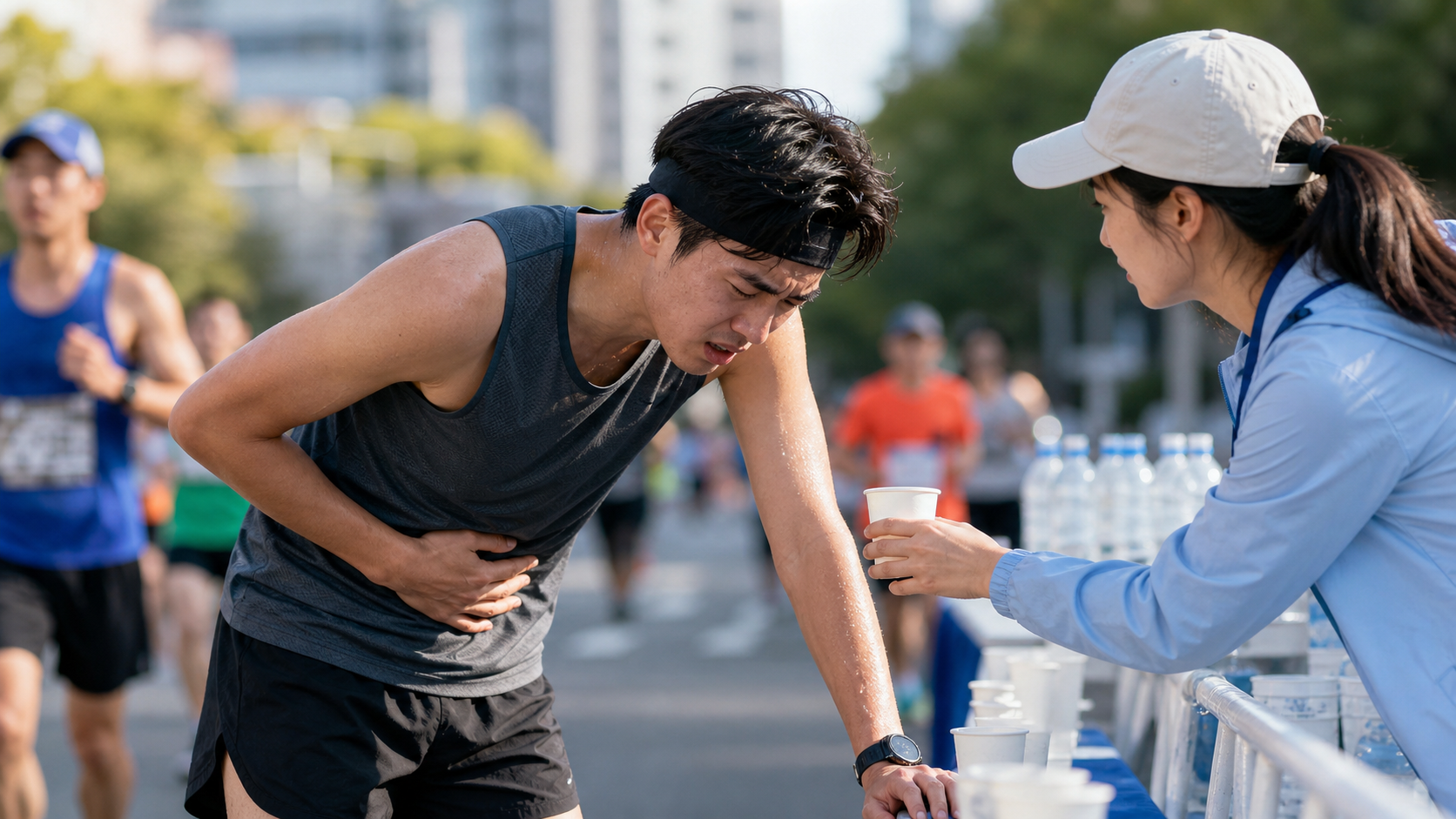
Coach’s Opening: The Athlete Crouching by the Roadside Dry-Heaving at the 42K Mark
Let me start with a scene I’ll never forget.
A few years ago, I took one of my athletes to run a city marathon. His training data in the three months leading up to the race was flawless—he handled every long run, his pace was steady, and his heart rate stayed obediently in the right zones. But after the 30K mark on race day, his pace started to fall apart. When I saw him at an aid station, his face was pale, he was gripping a railing and dry-heaving. He told me, “Coach, it’s not my legs. I keep feeling like I’m going to throw up. The moment anything sweet hits my mouth, my stomach turns, and I can’t get any fuel down.”
He still gritted his teeth and finished that race, but his time was nearly 20 minutes slower than expected. Afterward, we sat down and retraced everything, and we realized the problem wasn’t in his legs at all—it was in his gut. The night before, he’d eaten a huge plate of pasta loaded with onions and garlic. For breakfast, he’d downed a bowl of high-fiber oatmeal with milk. And at every aid station during the race, he forced down energy gels chased with sports drink—essentially bombarding his gut, at its most vulnerable moment, with a barrage of hard-to-digest stuff.
In this article, I want to use my 15 years of coaching experience to explain something too many runners overlook: Race-day gut issues are preventable. It’s not some mystical thing, not “just bad luck today.” It’s a factor with clear physiological mechanisms and evidence-based interventions. Feeling like you’re going to throw up mid-run is, in the vast majority of cases, “predictable and manageable”—not fate.
How common is exercise-induced gastrointestinal discomfort in endurance sports? According to reviews of sports science literature, the estimated proportion of endurance athletes—marathoners, triathletes, and long-distance runners—who experience GI symptoms during exercise ranges anywhere from roughly 30% to 90% (the wide range is due to differences in definitions, severity thresholds, and assessment timing). In ultra-endurance events, the rates of nausea, vomiting, abdominal cramps, and diarrhea are even higher. What’s more, GI symptoms are one of the strongest proximal factors associated with dropping out of endurance races—in other words, many people don’t lose to their fitness; they lose to their stomach.
So this isn’t a niche problem—it’s a wall nearly every endurance athlete will hit sooner or later. Let’s break it down layer by layer.
Conceptual Foundation: Why Does Your Gut Start Acting Up the Moment You Exercise?
To prevent it, you first need to understand why it happens. Exercise-induced GI discomfort is driven by three pathways working simultaneously. I often tell my athletes it’s a “triple whammy” of blood flow, vibration, and contents.
1. Blood Flow Gets “Drafted” to the Muscles, Leaving the Gut Starved
This is the most core mechanism. When you run or ride at race intensity, your body prioritizes shunting large volumes of blood to the working skeletal muscles and the skin (for cooling), while blood flow to the internal organs—especially the GI tract—drops significantly. The literature generally describes that at high intensity, blood flow to the digestive tract can fall to less than half of resting levels, or even lower.
Once the gut becomes ischemic and hypoxic, several things happen:
- Digestion and absorption efficiency drop: Gastric emptying slows, small intestine absorption worsens, and the fuel you swallow gets “stuck,” creating a bloated, nauseated feeling.
- Intestinal barrier permeability increases: This is the so-called “leaky gut” phenomenon. Under ischemia and heat, the tight junctions between intestinal wall cells loosen, allowing substances that shouldn’t enter the bloodstream to seep through, triggering inflammation and nausea.
- The hotter and more dehydrated you are, the worse it gets: Heat and dehydration cause splanchnic blood flow to drop even more sharply. This is especially critical for runners in Taiwan, and I’ll address it specifically later.
2. Mechanical Vibration: The Act of Running Itself Is “Shaking” Your Gut
The second pathway is purely mechanical. Running is a repetitive up-and-down impact motion; every footstrike sends shockwaves through the abdominal organs. This is also why GI symptoms are typically worse in running than in cycling or swimming—on the bike, your posture is stable, and in the water, your body is horizontal, so the mechanical disturbance to your organs is much smaller. This explains a common experience among triathletes: they can eat fine on the bike leg, but the moment they hit the run leg, their stomach starts turning.
This vibration stimulates the lower GI tract, easily triggering “urgent need for the bathroom” lower-GI symptoms (diarrhea, abdominal cramps, fecal urgency), and it also worsens the queasy feeling in the upper abdomen.
3. Gut Contents: What You Put In Determines How Much It Acts Up
The third pathway—and the one we have the most active control over—is: exactly what you eat, what you drink, how concentrated it is, and whether the timing is right.
- Highly concentrated sugar water (high osmolality): Chugging overly concentrated energy drinks or sugary beverages at once raises the osmotic pressure in your stomach, causing your body to actually pull water into the intestinal lumen to dilute it, resulting in bloating, diarrhea, and nausea.
- Carbohydrates exceeding absorption limits: The gut has a ceiling on how many carbs it can absorb per hour. Overloading it just means the excess sits there fermenting, producing gas, and turning your stomach.
- Residue from hard-to-digest foods: High-fiber, high-fat, and high-FODMAP foods (more on this below) that haven’t emptied by race day ferment and cause trouble in your ischemic gut.
- Caffeine and NSAIDs: Taking painkillers before a race (e.g., some people habitually pop one to prevent soreness) has been shown to worsen intestinal barrier damage—a landmine many people don’t know about.
Put these three pathways together, and you’ll understand why the athlete from my opening story blew up: he made his gut work under the triple assault of drained blood flow, running-induced vibration, and a gut stuffed with high-FODMAP foods and concentrated sugar. It would have been surprising if he hadn’t had problems.
What Is FODMAP? Why Should You Be Especially Careful With It in Pre-Race Nutrition?
This is the lever I’ve most often pulled with athletes in recent years, and it’s had the most visible results. It deserves a proper explanation.
FODMAP in Plain Terms
FODMAP is an acronym for a group of short-chain carbohydrates that are “easily fermented in the gut and not fully absorbed.” It stands for:
- Fermentable
- Oligosaccharides (e.g., fructans and galacto-oligosaccharides in wheat, onions, garlic, and legumes)
- Disaccharides (mainly lactose, found in milk and some dairy products)
- Monosaccharides (excess fructose, e.g., from honey and certain fruits)
- And
- Polyols (sorbitol, xylitol, and other sugar alcohols, also present in some fruits)
The common trait of these compounds: they’re incompletely absorbed in the small intestine, travel to the large intestine where bacteria ferment them, producing gas and osmotic water—leading to bloating, borborygmus, diarrhea, and nausea. At rest, you might not notice them; but on race day, when your gut is ischemic and being jostled, the same compounds pack several times the punch.
What Does the Evidence Say?
Sports nutrition research has begun to examine the effects of a “short-term low-FODMAP diet” on exercise-related GI symptoms. One randomized crossover study in healthy, recreational runners found that a short-term low-FODMAP diet reduced exercise-associated GI symptoms and improved “perceived ability to exercise”; the researchers hypothesized this was linked to a reduction in poorly digested carbohydrates available for gut fermentation (see references at the end). Multiple systematic reviews also indicate that restricting FODMAP before and during events lowers symptom severity in most studies.
But I have to be honest and give you the full picture—this is the attitude I always take with my athletes:
- A low-FODMAP diet is not meant for long-term use. It’s too restrictive; following it long-term can lead to nutritional imbalances and changes in the gut microbiome. Think of it more as a “short-term tool for the 1–3 days before a race.”
- It’s highly individualized. Tolerance to different FODMAPs varies wildly from person to person—for some, lactose is the landmine; for others, onions and garlic are the culprits. The only reliable method is to track and test it yourself.
Coach’s Practical Guide: Pre-Race FODMAP Adjustment Checklist
The table below is the “pre-race low FODMAP quick swap” reference I give my athletes. It’s not meant to be memorized, but to grasp the big picture: In the 24–48 hours before the race, lean as much as possible toward the right column.
| Category | Avoid Before Race (High FODMAP) | Safer Swaps (Low FODMAP) |
|---|---|---|
| Staples | Large amounts of wheat products, ramen, pasta with lots of ingredients | White rice, white toast, potatoes, gluten-free noodles |
| Protein | Large amounts of beans, processed sausages (often contain garlic/onion) | Chicken breast, lean pork, fish, eggs |
| Vegetables | Onions, garlic, broccoli, mushrooms | Carrots, spinach, cucumber, zucchini (in moderation) |
| Fruit | Apples, watermelon, mango, honey | Bananas (not overripe), blueberries, grapes, oranges (in moderation) |
| Dairy | Regular milk, large amounts of cheese | Lactose-free milk, small amounts of hard cheese, yogurt (depending on tolerance) |
| Sweeteners | Sorbitol/xylitol artificial sweeteners, sugar-free gum | Regular sugar, glucose (in moderation) |
Key Reminder: This table is for the “pre-race” period. On race day itself, you need rapidly absorbed sugar, which is a different logic entirely (covered in the gut-training section below). Don’t confuse “low FODMAP” with “don’t eat sugar during the race”—these are two completely different things.
Training the Gut: Carbohydrate Absorption Can Be Trained
Many athletes assume “gut strength is something you’re born with.” This is one of the myths I most want to debunk. The gut’s carbohydrate absorption capacity, just like muscular strength or cardiovascular fitness, can be amplified through training. In sports science, this is called “train the gut.”
Absorption Has a Ceiling, but the Ceiling Can Be Raised
Generally speaking, an untrained gut maxes out at around 60 grams of carbohydrate absorption per hour; however, studies show that endurance athletes who systematically train their gut can push absorption rates to approximately 90 grams per hour (see references at the end). Mechanistically, sustained carbohydrate intake increases the number and activity of glucose transporters like SGLT1 in the small intestine, improving absorption capacity.
Here’s a key technique: Glucose and fructose use different transporter proteins. Mixing them at roughly a 2:1 ratio allows you to absorb more total carbohydrate per unit of time than glucose alone, raising your hourly intake without as much stomach distress. This is why better energy gels and sports drinks advertise “multiple carbohydrate sources (2:1 glucose:fructose).”
Training the Gut Takes Time—Don’t Cram the Week Before a Race
This is not a quick fix. Relevant reviews indicate that gut training typically requires at least 8–12 weeks of consistent practice to produce meaningful adaptations; while just two weeks of a high-carb diet can increase intestinal SGLT1 content, actually being able to eat and keep food down at race intensity requires a longer period of repeated practice that closely mimics race conditions.
Coach’s Sample Gut-Training Schedule
Below is the 8-week progressive gut-training framework I often give advanced athletes, layered on top of their existing long-distance workouts. Units are “grams of carbohydrate per hour,” progressively increasing with each long session:
| Week | Hourly Carb Target During Long Workouts | Suggested Fueling Format | Key Observations |
|---|---|---|---|
| Weeks 1–2 | 30–40 g/hour | Single energy gel or sports drink | First establish the habit of “eating while moving” |
| Weeks 3–4 | 45–55 g/hour | Mix of gels + sports drink | Note any bloating or nausea |
| Weeks 5–6 | 60–70 g/hour | Primarily multiple-carb (2:1) products | Tolerance at higher intensity |
| Weeks 7–8 | 75–90 g/hour | Fully replicate race-day fueling | Can you eat at race pace |
Two Non-Negotiable Principles:
- Gut training must be done during workouts that actually hit intensity—not just easy runs. During easy runs, intestinal blood flow is ample, and you can eat anything without issue; the real test is whether you can eat when the gut is ischemic at race pace.
- Pacing and fueling must exactly replicate race day—same brand, same flavor, same amount of water, same intervals. “Nothing new on race day”—I tell my athletes to engrave this on their minds.
The Taiwan Context: Heat and Humidity Are Our Biggest Variable
I mentioned the blood flow mechanism earlier as especially relevant for Taiwan runners—let me expand on that here.
A large portion of Taiwan’s road running and triathlon season falls in spring and autumn, but even avoiding midsummer, high heat and humidity are part of our daily reality. In many city marathons and eastern triathlons, the moment the sun comes out after the start, the perceived temperature shoots up. High heat and humidity worsen two things simultaneously:
- Splanchnic blood flow is further diverted to the skin for cooling, making intestinal ischemia worse;
- Dehydration reduces blood volume, slowing gastric emptying and increasing the likelihood of nausea.
This is why the same fueling strategy that works perfectly on a cool morning training run can completely fall apart on a hot, humid race day. My practical advice:
- On hot days, proactively lower the carbohydrate concentration during the race—add more water to your energy gels to prevent hyperosmolar sugar water from wreaking havoc in an ischemic stomach.
- Keep up with electrolytes (especially sodium)—in Taiwan’s humid heat, sweat sodium losses are significant; hydrating without sodium risks hyponatremia and nausea.
- Don’t overhydrate before the race out of nervousness—overhydration can also cause stomach bloating and the urge to vomit.
Another very Taiwan-specific variable is eating out. Many runners go for hotpot, all-you-can-eat buffets, spicy hotpot, or a huge plate of fried noodles loaded with garlic and chili oil the night before a race to “carb-load”—these are almost a combination pack of high FODMAP, high fat, and high irritants. I often joke with my athletes: “That pre-race meal isn’t carbs; it’s laying landmines for your gut.” The night before a race, white rice, plain chicken, and a low-oil, low-garlic combination is far safer than a lavish hotpot meal.
What to Do on the Spot If You Feel Like Vomiting Mid-Race
No matter how good your prevention, race day can still go wrong. This is the question I get most from athletes: “Coach, if I really feel nauseous and want to throw up during the race, what should I do right then?” Here’s a SOP I’ve actually used and taught on the course.
Step 1: Back Off the Intensity First—Don’t Rush to Fuel
When nausea hits, the first thing to do is not to force down fuel, but to slow your pace. Reducing intensity allows some blood flow to return to the GI tract, and gastric emptying and absorption will partially recover; many mild cases of nausea ease after 3–5 minutes of slowing down. Pushing through the pace will only make the gut more ischemic and increase the urge to vomit.
Step 2: Pause Solids and High-Concentration Sugars; Switch to Small Sips of Plain Water or Dilute Electrolytes
At this point, don’t stuff another gel or concentrated sugar drink into your mouth—that’s adding fuel to the fire. Instead, switch to small, frequent sips of plain water or very dilute electrolyte water to help dilute the hyperosmolar contents in your stomach. Remember: “small sips,” not one big gulp—gulping too much can directly trigger the gag reflex.
Step 3: Use the “Flat” Version of Cola or Sugary Drinks
This is old marathoner folk wisdom, and it has merit: if an aid station later in the race has flat cola (shaken or left to go flat), taking small sips is often easier on the stomach than a gel—it provides quick sugar and a bit of caffeine, and the concentration isn’t as harsh. The caveat is that you must have tried it in training; race day is not the time for a first attempt.
Step 4: If You Vomit, You’ll Usually Feel Better Afterward, but Reassess
Sometimes the body just needs to throw up once to feel better. If you do vomit, don’t panic; the nausea often drops significantly afterward. Then:
- Rinse your mouth or take small sips of plain water;
- Restart fueling from very small amounts, very dilute, gradually building back up like you’re re-training your gut;
- Simultaneously watch for other signs of heatstroke or hyponatremia (dizziness, confusion, severe headache, cessation of sweating)—if these appear, this is no longer just a GI issue; you need to find medical staff, and you need to stop if necessary.
On-Site Quick Reference Chart
| Symptom Severity | On-Site Action | When to Stop |
|---|---|---|
| Mild nausea, bloating | Slow down, pause fuel, small sips of water | Usually no need to stop |
| Clear nausea, can’t swallow fuel | Slow down more, small sips of flat cola/diluted electrolytes | Be alert if no improvement after 10 minutes |
| Vomited but feels better after | Slowly restart very small amounts of fuel | Stop if repeated vomiting or unable to rehydrate |
| Nausea + dizziness/altered consciousness/no sweating | Stop immediately, seek medical help | Stop racing and get help immediately |
The bottom row of this chart is where I need you to absolutely not push through. If GI discomfort is combined with central nervous system or thermoregulation abnormalities, it’s not a “just tough it out” situation—pushing through could lead to serious consequences. Finishing is important, but no amateur race is worth risking your life for.
Common Mistakes and Fixes: I’ve Seen These Too Many Times at the Sidelines
After years of coaching, I see the same mistakes repeated over and over. Here’s a checklist for you—fix them one by one.
Mistake 1: Trying new fuel for the first time on race day.
Fix: Nothing new on race day. All fuel brands, flavors, concentrations, and timing must be practiced in long training sessions.
Mistake 2: Eating a big meal, hotpot, all-you-can-eat, lots of garlic, onion, or spicy food the night before the race.
Fix: 24–48 hours before the race, stick to light, low-FODMAP, easily digestible foods. Carb-load with white rice and white bread, not with how lavish the meal is.
Mistake 3: Chugging a big gulp of concentrated sugar drink only when thirsty.
Fix: Drink regularly, in small sips, at diluted concentrations. Downing a high-concentration sugar drink in one go is the number one cause of nausea.
Mistake 4: Not training the gut at all, relying on willpower to force food down.
Fix: Schedule gut training into your 8–12 week training plan so your absorption capacity actually develops.
Mistake 5: Popping painkillers before the race to prevent soreness.
Fix: Avoid NSAIDs before the race unless necessary—they worsen intestinal barrier damage and amplify GI symptoms.
Mistake 6: Copying cool-weather fuel concentrations for hot days.
Fix: In high heat and humidity, proactively lower sugar concentration, increase water intake, and top up sodium.
Mistake 7: Over-hydrating due to nerves.
Fix: Moderate pre-race hydration is enough; overdoing it bloats the stomach and dilutes blood sodium.
Action Recommendations by Athlete Level
No single plan fits everyone. Based on your current stage, here’s what to do:
First-Time Triathlon/Marathon Beginners
- Prioritize stability over quantity. Aim for 30–40 grams of carbs per hour during the race. First make sure you can eat without stomach upset, then worry about increasing.
- Keep the pre-race dinner light and digestible—white rice, white bread. Avoid hotpot feasts and high-FODMAP foods.
- Start testing fuel during training sessions to find flavors and concentrations that work for you, then replicate them on race day.
- Learn the on-site SOP: if you feel like vomiting, slow down first, take small sips of water—don’t force food.
Intermediate (Chasing a PB)
- Formally integrate gut training into your 8–12 week plan, gradually building long-session fueling to 60+ grams per hour.
- Do a short-term low-FODMAP protocol 1–3 days before the race, and keep a log of which foods are your personal triggers.
- Switch to multiple-transportable-carb products (2:1 glucose:fructose) to increase your hourly absorption rate.
- Practice a hot-weather fueling version tailored to Taiwan’s high heat and humidity (lower concentration, more electrolytes).
Advanced/Long-Distance, Ultramarathon, Beyond Olympic-Distance Triathlon
- Treat fueling as an independent training discipline—collect your own gut data in every long session.
- Push hourly carb targets toward 80–90 grams, but it must be personalized and practiced.
- Build your own “hot weather/cool weather” dual fueling setups and switch based on race conditions.
- Rehearse worst-case scenarios: simulate how to slowly restart fueling after vomiting and how to judge whether to stop.
One Week to Race Start: A Timeline to Get Your Gut Ready
Many athletes know the methods but don’t know “when to do what.” I’ve organized the pre-race gut preparation into a timeline you can copy and adapt. This assumes a Sunday morning race start.
7–10 Days Out: Finalize, No More Experimenting
By this stage, all fueling strategies should already have been tested and finalized in long sessions over the past few months. This week, your job is “copy and paste,” not “innovate.” Buy and prepare all the energy gels, sports drinks, and salt tabs you’ll need for race day, and calculate the quantities (e.g., one gel every 40 minutes for a full marathon, one gel every 25 minutes for the run leg of an Olympic-distance triathlon). Do not switch to a new product just because you see someone else using it.
I had a classic case: an athlete saw everyone raving about a new energy gel in a group chat five days before the race, bought one on a whim, tried it on an easy run the day before, thought “seems fine,” and used it on race day—then started feeling nauseous at 25K because the sugar formula was completely different from what he’d trained with all season. That’s a textbook “using something new on race day” lesson.
3–4 Days Out: Start Reducing Fiber, Fine-Tuning FODMAPs
Many people think they should “eat more vegetables for vitamins” before a race, but for gut preparation, these days are actually about gradually reducing high-fiber and high-FODMAP intake. It’s not about cutting out vegetables entirely, but dialing down large portions of high-fiber greens, beans, onions, and garlic—things that easily cause gas—and switching to easily digestible, low-residue options. The goal is to minimize the “residual fermentation material” in your gut on race day.
2–3 Days Out: Carb Loading (Glycogen Supercompensation) Alongside Gut Prep
Now you start increasing carb intake for glycogen storage, but choose easily digestible carb sources—white rice, white bread, white toast, potatoes, sports drinks—not whole wheat, brown rice, or lots of fruit. This is the key to making “high carb” and “low FODMAP/low residue” coexist: you’re loading starch, not fiber.
1 Day Out (Saturday): Light and Measured, No Big Meals
This is the day most people trip up. The “pre-race hotpot, all-you-can-eat” scenarios I mentioned all happen here. My iron rule for athletes: the night before the race, eat a familiar, light, normal-sized meal—the more boring, the better. White rice with lean chicken or fish, a little easily digestible vegetable, is plenty. Avoid heavy fried foods, spicy food, alcohol, and excessive caffeine. Eat early, sleep early, and give your gut time to empty.
Race Morning (2–4 Hours Before Start)
- 3–4 hours before the start, eat your pre-race meal: easily digestible carbs (white toast, white rice, banana, sports drink), moderate portion. This meal should have been rehearsed several times to confirm it won’t cause issues.
- Within 1 hour of the start, only do small top-ups: a small serving of easy carbs (half a banana, a small bit of energy gel) plus moderate water. Don’t binge.
- Don’t chug large amounts of water before the start: sip until you’re not thirsty. Over-hydration just bloats the stomach.
- Caffeine: if you normally rely on caffeine and your gut tolerates it, stick to your routine; but if you have a sensitive gut, a large strong coffee before the race could speed up bowel movements and send you hunting for a porta-potty mid-race.
The core message of this timeline is simple: your race-day gut condition is built up bit by bit over the previous week, not decided at the starting line.
Athlete FAQ: I’ve Been Asked These Questions a Hundred Times
Here are the most frequently asked questions from years of coaching—your doubts are probably covered here.
Q1: I only feel nauseous during races, but I’m fine in training. Why?
Because in training, you usually don’t reach race intensity and emotional stress, so intestinal blood flow is relatively adequate. On race day, intensity is higher, nerves are higher, and the weather may be hotter—three factors hit you at once, amplifying things that are normally fine. The solution is to make your long-session intensity and fueling as realistic as race day, so the race isn’t the first time your gut faces this kind of stress.
Q2: I get so nervous I get a stomachache and feel nauseous. Does that count as a GI issue?
Yes, and it’s very common. Anxiety itself affects gut motility and sensation through the gut-brain axis—many people start having diarrhea or nausea before the gun even goes off. The key to handling this “start-line anxiety” type is familiarity with the pre-race routine and breathing relaxation—when everything is rehearsed and predictable, anxiety drops significantly. Establishing a fixed warm-up and fueling ritual before the race is itself a way to soothe your gut.
Q3: Do energy gels always need to be taken with water?
In the vast majority of cases, yes. Energy gels are highly concentrated sugar. If you swallow them directly without water to dilute them, the osmotic pressure in your stomach becomes too high, easily causing bloating and nausea. The standard practice is to take a few sips of plain water with your gel (not sports drink, which would make the sugar concentration even higher). Some products marketed as “isotonic” and drinkable directly are the exception, but you should still test them during training.
Q4: So should I just not eat at all during the race to avoid throwing up?
No, that’s the opposite extreme and equally wrong. In endurance efforts lasting longer than roughly 90 minutes, not taking in carbohydrates will lead to hitting the wall (depleted blood glucose and liver glycogen), which is another form of collapse. The goal isn’t “not eating” — it’s “finding the amount and form of fuel your gut can tolerate and that’s just enough.” Starving yourself isn’t a victory; being able to eat just enough without your stomach rebelling is.
Q5: Can I just power through with anti-diarrhea or anti-nausea medication?
I want to be very clear here: I do not recommend using medication on your own to suppress symptoms and push through. Symptoms are your body’s signals. Suppressing them with drugs and continuing to push could mask more serious problems like heatstroke or hyponatremia. Please consult a physician before using any medication — don’t treat it as a shortcut to cover up inadequate preparation.
Q6: For triathlon, are there special considerations for gut preparation?
Yes. The key for triathletes is that the bike leg is the only time you can eat properly — the vibration is minimal, your position is stable, and your gut is relatively comfortable. Smart triathletes do most of their solid food and larger-volume fueling on the bike, then switch to small, easy-to-take liquid or gel fuel on the run, because the gut is most prone to upset during the run. Don’t put off fueling until the run leg and then eat like crazy — that’s a recipe for disaster. Also, swallowing seawater during the swim or swallowing air from nervousness can cause early nausea, which you need to adapt to through regular open-water practice.
Q7: Do I need to get tested for food allergies or intolerances?
If your gut symptoms are severe, recurrent, and affect your daily life (not just race day), it’s worth getting evaluated by a professional gastroenterologist or sports dietitian to check for lactose intolerance, gluten-related issues, or other GI conditions. But if it’s only exercise-related symptoms on race day, you can usually improve significantly by working on behavioral aspects first — “gut training,” pre-race dietary adjustments, and fueling strategy — without rushing into a battery of tests.
Use a one-week food log to find your own trigger foods
This is the “homework” I give to every athlete who comes to me with gut issues. It’s very simple but extremely powerful. Because FODMAP tolerance and fuel tolerance are highly individual, no universal chart can replace your own data.
Here’s how: keep a record for at least one to two consecutive weeks, filling out the table below after every “quality session.”
| Item to record | Example |
|---|---|
| Date / Workout | 6/12 Long run 90 min, race-pace effort |
| What you ate 2–4 hours before | White toast + banana + a latte |
| Fuel during the session | One gel every 30 min, with plain water |
| Weather | Humid morning, ~28°C, high humidity |
| Gut response | Mild bloating after 60 min, no vomiting |
| Post-session hypothesis | The lactose in the latte may be the culprit for bloating; try lactose-free next time |
After a few entries, you’ll start to see patterns: a certain flavor, a certain food, a certain weather condition always shows up alongside your symptoms. That’s your personal trigger list — more accurate than any general advice. Many of my athletes have used this table to discover that they were intolerant to the fructose ratio in a specific brand, or that pre-race dairy was the culprit.
Data doesn’t lie; feelings do. People who are willing to spend two weeks keeping good records usually find the problem that’s been bothering them for years within those two weeks.
Conclusion: Your stomach is the fifth discipline you need to train
Triathlon has swim, bike, run, plus transitions. I often tell my athletes there’s an invisible fifth discipline — your gut. Too many people pour all their effort into their legs and cardiovascular system, yet let the organ that determines whether they can actually take in energy make its first appearance on race day, forced to tough it out.
Back to the athlete from the opening. The following year, at the same race, we spent an entire season redesigning his fueling: low-FODMAP for two days before the race, systematic gut training during long rides, switching to a 2:1 multi-carbohydrate product, and rehearsing the hot-weather version in training first. That year, not only did he not have stomach issues, he smoothly set a new personal best. He said something to me after the race that I really liked: “Turns out the gut can be trained too. I used to fight against it; now we’re teammates.”
Feeling like you’re going to throw up mid-race is rarely fate — it’s preparation. Treat your gut as a teammate that needs to be understood, trained, and properly cared for on race day. You’ll find that the wall that once broke you can be torn down.
Wishing you, at your next race: able to eat, able to run, and crossing the finish line with a smile.
This article is for educational purposes and does not replace individual assessment by a physician, physical therapist, or dietitian. If you have recurrent, severe gastrointestinal symptoms during exercise, or if they are accompanied by other warning signs, please seek professional medical help.
References
- Prevalence of exercise-associated GI symptoms and association with dropout (PMC): https://pmc.ncbi.nlm.nih.gov/articles/PMC13074893/
- Review of exercise-induced gastrointestinal symptoms in endurance sports (MDPI): https://www.mdpi.com/2674-0311/2/3/21
- Randomized crossover study on the effects of short-term low-FODMAP diet on exercise-related GI symptoms (Springer / JISSN): https://link.springer.com/article/10.1186/s12970-019-0268-9
- Narrative review of the role of FODMAP in sports nutrition (PMC): https://pmc.ncbi.nlm.nih.gov/articles/PMC12845378/
- Systematic review of gut-training and feeding challenges on gastrointestinal status (PMC): https://pmc.ncbi.nlm.nih.gov/articles/PMC10185635/
Related Reading
- Feeling nauseous and want to throw up during exercise? A coach explains the causes and nutrition strategies
- Exercise and digestion: Why do you need to use the bathroom while running? A complete guide from intestinal ischemia to on-the-spot management
- Desperately looking for a toilet mid-run? A complete guide to the mechanisms, dietary adjustments, and pre-race strategies for exercise-induced diarrhea
- Gut training for running: How to get your gut used to digesting fuel while running
約騎爆笑地獄梗 大腸怎麼了🤣 #公路車 #cycling
3 年前
一日北高/長距離團騎 常見問題補充篇 / 組團或跟團的眉角 / 壯車友容易被瘦車友慢性拉爆 / 原來屁股痛可能是這個原因...? / 風場配速法 / 公路車 / CT Yeh
2 年前
FTL 與 SYB 車隊專訪 西進武嶺 實用攻略分享! 2小時 如何練?!你不知道的眉角!新手準備武嶺必看 EP1 | 實力派女車友 | 精華版 | 公路車 | CTYeh
4 年前
一日北高常見問題大集合 | 攻略 | 路線 | 訓練 | 補給 | 自行車 單車 | 一日雙城 | 雙塔 | TWB北高360 | 屁股痛
6 年前
CT 喇低賽) 武嶺牽車 才是王道 西進牽車四小時內秘訣 攝手位置 如何判斷 防抽筋小秘訣
7 年前
Never Stop 西進武嶺 前後雙機 完整全程錄影 訓練台 實境
8 年前
一日北高前的高裝檢 | 北高 360 | 挑戰11小時的裝備 | 一日雙塔 | 補給
6 年前
2019 夏季KOM 5小 完賽心得 準備攻略 東進武嶺 夏季登山王之路 Taiwan KOM Challenge
7 年前