Energy Gels and Bars Fully Explained: Carbohydrate Ratios, Osmolality, Caffeine, and DIY Recipes
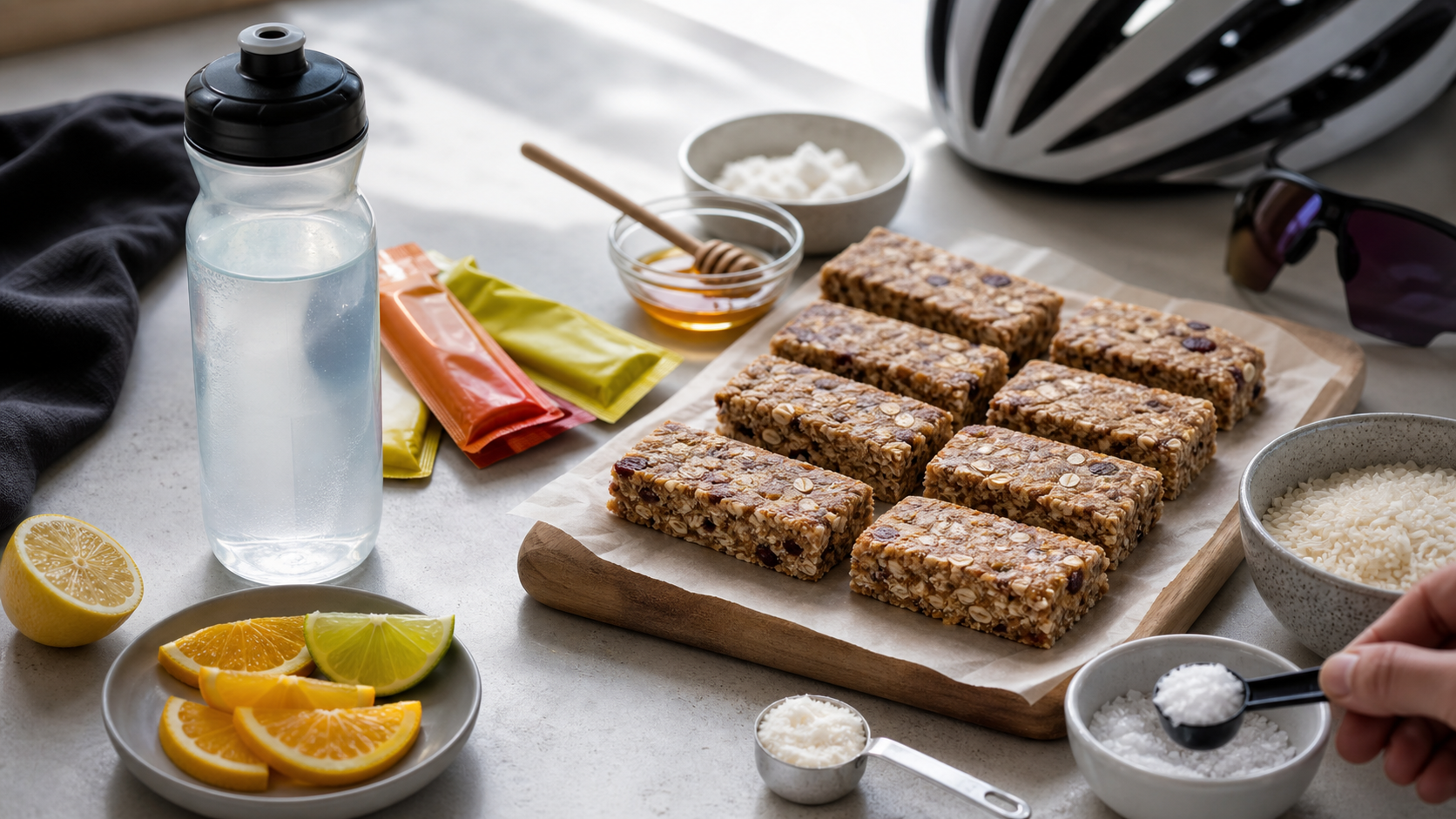
Coach’s Opening: The 10% Hidden in Your Fuel Belt That You Never Trained
Let me start with a scenario that really happens. I once coached an age-group athlete who trained seriously—let’s call him A-Kai. He was racing a half Ironman (113 km) in Kenting. His cycling power and run test data were excellent, and his training volume was sufficient. But on race day, in the last 30 km of the bike leg, he started “shifting down”—power slid steadily from 210 watts to 160 watts. When he got off the bike to run, he looked like someone had pulled the battery out of him, and his pace in the first 5 km collapsed by a minute and a half.
In the post-race debrief, his training wasn’t the problem. The problem was his fuel belt. He only ate two energy gels and drank half a bottle of sports drink during the entire bike leg. That works out to roughly 35 to 40 grams of carbohydrate per hour—far below what his body could absorb and use at that intensity. Worse, he carried three gels together but didn’t bring enough water. The gels turned into a highly concentrated syrup in his stomach, the osmolality was too high, and his gut protested directly.
I’ve told this story for years because it’s so typical. Many athletes spend hundreds of hours on pedaling and mileage, yet treat “what to eat, when to eat, and how much water to take with it” as something to grab randomly the night before a race. Fueling is a skill that can be trained, quantified, and replicated. It’s not mysticism. In this article, I’ll break down energy gels and bars from the ingredient level, from a coach’s perspective: how to formulate carbohydrates, why osmolality determines whether you’ll get diarrhea, how much caffeine to take, and how to make a serviceable—or even better—fuel in your own kitchen when you don’t want to spend a fortune on imported gels.
After reading this, I hope your next race fuel belt is packed according to a plan, not stuffed by feel.
1. Foundational Concepts: How the Body Actually Uses Sugar During Exercise
Why “Carbohydrates” and Not Something Else
Endurance exercise draws on two main energy sources: fat and carbohydrates. Fat stores are nearly inexhaustible (even a very lean athlete carries enough fat energy for several full marathons), but fat’s “energy delivery rate” is slow—once intensity rises, it can’t keep up. Carbohydrates (glycogen) deliver energy quickly and efficiently, but stores are limited—glycogen in the liver and muscles only supports about 90 to 120 minutes of moderate-to-high intensity exercise.
That’s why carbohydrate fueling is almost mandatory for events longer than two hours. You’re not eating for some vague concept of “replenishing energy.” You’re delaying the point where glycogen runs dry, so your body isn’t forced to drastically slow down to switch to fat. The physiological essence of bonking is glycogen depletion.
How Much Per Hour: From 60 to 90 and Even Higher
This is the most critical number, and the one most people get wrong. The classic recommendation used to be 60 grams of carbohydrate per hour, because the intestinal glucose transporter SGLT1 saturates at roughly 60 grams per hour—eat more, and the unabsorbed sugar just piles up in the gut, causing discomfort.
But sports science later found a clever approach: consume glucose and fructose together. Fructose uses a different transport pathway (GLUT5) and doesn’t compete with glucose. Research shows that mixing glucose and fructose at roughly a 2:1 ratio can push exogenous carbohydrate oxidation rates up to about 90 grams per hour—about 75% higher than glucose alone—and in events longer than 2.5 hours, it can even improve power output by about 9% (sources listed in the references at the end).
More recent research also suggests that when intake is pushed to 120 grams per hour, a glucose-to-fructose ratio closer to 1:0.8 may be more appropriate. But let me pour some cold water on this first: 120 grams is the ceiling for advanced athletes who have trained their gut—it’s not the number you should chase in your first race.
The table below is what I actually use to set hourly carbohydrate ranges for athletes at different levels. Use it as a reference:
| Athlete Level / Event Duration | Hourly Carbohydrate Recommendation | Glucose:Fructose Ratio | Notes |
|---|---|---|---|
| First triathlon / first half marathon (< 90 min) | 30–45 g | Not critical | Rely mainly on pre-race glycogen; a small amount mid-race is enough |
| Olympic triathlon / full marathon (2–4 hr) | 45–70 g | 2:1 | Start needing glucose + fructose mix |
| Half Ironman 113 (4–6 hr) | 60–90 g | 2:1 | The bike leg is the golden window for fueling |
| Full Ironman 226 / ultramarathon (> 8 hr) | 80–110 g | 2:1 to 1:0.8 | Requires long-term gut tolerance training |
Key reminder: The high-end numbers in the table (90 g and above) aren’t something you can hit the day after reading this article. The gut’s ability to absorb sugar can be “trained” (gut training), and it needs gradual practice within your regular long-distance sessions. I’ll give specific methods later.
2. Breaking Down the Ingredients: What’s Actually in an Energy Gel
Pick up any energy gel and flip it over—you’ll see roughly these categories of ingredients. I’ll go through them one by one, and by the end, you’ll be able to read labels yourself.
Carbohydrate Sources: Maltodextrin, Fructose, Glucose
- Maltodextrin: This is the workhorse of most energy gels. It’s a short-chain polysaccharide made of linked glucose molecules—low sweetness, dissolves easily, and most importantly, it has a lower osmolality than the same weight of simple sugars. This is crucial, and I’ll explain it in detail later.
- Fructose: It handles the other absorption pathway, pairing with glucose at a 2:1 or similar ratio. It also adds sweetness.
- Glucose / Sucrose: Provides quickly usable sugar. Some gels use sucrose, which is itself one glucose molecule plus one fructose molecule—naturally 1:1.
When reading labels, focus on how many grams of carbohydrate each packet provides, and whether it contains a fructose or sucrose source. A gel with only maltodextrin and no fructose source will hit its absorption ceiling if you eat more than 60 grams per hour.
Electrolytes: Sodium Is the Main One
Sweat doesn’t just lose water—it also loses sodium, potassium, magnesium, and calcium. Of these, sodium is what you need to replace most. In Taiwan’s summer races, especially in humid, hot environments like Dapeng Bay, Kenting, or the Northeast Coast, losing one to two grams of sodium per hour is common. Sodium content in energy gels varies widely, from a few dozen milligrams to over 200 milligrams. For long races in hot, humid conditions, you need to proactively get enough sodium—gels alone usually aren’t enough, so pair them with salt tablets or high-sodium sports drinks.
Caffeine: Some Have It, Some Don’t
This is the one I most often see athletes taking carelessly. Caffeinated gels typically contain anywhere from 25 to 100 mg per packet. Used well, caffeine is a weapon; used poorly, it causes heart palpitations, gut churning, and sleeplessness after the race that hurts next-day recovery. I’ll dedicate a whole section to dosing in Part 3.
Other Additives: Amino Acids, Sodium Citrate, Thickeners
Some gels add BCAAs (branched-chain amino acids), arginine, or even a little protein. Honestly, for the vast majority of age-group athletes, the actual benefit of these additives is far less than getting the basic carbohydrate amount and water distribution right. Don’t be led around by fancy ingredients.
3. Osmolality: The Invisible Variable That Decides Whether You’ll Get Diarrhea on the Course
This section is the most important in the entire article, yet the one few people explain clearly. When I coach athletes, osmolality is a concept I always explain.
What Is Osmolality, and Why Should Endurance Athletes Care
Simply put, osmolality is the “concentration of solute particles” in a solution. The higher the concentration, the higher the osmolality. Human blood plasma sits at roughly 280 to 300 mOsm/kg.
When you swallow a packet of highly concentrated energy gel without water, your stomach instantly becomes a pot of ultra-high-osmolality syrup. To dilute it to an absorbable concentration, your body pulls water from the blood and tissues into the gut. The result: a bloated gut, cramping, nausea, and in severe cases, outright diarrhea. That’s the direct cause of A-Kai’s power drop and nausea at Kenting 113—he ate gels without enough water.
This also explains a common misunderstanding: “I did eat, so why am I still weak and nauseous?” Because the sugar is stuck in the gut unabsorbed—it never reaches the bloodstream to provide energy, and it traps your water in the gut, creating discomfort.
The Smart Side of Maltodextrin
This explains why energy gels favor maltodextrin. To provide the same 25 grams of carbohydrates, using all glucose (a monosaccharide) would create a huge number of solute particles and send osmolality skyrocketing. But maltodextrin is a long chain of glucose molecules linked together, counting as just “one” large particle—same energy, but much lower osmolality. This lets manufacturers pack high energy into a small gel packet without letting osmolality get out of control.
Practical Takeaway: Gels Must Be Taken with Water
Here’s an easy principle to remember:
- Energy gels are “concentrated” and have high osmolality on their own. After taking a gel, you must drink about 100 to 200 ml of water to dilute it in your stomach to near-isotonic or hypotonic levels for better absorption.
- Sports drinks are usually designed to be isotonic or hypotonic (about 6% to 8% concentration) and can be sipped throughout the ride as a base for both fluids and carbs.
- Energy bars contain solids and fiber, so they digest more slowly and also require water. They’re not suitable for high-intensity efforts or when running over rough terrain.
The table below clarifies the roles of three common fueling options:
| Fuel Type | Relative Osmolality | Digestion Speed | Best Use Case | Water Requirement |
|---|---|---|---|---|
| Energy Gel | High (concentrated) | Fast | High intensity, quick sugar top-up needed | High, must drink 100–200 ml water |
| Sports Drink | Low to isotonic | Medium-fast | Base hydration and fueling throughout | It is a fluid source itself |
| Energy Bar | Medium | Slow (contains solids/fiber) | Cycling segments, low intensity, pre-race | Medium, needs water but avoid when bouncing |
| Dried fruit / Banana etc. | Medium to high | Medium | Ultra-long events for variety, giving gut a break | Medium |
4. Caffeine: Dosage, Timing, and Pitfalls to Watch Out For
Caffeine is one of the few supplements with solid scientific evidence showing genuine benefits for endurance performance. But dosage matters, and getting it wrong can backfire.
Effective Dosage: 3 to 6 mg per kg of Body Weight
Research consistently shows that caffeine at a dose of 3 to 6 mg per kg of body weight reliably improves exercise performance, typically taken about 1 hour before exercise, yielding about a 2% to 3% improvement in time-trial performance (sources at the end of this article). Studies also indicate that as little as 3 mg per kg is effective, and it may even work at 2 mg per kg. Beyond 6 mg per kg, the benefits don’t increase significantly, but side effects (palpitations, gastrointestinal distress, anxiety) rise noticeably.
Let’s convert this into real numbers. Assuming you’re a 65 kg athlete:
| Target Dose | Total for 65 kg Athlete | Equivalent in Energy Gels (approx. 50 mg caffeine per gel) |
|---|---|---|
| 3 mg/kg (conservative effective) | Approx. 195 mg | About 4 gels, spread out |
| 4 mg/kg (common) | Approx. 260 mg | About 5 gels, spread out |
| 6 mg/kg (upper limit) | Approx. 390 mg | About 7–8 gels, only finishable in a long race |
Note this is the “total for the entire race,” not to be taken all at once. Downing too much at once is the main cause of palpitations and stomach churning.
Timing Strategy: Save Caffeine for the Latter Half
My approach with athletes is: use caffeine-free gels for the first half to build a base, and save caffeinated gels for the latter half or key sections. For example, in an Olympic-distance triathlon, I’d have the athlete take their first caffeinated gel early in the run segment, applying that 2% to 3% boost where it hurts most and where you need to hold on. For a full 226 ultra-distance race, spread them across the latter part of the bike and the run to avoid a single large dose.
Three Common Pitfalls
- Trying a caffeinated gel for the first time right before a race. Reactions to caffeine on the gut and heart rate vary from person to person. Always test it during training first, especially if you have heart rhythm issues.
- Ignoring your daily caffeine intake. That pour-over in the morning and the latte from the convenience store all count. Habitual heavy coffee drinkers will see diminished marginal benefits during exercise.
- Overdoing it in evening or nighttime events, ruining the next day. Caffeine has a long half-life. Loading up in the latter half of an evening race means sleeplessness that night, directly compromising recovery—not worth it.
5. Practical Plan: How to “Train” Your Fueling
Fueling is a skill, and skills need practice. The fueling training I give athletes is usually embedded in their existing long-distance sessions, without adding extra training load. Below is a progressive “gut training” plan I commonly use, using long bike rides as the vehicle, suitable for athletes preparing for a 113 or a full marathon or longer.
Four-Week Progressive Gut Training Plan (Using Long Bike Rides)
| Week | Long Ride Duration | Carb Target per Hour | Fueling Arrangement | Key Observations |
|---|---|---|---|---|
| Week 1 | 2.5–3 hours | 50 g per hour | Sports drink primarily, 1 gel with water | Any bloating, ability to hold power |
| Week 2 | 3–3.5 hours | 60 g per hour | Sports drink + 2 gels (including fructose) | Rhythm of alternating gels and drinks |
| Week 3 | 3.5–4 hours | 70–75 g per hour | Add 1 energy bar (eat during low-intensity sections) | Digestive response to solid food |
| Week 4 | 4+ hours | 80–90 g per hour | Full race fueling simulation | Simulate race conditions, confirm gut tolerance |
Standard routine for every long ride: Set a watch reminder to fuel every 20 to 25 minutes (taking about one-third of the target amount each time) to build a rhythm. Don’t wait until you’re hungry or thirsty—by the time hunger or thirst hits, you’re already behind on fueling.
Simplified Carb Loading 3 Days Before Race
For races longer than a half-ironman, filling up glycogen stores beforehand is helpful. I don’t advocate the old strict “depletion then supercompensation” protocol—too grueling. The simplified version is:
- 2 to 3 days before the race: Increase daily carb intake while simultaneously cutting back training volume (the taper week fits perfectly). For Taiwanese athletes, white rice, sweet potatoes, noodles, rice noodles, and steamed buns are all great sources.
- Night before the race: A normal-sized, high-carb meal, avoiding high-fat, high-fiber, and spicy foods (to reduce next-day gut risk). Tainan-style yee noodles, danzai noodles, or a light donburi are far safer than a spicy hot pot.
- 2 to 3 hours before the race: An easily digestible carb breakfast, about 1 to 2 g of carbs per kg of body weight. White toast, bananas, and plain rice porridge with a little salt are combinations I often recommend.
6. DIY Recipes: Making Serviceable or Even Better Fuel in Your Own Kitchen
Imported energy gels cost NT$50–60 per packet, and a 226 race with a dozen or more gels adds up fast. Plus, many commercial gel flavors become sickeningly cloying in the later stages. Homemade fuel not only saves money but also lets you adjust concentration and flavor to your gut. Here are three recipes I’ve actually used with athletes that work. Treat them as “starting recipes”—always test them during training first, then fine-tune to your own digestion.
Recipe 1: Basic Homemade Energy Gel (Glucose:Fructose 2:1)
This mimics the carbohydrate logic of commercial gels at a very low cost.
- Maltodextrin powder: 40 g (provides glucose source, low osmolality)
- Fructose powder: 20 g (a separate absorption pathway)
- Water: about 60 to 80 ml (adjust to a consistency you can swallow)
- Salt: a pinch (about 0.5 g, for sodium)
- Lemon juice or a touch of salt: for flavor, to cut the sweetness
One batch provides about 60 g of carbs, with a glucose-to-fructose ratio close to 2:1. Fill a reusable squeeze tube with it. Still drink water when taking it, because the concentrated gel has high osmolality.
Recipe 2: Date and Nut Energy Bar (Whole-Food Version)
Great for the bike leg or ultra-long events to change things up and give your gut a break from pure syrup.
- Pitted dates: 150 g (natural sugars + a bit of fiber)
- Rolled oats: 50 g
- Peanut butter or almond butter: 2 tablespoons (adds satiety and flavor)
- A pinch of salt
- (Optional) Cocoa powder or a little coffee powder for flavor
Method: Soak the dates until soft, then blend everything in a food processor until it forms a dough. Press flat, cut into bars, and refrigerate to set. Note: this contains fat and fiber and digests slowly, so only eat it during low-intensity periods—don’t stuff it down before running or high-intensity surges.
Recipe 3: Homemade Isotonic Sports Drink (All-Around Base Hydration)
This is the most practical and cost-effective option, ideal for long rides and runs.
- Boiled water: 1000 ml
- Sugar (sucrose): 60 to 80 g (naturally a 1:1 ratio of glucose to fructose)
- Salt: about 1 g (for sodium; can be increased slightly to 1.5 g in hot, humid weather)
- Freshly squeezed lemon or orange juice: to taste (for flavor + trace potassium)
This gives a concentration of about 6% to 8%, close to isotonic, making it easy to absorb while simultaneously replenishing fluids, carbohydrates, and sodium. Taiwan’s summers cause heavy sweating, so you can bump the sodium up a bit, but don’t make it too salty at once, as it will affect palatability and you might not drink enough.
The table below quickly compares the positioning of the three homemade recipes:
| Homemade Recipe | Primary Function | Approx. Carbs per Serving | Best Used When | Notes |
|---|---|---|---|---|
| Basic Energy Gel | Quick carbohydrate boost | Approx. 60 g | When you need quick energy | Concentrated, must be taken with water |
| Date Energy Bar | Change of taste, longer-lasting satiety | Approx. 30–40 g per bar depending on size | Low-intensity cycling sections | Contains fat and fiber, digests slowly |
| Homemade Sports Drink | Base hydration, carbs, and sodium | Approx. 60–80 g per liter | All-around base | Increase sodium in hot, humid weather |
Three Practical Realities of Homemade Fueling
Although homemade is great, there are a few pitfalls I must mention upfront. First, homemade gels lack preservatives and sterile packaging—make them fresh on race day and use them up the same day; don’t leave them for the next day. Especially in Taiwan’s summer, sugar water left outdoors for a few hours can easily spoil. Second, soft flasks need thorough cleaning; residual sugar residue is a breeding ground for bacteria. I recommend using food-grade, disassemblable squeeze bottles and washing them immediately after each use. Third, ingredients like maltodextrin and fructose powder are not hard to find in Taiwan—baking supply stores or online retailers carry them—but when you buy them, make sure to check whether it’s “pure maltodextrin” or if it’s mixed with other additives, so your ratios are accurate.
7. Second Case Study: Hsiao-Wen, Who Kept Feeling Nauseous During the Run
Let me share another case, different from A-Kai’s, because it highlights another very common fueling problem.
Hsiao-Wen is a standard-distance triathlete. Her nutrition on the bike leg went smoothly, but the problem always appeared on the run—she’d feel nauseous as soon as she started running, couldn’t eat anything, and hit a massive energy cliff in the later stages. She always thought it was “running is harder, so I can’t eat,” but that wasn’t the case.
I asked her to pull up her fueling log from the bike leg and found that in the final 15 minutes before T2 (bike-to-run transition), she’d downed a whole concentrated gel plus half an energy bar in one go, thinking “I’ll get fueled up while I’m still on the bike.” That was the problem. The solid and concentrated fuel from the bike leg hadn’t finished digesting before she got off the bike and started running. The up-and-down jostling of running churned her not-yet-emptied stomach into a mess—of course she felt nauseous.
Our fix was simple:
- Stop solid food and concentrated gels 20 minutes before T2, switching to small sips of sports drink to let the stomach partially empty before getting off the bike.
- Switch to liquid-based fueling for the run leg. Energy gels must be taken with water and spaced further apart; energy bars are completely absent from the run leg.
- Realistically lower the hourly carbohydrate target for the run from the forced 60 g down to 40–50 g—the gut absorbs less efficiently during running than cycling, and chasing high numbers will only make you throw up.
After the adjustment, that season her run leg in standard-distance races was the first time she “could eat something the entire way,” and her time improved by nearly three minutes. The key takeaway from this case: fueling strategy must be designed segment by segment. The gut conditions on the bike and the run are completely different, and you can’t force the same approach on both.
8. Frequently Asked Questions (FAQ)
Over the years of coaching athletes, there are a few questions almost everyone asks. I’ve compiled them here.
Q1: Can I just drink sports drinks and skip gels?
For short events (under 90 minutes), yes—relying on pre-race glycogen plus sports drinks is enough. But for longer events, if you rely solely on sports drinks to hit 80–90 g of carbs per hour, you’d have to drink a massive volume of fluid, which can easily make you too bloated to drink more and might dilute your electrolytes. For long events, the most practical combo is usually “sports drinks as the base + energy gels to cover the peaks.”
Q2: For people on sugar-free or low-carb diets, do they really need to eat this much sugar in a race?
These are two separate things. Even if you normally follow a low-carb, fat-adapted approach, supplementing with exogenous carbohydrates during moderate-to-high-intensity racing will still improve performance, because at high intensity, your body’s demand for sugar outpaces what fat oxidation can supply. Fat adaptation can improve your ability to “spare sugar,” but it doesn’t mean you don’t need to fuel during a race. The actual ratio depends on your training style, and you should test it in training.
Q3: Will energy gels cause my blood sugar to spike and then crash?
The physiological state during exercise is completely different from sitting still and eating sugar. During exercise, muscles take up large amounts of glucose, and the insulin response is blunted. That “reactive hypoglycemia” almost never occurs during sustained exercise. The only thing to watch is the pre-race gel—if you eat a large packet of sugar 15–45 minutes before the start and then haven’t started moving yet, some people experience brief discomfort. The solution is either to eat it earlier (2 hours before the race) or to wait until after the start to take your first gel.
Q4: Energy bars or energy gels—which should I bring?
It depends on the race and the terrain. High intensity, running, need quick carbs → energy gels. Low intensity, bike leg, want some satiety or a change of taste → energy bars. For ultra-endurance events, I usually bring both, using energy bars on flat bike sections to give the gut and taste buds a “breather,” and relying mainly on gels and sports drinks the rest of the time.
Q5: I get gastrointestinal discomfort in every race. Is it just my constitution?
Don’t be too quick to blame your constitution. Ninety percent of race-day GI issues stem from three things: fueling without enough water (an osmotic pressure issue), fueling too quickly, or using new fuel you haven’t trained with. Control these three variables and do a few weeks of serious gut training, and the vast majority of people will see significant improvement. Only if you’ve ruled these out and still have severe, persistent discomfort should you see a sports nutritionist or physician for evaluation.
Q6: If GI distress happens mid-race, how do I fix it on the spot?
First, slow down and stop concentrated fuel. Take small sips of plain water or a low-concentration sports drink to give your gut time to clear out the sugar sitting in it. Many athletes, when they feel bad, respond by chugging even more sugar to “recover energy,” which is like pouring fuel on the fire. Once your stomach settles a bit, gradually resume fueling with low concentrations and small amounts.
9. Common Mistakes and Corrections
After all these years, the fueling mistakes athletes make are highly repetitive. I’ve compiled the most common ones into a comparison table you can use for a self-check.
| Common Mistake | What Happens | How to Fix It |
|---|---|---|
| Swallowing gels without water | Osmotic pressure spikes, GI cramps, diarrhea | Take each gel with 100–200 ml of water |
| Waiting until hungry or thirsty to fuel | Already behind schedule, hard to catch up | Set a timer for fueling every 20–25 minutes |
| Too few carbs per hour | Glycogen bottoms out late in the race, hitting the wall | Increase to 60–90 g depending on race length |
| Only glucose-based fuel, no fructose | Stuck at the 60 g absorption ceiling | Choose fuel with fructose/sucrose to use dual pathways |
| Too much caffeine at once | Heart palpitations, GI upset, insomnia after the race | Spread out the total dose, save some for the second half |
| Trying new fuel for the first time on race day | Unknown GI reaction ruins the race | Test all fuel in training first |
| Only water, no sodium, in hot, humid weather | Hyponatremia, cramping, feeling worse the more you drink | Pair with salt tablets or high-sodium drinks |
| Eating energy bars at high intensity or during the run | Solids are hard to digest, nausea | Save energy bars for low-intensity bike sections |
Special Note on Taiwan’s Hot and Humid Environment
Taiwan’s race environment is very different from Europe and America. At venues like Kenting, Dapeng Bay, and the Northeast Coast, summer brings high heat and high humidity, and you sweat a lot, and that sweat is salty. This means two things: First, your sodium needs are higher than in temperate climates; second, in high heat, blood flow to the gut is diverted to the skin for cooling, reducing digestive capacity, making thick or high-fat fuel more likely to cause discomfort. So for hot and humid races, I usually advise athletes to shift their fueling toward “liquid, low-concentration, and frequent sodium intake,” while reducing the proportion of energy bars.
Also, I want to flag a detail that Taiwanese athletes especially tend to overlook: While eating out is convenient, you need to be selective about carbohydrate quality in the days before the race. Night-market snacks and bento boxes are easy traps for high oil and spice, and your gut will make you pay for it the next day. I usually ask athletes to rein in their diet two days before the race to clean, easily digestible carbs like “white rice, plain noodles, sweet potatoes, and bananas,” saving the adventure for the post-race celebration. These foods are available everywhere in Taiwan, so the barrier to execution is actually very low—it just comes down to whether you’re willing to put in a little extra thought before race day.
10. Actionable Advice for Athletes at Different Levels
If You’re a First-Time Triathlete / First-Time Half Marathoner
Don’t think about numbers like 90 grams yet. Your first goal is to build the habit of “timed fueling” and to confirm that a particular brand of gel doesn’t upset your stomach. Start at 30 to 45 grams per hour, always take gels with water, and test everything you plan to use in training before race day. Treat “not wrecking your stomach and finishing strong” as success at this stage.
If You’re an Intermediate Olympic-Distance Triathlete / Full Marathoner
Start taking the dual-channel concept of glucose plus fructose seriously. Push your hourly carbohydrate intake to 45 to 70 grams, and learn to read labels to pick fuels containing fructose or sucrose. Use long-distance workouts for gut training so your digestive system adapts to higher intake. Caffeine can begin to be used strategically in the later stages.
If You’re a Half-Ironman / Ironman / Ultramarathoner
Fueling is your make-or-break factor. Aim for 80 to 110 grams per hour, which requires several weeks of gut training to tolerate. The bike leg is your golden window for fueling (stable position, can handle solids), so make the most of it. Prepare multiple flavors and formats to avoid taste fatigue, and calculate and allocate your total caffeine and sodium intake carefully. Homemade formulas are especially worthwhile at this level, because you’re consuming enough volume that the money saved and the customization flexibility are both substantial.
Conclusion: Turn Fueling into a Repeatable Skill
Back to A-Kai’s story from the beginning. Over the next two months, we retrained his fueling from scratch: timed fueling, gels with water, pushing hourly carbs to 75 grams, and adding sodium for hot, humid days. The following year at the same 113 race, his bike power stayed steady above 200 watts the entire time. When he got off the bike and started running, he told me: “This time my legs are sore, but they’re not empty.” — That difference is the difference between getting fueling right and getting it wrong.
Fueling isn’t a gut feeling the night before a race; it’s a skill that can be quantified, trained, and replicated race after race. Carbohydrate ratios let you absorb more, the concept of osmolality keeps you from getting diarrhea, caffeine dosing lets you apply the boost exactly where it counts, and homemade formulas save you money while giving you customization. These four things are things you can practice one by one in your regular long-distance workouts.
At your next race, may your fuel bag be packed according to plan. Your legs can be sore, but don’t let them be empty. Train your fueling, and you’ll find yourself unlocking a slice of performance that was previously being wasted—and it’s cheaper and faster than logging a few hundred more kilometers.
This article is educational content and does not replace individual assessment by a physician, physical therapist, or nutritionist. Individual carbohydrate tolerance, caffeine response, and electrolyte needs vary greatly. Any fueling strategy must be tested in training first, and consult a professional if you have health concerns.
References
- TrainingPeaks, Fueling Strategy for Endurance Sports: Combining Glucose and Fructose — https://www.trainingpeaks.com/blog/glucose-and-fructose-in-endurance-sport/
- The Feed, 90g Carbs Per Hour: The Endurance Fuel Strategy — https://thefeed.com/insider/90g-carbs-per-hour-the-endurance-fuel-strategy-that-changes-everything
- NCBI PMC, Increased exogenous carbohydrate oxidation with fructose-maltodextrin at 120 vs 90 g/h — https://www.ncbi.nlm.nih.gov/pmc/articles/PMC9560939/
- International Society of Sports Nutrition position stand: caffeine and exercise performance — https://pmc.ncbi.nlm.nih.gov/articles/PMC7777221/
- Frontiers, Caffeine Supplementation Strategies Among Endurance Athletes — https://www.frontiersin.org/journals/sports-and-active-living/articles/10.3389/fspor.2022.821750/full
Related Reading
- Energy Gels and Bars Explained: Ingredients, Selection Logic, and a Complete Guide to Homemade Recipes
- Fueling Isn’t Just Stuffing It in Your Pocket: A Complete Guide to Portioning, Carrying, and Race-Day Packing for Athletes
- The Complete Guide to Running Fuel: How to Use Energy Gels, Caffeine, and Sports Drinks
- The Complete Caffeine Supplementation Guide: Dosage, Timing, and Genetic Differences—A Coach’s Guide to Using Caffeine Right
CT暗黑廚房) 車友必備 宇宙無敵鮮蚵湯 幫助訓練恢復 天然食補 好市多 超肥鮮蚵 破PR
7 年前
靠單車減肥35公斤 心得分享與整理
7 年前
#公路車 #Fitting 靠人工智慧APP 幫你調整單車
6 年前
#公路車 #西進武嶺 配速配瓦實驗 坡度分析 四小時內攻略 建大盃 NeverStop #西進武嶺攻略
6 年前
2021 96聯賽 桃園市長盃 4K多視角實況 當天選手瓦數/推力比/均速/時間 即時數據分析 | 公路車 | CT Yeh
5 年前
3D 列印車褲墊 / 舒適改善? / 無痕 x 分區壓縮 / ATK & Decider系列 / JE22黑科技 / #公路車 #CTYEH
11 個月前
西進武嶺 免費訓練分析服務 Intervals | 練不夠還是練過頭?你哪一種類型選手?AI模型告訴你! | 備戰神器 | 公路車 訓練 | CT Yeh
4 年前
西進武嶺 自製新版AI配速表產生器 x 賽前攻略 抱佛腳! 沒有功率計也可以產生配速表嗎?有什麼其他眉角賽前要注意的呢? | 西進武嶺 / 東進武嶺 KOM 攻略 | 公路車 | CT Yeh
4 年前