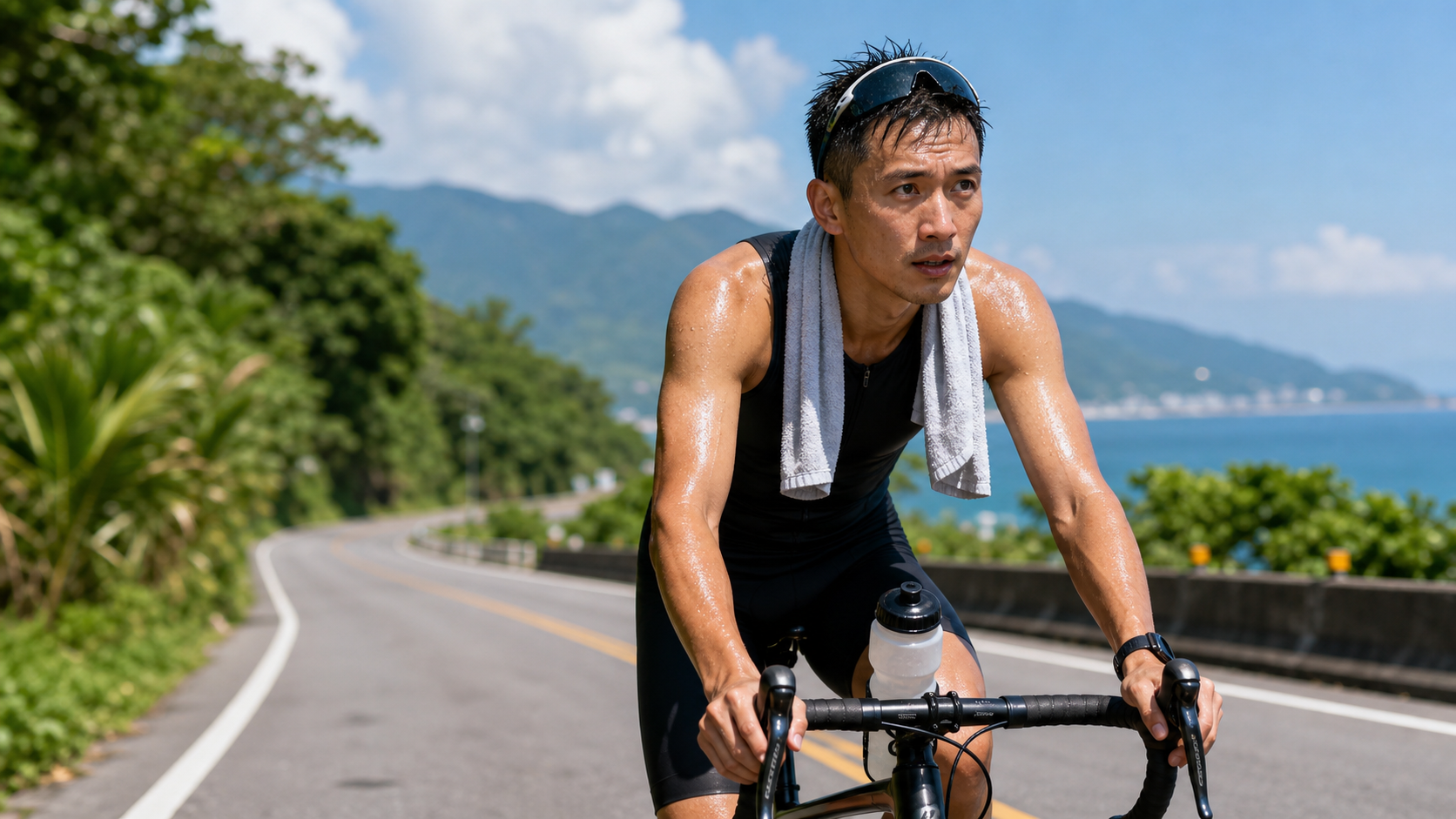
Coach’s Opening: Heat, the Opponent Taiwanese Athletes Most Often Underestimate
Every year after May, my phone starts receiving the same type of message: “Coach, I’ve been doing all my training, so why do I completely blow up within 40 km on race day?” I almost don’t need to look at the power file to guess the answer—it’s not that your engine is broken, it’s that your cooling system hasn’t booted up yet.
I once coached a 40-year-old triathlete, let’s call him A-Kai. On his trainer in an air-conditioned room, he could steadily hold 220 watts for an hour with his heart rate pinned below 150 bpm—impressive numbers all around. But when he went to Dapeng Bay for a 226 Ironman, halfway through the bike leg, with the same pace and same power, his heart rate inexplicably spiked to 165, 170 bpm, and he ended up cramping and walking the entire run leg. That day, it wasn’t a lack of fitness; it was that his body couldn’t dissipate heat. His core temperature kept climbing, and his heart, trying to simultaneously handle “sending blood to the muscles” and “sending blood to the skin for cooling,” had no choice but to beat faster and faster—this is what’s known as “cardiovascular drift.”
Taiwan’s summers are humid and hot, with afternoons often starting at 33°C and 80% relative humidity. In this environment, your sweat simply can’t evaporate, drastically reducing cooling efficiency. Many people think “just drink more water and wear an ice sleeve” will solve the problem, but the real key lies before the race—have you spent two weeks teaching your body to “work in the heat”? In this article, I’ll take the perspective of coaching athletes, explaining heat acclimation from the science to the training plan, so that before you press START, your cooling system is already installed, booted up, and warmed up.
Foundational Concepts: What Actually Happens to Your Body in the Heat
Why Do You Blow Up in the Heat? First, Understand Heat Dissipation
When the human body exercises, only about 20-25% of the energy produced by muscle contractions becomes forward propulsion; the remaining 70%+ becomes heat. This heat must be dissipated, or your core temperature will keep rising. When the environment is cool, the temperature difference between your skin and the air is large, allowing heat to be lost through radiation and convection. But when the air temperature approaches or exceeds skin temperature, the only effective cooling pathway left is “sweat evaporation.”
Here’s the problem: sweat only carries heat away when it evaporates; just “dripping off and falling on the ground” does nothing. Taiwan’s high humidity environment is exactly where this gets stuck—the air is already saturated with moisture, sweat can’t evaporate, and no matter how much you sweat, you’re only dehydrating yourself while your body temperature continues to climb. This is why the same power and the same pace feel so much harder cycling in a Taiwanese summer compared to a dry plateau.
Let me also debunk a common myth here: many people think “dry heat” is easier to handle than “humid heat,” but for endurance sports, humid heat is often far more troublesome. While dry heat has high air temperatures, sweat can evaporate effectively and the cooling pathway remains open; humid heat directly blocks your only cooling outlet. So for summer races on Taiwan’s western plains, that feeling of 32°C with 85% humidity is actually no less challenging to the body than a desert. Understanding this, you’ll see why “practicing heat acclimation in Taiwan” has its unique necessity—you’re not just adapting to high temperatures, but to the situation where “cooling is sealed off by humidity.”
The Core Physiological Changes of Heat Acclimation
The essence of heat acclimation is allowing the body, through repeated heat stimuli, to readjust an entire set of physiological systems so that cooling becomes more efficient and cardiovascular strain decreases. According to a relatively consistent consensus in exercise physiology, about 75-80% of heat acclimation occurs within the first 4-7 days, with most adaptations nearing completion within 14 days (see references at the end). This is why “two weeks” is the golden period for a heat acclimation plan.
The main physiological changes can be summarized in the table below:
| Physiological System | Adaptive Change | Timeline | Practical Impact on Racing |
|---|---|---|---|
| Plasma Volume | Expands by ~10-15% (varies by individual) | Within the first week, most noticeable around day 5 | Heart pumps more blood per beat, handling both cooling and oxygen delivery |
| Cardiovascular | Lower heart rate at same intensity, higher stroke volume | Noticeable from days 3-7 | Lower heart rate at same power, can last longer |
| Sweating System | Starts sweating earlier, increased sweat rate | Around days 3-8 | Cooling starts earlier, core temperature rises slower |
| Sweat Composition | Lower sodium concentration in sweat | Around the second week | Lose fewer electrolytes through sweat, reduced cramping risk |
| Core Temperature | Lower resting and exercising core temperature | Progressive throughout the period | More buffer room before the “heat exhaustion threshold” |
I want to especially emphasize plasma volume expansion here—it’s essentially the locomotive driving the entire adaptation process. Blood becoming slightly “thinner” and greater in total volume sounds like a bad thing, but for exercising in the heat, it’s actually beneficial: the heart can pump out more blood per beat, so it doesn’t have to struggle as much between “feeding the muscles” and “sending blood to the skin for cooling,” naturally keeping heart rate lower. After A-Kai completed two weeks of heat acclimation, riding at 220 watts in a 33°C environment, his heart rate dropped from 168 bpm back to around 155 bpm—that 13-beat difference was the key to whether he could finish that final marathon segment.
Sweating Gets Smarter, Not Just More Profuse
Many people think heat acclimation simply means “becoming better at sweating,” but that’s only half the story. The adapted sweating system has three intelligent features: it starts earlier (sweating begins before core temperature rises too high), it distributes more evenly (not just pouring from your forehead), and it retains more sodium (sweat becomes “diluter”).
The last point is especially important for Taiwanese athletes. Our summer diets are heavy on salt from eating out, and we often sweat profusely in humid heat. Many people only focus on drinking water during refueling without replacing electrolytes, which dilutes blood sodium levels and makes cramping—or even hyponatremia—more likely. Heat acclimation teaches the body to “conserve sodium,” effectively buying you an extra insurance policy on the electrolyte front.
I once coached an athlete who sweated profusely; after drying, his jersey would often be crusted with a layer of white salt residue—a classic case of the “high sodium loss” type. After completing two weeks of heat acclimation, he observed that the salt residue on his jersey was noticeably lighter—while not a precise measurement, it was the most直观 evidence that his body had learned to retain sodium. Of course, individual sweat rates and sweat sodium concentrations vary greatly, which is why I always emphasize that refueling strategies must be “personalized” and not copied from someone else’s formula. These two weeks of heat acclimation are the perfect time to figure out your own body’s “sweating personality.”
Practical Methods: Two Protocols, One Will Suit You
Heat acclimation operationally splits into two main routes: active heat acclimation and passive heat acclimation. Active means “exercising in a hot environment”; passive means “not exercising, simply exposing the body to heat.” Both can be used alone or in combination. When coaching athletes, I typically combine them based on their equipment, daily schedule, and race timing.
The Golden Indicator for Judging If You’re “Hot Enough”
Before getting into specific training plans, here’s a core principle: the stimulus for heat acclimation comes from a rise in core temperature, not from how much you sweat. Truly effective heat acclimation requires raising core temperature to about 38.5°C or higher and maintaining it for a period of time. In practice, you’re unlikely to measure your rectal temperature constantly, so I teach athletes to use three “perceptual proxy indicators” to judge if the intensity is sufficient:
- Continuous sweating: Not just light perspiration, but the level where clothes are soaked and sweat drips constantly
- Clearly elevated heart rate: 10-20 bpm higher than in a cool environment at the same intensity
- Feeling uncomfortably hot to the point of “wanting to stop” but still able to speak short sentences: This is the signal that intensity is just right
Each session should accumulate 60-90 minutes of heat exposure, performed consecutively for 10-14 days. If possible, do it every day, because heat acclimation is an ability that decays quickly with disuse; too many missed days will diminish the effect.
Sample Active Heat Acclimation Plan (Suitable for Those with a Trainer or Who Can Ride During Hot Periods)
Below is the two-week plan I most often prescribe for athletes with flexible schedules. Intensity follows the principle of “won’t blow up, can sustain it”; the focus is on accumulated time and core temperature, not pushing yourself to exhaustion.
| Day | Content | Intensity | Environment | Notes |
|---|---|---|---|---|
| Day 1-3 | Trainer or road ride 45-60 min | Zone 2 (easy aerobic) | AC off or afternoon time slot | Let the body first “get to know” the heat; don’t rush to add volume |
| Day 4-6 | Trainer 60-75 min | Zone 2 primarily, with 3×5 min Zone 3穿插 | Hot, humid environment | Start extending heat exposure time |
| Day 7 | Complete rest or very easy rollers | Recovery | Normal environment | Let the body integrate adaptations |
| Day 8-11 | Trainer 75-90 min | Zone 2-3 mixed | Hot, humid environment | Adaptation enters stable phase; maintain stimulus |
| Day 12-13 | 60 min including race-pace segments | Incorporate target race intensity | Simulate race time slot | Rehearse refueling and cooling strategies |
| Day 14 | Easy 30-40 min | Recovery | Normal environment | Wrap up; prepare for pre-race taper |
Here’s a detail that’s often overlooked: active heat acclimation requires “deliberately reducing cooling” to provide enough stimulus. Many people set up a big fan blasting directly at them in front of the trainer, and as a result, core temperature never rises enough—making the session pointless. I ask athletes to turn the fan off or to the lowest setting during heat acclimation sessions, or even wear an extra technical shirt, with the goal of forcing the body to initiate adaptation under “restricted cooling” conditions. Then, on真正 high-intensity interval days, turn the fan to maximum to protect performance—these two purposes are completely different, so don’t confuse them.
Passive Heat Acclimation: The Practical Value of Saunas and Hot Baths
If you live in an apartment where the AC can’t be turned off, or you have a knee injury that limits training, passive heat acclimation is your lifesaver. Its logic is: immediately after exercise, when core temperature is still high, enter a hot environment to extend heat exposure at minimal training cost.
There’s solid research supporting the method of “post-exercise hot water immersion.” The standard protocol used in studies is: first perform 40 minutes of moderate-intensity exercise in a temperate environment (about 18°C), then immediately immerse in 40°C hot water for 40 minutes right after exercise ends. After consecutive sessions, typical heat acclimation responses such as decreased resting core temperature can be observed (see references at the end). The biggest advantage of this method is—you don’t need to fly to the tropics to train; a bathtub at home that reaches your shoulders is all you need.
In practice, here’s my passive heat acclimation advice for Taiwanese athletes:
- Sauna version: Enter a dry or wet sauna for 15-25 minutes immediately after training. Aim for feeling hot and sweaty, but don’t push yourself to dizziness. Can be done in two sessions with a break in between.
- Hot bath version: After training, draw a bath at about 40°C (use a thermometer to confirm, don’t rely on feel), soak up to shoulder height for 30-40 minutes, and keep hydrating throughout.
- Frequency: 10-14 consecutive days, once daily or at least every other day.
There are several safety red lines for passive heat acclimation: never soak in a hot bath alone to the point of nearly falling asleep—the risk of fainting in a hot environment is higher than you think; hydrate before and after sauna or hot bath sessions, and if you experience dizziness, heart palpitations, or nausea during the session, leave immediately and cool down; don’t do it right after a heavy meal, on an empty stomach, or after drinking alcohol. I usually remind athletes to treat it as “training” rather than “relaxation and enjoyment”—training has a dose and boundaries; it’s not about the longer or more comfortable, the better. Find that line of “effective but safe” so you can complete two full weeks without incident.
Below is a side-by-side comparison of the two protocols so you can choose based on your conditions:
| Comparison Item | Active Heat Acclimation | Passive Heat Acclimation (Sauna/Hot Bath) |
|---|---|---|
| Core Logic | Exercise in a hot environment | Post-exercise or standalone heat exposure |
| Equipment Needs | Trainer or a hot time slot for riding | Sauna or deep bathtub |
| Joint Strain | Carries training load | Nearly zero additional load; suitable for injury recovery |
| Concurrent Fitness Training | Yes, can build aerobic fitness simultaneously | No, mainly trains “heat dissipation” |
| Applicability in Taiwan | Afternoon road rides, trainer with AC off | Gym sauna, home bathtub |
| Biggest Pitfall | Fan blasting reduces stimulus | Water temperature not measured, dehydration, solo soaking risk |
A Common Question: Will Heat Acclimation Affect Normal Training?
Yes, but it can be managed. Heat acclimation itself is a physiological stress, and if you stack it on top of an already hard training week, you risk over-fatigue. My approach is: place the main heat stimulus on low-intensity aerobic days, or use passive heat acclimation (sauna) to replace some intensity. On真正 high-intensity interval days, train normally in a cool environment to build performance. In other words, heat acclimation is “a layer added on top of your aerobic base,” not a replacement for your key training sessions.
How Long Do the Effects Last? Don’t Let Two Weeks of Effort Go to Waste
This is one of the questions athletes ask me most: “Coach, if I finish two weeks early, will it still be effective on race day?” The answer is—yes, but it decays over time, so timing matters.
The good news about heat acclimation: it decays more slowly than it builds. Based on the overall consensus of current research, the benefits of heat acclimation last about one week after cessation of heat exposure, then begin to decline; one meta-analysis estimates a loss of about 2.5% of adaptation per day without heat exposure, and by around three weeks, up to about 75% may be lost (see references at the end). Furthermore, adaptations that develop first (like sweating changes) also tend to be lost first, while cardiovascular-related adaptations are retained longer.
This gives us several very practical operational principles:
- Time it right: Schedule the two-week heat acclimation plan in the final 2-3 weeks before the race, so the effect is at or near its peak on race day.
- Don’t cut it off completely before the race: Even during the taper week, do a brief heat exposure every 3-4 days (e.g., one sauna session) as a “maintenance stimulus” to slow the decay rate.
- Don’t finish too early and then leave it alone: If you complete it six weeks before the race and never touch heat again, you’ll have only a fraction left by race day—essentially wasted effort.
I usually tell athletes: heat acclimation is like a phone battery. Once fully charged, it slowly drains even if you just leave it. Plugging in for a “top-up” every few days before the race ensures your battery is still full when you step up to the start line.
Why “Maintenance” Is Smarter Than “Rebuilding”
Here’s a logic many people haven’t fully grasped: rebuilding adaptation takes a full one to two weeks, but maintaining it only requires a brief stimulus every 3-4 days. From a return-on-investment perspective, spending 20 minutes on a sauna session during the pre-race taper week to preserve the results of two hard weeks of training is a deal that makes sense no matter how you calculate it. I even suggest that athletes living in urban areas who pass by a gym during their commute build “maintenance sauna” directly into their fixed routine, making it as habitual as brushing your teeth so you won’t forget.
One more reminder: decay is not linear. In the first few days after stopping heat exposure, you’ll barely notice a difference, but after a week, the loss accelerates. So don’t get complacent because “the first few days seemed fine” and skip maintenance stimuli entirely. The ones who truly lose out are often those who “finished two and a half weeks early and then completely let go”—by race day, they’ve lost a large portion but still think they’ve done heat acclimation.
How Do You Know If It Worked? Track Your Cooling System with Data
The most fascinating thing about heat acclimation is that it leaves clear fingerprints on your training data. When coaching athletes, I ask them to track the following metrics and compare weekly—whether the adaptation has taken effect becomes obvious at a glance.
| Monitoring Metric | Before Acclimation | After Acclimation (~2 weeks) | How to Measure |
|---|---|---|---|
| Heart rate at same power | Higher | Drops by ~10-20 bpm | Use the same Zone 2 session for comparison |
| Resting heart rate (upon waking) | Baseline | Stabilizes or slightly decreases | Measure at the same time every morning |
| Perceived exertion (RPE) for same session | Higher | Clearly easier | Self-rate on a 1-10 scale |
| Post-training feeling | Stuffy, heavy-headed, nauseous | Fresher, faster recovery | Subjective record |
| Sweat onset time | Later | Starts sweating earlier | Observe how long into warm-up you’re soaked |
For Taiwanese athletes, the most practical and easily accessible metric is the first one: “heart rate at the same power.” You don’t need an expensive core temperature capsule; just use the same Zone 2 trainer session weekly (e.g., steady 180 watts for 30 minutes) to compare heart rate curves. When you see heart rate dropping week by week, and “cardiovascular drift” (the upward creep of heart rate in the latter half) getting smaller and smaller, that’s ironclad proof your body’s cooling system has upgraded. I often tell A-Kai and others: “Data doesn’t lie—your heart will tell you whether your cooling system is online.”
Hydration and Electrolyte Strategy During Heat Acclimation
During heat acclimation, you’ll lose more fluids and electrolytes than usual, so your refueling strategy must be upgraded accordingly; otherwise, training while dehydrated will backfire. Here are some practical principles.
Before the session: Drink about 400-600 ml of water 2 hours before a heat acclimation session to get your body into a “well-hydrated” state. Plasma volume can only expand if your body has enough water available.
During the session: Take small sips of about 150-250 ml every 15-20 minutes. Don’t wait until you’re thirsty—by the time you feel thirst, you’re already mildly dehydrated. If the session exceeds 60 minutes or you’re sweating particularly heavily, add electrolytes (primarily sodium) to your drink.
After the session: This is the most overlooked part. Estimate fluid loss using “pre-session weight minus post-session weight,” and for every 1 kg lost, replenish with about 1.2-1.5 liters of a sodium-containing beverage. While Taiwan’s eating-out environment is heavy on salt, that’s mostly sodium from meals, which is different from immediate replacement during exercise—don’t use “eating salty food” as an excuse to skip electrolyte replacement.
A special warning here: more water is not always better. Some athletes overcorrect and chug plain water, diluting blood sodium and triggering hyponatremia—mild cases cause cramping, severe cases can be life-threatening. The core of hydration is “balancing water and sodium,” not simply pouring in water. This is also why the refueling rehearsal during heat acclimation is itself part of your race-day nutrition plan—if you learn your sweat rate and sodium needs during these two weeks, race day won’t be a scramble.
Common Mistakes and Corrections: I’ve Seen These Pitfalls Too Many Times
After more than a decade of coaching athletes, the same mistakes keep recurring. This section will help you avoid the landmines.
Mistake 1: Thinking “Sweating More” Means It’s Working
Sweating is a “result,” not a “goal.” The real stimulus is a rise in core temperature. Some people wear a rain jacket in an air-conditioned room and pedal hard, sweating profusely without actually raising their core temperature—limited effect. Correction: Turn off the fan, choose a hot and humid time slot, extend the duration, and let core temperature truly rise and be maintained.
Mistake 2: Not Drinking Enough During Heat Acclimation, Training Yourself into Dehydration
Heat acclimation makes you lose more fluid; if you’re dehydrated while doing it, plasma volume won’t expand and may even backfire. Correction: Weigh yourself before and after heat acclimation sessions, replenish about 1.2-1.5 liters of water per kilogram lost, and add sodium as appropriate. Keep sipping water steadily during the session.
Mistake 3: Ramping Up Too Fast, Turning Heat Acclimation into Heat Injury
Some athletes, eager for results, ride two hours under the blazing sun on day one and end up in the hospital with heat exhaustion. Heat acclimation must be progressive. Correction: Start with 45-60 minutes at low intensity; let the body “get to know the heat” for the first three days, then gradually increase. If any of these signs appear—dizziness, nausea, goosebumps, or cessation of sweating—stop immediately and cool down.
Mistake 4: Only Doing Heat Acclimation, Ignoring Race-Day Cooling Strategies
Heat acclimation is “pre-race preparation”; in-race immediate cooling is a separate matter, and the two must be combined. Correction: On race day, use pre-cooling (slushies, ice vests), pour water over your head and neck at every aid station, and stuff ice cubes into your jersey. These immediate strategies and heat acclimation have a synergistic effect.
Mistake 5: Treating the Sauna Like a Spa Session, with Insufficient Intensity
A post-exercise sauna should be entered immediately while core temperature is still high. If you shower first, rest for half an hour, then casually go in, the stimulus is greatly diminished. Correction: Enter the sauna or hot bath immediately after training, while still sweating, to capitalize on the “heat window” of elevated core temperature.
Actionable Advice for Athletes of Different Levels
Everyone’s equipment, time, and target races differ. I’ve broken down the advice by level—just find where you fit.
First-Timers / First Summer Race Athletes
You don’t need a complicated plan; prioritize “doing something” over “doing everything perfectly.” Start with the simplest passive heat acclimation: after each training session, hit the gym sauna for 15-20 minutes, or take a hot bath at home, 4-5 times a week for two consecutive weeks. The key is to first let your body experience what it feels like to work in the heat, while also practicing “how to replenish water and sodium after sweating.” Your race-day goal is “finish safely”; pace yourself 5-10% more conservatively than in cooler conditions, and don’t get swept up by the excitement of the early stages.
Age-Group Advanced / Athletes Targeting a PB
You’re suited for the full two-week active heat acclimation plan, with passive heat acclimation stacked on top to enhance the effect. Place the main heat stimulus on Zone 2 aerobic days, keeping high-intensity sessions in a cool environment. Be sure to rehearse your complete race-day refueling and cooling process within the plan: what to drink, how often, water-pouring strategy, and electrolyte composition. And track with power and heart rate data—when you see “heart rate at the same power dropping week by week,” that’s ironclad proof heat acclimation is working. Schedule it in the final 2-3 weeks before the race, and use sauna sessions during the taper week for maintenance.
Athletes Targeting Long Distance (113/226) or High-Heat Indicator Races
For you, heat acclimation isn’t a bonus—it’s a required course. Beyond the full two-week protocol, I recommend integrating heat exposure into your daily long sessions—for example, deliberately scheduling the latter part of weekend long rides during hotter periods to simulate the high-temperature fatigue of the race’s second half. You should also monitor body weight, urine color, and resting heart rate more rigorously as overtraining signals, because long-distance athletes already carry a high training load, and stacking heat acclimation on top requires extra caution against fatigue accumulation. For races like Dapeng Bay or Kenting in Taiwan, afternoon heat is the dividing line between victory and defeat—whoever’s cooling system boots up first wins before the starting gun even fires.
A Ready-to-Copy “Four-Week Pre-Race” Integrated Timeline
| Time to Race | Heat Acclimation Arrangement | Training Focus |
|---|---|---|
| Before Week 4 | Not yet started; normal training | Build aerobic and intensity base |
| Weeks 3-2 before race | Execute 10-14 day main heat acclimation plan | Maintain aerobic volume; intensity sessions in cool environment |
| Week 1 before race | Taper; sauna maintenance every 3-4 days | Significantly reduce training volume; preserve freshness |
| 2-3 days before race | One brief heat exposure only | Mostly complete rest; rehearse refueling |
| Race day | Pre-cooling + in-race immediate cooling | Execute established cooling and refueling plan |
Frequently Asked Questions (FAQ)
Over years of coaching, there are a few questions nearly everyone asks. I’ve compiled them here to answer all at once.
Q: I’m already riding outside every day in the summer. Do I still need to do specific heat acclimation?
If you’ve been regularly training during the hot afternoon hours all summer, you’re already doing “natural heat acclimatization,” which is good. But note two things: first, many people train in the cool early morning hours during summer, which doesn’t provide enough heat stimulus; second, if your target race is in more extreme humid heat (e.g., a long-distance race starting at noon), deliberately using a plan to maximize the stimulus can still stack another layer of adaptation on top. So the answer is: riding in the sun is a foundation, but don’t assume “riding equals enough training.”
Q: My life is air-conditioned from the office all the way home. What should I do?
This is exactly where passive heat acclimation shines. You don’t need to change your air-conditioned lifestyle; just spend an extra 20-30 minutes in a hot bath or sauna after training to make up the heat stimulus. Urban office workers are actually better suited to the passive route because it’s time-controllable and unaffected by weather.
Q: Will heat acclimation make me slower in a cool race?
No. The plasma volume expansion and improved cardiovascular efficiency from heat acclimation won’t hurt you in a cool environment, even if the benefit is less obvious. Research shows the effect on performance in cool conditions is mostly neutral. So even if you’re unsure about race-day weather, the downside risk of doing heat acclimation is very low.
Q: Can I replace all my training with sauna sessions?
No. Passive heat acclimation trains the “cooling system,” not the “engine.” Your aerobic capacity, strength, and skills still need to be built through proper training. The sauna is “a layer on top of training,” not a replacement for it. Treat it as a supplement, not a main meal.
Q: Will doing two heat exposures a day work faster?
For certain advanced athletes in specific situations, it might be feasible, but for the vast majority of amateur athletes, two sessions a day easily accumulates excessive fatigue and compromises the quality of regular training—not worth it. My advice is once a day, progressive, with proper hydration, and steadily completing two weeks. That’s far better than rushing and breaking yourself down. Remember, heat acclimation is a cycle of “stimulus plus recovery”; with only stimulus and no recovery, the body won’t improve.
Q: What should female athletes pay attention to during heat acclimation around their menstrual cycle?
Female thermoregulation naturally fluctuates with the menstrual cycle; basal body temperature is higher during the luteal phase, and heat tolerance may be slightly reduced. This doesn’t mean you can’t do it, but you should pay more attention to your body’s signals, keep intensity more conservative, and be stricter about hydration. Whenever anything feels off, it’s better to end early than to push through. If you have any related health concerns, be sure to consult an OB-GYN or sports medicine professional first.
Conclusion: Win Before You Press START
Back to A-Kai’s story at the beginning. The next year, he came back, and we scheduled heat acclimation into his plan three weeks out, combining active and passive methods, with sauna maintenance during the taper week. Same Dapeng Bay, same high temperatures—his heart rate on the bike leg stayed steadily around 155 bpm, no cramping on the run leg, and he set a new personal best. One thing he said to me after the race I’ve never forgotten: “So heat isn’t something you’re born to endure—it’s something you can train.”
That’s the most fascinating thing about heat acclimation—it’s one of the few “extremely high return on investment” pre-race preparations. You don’t need expensive equipment or a trip abroad; just two weeks of a little extra heat each day gives your body an entire additional cooling system. In Taiwan’s humid, hot racing environment, this might be the highest value-for-money investment in all your training.
Don’t let heat be your invisible opponent anymore. Starting today, turn off that big fan and let your body learn to dissipate heat. By the time you press START on race day, you’ll find you’ve already won before the starting line.
This article is educational content and does not replace individual assessment by a physician, physical therapist, or nutritionist. Those with cardiovascular disease, chronic conditions, or who are pregnant should consult a medical professional before undertaking heat acclimation training.
References
- Périard et al., Adaptations and mechanisms of human heat acclimation. Scandinavian Journal of Medicine & Science in Sports. https://onlinelibrary.wiley.com/doi/10.1111/sms.12408
- Time-course for onset and decay of physiological adaptations in endurance trained athletes undertaking prolonged heat acclimation training. https://www.tandfonline.com/doi/full/10.1080/23328940.2024.2383505
- Post-exercise Hot Water Immersion Elicits Heat Acclimation Adaptations That Are Retained for at Least Two Weeks. https://www.frontiersin.org/journals/physiology/articles/10.3389/fphys.2019.01080/full
- Post-exercise hot water immersion induces heat acclimation and improves endurance exercise performance in the heat (Zurawlew et al.). https://onlinelibrary.wiley.com/doi/full/10.1111/sms.12638
- Heat Acclimatization to Improve Athletic Performance in Warm-Hot Environments, Gatorade Sports Science Institute. https://www.gssiweb.org/sports-science-exchange/article/sse-153-heat-acclimatization-to-improve-athletic-performance-in-warm-hot-environments
Related Reading
- The Complete Heat Acclimation Manual: Why It Works, How Long to Train, How to Execute Safely, and How Many Days It Takes to Decay
- Heat Acclimation Training: Physiological Strategies to Improve Summer Cycling Performance in Taiwan
- Summer Race Preparation: Complete Heat Acclimation Training Protocols and Scientific Execution Guide
- Heat Acclimation Training: Performance Enhancement Strategies for Taiwan’s Hot Summer Environment
2019 夏季KOM 5小 完賽心得 準備攻略 東進武嶺 夏季登山王之路 Taiwan KOM Challenge
7 年前
大武山後門26%歡樂陡坡!JJSC南台灣單車行Day2 / 被颱風追著跑 / 公路車 / CT Yeh
2 年前
CT暗黑廚房) 車友必備 宇宙無敵鮮蚵湯 幫助訓練恢復 天然食補 好市多 超肥鮮蚵 破PR
7 年前
水金九不厭五分 10度寒流冷到不願停!feat. 卡卡 / 公路車 / CT Yeh
6 個月前
JJSC南台灣單車走春三日行 DAY 1 / 強度 x 美食 x 節慶體驗 / 公路車 CT Yeh
5 個月前
TBA 北高360 逆風爆熱再送空汙 苦行挑戰賽全記錄 4K沈浸式臨空畫質| 公路車 | CT Yeh
3 年前
西進武嶺 免費訓練分析服務 Intervals | 練不夠還是練過頭?你哪一種類型選手?AI模型告訴你! | 備戰神器 | 公路車 訓練 | CT Yeh
4 年前
嘉義大埔、阿婆灣挑戰賽,美到以為在日本!ft. 環騎5 Cool 西拉雅188 / 公路車 / CT Yeh
7 個月前