Coach’s Opening: The Student Who Trained for Hours but Never Improved
Let me start with a real story. A few years ago, I coached a student transitioning from road running to triathlon—let’s call him A-Hong. A-Hong was a strong runner, with a sub-3:30 marathon and undeniable fitness. His arm muscles during the pull looked like something out of a gym textbook. But his swimming could be summed up in one phrase: “working extremely hard to stay in place.”
Every session ended with him gasping for air, heart rate spiking above 170 bpm, yet his 100-meter time stubbornly stuck at 1:55 no matter what we did. He asked me, “Coach, should I strengthen my arms more? Should I start doing pull-ups?”
I asked him to lie on the pool deck and do one thing: keep his arms completely still, push off the wall, and see how far he could glide. He sank and stopped before reaching 5 meters. Meanwhile, a petite female swimmer in the same group, with far less strength, pushed off the same way and effortlessly glided 8 or 9 meters.
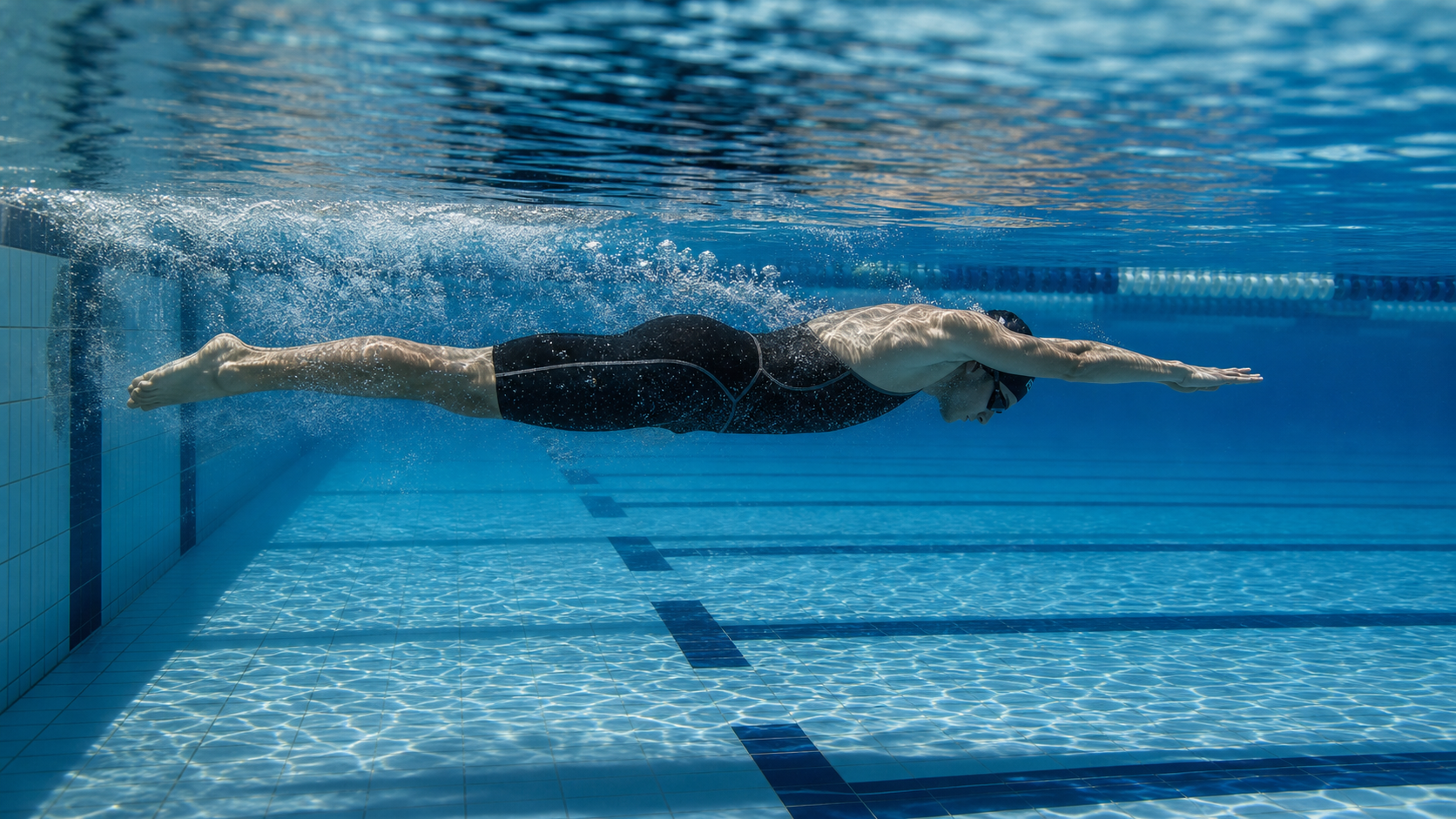
That was A-Hong’s lightbulb moment: The problem was never that his arms weren’t strong enough—it was that his body moved through the water like a turbulence-generating plank of wood. A large portion of every ounce of force he produced was spent fighting the drag created by his own poor body position.
In this article, I want to lay out clearly the core principle I’ve repeated to students for fifteen years: In swimming, reducing drag matters more than increasing propulsion, and body position is the single biggest variable within that drag. This isn’t mysticism—it’s fluid dynamics.
Why Is Water So “Thick”? Understanding the Magnitude of Drag
Many people don’t realize that water is roughly 800 times denser than air. This means the drag you encounter moving through water is a completely different challenge than running or cycling through air.
On a bike, we obsess over aerodynamics—lowering the torso, tucking the elbows, wearing an aero helmet—because above 40 km/h, over 80% of your power output goes toward overcoming air resistance. But as brutal as air resistance can be, it pales in comparison to the cruelty of water resistance.
There’s a key physics concept to establish first: The relationship between drag and speed is not linear. For swimming, which is dominated by “form drag,” drag is roughly proportional to the square of your speed. In plain language:
When you double your swimming speed, the drag you face doesn’t double—it becomes roughly 4 times greater.
This relationship is unforgiving. It means that for elite swimmers, every tiny increase in speed means battling a rapidly expanding wall of resistance. And precisely because of this, instead of trying to smash through that wall with more propulsion, it’s far smarter to first make the wall shorter—by lowering your drag coefficient. And the most effective, cheapest, and least talent-dependent way to lower your drag coefficient is to improve your body position.
The Three Types of Drag: What Exactly Are You Fighting?
To understand the importance of body position, you first need to know the three forms of underwater drag. According to sports science classifications, swimming drag can be divided into the following three types (Physics of Swimming teaching resource, Swimming Science Bulletin):
1. Form / Pressure Drag
This is the number one enemy of swimming drag. As your body moves through the water, a high-pressure zone forms in front of you and a low-pressure zone with turbulence (vortices) forms behind you. This front-to-back pressure difference pulls you backward.
The magnitude of form drag depends mainly on the “frontal projected area” your body presents to the oncoming water—in other words, how much of your body’s cross-section the water sees from directly ahead. Someone swimming with their head held high and hips sinking presents a frontal area several times larger than someone in a streamlined position.
Here’s the key data: research shows that at flow speeds around 2 m/s, pressure drag can account for approximately 90% of total water resistance (Numerical and experimental methods review, PMC). That’s an overwhelming proportion. In other words, the vast majority of drag you face in the water comes from your body’s “shape” and “posture,” not from the water itself being viscous.
2. Wave Drag
When you swim near the surface, your body pushes water aside and creates waves. Generating these waves costs energy, and that energy is the source of wave drag. Have you ever seen a poor swimmer who always has a huge bow wave pushed ahead of their head? That’s them actively manufacturing wave drag.
The relationship between wave drag and speed is even more extreme—it’s roughly proportional to the cube of your speed. So the faster you go, the more devastating wave drag becomes. Research also indicates that at near-race speeds and close to the surface, wave drag can account for a significant portion of total resistance; however, when your body depth exceeds about 0.5 meters, wave drag becomes almost negligible (Physics of Drag in Swimming).
This is why competitive swimmers do long, streamlined dolphin kicks underwater after starts and turns—because in the deeper water, you temporarily shed the burden of wave drag.
3. Skin Friction Drag
This is the drag generated by direct friction between the water and your skin or swimsuit surface. It has a roughly linear relationship with speed and is the smallest of the three drag types. Racing swimsuits, shaved body hair, and smooth swim caps all address this component—but honestly, for amateur triathletes, this is the last thing you need to worry about.
Summary Table of the Three Drag Types
| Drag Type | Primary Cause | Relationship with Speed | Relative Share (Surface Swimming) | How You Can Improve It |
|---|---|---|---|---|
| Form / Pressure Drag | Frontal projected area, front-to-back pressure difference | Roughly squared | Largest (up to ~90% at high speeds) | Improve body position, streamline (highest priority) |
| Wave Drag | Energy lost pushing waves at the surface | Roughly cubed | Significant at high speeds; negligible in deep water | Reduce body movement, control head position, glide underwater |
| Skin Friction Drag | Friction against skin / swimsuit surface | Linear | Smallest | Swimsuit, swim cap, shaving (lowest priority) |
Once you understand this table, you’ll understand why I told A-Hong, “Forget your arms for now—first get your body flat.” Because every time he lifted his head to breathe and let his hips sink, he was maximizing his own “frontal projected area,” essentially building a tall wall of form drag for himself.
How Much Does Body Position Really Matter? Look at the Measured Data
Concepts alone aren’t enough—let’s look at actual measured numbers. Sports scientists use two concepts to study this: “Passive Drag” and “Active Drag.”
- Passive Drag: The drag encountered when the body is held still (e.g., during a push-off glide).
- Active Drag: The drag encountered during actual swimming strokes.
Just the “Head Position” Alone Makes This Much Difference
One study measured passive drag on 10 male swimmers with an average of over 10 years of competitive experience, using a tow apparatus at three speeds (1.5, 1.7, 1.9 m/s) and three head positions. The results (Effect of The Swimmer’s Head Position on Passive Drag, PMC):
- With arms at the sides, a lowered head (aligned with the body) reduced average passive drag by approximately 4–5.2% compared to a raised head.
- With arms extended in a standard streamline, a lowered, aligned head reduced passive drag by approximately 10.4–10.9% compared to a raised head (statistically significant).
Note that this is the difference made by adjusting just one body part—the head. The study also noted that the laminar flow over a gliding swimmer is first disrupted at the head—it’s the first point on the body’s streamlined contour where a significant shape change occurs. How high you hold your head directly determines the quality of water flow over your entire downstream body.
Body Composition and Posture Together Determine Passive Drag
Another study on young swimmers found that body weight was the best predictor of passive drag, explaining approximately 69% of the variance; swimmers with lower passive drag tended to be leaner, have narrower shoulders, and present a smaller trunk cross-section in a streamlined position (Passive Drag in Young Swimmers, PMC).
This leads to an extremely important conclusion for amateur athletes:
You can’t easily change your skeleton and height, but you 100% can change your “cross-sectional size in a streamlined position”—that is, how flat, how long, and how narrow you make your body.
This is precisely the value of body position training. It’s one of the few levers that “doesn’t rely on talent or muscle strength—purely on technique—to dramatically reduce drag.”
Technical Priority Order: Why Body Position Comes First
When I coach swimmers, the teaching order for swimming technique is always fixed. This order isn’t something I invented—it’s derived from the logic of fluid dynamics: address drag first, then propulsion; address the largest source of drag first, then the secondary ones.
My Swimming Technique Priority Order (Top to Bottom)
| Priority | Technical Focus | Problem Addressed | Magnitude of Impact |
|---|---|---|---|
| 1st Priority | Body levelness / hips floating high | Form drag (the biggest contributor) | Extremely large |
| 2nd Priority | Neutral head position, eyes looking down | Form drag + wave drag | Large |
| 3rd Priority | Body roll and extension | Lengthening the body, reducing cross-section | Large |
| 4th Priority | Hand catch and propulsion path | Propulsive efficiency | Medium |
| 5th Priority | Kick rhythm, breathing timing | Balance and fine-tuning | Medium-small |
| 6th Priority | Swimsuit, swim cap, shaving | Skin friction drag | Small |
See how the pull is ranked 4th? This isn’t to say the pull isn’t important—it’s to say that refining your pull while your body position is still a mess is putting the cart before the horse. It’s like putting an expensive chain on a bike with a flat tire—no matter how good the chain is, it won’t fix the tire.
A-Hong’s problem was that he kept trying to work on the 4th priority. When we spent six weeks adjusting him from a “struggling plank” into a “smooth canoe,” his 100-meter time jumped to 1:42, and his heart rate actually dropped. The same arm strength, applied to a properly aligned body, produces completely different efficiency.
Practical Methods: A Concrete Workout for Getting Your Body Flat
Enough theory—here’s something you can actually take into the water. Below is a foundational workout I give to students who need to improve their body position. The focus is entirely on feeling level and streamlined, not on chasing speed.
Body Position Foundational Workout (Approx. 60 Minutes)
| Segment | Content | Distance / Sets | Key Focus |
|---|---|---|---|
| Warm-up | Easy freestyle + back float | 200 meters | Feel your body floating; don’t rush |
| Drill A | Push-off streamline glide | 8 x 10 meters | Arms pressed to ears, chin tucked, glide until you stop before standing up |
| Drill B | Side kick | 6 x 25 meters | One arm extended forward, eyes on the pool bottom, body like a long rod |
| Drill C | 6-1-6 kick and roll drill | 6 x 25 meters | Kick 6 times per side, 1 stroke, feel the extension |
| Main Set | Slow freestyle, focusing on hips floating high | 8 x 50 meters | Imagine someone lifting your hips up with a rope |
| Cool-down | Backstroke + easy freestyle | 200 meters | Relax, savor the feeling of being level |
What You Should “Feel” During These Drills
- Sense of Levelness: In a good level position, your body should feel like a long log floating on the water’s surface, not an arrow stabbing diagonally into it.
- Weight of the Head: Imagine your head is a bowling ball. Press your head down slightly, and your hips naturally rise; lift your head, and your hips sink. It’s leverage.
- Sense of Extension: With every hand entry, have the intention of “stretching your body longer.” The longer and narrower your body, the smaller your frontal projected area, and the lower your drag.
Here’s a mantra I often give students: “Press the chest, hide the head, lift the hips, lengthen the body.” All four of these actions target form drag—not a single word about arm strength.
Common Mistakes and Fixes
Over the years, about 90% of the body position errors I’ve seen fall into the categories below. Check how many apply to you.
Mistake 1: Looking Forward
This is the most common and most damaging mistake, especially common among open-water triathletes—because they develop the habit of lifting their head to sight, and it carries over into regular swimming.
Consequence: When the head lifts, the hips and legs immediately sink, the frontal projected area skyrockets, and both form drag and wave drag increase.
Fix: During normal swimming, keep your gaze directed straight down or slightly forward at the pool bottom, with the waterline around your hairline. For open-water sighting, practice the “crocodile eye”—just briefly lift your eyes above the water for a quick glance and immediately return, rather than lifting your whole head.
Mistake 2: Sinking Hips and Legs
Many people swim like a “diagonal plow”—upper body at the surface, lower body angled down into the water.
Consequence: This is one of the biggest sources of form drag—it’s like using your entire lower body to “shovel” water.
Fix: Actively “press your chest”—gently press your chest and head downward, using leverage to float your hips and legs up. Combine this with a light, continuous kick to maintain leg height. Remember: the kick is for “maintaining position,” not for “forceful propulsion.”
Mistake 3: Kicking Too Hard
Triathletes especially need to pay attention to this. Many people treat their legs like an engine and kick furiously, resulting in a skyrocketing heart rate, lactic acid buildup in the legs, and dead legs for the run after exiting the water.
Consequence: Kicking has very low propulsive efficiency but consumes a huge amount of oxygen. For triathlon, this is stealing energy from your bike and run legs.
Fix: The triathlon swim kick should be a relaxed, easy 2-beat rhythm designed to “maintain body levelness,” not an all-out sprint kick. Save the leg energy for the run after T2.
Mistake 4: Lifting the Whole Head and Twisting the Body to Breathe
Consequence: The moment of breathing destroys the entire body’s streamline, drag spikes instantly, and it’s often accompanied by excessive side-to-side body sway.
Fix: Breathing should be driven by “body roll,” not by “lifting the head and turning the neck.” Imagine a steel rod running from the top of your head down to your tailbone. When you breathe, rotate the entire rod along its long axis, letting your mouth naturally clear the water—you can even keep one eye still in the water.
Actionable Advice for Swimmers at Different Levels
Body position is approached differently depending on your stage. Here are my tiered recommendations.
Beginners Aiming to Finish Their First Triathlon
The only thing you need to work on right now is body levelness and breathing. Don’t touch any stroke technique books, don’t research high-elbow catch. Master the “push-off glide” and “side kick” from the foundational workout above. If you can float relaxed in the water and breathe smoothly, your finish is secure.
- Spend at least half of your weekly swim training time on technique and streamlining.
- Goal feeling: glide easily for 6+ meters, breathe without panic.
- Forget the clock—first, aim for “effortless.”
Advanced Age-Group Swimmers (Chasing PBs)
Your fitness usually isn’t the issue—the bottleneck is often “posture breakdown at high speed.” As speed increases, form drag grows quadratically and wave drag grows cubically, so any tiny postural flaw gets magnified.
- Video recording is your best coach. Film from the side and check whether your hips sink during pace swimming.
- Add “maintaining streamline at pace” specialty sets: e.g., 10 x 100 meters, each at race pace, with the focus being “fast, but the body doesn’t collapse.”
- Only now is it worth seriously refining your hand catch path (4th priority), because your foundation (body position) is already solid.
Long-Distance Triathletes (113 / 226)
For you, the goal of swimming is never to be the fastest—it’s to exit the water using the least energy, saving your strength for the bike and run ahead. The value of body position is amplified to the extreme for you: every bit of drag you save is endurance for the dozens of kilometers ahead.
- Train for “economy rhythm,” not “sprint speed.”
- Open-water races in Taiwan (such as Penghu, Sun Moon Lake, Taitung Living Water Lake, etc.) often involve higher water temperatures, crowded conditions, and frequent sighting needs. Practice “low-lift sighting” and “drafting” techniques—both save you drag and energy.
- Taiwan’s summer climate is hot and humid. Pay special attention to water temperature and hydration during open-water training, and don’t skimp on electrolyte replenishment after long sessions.
Going Deeper: What the Drag Equation Tells Us
If you want to fully understand from a conceptual level “why body position is so critical,” let’s look at the basic form of fluid drag. Drag can be roughly written as:
Drag ≈ ½ × water density × drag coefficient × frontal area × speed squared
You don’t need to be an engineer, but this equation contains three crucial messages for athletes:
- Water density is fixed—about 800 times that of air, and you can’t change it. This explains why water resistance is inherently more brutal than wind resistance.
- The drag coefficient and frontal area are exactly the two variables directly controlled by your body position. The more streamlined, flatter, and narrower you make your body, the smaller these numbers become. This is the only place where you can make major adjustments.
- Speed is the squared term. A small increase in speed causes drag to expand rapidly. This means at high speeds, any postural flaw is amplified by the square.
Connecting these three points, the conclusion is clear: Your biggest lever against water resistance isn’t “pushing harder”—it’s “minimizing your drag coefficient and frontal area.” And both of those—one through streamline technique, one through body position—are achieved not through brute force, but through awareness and practice.
This is also why I often tell students something that sounds contradictory: “Elite swimmers don’t necessarily pull harder than you—they just waste less of their effort than you do.” The propulsion you generate from your pull is a fixed cost, and a poor body position is like a hole that constantly leaks money. Rather than desperately earning more (increasing propulsion), it’s smarter to first patch the hole (reducing drag).
A Simple Analogy: Canoe vs. Flat-Bottom Barge
I love using boats as an analogy. Imagine two boats with the same engine and the same horsepower:
- Canoe: Long, slender hull, pointed bow, shallow draft. Water flows smoothly along the hull, creating almost no turbulence.
- Flat-bottom barge: Wide, blunt, deep draft, square bow. It pushes a massive amount of water forward and sideways, generating enormous form drag and waves.
With the same engine, the canoe glides forward effortlessly while the barge struggles to move. Which boat you choose to be in the water is the choice of your body position. A-Hong started out as that barge—strong engine (arms), but terrible hull design. All we did was convert him from a barge into a canoe.
Four-Week Body Position Transformation Plan
A single workout isn’t enough—changing body position takes time for your neuromuscular system to relearn. Here’s a progressive four-week plan I commonly use, suitable for swimmers who can get in the water 2–3 times per week. Each session is about 60–75 minutes.
| Week | Core Goal | Main Technical Drills | Technical Volume Share | Self-Check Indicator |
|---|---|---|---|---|
| Week 1 | Build floating sensation and level awareness | Back float, front float, push-off glide | 70% | Can glide 6+ meters from a push-off |
| Week 2 | Head position and chest-press leverage | Side kick, single-side breathing glide | 60% | Hips no longer visibly sink |
| Week 3 | Body roll, extension, and long stroke | 6-1-6, fingertip drag, catch-up | 50% | Stroke count per 25 meters decreases |
| Week 4 | Maintaining streamline at pace | Inserting technical cues into pace swimming | 30% | Posture doesn’t collapse when speeding up |
The Design Logic Behind This Plan
Notice that the technical volume share decreases week by week: Week 1 has 70% of time on slow technique, dropping to 30% by Week 4. This is deliberate—first engrave the correct body position into your neuromuscular memory, then gradually add speed back. Too many people make the mistake of rushing back to pace work before their posture is stable, and the moment they speed up, their form collapses—making all the previous work pointless.
“Stroke count per 25 meters” is my favorite single metric. When your body position improves and your body becomes longer and more streamlined, you’ll find that the same 25 meters requires fewer strokes—meaning each stroke propels you further with less drag. I often ask students to track their stroke count as a “body position health report.” If you originally took 22 strokes per 25 meters and train it down to 18, that’s real, tangible progress—a better reflection of technical improvement than time alone.
Frequently Asked Questions (FAQ)
These are the questions students have asked me most over fifteen years of coaching. Here they are, all in one place.
Q1: My arms are strong, so why can’t I swim faster?
Because no matter how strong your propulsion is, you first have to subtract the drag created by your body position to get your “net forward progress.” If your body position is poor, it’s like pushing a barge with a powerful engine. First convert the boat into a canoe, and your existing arm strength will suddenly “feel stronger”—not because it actually got stronger, but because it’s no longer being wasted.
Q2: Do I need to train my core to improve my body position?
Core stability does help, especially in maintaining body alignment without swaying and not collapsing your hips when breathing. But note the order: Core is a supplement; technical awareness is the main event. I’ve seen people with very strong cores who still swim like barges because they never developed the movement awareness of “pressing the chest and lifting the hips.” First establish the correct movement pattern in the water; then dry-land core training will have a multiplier effect.
Q3: Doesn’t a triathlon wetsuit make body position training less important?
No—it actually highlights its value even more. A wetsuit provides additional buoyancy and will indeed help lift your hips and legs somewhat, but it cannot fix your bad habits of lifting your head, shrugging your shoulders, or swaying your body. Moreover, many races in Taiwan have high water temperatures where wetsuits may not be permitted or suitable. Training your body position well is a foundational ability that benefits you whether or not you wear a wetsuit.
Q4: How important is kicking, really?
For triathletes, the “propulsive” role of the kick is overrated, while its “body position maintenance” role is underrated. Your legs don’t need to be an engine, but they do need to stay near the surface and not sink. A relaxed, easy, continuous 2-beat kick primarily serves balance and levelness, not forceful propulsion. Save the leg energy for the bike and run. On a side note, if you find your ankles are stiff and your kick is “stomping down” rather than “whipping backward,” that actually creates extra drag—in that case, ankle flexibility stretching will help more than kicking harder.
Q5: How do I know if my body position is actually good?
The most direct method is side-view video recording. Have someone film you swimming one length with a waterproof phone from the side or underwater. Look for three things: (1) Are your hips noticeably lower than your shoulders? (2) When you breathe, does your head lift up or rotate to the side? (3) Is your body swaying significantly side to side? If you answer “yes” to even one of these, that’s your next priority to work on.
A 30-Second Self-Assessment
If you’re not at the pool right now, you can still do a mental rehearsal. Close your eyes, recall how you felt during your last swim, and answer honestly:
- In the later part of your swim, do your legs feel increasingly heavy and start to sink?
- When you breathe, do you have to “forcefully lift your head” to get air?
- While swimming, do you often hear yourself pushing a lot of water with a “splash splash” sound?
- After swimming one 50-meter length, is your breathlessness disproportionately high?
If you answered “yes” to two or more of these, then congratulations—your biggest area for improvement isn’t your arms; it’s your body position. This is actually good news, because body position is the highest “return on investment” of all swimming techniques: it doesn’t require talent or muscle strength. As long as you train in the right direction and put in the work, anyone can improve significantly.
I’ve coached many students who were initially skeptical of “training floating instead of arms.” But almost every single one who seriously worked on their body position later said the same thing: “I wish I’d done this first.” Because when your body position is right, you’ll experience for the first time how “slippery water can be”—it’s not that you’ve become stronger; it’s that the water has finally stopped fighting you.
Practical Reminders for Taiwanese Athletes
Finally, a few localized observations. Taiwan’s triathlon environment has several characteristics that directly affect your body position strategy:
- Most people come from the pool: Most Taiwanese athletes train in standard pools and their form falls apart in open water (no lane lines, no bottom reference, waves, and crowds). Be sure to schedule open-water acclimatization before race season to train “maintaining levelness without reference points” into instinct.
- Crowded starts: In popular events like the Sun Moon Lake mass swim or CT113, the start area is extremely congested. When panicked, people instinctively lift their heads and stiffen up, causing drag to spike instantly. Practicing “maintaining streamline and rhythm even when jostled” is more practical than anything else.
- Hot, humid climate: In Taiwan’s summer training, the risk of dehydration after long swims is high. Be sure to pay attention to fluid and electrolyte intake before and after training to avoid dehydration compromising the quality of subsequent sessions.
Conclusion: First Let the Water Let You Go, Then Think About Propulsion
Back to A-Hong’s story. He eventually completed his first 113 half-ironman, and the swim went from his most feared segment to his most relaxed one. One thing he told me has always stayed with me: “So it wasn’t about trying harder—it was about being smarter.”
That’s the core of this entire article. Swimming isn’t about who has the most strength; it’s about who creates the least drag. And among the three types of drag, the largest—form drag—is precisely the one directly determined by body position. You can spend countless hours training arm strength, but if your body position isn’t right, a large portion of that strength is devoured by the drag you create yourself.
So next time you get in the water, don’t rush to pull. First ask yourself: Is my body flat enough? Long enough? Narrow enough? Is my head tucked away? Get these things right, and you’ll find that the same effort takes you a completely different distance.
First let the water let you go; then talk about propulsion. That’s the first thing I want to teach everyone after fifteen years of coaching.
This article is for educational purposes and does not replace individual assessment by a physician, physical therapist, or nutritionist.
References
- Physics of Swimming — Teaching resource on the three types of drag: http://www.civiced-ri.org/physite/Physics of Swimming/page 3.htm
- Swimming Science Bulletin, Part IV - Resistive Forces: https://coachsci.sdsu.edu/swim/bullets/forces4.htm
- Numerical and experimental methods used to evaluate active drag in swimming (systematic review), PMC: https://pmc.ncbi.nlm.nih.gov/articles/PMC9630912/
- The Physics of Drag in Swimming: https://triforge.co/the-physics-of-drag-in-swimming-why-water-fights-back-and-how-to-win/
- Effect of The Swimmer’s Head Position on Passive Drag, PMC: https://pmc.ncbi.nlm.nih.gov/articles/PMC4723180/
- Passive Drag in Young Swimmers: Effects of Body Composition, Morphology and Gliding Position, PMC: https://pmc.ncbi.nlm.nih.gov/articles/PMC7142561/
Related Reading
- The Science of Water Drag in Swimming: How Streamlined Posture Reduces Drag
- Improving Posture Against Water Drag: The Relationship Between Streamlined Body Position and Head Position
- The Science of Water Drag in Swimming: Streamline Technique and Energy Expenditure
- Freestyle Drag Thinking: Why Your Progress Should Start with “Reducing Drag” Instead of Relentlessly Training Arm Strength
CT 喇低賽) 武嶺牽車 才是王道 西進牽車四小時內秘訣 攝手位置 如何判斷 防抽筋小秘訣
7 年前
戰略) Zwift Race 如何咬在第一集團 如何評估自己要開多少推力 (請開1.5倍速看)
7 年前
CT 喇低賽) 單車 比賽總是沒照片? 攝影師的觀點大公開 姿勢就是力量! 請加速1.25倍收看
7 年前
西進武嶺 免費訓練分析服務 Intervals | 練不夠還是練過頭?你哪一種類型選手?AI模型告訴你! | 備戰神器 | 公路車 訓練 | CT Yeh
4 年前
3D 列印車褲墊 / 舒適改善? / 無痕 x 分區壓縮 / ATK & Decider系列 / JE22黑科技 / #公路車 #CTYEH
11 個月前
風櫃嘴 | 全台最多大砲的單車路線 | 尋寶網攝影師告訴你怎麼擺拍起來才好看 | 熱門攝影地點巡禮
6 年前
Live) 備戰2019彰化經典百K 賽前攻略 (已完賽請看新影片
7 年前
[防寒衣體驗] 鐵人魂 三鐵 防寒衣試穿會 於松運 深水游泳池 鯨魚池
8 年前