The Science of Suffering: The Psychophysiology of Endurance Sports and How to Train Your "Brain's Brake"
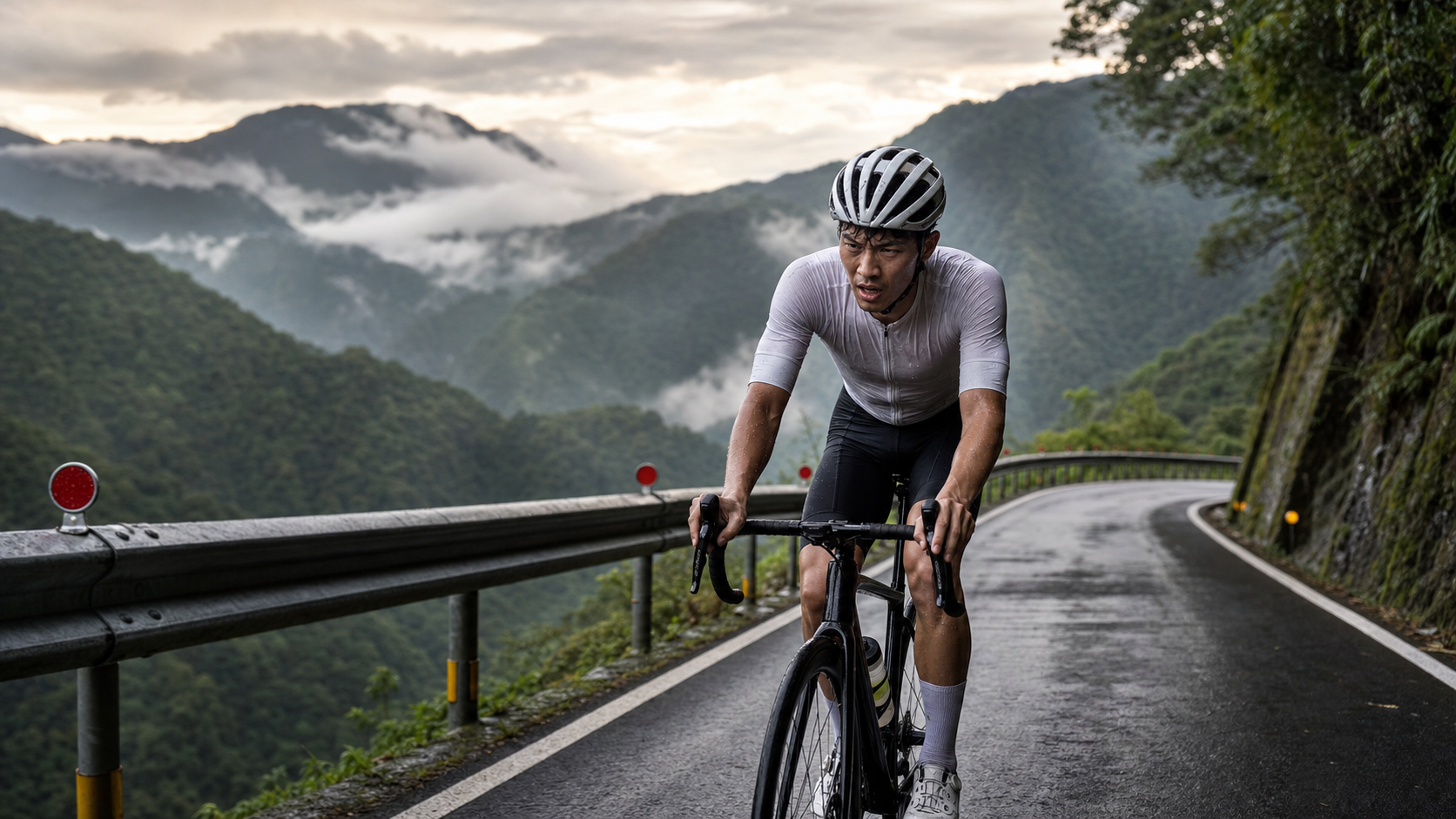
Coach’s Opening: On That Final Five Kilometers Before the Finish Line, It’s Not Your Legs That Call It Quits
In fifteen years of coaching athletes, the sentence I hear most often after a race is: “Coach, in that last stretch, my legs completely gave out—I couldn’t move them anymore.” But when I pull up their power and heart rate files, I often find something rather cruel—their average power over those final five kilometers had actually dropped by less than ten percent, their heart rate was still within range, and the muscles hadn’t truly “broken down.” What actually slammed on the brakes was their brain.
I once coached an amateur rider named A-Zhe. On his first attempt at Taiwan’s King of the Mountain (Wuling), he completely fell apart on the final steep climb from Kunyang to Wuling, walking his bike for nearly two kilometers. He came back and told me: “I felt like my heart was going to explode. If I’d kept pedaling, something bad was going to happen.” But his peak heart rate that day was actually 8 to 10 bpm lower than his maximum heart rate in training. He hadn’t hit a physiological limit—he’d hit a perceptual limit: an invisible wall set up by the brain to protect him.
This article is about the science behind that wall: how Rating of Perceived Exertion (RPE) is actually computed in the brain, what “pain” in endurance sports really is, and most crucially—can pain tolerance actually be trained? I’ll put the conclusion up front: yes, it can, and just like your lactate threshold or your VO₂max, it’s an ability that can be systematically developed through training.
Concepts and Scientific Foundations: What You Think Is Your Limit Is Actually Your Brain’s Estimate
RPE Isn’t About How Sore Your Muscles Are—It’s About “How Hard You Feel You’re Working”
Let’s clear up the most common misconception first. Many people assume that the Rating of Perceived Exertion (RPE) simply means “how sore or out of breath your muscles are.” That’s not quite right. In exercise science, RPE has a more precise definition: it is your subjective conscious awareness of “how much effort your body is currently expending to maintain this given action.” The key phrase is “sense of effort”—not pain, not breathlessness, and not soreness.
The classic scale is Borg’s 6-to-20 scale. Why the odd 6 to 20? Because when Borg designed it, he wanted the number multiplied by 10 to roughly correspond to your heart rate—an RPE of 15 would roughly match a heart rate of 150 bpm. Interestingly, one study conducted on young Taiwanese males actually measured the relationship between Borg RPE and heart rate and derived the regression equation “heart rate = 8.88 × RPE + 38.2 (bpm).” This shows that during dynamic exercise, the sense of effort and heart rate are indeed highly correlated, but correlated, not equal. The same study also found that once static exertion is introduced (such as sustained muscle tension when climbing a steep grade), the association between RPE and heart rate weakens noticeably. That’s the first clue: the sense of effort isn’t simply “read” directly from the heart or the muscles.
Where Does the Sense of Effort Come From? The Central “Efference Copy” Theory
In recent years, the explanation most widely accepted in exercise physiology circles goes like this: the sense of effort primarily comes from the intensity of the “commands” sent out by the brain’s motor cortex, not from the fatigue signals “reported back” by the muscles.
Let me put that in plain language. When you need to maintain a certain power output or pace, the motor area of the brain must send neural commands to recruit muscle fibers. As muscles begin to fatigue and more fibers need to be recruited to sustain the same output, the commands the brain sends must be “amplified.” A “copy” of this “I am commanding with great effort right now” signal—scientifically known as corollary discharge, or efference copy—is sent back to the sensory areas. The “this is really hard” feeling you’re aware of is likely your brain detecting how strong the commands it’s sending out are.
This explains something: why does the same pace feel progressively harder the more fatigued you are? Because the “central command” required to maintain the same output has increased, even if your watch shows pace, power, and heart rate all unchanged. Pain is the brain’s estimate of “how much more effort I still need to exert,” not a direct readout of muscle damage.
So Are the Signals Reported by Muscles Completely Useless? Don’t Jump to a False Dichotomy
Here I want to complete the picture for athletes, so you don’t go overboard and think “it’s all psychological.” Peripheral signals from the muscles, metabolism, and body temperature certainly matter—it’s just that the pathway by which they exert influence is more indirect than you might imagine.
In the body, there is a group of sensory nerves called group III/IV afferents that report the metabolic state within the muscles (such as accumulation of hydrogen ions, lactate, and inflammatory substances) back to the brain. These signals don’t directly translate into a “my legs are done” command; instead, they become “one piece of input data” the brain uses when making decisions. The brain takes this data, combines it with its predictions about “how much distance remains, how hot it is, how badly I want to finish,” and only then computes a current “sense of effort” and decides whether to slow down.
So the correct picture is this: peripheral fatigue signals are the raw ingredients, the sense of effort is the finished dish the brain cooks up, and whether to slow down is the decision the brain makes after serving that dish. Through training, you can teach your brain to “cook” a lower sense of effort from the same ingredients—that’s why, at the same lactate concentration and the same heart rate, a well-trained athlete feels less pain. Pain tolerance training works precisely on this “cooking” and “decision-making” link.
RPE Can Also Be Silently Inflated by Low Blood Sugar and Dehydration
There are two more variables that Taiwanese athletes are especially prone to tripping over, which can push the sense of effort upward without you even noticing: glycogen depletion and dehydration.
When a race drags on and your body’s glycogen (carbohydrate stores) runs low, the brain—that supremely sugar-hungry organ—detects that fuel is running short and turns the sense of effort up, forcing you to slow down to conserve energy. Physiologically, this makes perfect sense, but it’s deadly if you’re trying to set a personal best. This is also why, in events lasting longer than 90 minutes, taking in carbohydrates (roughly 30 to 90 grams per hour, depending on intensity and gastrointestinal tolerance—I give a range rather than false precision) can effectively “suppress” your subjective sense of effort in the later stages—not because your muscles suddenly have more power, but because the brain stops sounding the alarm.
Dehydration works the same way. When cycling or running in Taiwan’s summer, you sweat fast and lose electrolytes quickly. A drop in plasma volume causes your heart rate to drift upward at the same output and your body temperature to rise, which through the anticipatory regulation mentioned earlier pushes your power output down. In Taiwan, when training for endurance, hydration and carbohydrate intake aren’t just “a matter of sports nutrition”—they’re directly “a matter of pain tolerance.”
Two Competing Models—Both Pointing to the Brain
Regarding “what determines whether you can keep going,” sports science offers two well-known models worth knowing as an athlete.
The first is the Central Governor Model, proposed by South African sports scientist Tim Noakes. It argues that a “governor” in the brain preemptively downregulates your exercise intensity before you actually push your body into danger, protecting vital organs (especially the heart) from being overdriven. This model places particular emphasis on “anticipation”: your brain adjusts your effort in advance based on weather, remaining distance, and course difficulty. Worth noting: the term “central governor” has fallen out of favor in recent years, because no single brain region is solely responsible for this. The academic community now more commonly refers to “anticipatory regulation of fatigue.”
The second is the Psychobiological Model, proposed by Samuele Marcora. His core claim is more direct: how long you can last and how hard you can push is determined by the brain, not the body; and the brain’s decision rests on two things—how high your “perceived exertion” is, and how strong your “potential motivation” is. When perceived exertion rises above the motivational ceiling you’re willing (or able) to tolerate, you slow down or stop. Note that the limit here isn’t that the muscle “can’t” move—it’s that the brain “won’t” pay that effort anymore.
Marcora’s team ran a classic, and rather striking, experiment: subjects first performed 90 minutes of high-cognitive-load computer tasks to induce “mental fatigue,” then did an exhaustion test—their time to exhaustion dropped by roughly 15% to 20%, while physiological markers (heart rate, lactate, oxygen uptake) were nearly identical to when they hadn’t done the computer tasks. The body wasn’t more tired, but the brain found the effort more costly, so it called it quits early. That finding cuts straight to today’s topic: if perceived exertion can be influenced by “mental state,” then it can certainly also be trained.
First, Learn to “Read” RPE: Turning Subjective Sensation into a Usable Tool
Before discussing how to train, you must genuinely know how to “use” RPE—otherwise, the workouts below are just a string of numbers. I require every new athlete to practice “anchoring” effort perception for the first four weeks—building a stable link between your body’s actual sensations and the scale’s numbers.
The table below is the Borg 6-20 reference card I give athletes to carry, with the extremely practical “can you talk right now?” criterion added:
| Borg RPE | Subjective Description | Approximate Heart Rate Zone | Talk Test | Typical Use |
|---|---|---|---|---|
| 6-8 | Almost no sensation | Rest–very low | Can chat freely | Warm-up, cool-down |
| 9-11 | Very easy | Low aerobic | Can speak in full sentences | Recovery ride, super-slow running |
| 12-13 | Somewhat hard | Aerobic endurance | Breathing picks up mid-sentence | Long-distance base |
| 14-15 | Hard, starting to feel uncomfortable | Sweet spot–threshold | Can only manage short phrases | Threshold workouts, race pace |
| 16-17 | Very hard | Above threshold | Only single words | VO2 intervals, climbing |
| 18-19 | Extremely hard, nearly at the limit | Near maximum | Barely able to speak | Sprints, race finale |
| 20 | Maximal, cannot sustain any longer | Maximum heart rate | Unable to speak at all | Final seconds of an exhaustion test |
The training method is simple: during each workout, the coach (or yourself) randomly calls out “what’s your number right now?” You must immediately give a figure, then check it against heart rate and power data afterward to see how accurate your subjective rating was. After three or four weeks, your RPE becomes a built-in power meter with small error that you carry anywhere—and on race day without a power meter, or when your power meter suddenly fails, it can save you.
Pain Tolerance Can Be Trained: Practical Methods and Workouts
Alright, groundwork laid—now for the most valuable part: how to train. I break “pain tolerance” into three trainable dimensions, each with corresponding concrete methods.
Dimension One: Lower Perceived Exertion at the Same Intensity (Making the Same Pace Hurt Less)
This is the most fundamental, least glamorous, but highest-return piece. Improving aerobic fitness itself is lowering perceived exertion. When your lactate threshold, running economy, and pedaling efficiency improve, maintaining the same pace recruits fewer muscle fibers and requires less central command—so naturally it feels “less hard.” That’s why I always tell athletes: the first step in training pain tolerance is honestly building your aerobic base.
Here’s a “threshold accumulation” block example I often give advanced athletes (cycling-based; runners can convert accordingly):
| Week | Main Workout | Intensity (%FTP) | Accumulated Time | Target RPE (6-20) |
|---|---|---|---|---|
| Week 1 | Sweet spot 3×12 min | 88-93% | 36 min | 14-15 |
| Week 2 | Sweet spot 3×15 min | 88-93% | 45 min | 15 |
| Week 3 | Threshold 4×10 min | 95-100% | 40 min | 16 |
| Week 4 | Deload week: sweet spot 2×12 min | 85-90% | 24 min | 13-14 |
The point isn’t the numbers themselves, but that with the same workout, as weeks progress, your RPE at the same power should decline week by week. If in week 3 the threshold session feels as painful as week 1, adaptation hasn’t happened yet—don’t rush to add volume.
Dimension Two: Raise the Ceiling of Perceived Exertion (Making Yourself Willing to Endure More Pain)
This is the real “pain tolerance training.” The core logic: repeatedly and controllably exposing yourself to high perceived exertion states, letting the brain recalibrate its belief that “this level is still safe and sustainable.” The concrete tool is high-intensity intervals.
Below is a “pain tolerance” interval block I commonly give athletes preparing for Wuling, or the bike leg of a 113 half-ironman. Do it at most once or twice a week—never daily:
| Workout Name | Content | Intensity | Rest Between Sets | RPE Target | Training Intent |
|---|---|---|---|---|---|
| Short VO2 | 6×3 min | 110-115% FTP | 3 min | 17-18 | Familiarize with the suffocating feeling of the high-VO2 zone |
| Micro-burst intervals | 8×40 sec | 130%+ FTP | 20 sec | 18-19 | Train the “hurts but hold on” mindset |
| Ramp to failure | Add 15 W every 2 min until you can’t turn the pedals | Open-ended | — | Approaching 20 | Explore and update your true limits |
| Race-finale simulation | 20 min steady + final 3 min all-out | Threshold→all-out | — | 15→19 | Train “still able to push when fatigued” |
Here’s a key coaching note: the value of a “ramp to failure” workout is half physiological, half psychological. Every time you push to “I thought I couldn’t turn the pedals anymore, but I held on another 30 seconds,” your brain updates its estimate of your limits. This is precisely the practical application of the Central Governor Model and the Psychobiological Model—you’re not fighting your muscles; you’re negotiating with your brain and resetting its protective threshold.
Dimension 3: Training the Mind Itself (The Concept of Brain Endurance Training)
Since mental fatigue raises your perceived effort and makes you quit earlier, the reverse is also true—if you get your brain used to working under fatigue, you’ll be more resilient during the actual race. Marcora’s recent push for “Brain Endurance Training (BET)” is exactly this concept: adding cognitively demanding tasks before, after, or during physical training, so the brain learns to maintain focus and output even when it’s already exhausted.
For amateur athletes, my practical version is simple and low-tech, but effective:
- During the hardest set of your workout, force yourself to do “pace mental math”: for example, silently counting your cadence during intervals, or calculating “at this pace, how many more minutes to Wuling,” forcing the brain to compute under fatigue instead of zoning out to seek relief.
- Practice “breaking down the pain”: split the final 5 km into five 1 km segments, mentally checking off each one as you pass it. This is an old-school psychological trick, but it turns “one unbearable, massive pain” into “five bearable, small pains.”
- Switching between associative and dissociative attention: when the pain is overwhelming, deliberately shift your attention away from bodily sensations (associative) to looking at the scenery, counting utility poles, or listening to your breathing rhythm (dissociative)—this can effectively lower your subjective perceived effort. This isn’t avoidance; it’s a trainable skill.
Real-World Case: How to Budget “Pain” in a 113 Half-Ironman
Talking about dimensions alone is too abstract. Let me tie the whole logic together with a real scenario. This is how I helped another athlete, Xiao Ya, plan her “pain budget” for a 113 half-Ironman (1.9 km swim, 90 km bike, 21 km run).
The core concept was mentioned earlier: perceived effort accumulates, and mental battery is a finite resource. In a race lasting over three hours, you can’t stay at RPE 17 the entire time—that would push the brain’s protective mechanism to full activation midway through the run. So we planned the entire race as a “pain budget”:
| Segment | Distance | Target RPE | Key Strategy | Common Mistake |
|---|---|---|---|---|
| Swim | 1.9 km | 13-14 | Relax, conserve energy, don’t spike your heart rate for a better position | Going all out from the start, burning through your battery in the first leg |
| Bike – First Half | 0-45 km | 14 | Steady cruising, force yourself to feel “too easy” | Enjoying the tailwind too much, draining your legs |
| Bike – Second Half | 45-90 km | 14-15 | Start taking in carbs and fluids, maintain pace | Forgetting to fuel, glycogen bottoms out and RPE spikes |
| Run – First Half | 0-10 km | 15 | Accept the “heavy legs” feeling, use pace discipline to hold back | Trying to chase speed right off the bike and blowing up |
| Run – Second Half | 10-21 km | 16→19 | Pour in all remaining mental battery, break it down segment by segment | Didn’t save earlier, now there’s nothing left |
The first time Xiao Ya raced, she pushed to RPE 16 on the bike’s first half during a tailwind section, feeling great about herself. The result? She completely fell apart at 8 km into the run and ended up walking to the finish. The second time, we held firm to the discipline of “the bike’s first half must feel too easy,” saving the pain budget for the final half-marathon—she ran 14 minutes faster than her previous effort in that last segment. This wasn’t a difference in fitness; it was a difference in pain distribution.
This case also reflects the reality of racing in Taiwan: in races held during hot months, you need to be even more conservative in the early stages, because heat accumulation will impose an “extra tax” in the latter part, pushing the perceived effort of the same pace even higher. Your pain budget needs to be discounted for Taiwan’s summers.
Common Mistakes and Corrections
After coaching athletes for so many years, I’ve seen too many people train “pain tolerance” the wrong way. Here are the most common pitfalls, with direct corrections.
Mistake 1: Treating “being in pain every day” as effort
Symptoms: Believing that more pain equals more results—doing intervals daily, pushing yourself to RPE 18 every single day.
Problem: Pain tolerance training places enormous physiological and psychological stress on the body, and it requires recovery to produce adaptation. Training hard every day only accumulates fatigue, raises chronic perceived effort, and ends up making every workout sloppy—which teaches your brain “I’m actually this weak.”
Correction: One to two high-intensity pain workouts per week is enough; fill the rest with aerobic base and sweet spot work. Pain should be “rare and high-quality,” not “cheap and abundant.”
Mistake 2: Gritting through with willpower, but no strategy
Symptoms: Going all out from the start of a race, relying purely on the spirit of “I’m going to push through.”
Problem: Perceived effort accumulates. If you spend too much “mental battery” early on, the brain’s protective mechanism will kick in earlier and more forcefully later. This is why so many people start strong and collapse in the second half.
Correction: Pain has a budget—allocate it. Use power, pace, and heart rate to set objective limits, suppress the urge to “push harder” for the first two-thirds of the race, and save the mental battery for the final third.
Mistake 3: Ignoring the destructive power of sleep and mental fatigue
Symptoms: Staying up late, burning out at work, being too anxious to sleep before a race, then feeling “heavy legs” the next day.
Problem: As mentioned in the earlier experiment, mental fatigue genuinely raises perceived effort and shortens your time to exhaustion, even when your muscles are in good shape.
Correction: Treat sleep and mental recovery as part of your formal training. Mental management in the week before a race is just as important as your taper.
Mistake 4: Only training pain tolerance on an indoor trainer
Symptoms: Crushing intervals on the trainer, but falling apart at Wuling or on a scorching Kenting race course.
Problem: Perceived effort is highly influenced by the environment. Taiwan’s summers are humid and hot—rising body temperature will actively downshift your power output through anticipatory regulation. This is exactly what the central governor model describes: “heat storage rate will automatically slow you down at a fixed RPE.” The pain tolerance you build in an air-conditioned room doesn’t include the “heat” variable.
Correction: Schedule several outdoor training sessions close to race conditions (time of day, temperature, humidity) before the event, so your brain learns the “heat + pain” combination together.
Mistake 5: Confusing “pain” with “injury”
Symptoms: Gritting through everything, unable to distinguish which pain should be endured and which should stop you.
Problem: Pain tolerance training builds the ability to endure perceived effort and metabolic discomfort—it absolutely does not include enduring sharp joint pain, tendon stabbing, or any “localized, single-point, worsening with movement” pain. The former is trainable tolerance; the latter is your body warning you of injury. Confusing the two is the shortest path to getting hurt.
Correction: Establish a simple self-assessment—discomfort that is “systemic, symmetrical, rises and falls smoothly with intensity, and eases when you stop” is perceived effort, and it can be trained; pain that is “localized, one-sided, sharp, and persists even at rest” is a warning sign—stop and seek medical attention. Pain tolerance isn’t about being tough; it’s about being able to tell the difference.
Actionable Advice for Athletes of Different Levels
Pain tolerance isn’t exclusive to advanced athletes, but the entry point is completely different depending on your level.
First-Timer / First Half-Marathon Finisher (Goal: Finish Safely)
The last thing you need right now is “pain tolerance training.” What you need is to build your aerobic base first and lower your floor of perceived effort.
- Spend 80% of your training time at RPE 11-13 (an intensity where you can chat while riding).
- Do at most one “slightly breathless” workout per week, just to get a taste of what RPE 15 feels like.
- Learn to pace using RPE, and don’t blow up at the start. For your first race, pace discipline matters far more than pain tolerance.
Advanced Age-Grouper (Goal: Set a PB, Stand on the Age-Group Podium)
You already have a foundation, so you can start systematically training pain tolerance.
- Following the threshold accumulation and high-intensity interval workouts mentioned earlier, schedule one to two high-quality pain workouts per week.
- Do one “incremental ramp to exhaustion” test per training cycle, recording the power or pace you hold until failure, and watch whether it shifts upward week by week—this is objective evidence of your pain tolerance improving.
- Start incorporating mental training (pace mental math, pain breakdown) into the final sets of your workouts.
Advanced / Challenge Group (Goal: Wuling, Ironman, Kona Qualification)
For you, the marginal returns on physical fitness are already small. Pain tolerance and mental toughness are often the deciding factors for that final 3%.
- Do specific simulations targeting the “pain points” of your goal event: for Wuling, practice sustained high output at the end of long climbs; for Ironman, practice the scenario of “your legs are already shot at the start of the run, but you still have to hold your pace.”
- Seriously implement environment-specific training, incorporating Taiwan’s heat and humidity.
- Treat sleep, mental fatigue, and pre-race anxiety as quantifiable, manageable training variables, not as something mystical.
- Before key races, do “mental rehearsal”: close your eyes and run through the most painful section in your mind, pre-deciding what you’ll say to yourself and where you’ll focus your attention at that moment. The brain’s tolerance for “anticipated pain” is significantly higher than for “surprise pain.” This is the most direct practical application of the “anticipatory” concept in the central governor model.
A common reminder for athletes of all levels: Progress in pain tolerance is often silent. It doesn’t show up as a nice round number like a 20-watt FTP increase. It shows up as “I didn’t blow up in the same final stretch of the race this time” or “I held the pace I previously couldn’t even imagine.” So please make a point of recording those moments when you “subjectively held on”—that’s the real report card for this kind of training.
FAQ
Q: RPE is so subjective. Is it really reliable? How do I know my 15 is the same as someone else’s 15?
The absolute value of RPE does vary from person to person, but its value lies in its consistency and trend “for you.” You don’t need to compare yourself to others; what you need to look at is: with the same workout plan, is your RPE decreasing as you train? On race day at the same pace, does it feel harder or easier than usual? If you treat it as an “internal gauge for talking to your own body,” it’s very reliable.
Q: So can I completely ignore heart rate and power and just train by feel?
Going to extremes isn’t recommended. The best approach is cross-validation of subjective and objective measures: power/heart rate give you an objective ceiling (to avoid overtraining and injury), while RPE gives you real-time feedback on your daily condition (if the same power feels especially hard today, it might mean you haven’t recovered). When the two conflict, it’s usually a reminder that “you should back off today.”
Q: Will pain tolerance disappear once you’ve built it up?
Yes, it will fade just like fitness. It’s an ability that needs continuous maintenance. So even during the maintenance phase, I keep one workout per week where athletes “touch that high-effort feeling,” so the brain doesn’t forget “how long I can actually hold on.”
Q: During a race, it really hurts and I want to quit. Are there any tricks I can use in the moment?
There are a few practical techniques: first, the “pain chunking” mentioned earlier—break the remaining distance into smaller segments and tackle them one by one; second, “positive self-talk”—mentally change “I’m about to fail” into “I can still hold on, just hold on for this one more segment”—it sounds cheesy, but it genuinely lowers the subjective feeling of effort; third, focus on what you can control in the “here and now,” like your current cadence or this one step’s rhythm, rather than the distant finish line.
Q: Does smiling really work? I heard relaxing your face can make you run faster?
This has actually been studied—relaxing your facial muscles and body, even deliberately smiling, may slightly lower perceived effort through emotional and neural feedback. I won’t exaggerate its effect, but it costs nothing and has no side effects, so it’s worth adding to your toolbox. In practice, I remind athletes: when it hurts, check if your “shoulders are hunched, jaw is clenched, or hands are gripping too tight.” Actively relaxing that unnecessary tension usually drops the feeling of effort by a notch.
Q: I’m not racing; I just want to exercise for health. Do I need to train pain tolerance?
You probably don’t need to deliberately train to the RPE 18-19 level. For a health-oriented person, the focus should be on “consistency” and “sufficient volume.” Spending most of your time at RPE 11-13, with the occasional touch of 15, is great. Pain tolerance training is an advanced tool for “performance,” not a necessity for healthy exercise. Don’t get it backwards and turn exercise into something you dread.
Q: That Marcora guy says ‘mental fatigue will hurt my performance.’ Doesn’t that put office workers at a huge disadvantage?
That’s a good question, and it’s the real situation for many Taiwanese office-worker athletes—overtime, meetings, commuting, and your brain is already drained by the time you train after work. What you need to do isn’t to push through hard. First, schedule your most important, high-concentration workouts during times when your mind is fresher (like weekend mornings). Second, conversely, treat “training under fatigue” as a form of BET, getting your brain used to producing output even when tired—but these workouts should have lower intensity and lower expectations. Third, in the days before a race, seriously protect your sleep and mental space; that’s just as much “recharging” as tapering.
Conclusion: Your Limits Are Further Than You Think
Let’s go back to A-Zhe from the beginning. In the second year, we didn’t drastically change his fitness plan—his FTP only improved by about 5%. What we actually did was systematically train pain tolerance: one high-quality interval session per week, one incremental exhaustion test per training block, incorporating Taiwan’s summer heat and humidity into training, and repeatedly practicing breaking pain into smaller pieces and negotiating with the brain.
At Wuling in the second year, not only did he not get off and walk, but he even passed three people on the final section from Kunyang to Wuling. The first thing he said to me when he came back was: “Coach, that section hurt just as badly as before, I was dying. But this time I knew it was just my brain lying to me.”
That’s the message this article most wants to leave you with: A large part of the pain in endurance sports is a “conservative estimate” your brain makes to protect you. And estimates can be trained, updated, and recalibrated. You’re not trying to destroy that protective wall—it means well—you’re trying, through repeated controlled exposure, to gently and firmly tell your brain: I’m okay, I can do more, move the wall back a little.
Next time you’re in pain and want to quit, remember to ask yourself: Is it really my legs calling for a stop right now? Or is it my brain?
This article is for educational purposes and cannot replace individual assessment by a physician, physical therapist, or nutritionist.
References
- The central governor model of exercise regulation applied to the marathon (Noakes) — PubMed: https://pubmed.ncbi.nlm.nih.gov/17465612/
- The Psychobiological Model of Endurance Performance: An Effort-Based Decision-Making Theory to Explain Self-Paced Endurance Performance (Marcora) — Springer: https://link.springer.com/article/10.1007/s40279-014-0198-2
- Relationships of Borg’s RPE 6–20 Scale and Heart Rate in Dynamic and Static Exercises among a Sample of Young Taiwanese Men — PubMed: https://pubmed.ncbi.nlm.nih.gov/24665812/
Related Reading
- Pain in Sports: Can Pain Tolerance Be Trained? A Complete Breakdown from Science to Practice
- The Science of Fatigue: Central vs. Peripheral Fatigue—A Coach’s Guide to Understanding the “Wall”
- Pain Management in Endurance Sports: A Psychological Perspective
- Mental Toughness for Cyclists: How to Keep Moving Forward in Pain
西進武嶺 免費訓練分析服務 Intervals | 練不夠還是練過頭?你哪一種類型選手?AI模型告訴你! | 備戰神器 | 公路車 訓練 | CT Yeh
4 年前
Never Stop 西進武嶺 前後雙機 完整全程錄影 訓練台 實境
8 年前
大禹嶺 到 武嶺牌樓 全程前後實況錄影 | 北進武嶺 | 東進武嶺 | KOM | 訓練台 | 坡度分析 | Taiwan KOM Last 10 km HARD | 公路車
6 年前
FTL 與 SYB 車隊專訪 西進武嶺 實用攻略分享! 2小時 如何練?!你不知道的眉角!新手準備武嶺必看 EP1 | 實力派女車友 | 精華版 | 公路車 | CTYeh
4 年前
西進武嶺 自製新版AI配速表產生器 x 賽前攻略 抱佛腳! 沒有功率計也可以產生配速表嗎?有什麼其他眉角賽前要注意的呢? | 西進武嶺 / 東進武嶺 KOM 攻略 | 公路車 | CT Yeh
4 年前
水金九不厭五分 10度寒流冷到不願停!feat. 卡卡 / 公路車 / CT Yeh
6 個月前
RAMP FTP Test 直播 究竟能撐到幾瓦 訓練台 Gravat Zwift
6 年前
單車AI教練!全新 ChatGPT4o 幫你分析訓練成果!排武嶺課表,分析騎車姿勢! 太神了! / 公路車 / CT Yeh / feat. 緯緯
2 年前