Starting with a Student’s Confusion
A few years ago, I coached an engineer in his early forties in the tech industry—let’s call him Kai. The first time he came to me, he was holding up his watch showing a number, looking puzzled, and asked: “Coach, my VO2max is only 42, and the app says I’m ‘worse than people my age.’ Does that mean I’m not cut out for cycling?”
That day I spent nearly an hour, and the first thing I did was have him take off his watch. Because I knew that this number—both glorified and misunderstood—hides a lot of physiology that hasn’t been properly explained. VO2max (maximal oxygen uptake) is indeed one of the most core metrics in endurance sports, but it’s neither a verdict on your fate nor a score you can keep inflating endlessly. It’s something with a clear physiological origin, with room for training adaptation, and also with a ceiling.
In this article, I want to walk you through the whole picture: what VO2max actually is, which physiological components determine it, how the number from a lab differs from the one on your watch, whether it can be trained and how much, and finally—whether you’re a complete beginner or a seasoned athlete stuck at a plateau—how to actually approach it in practice. I’ll try to explain it the way I talk to my athletes, and lay out the misconceptions I’ve repeatedly seen over the past fifteen years.
Conceptual Foundation: What VO2max Is Actually Measuring
The Most Plain-Spoken Definition
VO2max refers to the maximum amount of oxygen your body can take in, transport, and utilize per minute during maximal exercise. There are usually two ways to express the unit:
- Absolute value: liters per minute (L/min), representing the total oxygen uptake capacity of the entire body.
- Relative value: milliliters per kilogram per minute (ml/kg/min), which divides body weight into the equation—this is especially critical for gravity-fighting climbing sports (such as riding up Wuling, or running mountain trails).
Why divide by body weight? Because a 90 kg strong man and a 60 kg lean cyclist, even if their absolute oxygen uptake is identical at 4 L/min, will perform vastly differently on climbs. This is also why professional climbing cyclists tend to be both light and capable of consuming a lot of oxygen.
The Fick Equation: Breaking VO2max Down into Understandable Components
To truly understand VO2max, you have to know the most important equation in exercise physiology—the Fick equation. It breaks maximal oxygen uptake into two major parts multiplied together:
VO2max = Maximal cardiac output × Maximal arteriovenous oxygen difference
Breaking it down further:
Cardiac output = Heart rate × Stroke volume (the amount of blood pumped with each heartbeat)
To use the most relatable analogy: every oxygen molecule “burned” by your muscles must first be pumped out by the heart—that pump—carried by the blood, and finally pulled out and used at the muscle tissue. So VO2max is really asking three things—whether the pump is strong enough, whether the transport line is sufficient, and whether the terminal unloading capacity is adequate. This concept of the “oxygen supply chain” is the first key point I want you to remember from this article (source listed at the end).
The table below lays out the three key components, what they mean in plain terms, and whether training can change them:
| Physiological Component | Plain Meaning | Degree of Trainability |
|---|---|---|
| Maximal heart rate (HRmax) | The maximum number of times your heart can beat per minute | Barely changes; largely determined by age and genetics |
| Stroke volume (SV) | How much blood is pumped with each heartbeat | Most trainable; endurance training enlarges the ventricles and strengthens contraction |
| Blood oxygen-carrying capacity | How much oxygen the blood can carry (hemoglobin, blood volume) | Partially changeable; plasma volume and red blood cells adapt |
| Arteriovenous oxygen difference (a-vO2 diff) | How much oxygen the muscles extract from the blood | Partially changeable; mitochondria and capillary density increase |
This table already contains the answer to whether VO2max can be trained. You can’t change your maximal heart rate; blood oxygen-carrying capacity and muscle extraction ability have upper limits; the truly largest adjustable component left is stroke volume. Research generally indicates that both the blood’s oxygen-carrying capacity and tissue extraction have physiological ceilings, so the main way endurance training raises VO2max is by training the “pump” to be bigger and stronger.
Central vs. Peripheral: Two Paths of Adaptation
Exercise physiology divides VO2max adaptations into two parts:
- Central adaptations: the heart itself. The ventricular chamber enlarges, the myocardium contracts more forcefully, stroke volume rises, and total blood volume and plasma volume increase. This is the upgrade on the “supply side.”
- Peripheral adaptations: the muscle side. Capillary density increases, mitochondrial number and size rise, and oxygen extraction capacity improves. This is the upgrade on the “usage side.”
These two aren’t an either/or choice. Generally speaking, high-intensity intervals tend to stimulate both central and peripheral adaptations simultaneously, while long-duration steady-state aerobic work is especially helpful for peripheral oxygen extraction. This is also why a well-designed training plan usually doesn’t do just one type of training, but both—I’ll expand on this when we get to practical application later.
Is It “Oxygen Supply” or “Oxygen Use” That Limits You?
There’s a decades-old debate in exercise physiology: is VO2max constrained by the “heart’s ability to deliver oxygen” or by the “muscle’s ability to use oxygen”? The mainstream view is: for the vast majority of people, the true ceiling lies at the central oxygen supply end—that is, how much oxygenated blood the heart can pump out. You can picture it this way—if the muscles are a group of workers waiting to unload cargo, and the heart is the delivery truck, then during maximal exercise, it’s usually the number of trucks that’s insufficient, not the workers. This is why training the “pump” to be bigger is often where the most leverage lies for improving VO2max.
But this doesn’t mean the peripheral side isn’t important. The mitochondria and capillaries at the muscle level determine your “efficiency in using that oxygen” and “how long you can sustain a given intensity.” In other words, the central side determines how high your ceiling is, and the peripheral side largely determines whether you can comfortably stay near that ceiling without blowing up. A real example from coaching: I once had an athlete transitioning from swimming to cycling. His cardiorespiratory foundation (central) was excellent, but his leg muscles weren’t yet adapted to pedaling—on climbs, his legs gave out first. His bottleneck was clearly peripheral, so I added a large volume of low-to-moderate intensity pedaling mileage, and two months later his climbing was much smoother.
The Respiratory System Is Usually Not the Bottleneck
Many people assume that “gasping for air” means the lungs aren’t strong enough, so they try to train lung capacity to improve VO2max. This is a common misconception. For healthy people without respiratory disease, the lungs’ ability to deliver oxygen into the blood is usually more than sufficient—the bottleneck is almost always in cardiac delivery and muscle utilization, not the lungs. When you’re gasping at the end of an interval, it’s mainly your body processing metabolic stress and carbon dioxide, not that your lungs can’t get enough air. So “deep breathing to train the lungs” has limited benefit for improving VO2max; spending that time on intervals and aerobic mileage is far more practical. Of course, if you have asthma, COPD, or other respiratory conditions, the situation is different—that falls under the scope of medical evaluation.
The Meaning of VO2max: What It Can Tell You, and What It Can’t
Here I have to pour a little cold water, because too many people treat VO2max as the only report card.
What VO2max can tell you: roughly where the “displacement” ceiling of your aerobic engine is, where you stand in aerobic talent among your peers, and the overall progress of your oxygen delivery system after long-term training. It’s positively correlated with long-distance endurance performance, and it’s also associated with overall health and cardiovascular risk—generally, people with better aerobic capacity tend to have better long-term health markers.
What VO2max cannot tell you:
- It doesn’t equal actual race performance. Two people with the same VO2max can finish a race more than ten minutes apart, because there are a host of other factors like “lactate threshold/functional threshold power,” “exercise economy,” “pacing and fueling strategy,” and “psychology.”
- It’s not a linear score where higher is always healthier. For the general athletic population, the health benefits are most pronounced when going from very low to the moderate range; but pushing from very high to even higher yields much smaller marginal health benefits.
- The number on your watch is not the lab number. I’ll address this specifically in the next section.
I often tell my athletes: VO2max is the engine’s displacement, but racing is about how well you drive the whole car overall. Big displacement is an asset, not a guarantee. Once Kai understood this, his training mindset relaxed entirely, and he actually improved faster.
Practical Methods: How to Measure VO2max
Laboratory Gold Standard: Graded Exercise Test
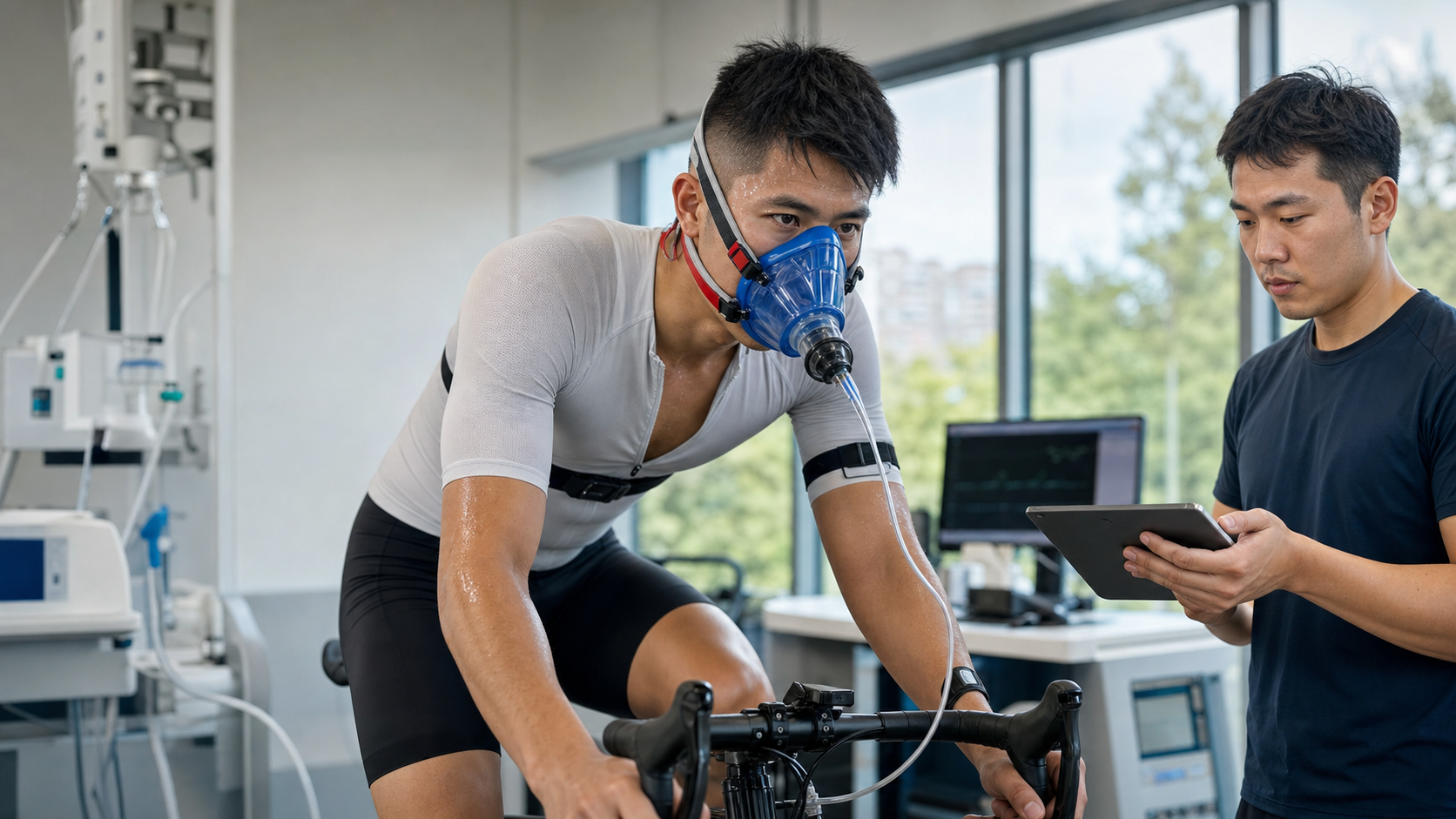
The VO2max measurement truly recognized by academia is the graded exercise test performed in a laboratory. You wear a mask connected to a gas analyzer, and on a treadmill or cycle ergometer, the intensity increases at set intervals until you reach exhaustion. The equipment directly measures the air you inhale and exhale to calculate your actual oxygen uptake.
Determining whether you’ve “truly reached VO2max” typically relies on several indicators: oxygen uptake plateaus despite increasing intensity, respiratory exchange ratio exceeds a certain threshold, heart rate approaches the age-predicted maximum, and perceived exertion reaches its limit. This is currently recognized as the most accurate method, but its drawbacks are practical: it requires equipment, trained personnel, costs money, and the process is quite grueling. In Taiwan, this type of testing is mainly found in university sports science laboratories, sports medicine centers at some hospitals, and high-performance sports institutions.
Field Tests: Estimating Without a Laboratory
Most people don’t need—and won’t—go into a lab. Sports science has developed many field tests that estimate VO2max from performance:
- Cooper 12-minute run: Run as far as possible for 12 minutes on a track, measure the distance, and plug it into a formula. Many school tracks and riverside paths in Taiwan are suitable.
- Multi-stage shuttle run (Beep test): A back-and-forth run that progressively speeds up with beeps, commonly used in team sport assessments.
- Cycling power tests: Use a power meter for incremental or timed maximal efforts, then estimate based on models.
This table helps you quickly compare different testing methods:
| Test Method | Accuracy | Cost | Discomfort Level | Who It’s For |
|---|---|---|---|---|
| Laboratory gas analysis | Highest (gold standard) | High | High | Competitive athletes and research subjects needing precise data |
| Cooper 12-minute run | Moderate | Nearly zero | High | General runners with track access who want to self-test |
| Beep test shuttle run | Moderate | Low | High | Team sports, student populations |
| Power meter incremental test | Moderately high | Moderate (requires power meter) | High | Cyclists |
| Wearable device estimate | Lower, trend-only | Low | Low | General public wanting long-term trend tracking |
How Your Watch Calculates VO2max
This is the most misunderstood part. Your sports watch isn’t measuring your gases; it uses a model relating “pace/power” to “heart rate” to work backward: if you can run faster or produce more power at the same heart rate, the model estimates a higher VO2max.
This means several things you need to know:
- It measures trends, not absolute truth. It can differ from lab numbers by a few units.
- It’s easily disrupted. A poorly fitted heart rate strap, optical heart rate drift, hot weather raising heart rate, poor sleep, a cold, or GPS drift on climbs can all make the number fluctuate.
- Taiwan’s summers are especially prone to underestimation. Humid, muggy weather pushes heart rate higher at the same pace, making the watch think you’ve “gotten weaker.” That’s not regression—it’s the environment.
So my advice to athletes is always: Only look at the month-over-month long-term trend from your watch’s VO2max; completely ignore daily ups and downs. A-Kai eventually learned this—seeing a drop of 2 units on a given day no longer caused anxiety, because it was usually just a bad night’s sleep plus Taipei’s humidity.
Trainability: Can You Improve It? How Much?
This is the core question of this entire article. The answer has two layers: Yes, but the magnitude depends on your starting point and genetics.
Lower Starting Point, Greater Room for Improvement
This is the most important principle. Research literature consistently shows a clear gradient:
- Completely sedentary people with no exercise habits can improve VO2max by approximately 10% to 20% within a few months of regular training; those with the worst starting points often land at the upper end of that range.
- Recreational exercisers with some training base see improvements converge to a moderate level.
- Elite competitive athletes, already close to their genetic ceiling, can often only squeeze out a few percentage points (about 2% to 5%) even with intense training.
I’ve organized common scenarios into the table below so you can find where you fit (values are common ranges from the literature; individual variation is large):
| Training Starting Point | Expected Improvement with Regular Training | Approximate Timeline | Coach’s Note |
|---|---|---|---|
| Completely sedentary, zero base | About 10–20% | Noticeable change in 8–24 weeks | Almost “any training works”; the key is avoiding injury and not quitting |
| Already has recreational exercise habits | About 5–15% | Several months to a year | Needs more structured intensity to feel the difference |
| Well-trained amateur | About 3–8% | Slow accumulation over a year or more | Slower progress is normal; don’t doubt yourself |
| Near-elite competitive | About 2–5% or even less | Requires long-term systematic approach | Already near genetic limits; focus shifts to threshold and economy |
Here’s an important concept: When VO2max becomes hard to push higher, race performance can still improve. Because you can continue optimizing lactate threshold, exercise economy, pacing, and fueling. In the world of elite athletes, it’s often not about who has the bigger engine, but who uses the same-sized engine more efficiently and intelligently.
The Role of Genetics: Don’t Ignore It, But Don’t Be Pessimistic
Exercise physiology has long known that both the VO2max ceiling and the “degree of response to training” have a significant genetic component. Some people are naturally gifted; some respond particularly quickly to the same training plan (commonly called “high responders”), while others respond more slowly.
But I want to specifically address people like A-Kai: Genetics determine the ceiling and the slope, not whether you can improve. Almost all healthy people will see their VO2max rise with regular training, and the health benefits will genuinely materialize. Focusing on “comparing yourself to yesterday’s you” is far healthier and more practical than comparing to the age percentile in an app.
It Also Declines Quickly: Reversibility
The harsher side is—VO2max also regresses. After stopping training, what’s lost first is often “central” adaptations like plasma volume and stroke volume, which can drop noticeably within weeks. This is why I always emphasize “maintenance matters more than spiking,” especially for busy Taiwanese office workers. Rather than going all-out for three weeks and then abandoning it for a month, it’s better to consistently hit a baseline every week.
The good news is, if you’ve built it up before, retraining is often faster than the first time—the body has “muscle memory.” So even if you’ve taken a break due to work, family, or injury, don’t be discouraged; you’re not starting from zero.
A-Kai’s Two-Year Progress Trajectory (Case Study Breakdown)
To give you a clearer picture, let me lay out A-Kai’s two-year progress. His starting point was completely sedentary, with a watch-estimated VO2max of about 42, weighing 78 kilograms, and getting winded climbing a pedestrian overpass. This is a very typical picture of a middle-aged Taiwanese office worker.
The table below shows his approximate phased approach and feelings (numbers are watch estimate trends, for understanding the pace of progress only, not lab data):
| Phase | Main Approach | Watch VO2max Trend | Subjective Changes |
|---|---|---|---|
| Months 0–3 | Pure habit-building, 3x/week easy cycling or brisk walking | 42 → 44 | No longer winded after two flights of stairs |
| Months 4–8 | Added 1x/week short intervals, maintained lots of easy mileage | 44 → 46 | Can ride continuously for 1 hour on the riverside path without suffering |
| Months 9–15 | 1–2x/week intervals plus weekend long rides | 46 → 48 | Started keeping up with group rides, climbing small hills with ease |
| Months 16–24 | Periodized planning, incorporating deload weeks and goal events | 48 → approaching 50 | Completed his first long-distance challenge |
This table conveys three messages. First, the biggest gains come early—the dividend of a low starting point is real. Second, progress slows down later; going from 46 to 48 took much longer than 42 to 44. This is normal diminishing returns, not something he did wrong. Third, what truly kept him going wasn’t the numbers, but the change in quality of life. When exercise became the source of breathing easier, sleeping better, and better health checkups, the numbers were just a byproduct.
This is also what I want to remind every reader: Treat VO2max as one signpost for long-term health and performance, not a test you have to ace every day.
Practical Application: How to Train Effectively
After all that theory, here’s something you can put into practice right away. To improve VO2max, training revolves around two main pillars: high-intensity intervals and a large aerobic base.
Pillar One: High-Intensity Intervals (Training Central Oxygen Delivery)
This is the most efficient tool for raising VO2max. The principle is to spend enough “effective time” at an intensity close to your VO2max, forcing the heart and oxygen delivery system to adapt. The classic approach is intervals near maximal effort, with incomplete recovery.
Below is a sample workout set I often give to advanced athletes (transferable to cycling or running; gauge intensity with perceived exertion and heart rate—don’t copy it verbatim from the start):
| Workout Type | Protocol | Intensity Feel | Best For |
|---|---|---|---|
| Long Intervals 4×4 | 4 min hard + 3 min easy, repeat 4 times | Very hard to speak, near limit | Those with a base aiming to push VO2max |
| Short Intervals 30/15 | 30 sec hard + 15 sec easy, 10–12 reps per set | High but sustainable pace | Those wanting to accumulate effective time without blowing up |
| Pyramid 1-2-3-2-1 | Minutes increase then decrease, equal recovery between | Undulating, tough at the end | Those wanting variety and fun |
Key reminder: Two to three high-intensity sessions per week is plenty, with recovery days in between. The benefit of this workout comes from “quality,” not “quantity.” If you’re so tired that quality drops, you’re wasting your effort.
Pillar Two: Aerobic Base (Training Peripheral Extraction and Tolerance)
Many people eager for numbers overlook this part, and that’s a big mistake. Easy aerobic training, where you can chat while riding, increases capillaries and mitochondria, improves fat utilization, and thickens your aerobic foundation, giving you the capacity to handle more high-intensity work.
The industry-standard “mostly easy, a little hard” distribution principle works very well for the general population: Most of your training time should be easy, saving the hard efforts for those few truly intense sessions. In Taiwan, riverside bike paths, the East Ring drainage canal, Dajia Riverside Park, Taichung’s Tanzih-Yashen Greenway, and the Kaohsiung Love River route are all great places to accumulate easy aerobic miles.
Sample Weekly Framework (General Advanced Athlete)
| Day | Content | Purpose |
|---|---|---|
| Mon | Rest or stretching | Recovery |
| Tue | High-intensity intervals (e.g., 4×4) | Stimulate VO2max |
| Wed | Easy aerobic 45–60 min | Build base, promote recovery |
| Thu | Easy to moderate | Accumulate mileage |
| Fri | Rest | Recovery |
| Sat | Long aerobic (weekend long ride/run) | Endurance and peripheral adaptation |
| Sun | Moderate or short intervals (depending on condition) | Additional stimulus |
This is just a skeleton; adjust it based on your fitness, schedule, and injury history. Better to have a conservative plan you can sustain long-term than a flashy one you’ll abandon after three weeks.
Two Bonus Factors Not to Ignore: Strength and Body Weight
Beyond cardio workouts, two things substantially affect your performance, especially relative VO2max (ml/kg/min).
First is strength training. Many endurance enthusiasts shy away from lifting, fearing bulk and slowness—that’s an outdated view. Moderate strength training improves muscle work efficiency and fatigue resistance, letting you output more with the same oxygen supply and delaying exhaustion. It’s even more crucial for middle-aged and older athletes—it combats age-related muscle loss, maintains bone density, and reduces injury risk. One to two sessions a week focusing on multi-joint movements like squats, deadlifts, and lunges is a solid long-term investment.
Second is body weight and composition. Since body weight is the denominator in relative VO2max, losing excess fat—without sacrificing muscle or health—directly improves that number and makes climbing easier. But I want to be very clear: Don’t resort to extreme dieting just to chase a number. Chronic calorie deficit will leave you unable to train, disrupt hormones, lower immunity, potentially cause amenorrhea in women, and lead to bone loss—ultimately wrecking long-term performance and health. The sensible approach is steady, moderate dietary adjustments combined with training, letting body composition gradually improve. This is especially relevant for Taiwan’s frequent diners—instead of crash dieting, start with sustainable small changes like swapping sugary drinks for sugar-free ones and fried foods for braised or steamed options.
Environmental Challenges: Taiwan’s Heat and High-Altitude Thin Air
Two variables in Taiwan’s training environment deserve special attention.
Heat: Taiwan’s summers are hot and humid, causing your heart rate to run noticeably higher at the same pace and making you fatigue earlier. This happens because your body must divert blood to the skin for cooling while still supplying muscles. Your watch might show a “VO2max drop” during this time, but that’s often a heat-induced artifact, not a real decline. The response is gradual heat acclimation, moving hard sessions to cooler early morning or evening hours, and staying on top of hydration and electrolytes. After prolonged sweating, drinking only plain water without replacing salt can lead to hyponatremia—something to be especially careful about during long summer rides.
Altitude: Taiwan boasts exceptional high-mountain terrain, with Wuling being a classic pilgrimage site for cyclists. At altitude, the partial pressure of oxygen in the air drops, reducing your actual oxygen uptake capacity. The same effort feels more breathless with a higher heart rate—this is a normal physiological response. If you plan to tackle high-altitude routes, plan ahead, ascend gradually, watch for signs of altitude sickness (headache, nausea, unusual fatigue, insomnia), and descend promptly and seek medical help if symptoms become pronounced. High altitude is no place for ego; safety always trumps numbers.
Common Mistakes and Fixes
In fifteen years of coaching, I’ve seen these pitfalls far too many times:
Mistake One: Treating Daily Watch Numbers as Gospel
Fix: Look only at monthly trends. A few points dropping on any given day is usually sleep, weather, or heart rate measurement error. Taiwan’s summer heat especially tends to underestimate fitness.
Mistake Two: Doing High Intensity Every Day
Fix: VO2max improvements happen during recovery, not during the workout itself. Daily high intensity only accumulates fatigue, drives heart rate drift, degrades performance, and risks injury. Quality over quantity—recovery is part of the training plan.
Mistake Three: Only Doing Intervals, Skipping the Aerobic Base
Fix: Spend 80% of your time on easy aerobic work and 20% on hard efforts. Without a solid foundation, high intensity won’t last long.
Mistake Four: Ignoring Body Weight and Eating Out
Fix: Relative VO2max (ml/kg/min) has body weight as the denominator. Taiwanese restaurant food is generally high in oil, sodium, and sugar. If your goal is climbing performance, dietary management matters as much as training. But this doesn’t mean extreme dieting—overly restricting calories leaves you unable to train and lowers immunity, ultimately hindering progress.
Mistake Five: Pushing Through Warning Signs
Fix: This is the most important one. If you experience chest tightness, chest pain, unusual breathlessness, dizziness, palpitations, or cold sweats during exercise, stop immediately and seek medical attention. Don’t chalk it up to “just having a bad day” and push through. Taiwan’s National Health Insurance makes seeing a doctor easy; family medicine, cardiology, or sports medicine clinics can all help assess. Anyone with hypertension, diabetes, hyperlipidemia, heart disease history, or a family history of these should consult a physician before starting high-intensity training.
Actionable Advice for Different Fitness Levels
If You’re a Complete Beginner
You have the most room for improvement—congratulations. What you need now isn’t intervals, but:
- Build “consistency” first—exercise three times a week, 30 to 45 minutes each, at an easy intensity where you can hold a conversation.
- For the first four to eight weeks, you barely need to touch high intensity. Just regular aerobic work will noticeably raise your VO2max.
- If you have hypertension, diabetes, heart, or metabolic conditions, see a doctor before starting.
- Don’t stress over watch numbers; at this stage, you’re almost guaranteed to improve.
If You’re an Amateur with a Base
What you need is structure:
- Introduce one to two high-intensity interval sessions per week (e.g., 4×4 or 30/15).
- Keep the rest of your time filled with plenty of easy aerobic work, sticking to “mostly easy, a little hard.”
- Schedule a deload week every three to four weeks to let your body absorb the training.
- Track trends rather than daily readings, and start paying attention to lactate threshold/threshold power, because for race performance it’s often more critical than VO2max.
If You’re an Experienced Rider Nearing a Plateau
Your VO2max may already be very difficult to push higher. This is normal—don’t doubt yourself:
- Shift your focus from “chasing VO2max” to “improving threshold and exercise economy.”
- Refine the technical details: pacing, fueling, weight management, and cadence/stride frequency.
- View progress through longer training cycles and accept diminishing marginal returns.
- If necessary, go to a lab for a precise test to identify whether your true weakness lies centrally or peripherally.
Practical Reminders for the Taiwan Context
- Climate: Taiwan’s summers are hot and humid. At the same pace, heart rate runs higher, watches tend to underestimate VO2max, and training feels harder. In summer, move high-intensity sessions to early morning or evening, and increase hydration and electrolyte intake.
- Terrain: Riverside bike paths are great for accumulating easy miles. For climbing-style VO2max work, Fengguizui in the north, the major mountain routes in central Taiwan, and the foothills in the south all serve as natural workouts—but be sure to watch out for safety on descents and around traffic.
- Medical care: Taiwan’s National Health Insurance offers easy access. If you experience cardiovascular warning signs during exercise, don’t delay—seek evaluation early. Before starting high-intensity training, middle-aged and older adults or those with chronic conditions are advised to get a basic health check-up first.
- Diet: Those who eat out often should watch out for hidden oils, salt, and sugar. For post-training recovery, prioritize whole foods so that your hard workouts aren’t undone by your diet.
FAQ
These are the questions I get asked to death by my athletes. Here they are, all organized for you.
Q1: I’m getting older. Can I still improve my VO2max?
Yes, you can. Age does cause VO2max to decline slowly and naturally over time—that’s a physiological reality. But a large body of observation indicates that regular training can significantly slow down, or even temporarily reverse, this downward trend. In other words, a sixty-year-old who stays active can have better aerobic capacity than a forty-year-old who sits all day. Age isn’t an excuse not to train; it’s actually a stronger reason to train—because maintaining aerobic capacity and muscular strength is directly tied to independence and health in later life. Before starting high-intensity training, middle-aged and older adults should get a basic health check-up and consult a physician.
Q2: Is women’s VO2max naturally lower?
On average, in relative terms (ml/kg/min), women tend to be slightly lower than men, mainly due to differences in body composition (body fat percentage) and hemoglobin concentration. But that’s a “group average,” not “your personal destiny.” Women respond just as well to training, and the principles of improvement are exactly the same. More importantly, female athletes need to pay special attention to whether their energy intake is sufficient. Long-term caloric deficiency can lead to menstrual irregularities and bone loss—this matters far more than chasing a number. If you have related concerns, consult an OB-GYN or a sports medicine physician.
Q3: Can I improve my VO2max with strength training alone?
Traditional low-rep, heavy-load strength training alone has limited direct effect on VO2max, because it primarily stimulates strength and muscle mass rather than the cardiorespiratory oxygen delivery system. To improve VO2max, the core remains cardiorespiratory training—intervals and aerobic mileage. However, strength training is extremely valuable as a “supplement” (see the strength section earlier). Combining the two is the complete approach.
Q4: How often should I measure my VO2max?
If it’s the gold-standard lab test, given the cost and discomfort, once or twice a year at key points in your training cycle is plenty for most people. If you rely on your watch, it’s estimating every day—just look back at the trend line once a month. Don’t obsess over daily fluctuations and get anxious.
Q5: Can supplements (like caffeine, sugary drinks, or commercial ergogenic aids) improve VO2max?
I need to answer this carefully. Some substances may make you feel more energetic and able to push longer during a single session, but that’s an effect on acute performance—it’s a different thing from “raising your physiological ceiling of VO2max over the long term.” The latter can only come from accumulated training adaptations day after day. The quality of commercial supplements varies, and they may interact with individual health conditions or medications. Before using any supplement, consult a physician or dietitian—especially if you have chronic diseases or are taking medication. For the vast majority of people, nailing the fundamentals—sleep, diet, and training—will deliver far more benefit than any jar of supplements.
Q6: I have high blood pressure / diabetes / a history of heart disease. Can I do high-intensity intervals?
This is exactly the situation that requires individualized professional assessment. Exercise is often helpful for the long-term management of chronic diseases, but high-intensity training places a greater immediate load on the cardiovascular system, and you absolutely must not start it on your own. Be sure to discuss this with your primary care physician first, and let them determine the appropriate exercise type and intensity based on your condition, medications, and test results. If necessary, they may arrange evaluations such as an exercise ECG. Medical access is convenient in Taiwan—cardiology, endocrinology, or sports medicine clinics can all help. If you experience chest tightness, chest pain, unusual breathlessness, dizziness, or palpitations during exercise, stop immediately and seek medical attention.
Conclusion: Put the Number Back in Its Place
Back to A-Kai. Two years later, his watch VO2max had slowly climbed from 42 to nearly 50. But as he put it himself, what felt more meaningful than the number was—climbing the same hill without being too breathless to talk, no longer collapsing with fatigue the day after a long weekend ride, and a cleaner health check report. That’s the real meaning behind VO2max: it’s the displacement of your aerobic engine, and the value of training is to make that engine bigger, more durable, and to give your life more headroom.
VO2max is determined by every link in the oxygen delivery chain. You can’t change your maximum heart rate, but stroke volume, blood volume, and the muscles’ ability to extract oxygen can all be pushed upward through training. The lower your starting point, the bigger the gains; the closer you get to the ceiling, the more you need to rely on smart training rather than brute force. No matter what stage you’re at, the best strategy is always: be consistent, recover well, keep most sessions easy and a few very hard, and compare yourself to the person you were yesterday.
Put the watch back in your pocket. Go ride, go run, go accumulate. The numbers will catch up on their own.
This article is educational content and cannot replace individual diagnosis and treatment advice from a physician, physical therapist, or dietitian. If you have cardiovascular, metabolic, or other chronic conditions, please consult a qualified medical professional before starting or adjusting your training.
References
- Empirical Health — The Fick equation and your heart: https://www.empirical.health/blog/fick-equation-vo2max-heart/
- Empirical Health — How to improve your VO2Max: an evidence-based guide: https://www.empirical.health/blog/how-to-improve-vo2max/
- The Effect of Exercise Training Intensity on VO2max in Healthy Adults (Translational Sports Medicine, Wiley): https://onlinelibrary.wiley.com/doi/10.1155/2022/9310710
- VO2max in elite athletes under high-intensity interval training: A meta-analysis (PMC): https://www.ncbi.nlm.nih.gov/pmc/articles/PMC10279791/
Related Reading
- VO2max Fully Explained: What It Measures, How Much You Can Improve, and Why It Doesn’t Decide Your Race Result
- VO2max Training: Workout Design for Improving Maximal Oxygen Uptake
- VO2max: The Most Important Aerobic Metric for Cyclists
- VO2max Training Methods: What Maximal Oxygen Uptake Means for Road Cyclists
#公路車 #Vo2Max #最大攝氧量 測驗 體驗 | 心肺測試
6 年前
西進武嶺 免費訓練分析服務 Intervals | 練不夠還是練過頭?你哪一種類型選手?AI模型告訴你! | 備戰神器 | 公路車 訓練 | CT Yeh
4 年前
實景訓練台) 彰化經典百K 高強度喵團 90分鐘 跟著一起練功 2019 Indoor workout Changhua Classic 100 Taiwan
7 年前
再快都跟的上!? 單車跟隨攝影機之王 HOVERAir X1 PROMAX 全面實測 / 唯一!8K畫質&自行車專用模式和跟蹤信標&前後避障 / DJI Neo 可參考/ 公路車 / CT Yeh
1 年前
多機位拍片神器 DJI Action 2 拍出速度張力感 | 類空拍機視角 4陣列麥克風超強降風噪 實測! | 公路車 | CT Yeh
3 年前
一日北高前的高裝檢 | 北高 360 | 挑戰11小時的裝備 | 一日雙塔 | 補給
6 年前
2026 車錶排行榜!誰是最多車友正在使用?練家子最愛哪款?🏆 (2萬名車友數據) / 公路車 / CT Yeh
5 個月前
live) 超越北高 之一日北高12小時 策略
7 年前