Complete Guide to Muscle Fiber Types: Slow-Twitch vs. Fast-Twitch, Evidence of Convertibility, and the Truth About Athletic Talent
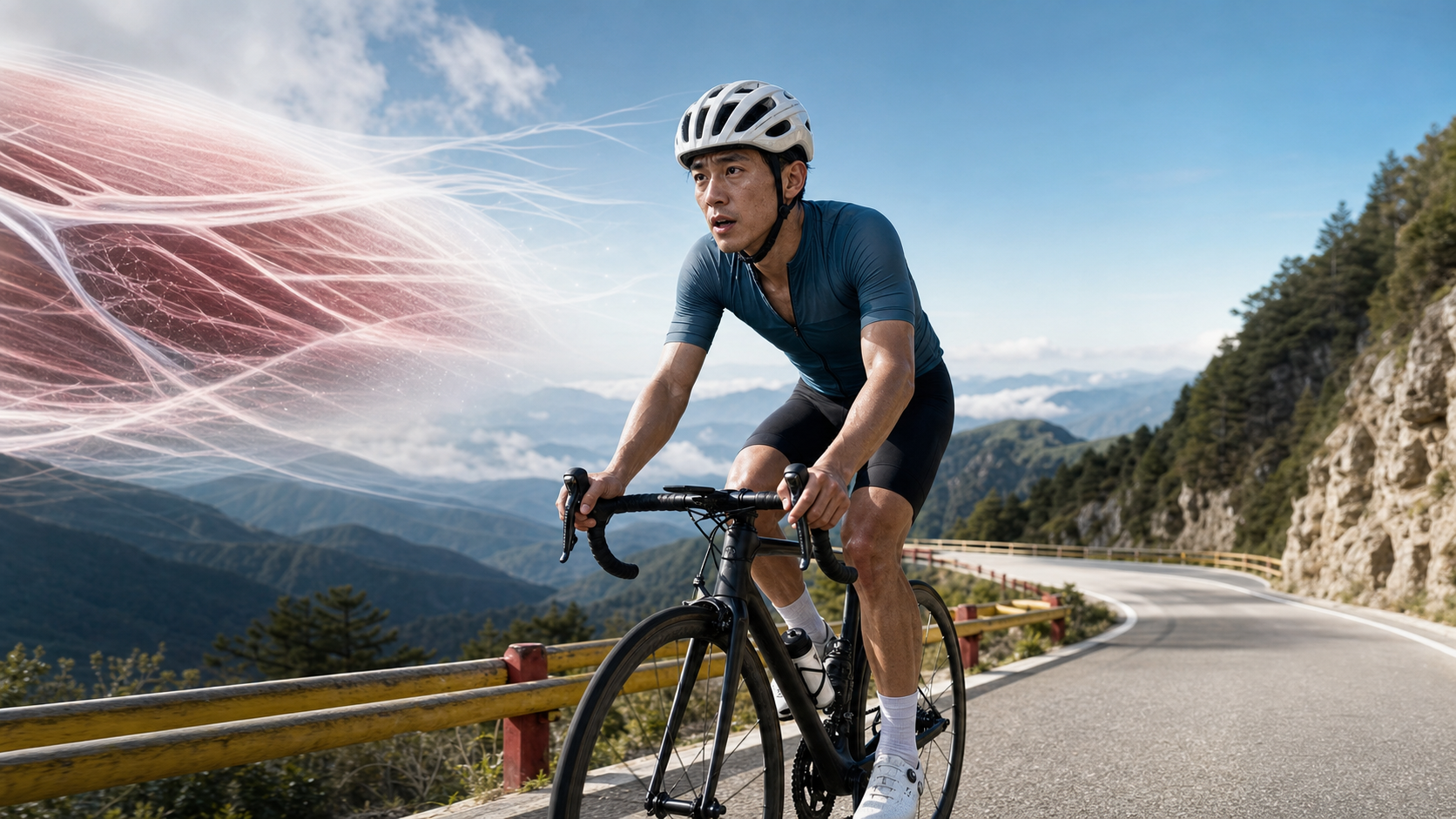
Starting with a Student Stuck on the Wuling Climb
A few years ago, I coached a very interesting student—let’s call him A-Kai. A-Kai was the kind of rider who, on flat roads, would sprint so hard that the whole team couldn’t catch him—explosive off the start, often first across the line in the final dash, and his short time-trial power was among the best in the squad. But whenever he hit a long climb, especially the holy mountain of Taiwanese cyclists, the “West Approach to Wuling”—that kind of terrain stretching over 40 kilometers with an average gradient around 5%, where the air gets thinner the higher you go—he would drop from the front of the group all the way to the back. By the time he reached Cuifeng, he looked completely drained.
He was frustrated and came to ask me: “Coach, am I just not working hard enough? I’m so strong on the flats, so why do I fall apart on long climbs?”
I told him: This isn’t a matter of effort. It’s a matter of the “factory settings” of your muscles—and here’s the good news—part of those settings can be changed, and part of them can’t. What we need to do is first figure out which part can be changed and which part we need to accept, then put our training resources where they’ll do the most good.
This article is the full version of what I lay out whenever I talk about muscle fibers with countless “A-Kais” and the opposites of A-Kai (those who have no sprint on the flats but can climb forever). I’ll keep it as plain-spoken as possible, but I won’t cut corners. If you’ve ever wondered whether you’re “just not built for a certain discipline,” this will give you a more precise answer.
The Conceptual Foundation: Three “Personalities” of Fibers Live in Your Muscles
Skeletal muscle isn’t a homogeneous lump of tissue. It’s made up of tens of thousands of muscle fibers (muscle fiber, i.e., muscle cells), and these fibers can be broadly divided into three major categories based on contraction speed, metabolic pathway, and fatigue resistance. The most common classification in exercise physiology is based on the type of “myosin heavy chain (MHC)” within the fiber:
Type I: Slow-Twitch Fibers (Slow-Contraction, Red Muscle)
These are the darlings of endurance athletes. Type I fibers contract slowly but are extremely fatigue-resistant. They have abundant mitochondria, high capillary density, and strong aerobic capacity, relying primarily on burning fat and carbohydrates to produce energy “slowly and steadily.” Because they contain large amounts of myoglobin and capillaries, they appear reddish to the naked eye, hence the nickname “red muscle.”
Think of Type I as a fuel-efficient, durable diesel truck that can run all day. In a scenario like climbing Wuling, where you need a steady output for hours, these fibers are the stars.
Type IIa: Intermediate Fast-Twitch Fibers (Fast-Contraction Oxidative)
Type IIa is a fascinating “amphibian.” It contracts much faster than Type I and produces more force, but it also retains fairly good aerobic capacity and fatigue resistance. It can go down the aerobic pathway or the anaerobic pathway, and among the three fiber types, it has the “highest plasticity and adapts its character most readily to training.”
Here’s a foreshadowing for the further reading: when we get to “convertibility” later, Type IIa is almost always the core of the story.
Type IIx: Pure Explosive Fast-Twitch Fibers (Fast-Contraction Glycolytic, White Muscle)
Type IIx is the fastest-contracting, most powerful, but least fatigue-resistant of the three. It relies almost entirely on anaerobic glycolysis for energy and fatigues very quickly—plainly put, these are fibers meant to be “burned through in a few seconds.” Pure IIx fibers are actually very scarce in healthy people; in most individuals, the proportion of pure IIx fibers is often below 2%, because as long as you’re regularly active, your body “domesticates” them into a more IIa-like state. It’s elite sprinters who show the highest observed proportions of pure IIx fibers.
Let’s clear up a common misconception first: The “Type IIb” written in older textbooks actually corresponds to Type IIx in humans (IIb is a type found mainly in small mammals like mice). So if you see IIb in old sources, when talking about humans, you can read it directly as IIx.
Why Are Fibers Recruited in Order? Understanding the “Size Principle”
Here’s a concept many people haven’t heard of but is incredibly useful—motor unit recruitment follows a sequence, called the “size principle.” As your force output increases from low to high, the body first activates the smallest, most fatigue-resistant slow-twitch fibers (Type I); when more force or speed is needed, it recruits IIa in order, and only finally calls on the largest, fastest, least durable IIx fibers.
This explains two practically important things:
- To train fast-twitch fibers, intensity has to be high enough. If you only ever do easy, low-intensity exercise, those high-threshold IIx fibers will rarely be called into action, and naturally won’t get trained. This is why people who lean slow-twitch, if they want to awaken dormant fast-twitch fibers, must deliberately schedule “hard enough” sprints or heavy loads—if it’s not intense enough, they won’t be recruited.
- Fatigue changes recruitment. When slow-twitch fibers fatigue, the body is forced to recruit fast-twitch fibers earlier to take over. This is also part of why, in the later stages of prolonged exercise, movements become “stiff and heavy.” Understanding this, you’ll see why someone with a deep aerobic base can delay the point at which “fast-twitch fibers get called in” and last longer.
The Three Fiber Types at a Glance
| Characteristic | Type I (Slow-Twitch/Red) | Type IIa (Intermediate Fast-Twitch) | Type IIx (Explosive Fast-Twitch/White) |
|---|---|---|---|
| Contraction speed | Slow | Fast | Fastest |
| Force output | Low | Medium-high | Highest |
| Fatigue resistance | Excellent | Moderate | Poor (fatigues in seconds) |
| Primary energy system | Aerobic (fat + carbs) | Both aerobic and anaerobic | Primarily anaerobic glycolysis |
| Mitochondria/capillaries | Abundant | Moderate to high | Sparse |
| Representative scenarios | Wuling long climb, marathon | Middle distance, criteriums, intervals | Sprint finish, 200 meters, weightlifting |
| Plasticity | Relatively stable | Highest (adjustable both ways) | Easily “domesticated” into IIa |
The Talent Question: What Elite Athletes’ Muscles Look Like
Many people think, “If I just work hard enough, I can reach the top in any discipline.” Sports science gives a harsher and more honest answer: At the very highest level, the genetic makeup of muscle fiber composition does set a ceiling.
In the average person’s quadriceps, Type I and Type II are roughly half and half (around 50/50, with large individual variation). But in world-class athletes, this ratio becomes extreme:
- Elite marathoners and long-distance athletes: Type I slow-twitch fibers often make up 70–80%. This allows them to sustain a very high aerobic efficiency over long periods.
- World-class sprinters: Type II fast-twitch fibers can reach as high as 70–75%, and as mentioned earlier, their proportion of pure IIx is the highest observed in humans.
This is also why A-Kai was so strong in flat sprints but collapsed so badly on long climbs—he’s very likely a predominantly Type II-dominant physique. This isn’t a flaw; it’s a “characteristic.” Forcing an explosive-oriented physique to compete against a pure climbing-oriented physique in ultra-long climbs is, by definition, using your weakness against someone else’s strength.
A coach’s honest words: I never tell students, “You’re not born for this, give up.” What I say is—your talent distribution tells us that certain disciplines have a higher “return on investment” for you. Rather than spending three years turning your climbing from terrible to mediocre, it’s better to take your sprint and short climbs from strong to elite, while training your climbing to “good enough, not a liability.” That’s strategy, not resignation.
An Important Caveat: Composition Isn’t Everything
Fiber composition sets the “potential ceiling,” but the vast majority of amateur athletes will never touch that ceiling in their entire lives. In other words—for 99% of people, what limits your performance is never fiber ratio, but whether you’ve trained the muscles you have to their full potential. I’ll keep coming back to this idea, because too many people use “I was born with few slow-twitch fibers” as an excuse not to improve, and that’s a real shame.
The Core Debate: Can Muscle Fibers Actually “Convert”?
This is the part of the article that’s most misunderstood and most in demand. I’ll break the evidence down into three levels, so you won’t be led astray by the black-and-white claims you see online.
Level 1: Between IIx and IIa, the conversion is clear and bidirectional
This is the most well-supported area. The most common and most easily induced fiber type conversion is Type IIx shifting toward Type IIa. Whether through aerobic endurance training or resistance training, once you begin training regularly, your body remodels those “pure explosive, low-endurance” IIx fibers toward the IIa direction—“just as powerful but more durable.”
What’s even more interesting is that detraining reverses this process: when you stop training for a period, fibers that had been pushed toward IIa swing back toward IIx. The literature also documents a classic phenomenon—after a training block followed by a reduction in volume or a short rest, a so-called “IIx overshoot” occurs, where the IIx proportion temporarily spikes and the fibers’ shortening velocity characteristics actually improve.
This has direct practical implications: this is one of the physiological explanations for why endurance athletes can improve their final sprint during a pre-race “taper.” You train hard to make your fibers durable; then, by tapering appropriately before the race, you allow some fast-twitch characteristics to “recharge”—part of that ability to “keep turning the pedals” in the final sprint comes from right here.
Level 2: Conversion between Type I and Type II—the evidence is much weaker
This is the key “practical dividing line.” IIx↔IIa is an internal adjustment within the same fast-twitch family and is relatively easy; but making a “slow-twitch” fiber become “fast-twitch,” or vice versa, crossing the boundary between Type I and Type II, has much fuzzier and more inconsistent evidence.
Cross-sectional studies (comparing different athletes) do show that endurance athletes have particularly high Type I proportions and explosive athletes have particularly high Type II proportions—but that may simply be because people who were born that way were selected into those sports, not because training completely swapped out their muscles. Longitudinal studies that track the same individuals over time have not clearly or consistently observed large-scale interchange between slow- and fast-twitch fibers. So the honest statement is: there may be a little room for movement at the boundary between slow and fast fibers, but don’t expect that training can turn a body that is “50% slow-twitch” into a marathon physique that is “75% slow-twitch.”
Level 3: What matters more is “making the fibers you have work better”
This is the sentence I most want my athletes to remember: instead of obsessing over whether fibers can change type, train every fiber you have to be more efficient.
Even if your Type I proportion barely changes, training can still dramatically increase the number of mitochondria in those fibers, capillary density, and aerobic enzyme activity—in other words, for the same slow-twitch fiber, the trained version versus the untrained version can differ enormously in work efficiency. Your climbing ability improves because roughly 80–90% of that gain comes from “fiber quality upgrades” plus overall improvements in cardiovascular, metabolic, and technical factors—not from a “reshuffling of fiber numbers.”
| Training stimulus | Primary fiber change | Strength of evidence | Meaning for performance |
|---|---|---|---|
| Regular endurance/resistance training | IIx → IIa (more durable) | Strong | Fast-twitch fibers can sustain output longer |
| Detraining/pre-race taper | IIa → IIx swing-back, IIx overshoot | Moderate-strong | Tapering before a race helps final sprint |
| Any regular training | Increases in mitochondria, capillaries, enzymes within fibers | Strong | Same fiber becomes far more efficient (most practical) |
| Training changes Type I↔II ratio | Large-scale slow/fast fiber interchange | Weak/inconsistent | Don’t make this a primary goal |
Practical approach: how to get the best out of the muscles you have
Science aside, let’s talk about how I actually structure training plans for my athletes. The principle is simple: first assess which type you lean toward, then decide how to allocate your resources.
Step 1: Roughly determine your fiber tendency (no muscle biopsy needed)
The truly precise method is a muscle biopsy, but that’s research-grade and not something ordinary people do. In practice, I use several “behavioral signals” to estimate:
- Fast-twitch-leaning (Type II dominant) signals: strong short-duration explosive power and fierce sprinting, but power drops quickly once intensity is sustained; longer recovery needed after high-intensity intervals; rapid progress in weight training.
- Slow-twitch-leaning (Type I dominant) signals: comfortable with long, steady output, and the longer it goes, the more of an advantage; often at a disadvantage in sprint finishes; quick recovery, can train many days in a row.
A-Kai is a typical fast-twitch-leaning athlete: his 3–5 second sprint power is remarkable, but he clearly fades once he goes above 20 minutes at threshold intensity—that’s a very clear signal.
Step 2: Allocate training according to tendency (cycling example)
The table below is the resource allocation logic I commonly use, with intensity expressed as a percentage of FTP (Functional Threshold Power) and heart rate zones. Please note the values are ranges; individual variation is large, so adjust based on your own feel and your coach’s guidance:
| Training type | Intensity range (%FTP) | Primary fibers stimulated | Suggested weekly share for fast-twitch-leaning | Suggested weekly share for slow-twitch-leaning |
|---|---|---|---|---|
| Long aerobic (Zone 2) | 56–75% FTP | Type I dominant | 40% | 55% |
| Tempo/sweet spot | 84–97% FTP | Type I + IIa | 20% | 25% |
| Threshold intervals | 95–105% FTP | Type IIa | 20% | 15% |
| VO2max intervals | 106–120% FTP | IIa + IIx | 12% | 4% |
| Neuromuscular sprints | >150% FTP (all-out) | IIx dominant | 8% | 1% |
For fast-twitch-leaning athletes: your explosiveness is a gift from genetics—don’t waste it—but your weakness is “too thin an aerobic base.” So deliberately increase the share of long Zone 2 rides to domesticate those IIx fibers toward IIa while stacking aerobic capacity, so your strength “lasts longer.” A-Kai later relied on two 2.5–3 hour Zone 2 long rides per week (in Taiwan, you can choose riverside bike paths or the gentler sections of routes like Beiyi Highway or Fengguizui), and after six months, his rate of power fade on the Wuling climb improved dramatically.
For slow-twitch-leaning athletes: your endurance is your capital, but you often lose out in “sprint finishes, breakaways, and surges.” Deliberately add short, explosive neuromuscular sprints and VO2max intervals to wake up those fast-twitch fibers that rarely get called upon, so you not only climb well but can also fight for position.
Step 3: A ready-to-use weekly training plan example (fast-twitch-leaning, preparing for a long climb)
| Day | Session | Intensity focus | Duration |
|---|---|---|---|
| Monday | Rest or easy rollers | Recovery | — |
| Tuesday | Threshold intervals 4×8 min @95–100% FTP | Type IIa | 75 min |
| Wednesday | Zone 2 long ride | Type I aerobic base | 150 min |
| Thursday | Rest or core + strength | Whole-body stability | 40 min |
| Friday | Sweet spot 3×15 min @88–92% FTP | Type I + IIa | 80 min |
| Saturday | Zone 2 long ride (simulating climbing terrain) | Aerobic + climbing technique | 180 min |
| Sunday | Neuromuscular sprints 6×15 sec all-out + easy spin | IIx preservation | 90 min |
Practical note for Taiwan: summer afternoon heat and humidity are the enemy—schedule long rides to start in the early morning and avoid the high-temperature window from 11 AM to 3 PM; keep up with hydration and electrolytes, heatstroke is no joke. In winter, watch out for temperature differences in mountain areas—around Wuling, early mornings can be in the single digits Celsius; if you don’t dress warmly enough, even the best muscles won’t perform.
Switching Sports: A Runner’s Fiber Story
After cycling, let’s look at running, because many Taiwanese athletes are “one bike, one run” dual-discipline players, and the fiber logic is universal.
Another student of mine, Xiao Ting, is the type who can steadily complete a full marathon at a 6:30 (per km) pace, yet gets dropped by runners her age in a 5K time trial. She’s very typical of Type I: the longer the distance, the more comfortable she gets, she recovers quickly, and can maintain form for days on end; but as soon as she enters a full-out 400m or a final sprint, she clearly “can’t push any harder.”
What I did for her wasn’t forcing her to chase sprint times (that would be pitting her weakness against others), but rather adding a little fast-twitch stimulation while maintaining her endurance advantage—once a week, short hill sprints (finding common riverside embankment slopes or short steep community hills in Taiwan, 8-10 reps, 10-12 seconds all-out each) and 200m fast walk-runs. The goal isn’t to turn her into a sprinter, but to sharpen those fast-twitch functions that have “been asleep for too long,” so she can still push in the final stretch of a marathon and no longer gets easily overtaken in a 5K.
What this case illustrates is: slow-twitch-dominant people often neglect fast-twitch training, and fast-twitch-dominant people often neglect their aerobic foundation—both sides are wasting the potential of their “other half.” Truly smart training is about filling in the area you’re naturally weaker at, not just feeling good about yourself in your strengths.
Training Focus Comparison for the Two Physiques
| Aspect | Slow-Twitch Dominant (e.g., Xiao Ting) | Fast-Twitch Dominant (e.g., A-Kai) |
|---|---|---|
| Natural Strength | Long distance, fast recovery | Explosiveness, sprinting, strength |
| Natural Weakness | Speed, final sprint | Aerobic base, sustained output over time |
| Most Needed Training | Short sprints, VO2max intervals | Zone 2 long duration, threshold tolerance |
| Common Psychological Blind Spot | Avoids sprinting thinking “it’s not my thing” | Skips slow riding/running thinking “it’s too easy” |
| Event Positioning Suggestion | Long distance, climbing, ultramarathon | Sprinting, short climbs, criterium points |
Fibers and Energy: How Different Fibers “Burn Fuel”
Many students ask me about nutrition, and actually, your fueling strategy is highly related to which fibers you’re using and which metabolic pathway you’re on. Let me connect the dots simply.
Type I fibers primarily use aerobic metabolism, burning both fat and carbohydrates, providing steady, sustained energy; Type IIx relies almost entirely on anaerobic glycolysis, burning glycogen, metabolizing quickly, and accumulating byproducts quickly too (which is why your legs feel like lead after a few dozen seconds of all-out sprinting); Type IIa sits in between, capable of both aerobic and anaerobic work. This also explains a phenomenon: during low-intensity, long-duration exercise, your body tends to recruit slow-twitch fibers and burn fat; as intensity rises, fast-twitch fibers and carbohydrates take over as the primary fuel source.
So the fueling logic is roughly:
- Long-duration, low-intensity training (Zone 2 long rides/runs): Fat contributes a high proportion of energy, carbohydrate consumption is relatively gradual, but beyond 90 minutes, moderate carbohydrate intake is still recommended to maintain blood sugar and delay glycogen depletion.
- High-intensity interval/sprint training: Highly dependent on glycogen; pre-session glycogen stores should be sufficient, and post-session replenishment should be timely.
Below are general reference ranges for daily carbohydrate intake on training days (per kg body weight, not individualized prescriptions, for conceptual understanding only):
| Training Type | Approximate Carbohydrate Reference (g/kg/day) | Fuel Focus | Notes |
|---|---|---|---|
| Rest/Easy Day | ~3-5 g/kg | Maintenance | Adjust based on body weight and goals |
| Moderate Training Day (~1 hour) | ~5-7 g/kg | Aerobic + partial glycogen | Long ride days lean toward the upper end |
| High-Intensity/Long-Duration Day | ~6-10 g/kg | Glycogen primary | Heavy high-intensity work requires the upper end |
Practical tip for Taiwan’s eat-out culture: getting enough carbs on training days isn’t hard—a bowl of rice, sweet potato, steamed bun, onigiri, or banana are all convenient sources; readily available at convenience stores. The key is pairing them with quality protein (chicken breast, soy milk, tea eggs, unsweetened yogurt) to aid recovery, and avoid using high-sugar bubble tea as your sole carbohydrate source. These are general nutrition concepts; for individualized amounts and ratios, it’s recommended to consult a sports nutritionist, especially if you have blood sugar-related conditions.
Common Mistakes and Corrections
After coaching students for so many years, I’ve compiled the most common myths and pitfalls regarding muscle fibers.
Mistake 1: “I’m naturally low in slow-twitch fibers, so training for climbing is useless for me”
This is the most regrettable self-limitation. As mentioned earlier, for amateurs, what limits you is almost never your fiber ratio, but rather your aerobic foundation and training volume not yet being in place. Your climbing ceiling might be slightly lower than someone with a pure climbing physique, but the room to go from “bad” to “pretty good” is enormous. Don’t use genetics as an excuse to give up.
Mistake 2: Thinking that doing lots of sprints will “grow more fast-twitch fibers”
Training doesn’t magically “grow” a bunch of new fast-twitch fibers. What sprint training actually does is improve neural recruitment efficiency, strength, and sharpen the functional characteristics of IIx/IIa fibers—these are enough to make you stronger, but don’t mistake it for “changing your fiber ratio.” Get the direction right, and set your expectations right.
Mistake 3: Fast-twitch-dominant people only train intensity and refuse Zone 2 slow riding
This is the most common flaw I see in explosive athletes. They feel slow riding is “too easy, no sensation,” so their aerobic foundation stays thin forever, and they fall apart in long events. Slow riding isn’t wasted time—it’s helping convert your fast-twitch fibers toward greater endurance while stacking mitochondria and capillaries. This is an extremely high-ROI component that’s most often skipped.
Mistake 4: Afraid to taper before races, worried about “losing fitness”
Many people are reluctant to reduce volume before a big race, fearing that rest will make them weaker. But from a fiber perspective, appropriate tapering actually allows fast-twitch characteristics to “recharge” (the IIx overshoot phenomenon), giving you more power for the final sprint. Tapering is strategic recharging, not laziness. Of course, the degree of tapering should be individualized—don’t go to extremes.
Mistake 5: Directly attributing muscle soreness or cramps to “fiber type”
Post-exercise soreness and cramps have complex causes (fatigue, electrolytes, hydration, neuromuscular control, etc.) and have no direct causal relationship with whether you’re slow-twitch or fast-twitch dominant. If you repeatedly experience unusual muscle pain, weakness, or abnormally dark urine after exercise (which could be a warning sign of rhabdomyolysis), seek medical attention promptly. Taiwan’s National Health Insurance makes it easy to see a doctor—don’t scare yourself by googling symptoms or tough it out.
Actionable Advice for Readers at Different Levels
If You’re a Beginner Just Starting Out
Don’t rush to figure out whether you’re slow-twitch or fast-twitch. Your primary task right now is to build a thick aerobic foundation, stabilize your movement technique, and turn training into a habit. At this stage, any consistent training will improve the efficiency of all your fibers across the board, and you’ll see the biggest gains. Aim for 3-4 sessions per week, primarily Zone 2, with just a little intensity sprinkled in. First let your body “learn to use” its muscles, then talk about fiber typing.
If You’re an Intermediate with Some Foundation
You can start doing a “self-tendency assessment.” Observe your relative strengths and weaknesses between short bursts vs. long endurance, then strengthen your weaknesses and deepen your strengths. Fast-twitch-dominant people should increase their aerobic ratio; slow-twitch-dominant people should add sprints and VO2max intervals. At the same time, start paying attention to pre-race tapering and put the IIx overshoot tool to use.
If You’re a Competitive/Performance-Oriented Athlete
At your level, the distribution of fiber genetics is indeed worth incorporating into strategic decisions about “event selection and positioning.” Rather than fighting hard in events that are naturally unfavorable to you, invest resources in events and roles with higher ROI (e.g., being a sprinter vs. a climber on a team). And use more refined periodization to manipulate fiber characteristics—taming IIx into durable IIa during training blocks, then allowing some fast-twitch characteristics to recharge during the pre-race taper.
Quick Comparison Across the Three Levels
| Level | Primary Task | Should You Obsess Over Fiber Type | Key Actions |
|---|---|---|---|
| Beginner | Build aerobic foundation, establish habits | Not at all | Consistent Zone 2 + technique |
| Intermediate | Fill weaknesses, deepen strengths | Can roughly assess tendencies | Targeted intervals + pre-race taper |
| Competitive | Strategic positioning and periodization | Incorporate into event selection | Refined periodization + role specialization |
FAQ
Q: Do I need to get a muscle biopsy to know my fiber type?
A: For the vast majority of people, absolutely not. A biopsy is an invasive procedure and is research-grade. Using the “behavioral signals” described earlier for a rough estimate is more than sufficient for planning your training.
Q: Can I train myself from a fast-twitch-dominant physiology to a slow-twitch-dominant one?
A: Evidence for large-scale conversion between Type I and Type II fibers is weak and inconsistent, so don’t make that your primary goal. What you can actually change—and what you should focus on—is training your existing fibers to be more efficient and making adjustments within the IIx↔IIa range.
Q: Do my fibers change as I get older?
A: With age, fast-twitch fibers (especially Type II) typically decline more noticeably. This is one reason why strength training matters for middle-aged and older adults—regular resistance training is key to combating sarcopenia and preserving fast-twitch function. If you have a chronic condition (such as diabetes, hypertension, or heart disease), please discuss with your physician before starting a new training program, and ensure individualized assessment and monitoring.
Q: Does being fast-twitch dominant mean I should avoid marathons/long-distance events?
A: No. It just means you need to invest more effort in your aerobic foundation and accept that your ceiling at extreme distances may be somewhat lower. But finishing—even finishing well—is entirely achievable. The joy of sport shouldn’t be held hostage by your fiber composition.
Q: Are commercial “genetic tests that tell you which sport suits you” reliable?
A: Currently available sports genetic tests (e.g., testing genes related to muscle characteristics) can only provide very rough, probabilistic tendencies—they are nowhere near capable of accurately predicting your actual fiber composition or athletic potential. Athletic performance is the result of countless interacting factors: genetics, training, nutrition, psychology, and environment. Don’t treat a test report as a verdict on your destiny. Rather than spending money on a test, train honestly for a few months—your body will give you the answer through its actual responses.
Q: Will weight training make me “too bulky” and hurt my endurance performance?
A: For the vast majority of endurance athletes, moderate strength training offers far more benefits than drawbacks—it improves movement economy, prevents injuries, and preserves fast-twitch function that declines with age. Becoming genuinely “too bulky” requires highly specialized hypertrophy training and dietary support; it won’t happen from two strength sessions a week. Don’t fear lifting—fear never lifting at all.
Q: I have a bit of both signals. Does that make me “balanced”? How should I train?
A: Many people do fall in the middle, and that’s actually a good thing—it means you have more options and greater plasticity. For balanced types, I recommend a strategy of “stay well-rounded, fine-tune toward your target event”: maintain an even distribution of aerobic and intensity work in daily training, then shift more weight toward the specific demands of an upcoming goal event (e.g., if you’ve signed up for a long climbing ride).
Conclusion: Get to Know This Body of Yours First, Then Reshape It Gently but Steadily
Back to A-Kai. Six months later, he’s still the guy nobody can catch in a flat sprint—that’s his gift, and we didn’t, nor did we need to, train it away. But he no longer blows up climbing Wuling, because we invested the right effort into building his aerobic foundation thicker and domesticating those explosive IIx fibers toward the more durable IIa direction. He didn’t become a different person; he simply trained the muscles he has into a better-working version.
This is the core idea I want to leave you with: Your muscle fiber type sets your natural tendency, but it is far from the end point of your performance. Between IIx and IIa, you have clear room for adjustment. It doesn’t matter that the slow/fast-twitch big picture can’t be changed much—because making every individual fiber more efficient is where the vast majority of people find their real progress.
Know your gifts, accept what you can’t change, and then put all your effort into what you can change and where the return on investment is highest—that is my most sincere advice to every athlete I coach, and to you reading this article right now.
The next time the thought “maybe I’m just not built for this” crosses your mind, I hope you’ll think of A-Kai and Xiao-Ting: genetics determine your starting stance, but how far you can run is always determined by how you train this body. Taiwan’s mountains, riverside paths, and tracks are all out there—pick a route that suits your gifts and get going. Leave the rest to time and consistent accumulation.
This article is educational content and does not replace individual diagnosis or treatment advice from a physician, physical therapist, or nutritionist. If you have a chronic condition or experience abnormal symptoms during exercise, seek medical attention and professional individualized assessment promptly.
References
- Muscle Fiber Type Transitions with Exercise Training: Shifting Perspectives (PMC) — https://pmc.ncbi.nlm.nih.gov/articles/PMC8473039/
- Skeletal muscle signature of a champion sprint runner (PMC) — https://pmc.ncbi.nlm.nih.gov/articles/PMC4469925/
- Muscle Fibre Types — Clinical Guide for Athletes (Sydney Physio Clinic) — https://www.sydneyphysioclinic.com.au/injury-rehabilitation/muscle-fibre-types-clinical-guide-for-athletes/
Related Reading
- Muscle Fiber Types and Cycling-Specific Training: Choosing Between Slow-Twitch and Fast-Twitch
- Fast-Twitch vs. Slow-Twitch: Characteristics of Muscle Fiber Types, and Can Training Really Change Fiber Composition?
- Skeletal Muscle Fiber Types in Cyclists: Training Implications of Type I and Type II Fibers
- Muscle Fiber Morphology: Are You a Born Sprinter or Endurance Athlete, and How Much Can You Change?
西進武嶺 免費訓練分析服務 Intervals | 練不夠還是練過頭?你哪一種類型選手?AI模型告訴你! | 備戰神器 | 公路車 訓練 | CT Yeh
4 年前
CT趣訪 西進武嶺 2小時組 EP2 全村的希望 蔣緯緯! 訓練菜單&技巧公開 |公路車 |CT Yeh
4 年前
FTL 與 SYB 車隊專訪 西進武嶺 實用攻略分享! 2小時 如何練?!你不知道的眉角!新手準備武嶺必看 EP1 | 實力派女車友 | 精華版 | 公路車 | CTYeh
4 年前
如果Pogačar騎西進武嶺可以多快?會破2嗎?各種情況深度推估探討 / 公路車 / CT Yeh
2 年前
西進武嶺 自製新版AI配速表產生器 x 賽前攻略 抱佛腳! 沒有功率計也可以產生配速表嗎?有什麼其他眉角賽前要注意的呢? | 西進武嶺 / 東進武嶺 KOM 攻略 | 公路車 | CT Yeh
4 年前
#公路車 #西進武嶺 配速配瓦實驗 坡度分析 四小時內攻略 建大盃 NeverStop #西進武嶺攻略
6 年前
西進武嶺各路段 前8000名 大數據分析 配速攻略/功率/心律/推力比/維持率/踏頻/踏瓦比/牽車率 大公開 | 建大盃 NeverStop 可參考 | 公路車 | CT Yeh
5 年前
CT Talk) 數據面窺看 武嶺大神們 平時的備戰 共通點 (娛樂性質XD)
7 年前