The Unique Adaptations of Eccentric Training: From Mechanics and Tendons to DOMS Management, a Coach's Field Notes
Starting with a Student Whose Knees Shook from Downhill Running
A few years ago, I coached a cyclist in his early forties named A-Hong. He rode hard on flats with an FTP around 250 watts—Wuling Pass and Fengguizui were no problem for him. But every time he ran downhill or walked down consecutive flights of stairs, his front thighs would be so sore the next day he could barely get up, and the outside of his knees would start to ache subtly. He always thought it was “insufficient aerobic fitness” or “lack of strength,” so he doubled down on cycling volume. The situation didn’t improve—he just got more exhausted.
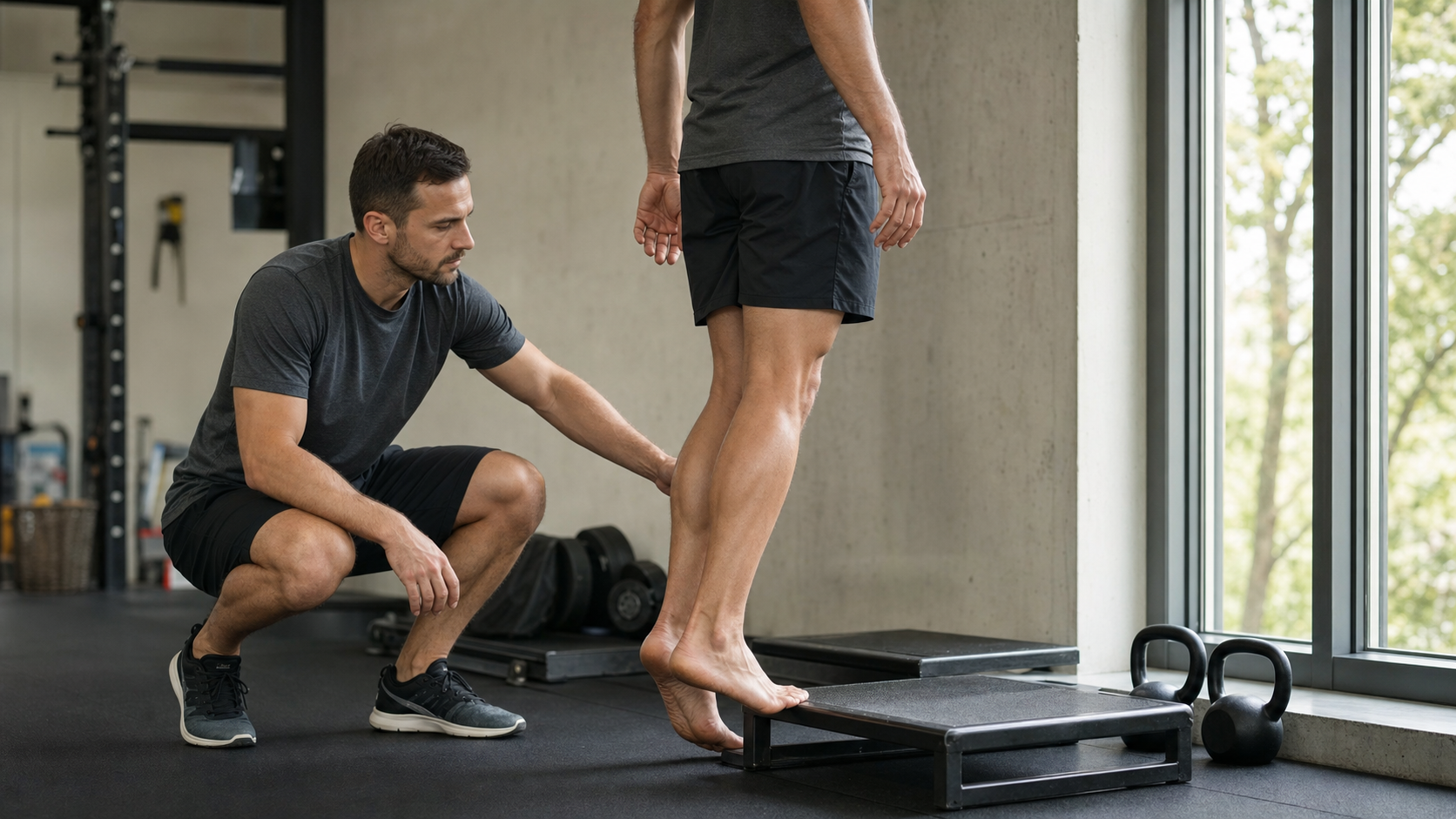
I asked him to do something very simple: stand on the edge of a step, slowly lower one heel with a single leg, counting to four seconds until reaching the lowest point, then use both legs to return to the start. Just that one movement—on the first day he only did three sets of ten reps—and the next day he complained that his calves and thighs were “so sore he questioned his life choices.” This is exactly what makes eccentric training so fascinating and most underestimated—it produces maximal force with minimal effort while triggering the body’s deepest adaptations.
In this article, I want to explain “eccentric training” clearly from my years of coaching students. Not by throwing a bunch of jargon to intimidate you, but to help you understand: why downhill running makes you so sore, why slow-lowered weights can rescue your tendons, and how to fit it into your own training. Whether you’re a cyclist looking to strengthen riding muscles, a runner plagued by Achilles pain, or just a general athlete wanting to train smarter, you’ll find something actionable here.
What Is an Eccentric Contraction? First, Clarify the Three Contraction Types
The ways muscles produce force can be simply divided into three categories. I often use “carrying a bucket” to explain to students:
- Concentric Contraction: The muscle shortens while producing force. When you “lift” the bucket up from the ground, the biceps shorten and produce movement.
- Isometric Contraction: The muscle produces force but length stays the same. When you “hold the bucket suspended mid-air,” the muscle is working, but the joint angle doesn’t change.
- Eccentric Contraction: The muscle is lengthened while producing force. When you “slowly lower the bucket back to the ground,” the biceps are actually still working against gravity, but they are being stretched.
The key lies in this third type. Eccentric is not “relaxing”—it’s “being forcefully lengthened.” Many people think lowering a weight doesn’t count as training—this is the biggest misconception. In reality, the muscle resisting load while being lengthened is the moment it experiences the greatest tension.
Eccentric movements are everywhere in daily life: the front of your thigh (quadriceps) works eccentrically when going downstairs, every foot strike during downhill running is an eccentric braking action, the lowering phase of a dumbbell, and even the controlled return to the saddle after standing sprints on a bike—eccentrics are involved. And sports injuries are especially likely to occur when eccentric load is excessive and the body is unprepared.
Mechanical Properties: Why Eccentric Can Produce Greater Force
Eccentric contraction has a counterintuitive property: within the same muscle, the maximum force eccentric can produce is greater than concentric—typically about 1.2 to 1.5 times higher.
There are two main mechanisms behind this:
The first is mechanical stretching of cross-bridges. Muscle contraction relies on the cross-bridge cycle between actin and myosin. During concentric action, cross-bridges must actively row and consume energy; during eccentric action, cross-bridges are “forcibly pulled apart by external force”—they remain attached and resist at the moment of being pulled apart, essentially squeezing out extra force mechanically.
The second is titin, the giant spring. Titin is a spring-like giant protein within the sarcomere. When the muscle is lengthened and calcium ions are present, titin’s stiffness increases, storing elastic potential energy like a stretched rubber band, contributing substantial passive tension. The key point is—this spring stores energy with almost no additional ATP consumption.
This also explains why eccentric is so “cost-effective”: you can subject the muscle to very high tension with relatively light perceived effort. For people who want to increase strength and muscle mass without exhausting their cardiovascular system, this is a major advantage; but for unprepared tissue, this sudden high tension is precisely the source of tears and soreness.
Metabolic Properties: More Economical, Yet Better at Stimulating Adaptation
Another unique aspect of eccentric lies in metabolism. According to exercise physiology literature, under the premise of “producing the same force,” the metabolic cost of eccentric contraction is significantly lower than concentric—the gap is considerable, with most studies pointing to a several-fold difference, meaning that to produce the same force, eccentric requires far less energy and oxygen consumption than concentric.
There are three main reasons behind this:
- Fewer motor units recruited: To achieve the same force output, eccentric requires a lower proportion of activated muscle fibers—“the same force with fewer troops deployed.”
- Elastic potential energy can be recycled: The muscle–tendon system acts like a spring, storing and reusing elastic potential energy; as mentioned earlier, the energy stored by titin doesn’t require ATP.
- Fewer active cross-bridges: The proportion of cross-bridges that need to actively row and consume energy is lower.
This has a very practical clinical and training implication: for people with limited cardiovascular function, weaker physical capacity, or those in rehabilitation, eccentric offers a path of “low metabolic burden, high mechanical stimulus.” I’ve worked with elderly patients in post-surgical rehab and beginners whose cardiovascular systems easily left them breathless. Using eccentric-dominant progressive loading, they could often accumulate sufficient strength stimulus without getting too winded.
The table below organizes the characteristics of the three contraction types into a clear comparison:
| Characteristic | Concentric Contraction | Isometric Contraction | Eccentric Contraction |
|---|---|---|---|
| Muscle length change | Shortens | Unchanged | Lengthens |
| Maximum force producible | Baseline (1.0×) | Slightly higher | Highest (approx. 1.2–1.5×) |
| Metabolic cost at same force | High | Medium | Significantly lower |
| Motor unit recruitment | More | Medium | Fewer |
| Tensile stimulus on tendons | Medium | Medium | High |
| Delayed-onset muscle soreness (DOMS) risk | Low | Low | High |
| Everyday representative movements | Lifting heavy objects, climbing stairs | Plank, wall sit | Lowering objects, going downstairs, downhill running |
Tendon Benefits: Why Eccentric Can Rescue Stubborn Tendinopathy
This is what I consider the most valuable and most underestimated aspect of eccentric training. Many long-standing pains troubling cyclists and runners aren’t actually muscle problems—they’re tendinopathy—such as the Achilles tendon, the patellar tendon (the one below the kneecap), and the rotator cuff tendons of the shoulder.
Tendons Are Living Tissue—They “Listen to What Force Says”
Many people think tendons are just passive ropes, but that’s not the case. Tendons are living connective tissue, primarily composed of collagen, and they remodel in response to the mechanical loads they experience—a phenomenon called mechanotransduction. Simply put: give them appropriate tension, and they’ll produce more, better-aligned, stronger collagen fibers.
The problem with chronic tendinopathy is often that collagen fiber alignment becomes disorganized and tissue quality declines. And high tension applied along the tendon’s long axis—exactly what eccentric loading excels at providing—can stimulate collagen remodeling, fiber realignment, and increased tensile strength.
The Classic Alfredson Eccentric Protocol
When discussing eccentric training for Achilles tendinopathy, the classic Alfredson protocol is always mentioned. According to the literature, its core elements are:
- Targeting the calf and Achilles tendon with single-leg heel raises followed by a slow eccentric lowering
- 3 sets × 15 reps each session
- 2 times per day, 7 days per week
- Continuing for approximately 12 weeks
This protocol is famous because it allowed many patients who had been advised to rest—or even consider surgery—to return to their previous activity levels. Additionally, research has shown that approximately 12 weeks of high-load tendon exercise can increase Achilles tendon stiffness and cross-sectional area—in plain terms, the tendon becomes thicker, stiffer, and stronger.
I want to emphasize a conceptual shift: tendon pain often doesn’t require “complete rest”—it requires “appropriate loading.” In the past, people were told to stop at the first sign of pain, and the tendon only got weaker from disuse. The direction of modern sports medicine is to use progressive, controlled eccentric (and heavy-load) stimulation under professional assessment to make the tissue strong again.
Tendon Remodeling Is Slow Work: Why Patience Matters
Compared to muscle, tendons have poor blood supply, slow metabolism, and require far more time to remodel. Muscles show noticeable progress within weeks of training, but tendon collagen remodeling is measured in “months”—which is why almost all tendon rehabilitation protocols are set at ten weeks, twelve weeks, or longer.
This brings two very practical coaching reminders. First, don’t rush. I’ve seen too many people give up after three weeks thinking “why isn’t it better yet,” when the tendon has only just begun remodeling. Second, don’t spike the load. Muscles recover quickly, which can fool you into thinking you can ramp up volume significantly, but tendons can’t keep up with that pace—and jumping the load is exactly why many people get re-injured. The increase in training load should be capped by “what the tendon can tolerate,” not by “the muscle isn’t sore anymore.”
This is also another reason eccentric training is valuable: it provides high-tension stimulus while keeping metabolic demand relatively low, allowing you to feed the tendon the mechanical signal it needs day after day without exhausting the entire system.
But I need to be clear: the causes and stages of tendinopathy vary widely, and the management principles for the acute inflammatory phase differ from those for the degenerative phase. The above is a general principle and an introduction to classic protocols—it is not a basis for self-diagnosis or self-prescription. In Taiwan, orthopedic, rehabilitation, and sports medicine clinics are all easily accessible, and health insurance covers physical therapy. If pain lasts more than two to three weeks, or if it affects daily life, please seek individualized assessment from a physician or physical therapist.
DOMS Management: That “Sore Enough to Question Life Itself the Next Day” Thing
Back to A-Hong’s story at the beginning. The deep soreness he felt after his first eccentric heel drop was Delayed Onset Muscle Soreness (DOMS).
What DOMS Is and Isn’t
DOMS typically appears 12 to 24 hours after exercise, peaks between 24 to 72 hours, and then gradually subsides. It is characterized by soreness and stiffness in the muscle during pressing, stretching, or contraction.
Regarding its cause, the more accepted view is: mechanical microdamage from eccentric contractions triggers subsequent inflammation and repair responses. Here are a few important points to help you break through common myths:
- DOMS is not caused by lactic acid buildup. Lactic acid is mostly metabolized within an hour after exercise, which doesn’t match the timeline of DOMS that sets in two days later. This is the most widespread misconception.
- DOMS is not a necessary condition for “effective training.” Not being very sore doesn’t mean you didn’t get a workout, and being very sore doesn’t mean you trained particularly well. It’s simply the body’s response to “unfamiliar eccentric load.”
- DOMS is not an injury. It’s a normal adaptation process, different from the sharp, localized, immediate pain of a strain or tendon tear.
The Repeated Bout Effect: The Body Learns
Eccentric training has a very reassuring characteristic called the Repeated Bout Effect: the same movement—the first time you do it, you’re extremely sore; the second time (even one to two weeks later), soreness drops significantly, and the protective effect lasts for weeks. This means your body is adapting. So don’t give up just because the first time is very sore—that’s exactly the signal that it’s starting to get stronger.
Practical DOMS Management Strategies
This table is what I often give trainees as DOMS management principles, organized by “whether it works” and “whether you should do it”:
| Strategy | Practical Approach | Help for DOMS | Coach’s Note |
|---|---|---|---|
| Progressive Loading | Start new movements with low volume; don’t max out on day one | Most effective for prevention | This is the most important move |
| Low-Intensity Active Recovery | Easy cycling, walking, gentle stretching the next day | Promotes circulation, relieves stiffness | Don’t stay completely sedentary |
| Adequate Sleep and Protein | About 1.4–2.0 grams of protein per kg of body weight, enough sleep | Supports repair | For those eating out in Taiwan, pair with soy milk, chicken breast, boiled eggs |
| Hydration | Replenish fluids before and after exercise | General support | Taiwan’s humid summers require extra attention |
| Light Massage / Foam Rolling | Gentle rolling over sore areas | Subjective relief, feels better | Don’t press hard at the peak of soreness |
| Heat / Cold Therapy | Choose based on personal preference | Primarily subjective comfort | Effects vary by individual; don’t overexpect |
| Pushing Through and Training the Same Area | Continuing heavy eccentric work with severe pain | Not recommended | Actually slows recovery |
One local reminder for Taiwan: if you do eccentric training outdoors in summer (e.g., downhill running on Yangmingshan, riverside weight training), heat and sweating can lead to dehydration, which makes you feel subjectively more fatigued and sorer. Replenishing fluids and electrolytes before and after training—just that alone—can greatly improve how recovery feels.
Recovery and Nutrition: Practical Tips for Those Who Eat Out
DOMS is fundamentally about repair, and repair requires raw materials and time. Nutrition doesn’t need to be complicated—just focus on two big directions: adequate protein and adequate total calories and sleep.
For protein, for those who train, general recommendations fall in the range of about 1.4 to 2.0 grams per kilogram of body weight, spread across several meals a day—this works better than one big bolus. For a 60 kg athlete, that’s roughly 85 to 120 grams of protein per day. Eating out in Taiwan makes this easy to hit: a chicken breast or chicken leg bento, a cup of unsweetened soy milk, two tea eggs, and a container of unsweetened yogurt add up quickly. At the buffet place near the gym, grabbing an extra piece of tofu, a braised egg, and a portion of fish is also convenient.
Sleep, I think, matters far more than supplements. If you don’t get enough sleep, every recovery strategy becomes half as effective. I often tell trainees: rather than spending money on a pile of recovery products, first get your sleep from six hours back to seven to eight—your body will honestly tell you the difference.
As for all the supplements claiming to speed up recovery, my stance has always been conservative: getting the big principles right (sleep, protein, progressive loading) accounts for 90% of the results; supplements are at best the icing on the cake, and their effects vary by individual. If you have chronic illness, kidney issues, or are on medication, please consult a physician or nutritionist before supplementing with high protein or any other product—don’t self-prescribe.
Practical Methods: Fitting Eccentrics Into Your Training
Now that we’ve covered the theory, here’s something you can directly apply. These are the three eccentric variables I commonly use, so you understand how to “adjust the concentration”:
- Tempo: Lengthening the eccentric phase to 3–5 seconds is the most common and easiest to execute. The slower you lower, the longer the muscle is under tension.
- Load: Advanced trainees can use “eccentric overload”—lowering more weight than you can lift (e.g., lift with both legs, lower with one). The stimulus is stronger, but the risk is also higher, so you need a foundation before attempting it.
- Range: For Achilles tendon training, emphasis is placed on lowering the heel below the level of the step, increasing tension at the end range of stretch.
One frequently asked point: eccentric training doesn’t require expensive equipment. A single step in your stairwell at home, the edge of a planter in the park, or a sturdy chair—combined with your own body weight—is enough to create adequate stimulus. To increase difficulty, wear a backpack filled with water or switch to a single-leg version. What truly determines the effect is whether you lower slowly enough and control it well enough, not how fancy the equipment is. This is very friendly for people in Taiwan, where living spaces are generally compact and not everyone has a gym membership.
An Eccentric Exercise Checklist for Cyclists and Runners
| Target Area | Exercise | Recommended Protocol | Primary Benefit |
|---|---|---|---|
| Calves / Achilles Tendon | Slow single-leg eccentric heel drops off a step | 3–4 second eccentric, 3 sets × 10–15 reps | Strengthens the Achilles tendon, prevents tendinopathy |
| Front of Thigh (Quadriceps) | Slow eccentric squats or split squats | 4-second descent, 3 sets × 8–12 reps | Improves downhill braking ability, protects knees |
| Patellar Tendon (below knee) | Eccentric decline single-leg squats | 3-second eccentric, 3 sets × 15 reps | Classic exercise for patellar tendinopathy |
| Back of Thigh (Hamstrings) | Nordic curls | Control the lowering phase as much as possible, 3 sets × 5–8 reps | Reduces risk of hamstring strains, beneficial for sprinting/climbing |
| Core and Lower Back | Eccentric bridge lowers, slow eccentric crunch lowers | 3–4 second lowering phase | Supports riding posture, protects the lower back |
A Ready-to-Use Four-Week Beginner Program
This is the starting template I give to clients who have never specifically trained eccentrics. The focus isn’t on difficulty, but on progression. The difference between each phase lies in the accumulation of reps, speed, and load:
| Week | Frequency | Main Exercises | Sets × Reps | Eccentric Tempo | Notes |
|---|---|---|---|---|---|
| Week 1 | 2x per week | Double-leg slow heel drops, double-leg slow squats | 2 × 10 | 3 seconds | Let the body learn the eccentric movement; mild soreness is acceptable |
| Week 2 | 2–3x per week | Same as above, start attempting single-leg heel drops | 3 × 10 | 3–4 seconds | Soreness should be noticeably less than week one |
| Week 3 | 3x per week | Single-leg heel drops, slow split squats | 3 × 12 | 4 seconds | Can add decline single-leg squats |
| Week 4 | 3x per week | Add Nordic curls (assisted version) | 3 × 8–12 | Control as much as possible | Start to feel strength gains |
Reminder: This is a general beginner template for healthy, injury-free individuals. If you currently have tendon pain or joint discomfort, the exercise selection, reps, and progression should be adjusted by a physical therapist or sports medicine professional based on your specific condition. Don’t just copy it directly.
In-Depth Case Study: A Marathon Runner with Recurring Achilles Issues
Let me share a more complete case study so you can see how eccentrics work in the real world. The client, Xiao-Ting, was in her thirties, a serious runner with a sub-4-hour marathon. She lived in Taipei and usually trained along the riverside and in Daan Forest Park. Her left Achilles tendon had been intermittently painful for nearly six months. The pain was most noticeable on that first step out of bed in the morning. The first few kilometers of a run felt tight and stiff, easing up somewhat once warmed up, but it would flare up again whenever her mileage increased. She had tried resting completely for two weeks, but the pain returned as soon as she started running again, trapping her in a “pain-rest-pain” cycle.
The first thing I did was ask her to see a rehabilitation doctor to rule out an acute tear or other structural issues (this step is non-negotiable and not something I, as a coach, should diagnose). After evaluation, the doctor and physical therapist determined it was chronic Achilles tendinopathy, suitable for progressive loading. Only then did we start planning an eccentric-focused program.
I roughly divided her progression into three phases. I’ll list them here so you can understand what “progression” really means:
| Phase | Duration | Primary Load | Running Plan | Pain Tolerance Principle |
|---|---|---|---|---|
| Building Tolerance | Weeks 1–3 | Double-leg slow heel drops, gradually transitioning to single-leg | Temporarily reduce volume, focus on pain-free easy runs | Pain during training and the next day can be “mild and tolerable,” as long as it doesn’t worsen |
| Accumulating Load | Weeks 4–8 | Single-leg eccentric heel drops, adding end-range work below the step | Gradually add back mileage and intensity | Same tolerance principle; pain should not increase day over day |
| Return to Sport | Weeks 9–12 | Maintain eccentrics and add running-specific stimuli | Resume target training volume | Track progress via function and morning stiffness |
There’s a very important and often misunderstood concept here: during tendon eccentric rehab, experiencing “mild, tolerable pain that doesn’t worsen day by day” during and the day after training is generally acceptable. This differs from the usual muscle-training intuition of “no pain at all.” However, this “acceptable pain” threshold is subtle and must be set and monitored by a professional based on the individual case—I’m explaining the concept so you understand it, not so you can self-manage this line.
Around weeks eight to ten, Xiao-Ting began to notice that the morning step was no longer sharp, and the pre-run tightness had significantly faded. There was no magic shortcut in the whole process—it was just consistent, patient, well-controlled slow lowering every day. She later joked that the hardest part wasn’t the exercise itself, but “believing that taking it slow would actually work.”
Eccentrics and Cycling: Why Cyclists Should Care Too
Some cyclists ask: “Cycling is mostly concentric pedaling, what do eccentrics have to do with me?” That’s actually a good question. There isn’t much eccentric component in simply pedaling, which is why many cyclists who ride hard tend to get severely sore legs or injured easily when they go for a run or ride downhill—their bodies lack eccentric tolerance.
Eccentrics offer cyclists at least three practical benefits:
- Protects the knee joints and patellar tendon: Prolonged, high-cadence pedaling places continuous load on the tissues around the knee. Eccentric strength in the quads and patellar tendon is a key foundation for knee protection.
- Strengthens “non-pedaling” movement capacity: Lifting bikes, getting on and off the bike, landing from off-road obstacles, and even bracing during a crash all require eccentric braking ability.
- Cross-training without crippling soreness: If you want to add running as cross-training in the winter, building a few weeks of eccentric foundation first can drastically reduce the misery of “one run, one week of soreness.”
So I often tell pure cyclists: eccentric strength training isn’t stealing time from your riding—it’s helping you ride longer and safer. Twice a week, ten to fifteen minutes per session, is an incredibly high return on investment.
FAQ
Q: Does eccentric training have to be done in a gym with heavy equipment?
A: Not at all. A set of stairs, your body weight, and one or two resistance bands or dumbbells are enough for effective eccentric stimulus. The slow lowering is the key, not the weight itself.
Q: If I’m sore every time, does that mean I’m not making progress?
A: Quite the opposite. Being very sore the first time is normal. The key is the “repeated bout effect”—the same exercise will cause less and less soreness over time, which is evidence that your body is adapting and getting stronger. To confirm progress, look at “less soreness at the same load, or the ability to handle a higher load,” not “whether you’re sore.”
Q: Can I still train when I have severe DOMS?
A: You can do low-intensity activities, train other body parts, or do aerobic work to aid circulation and recovery. But avoid doing a large volume of eccentrics on the same area during the peak of soreness. Give it 48 to 72 hours to recover before hitting it again.
Q: Is it okay to take painkillers to suppress DOMS?
A: Occasional short-term use for sleep or daily function is fine, but I don’t recommend habitually using anti-inflammatory painkillers to suppress “normal post-training soreness.” Inflammation and repair are part of the adaptation process, and chronically suppressing them might actually interfere with adaptation. If you have chronic conditions or are on long-term medication, consult your doctor or pharmacist before use.
Q: Can I do eccentrics every day?
A: Tendon rehab protocols for conditions like the Achilles are indeed done daily (using the “acceptable pain” principle), but that’s a specific professional arrangement for specific situations. For healthy individuals with general strength goals, it’s usually more reasonable to allow at least 48 hours between sessions for the same major muscle group, so repair and supercompensation can occur.
Q: Am I too old for eccentric training?
A: It’s suitable, and highly valuable. The “low metabolic cost, high stimulus” nature of eccentrics is friendly for older adults, benefiting both strength and fall prevention. However, the starting point should be more conservative and the progression slower. If you have chronic conditions, be sure to consult your medical team first.
Common Mistakes and Corrections
Over the years of coaching clients, I’ve seen all kinds of mistakes. Here are the most common ones, and the ones most worth highlighting:
Mistake 1: Going all out on day one, then being crippled with soreness the next day
Eccentric soreness is delayed and deep. Many people don’t feel much right after the first session, but regret it the next day. Correction: For any new exercise, “start conservatively.” It’s better to do too little than too much. The goal of the first session is to “learn the movement,” not to “train to failure.”
Mistake 2: Lowering Too Fast in the Eccentric Phase
Many people “drop” the weight when lowering it, wasting the golden stimulus of the eccentric phase and increasing the risk of injury. Fix: Mentally count “one, two, three, four” and control the lowering with effort. Slow is the soul of the eccentric phase.
Mistake 3: Confusing DOMS with Injury, or Injury with DOMS
Both misjudgments are dangerous. DOMS is “widespread, symmetrical, sore to pressure and stretching, and slightly relieved after activity”; while a real injury (strain, acute tendon issue) is often “localized, unilateral, sharp, triggered by specific movements, and possibly accompanied by swelling.” Fix: Learn to tell them apart. If the pain is localized and sharp, there is swelling, or the pain hasn’t improved after more than a week, don’t just tough it out with a foam roller—see a doctor or physical therapist.
Mistake 4: Complete Rest at the First Sign of Tendon Pain
As mentioned earlier, chronic tendinopathy often requires “appropriate loading” rather than complete rest. Fix: Under professional assessment, use progressive eccentric loading to stimulate tissue remodeling. However, during the acute phase, with obvious inflammation, or when the stage is unclear, professional judgment is still needed—don’t increase the load on your own.
Mistake 5: Only Training Eccentrics, Ignoring the Big Picture
Eccentric training is a powerful tool, but it’s not everything. Fix: Treat it as a “signature dish” in your training menu, paired with concentric strength, aerobic work, mobility, and adequate recovery for a complete meal.
Actionable Advice for Readers of Different Levels
Beginners / General Exercisers
Start with twice a week, bilateral versions, and a 3-second slow lowering. Pick one or two movements (calf raises, squats) and practice them until they feel familiar. Accept that the first two sessions may bring soreness, and enjoy the “repeated bout effect” starting from the third session. The goal is to build a habit and tolerance to eccentric loading—don’t rush to add weight.
Advanced Athletes / Cyclists and Runners with a Training Base
You can use eccentric training as a weapon for specific strengthening and injury prevention. Runners should focus on Nordic hamstring curls and Achilles tendon eccentrics; cyclists can strengthen quadriceps eccentrics to improve control on descents and during prolonged pedaling. When attempting eccentric overload, make sure you have a solid foundation and (ideally) supervision, starting with a small overload.
Those Suffering from Tendon Pain
Focus on “finding the right person to assess you.” Eccentric training has strong evidence supporting its use for tendinopathy, but staging, dosage, and exercises all need to be individualized. In Taiwan, rehabilitation and sports medicine clinics are very accessible, and physical therapy is covered by the National Health Insurance. Don’t try to figure it out on your own, and don’t stop moving entirely out of fear of pain—let a professional design a progressive loading plan for you, and the results will be much better.
Middle-Aged, Older Adults, and Those with Chronic Conditions
The “low metabolic cost, high mechanical stimulus” nature of eccentric training is actually friendly to those with lower physical capacity, but if you have cardiovascular disease, diabetes, hypertension, or other chronic conditions, be sure to discuss exercise with your doctor first, emphasizing individualization and gradual progression. The high tension and DOMS from eccentric training require a more cautious start for certain populations. No prescription is given here for any disease; always follow the advice of your medical team.
Conclusion: Slow Lowering Is the Most Underrated Training Wisdom
Looking back at A-Hong. After he consistently practiced eccentric calf raises and slow squats for over two months, the downhill knee pain that had bothered him for a long time improved significantly. He no longer trembled going down stairs, and his control on descents after long climbs became more stable. He told me: “What I was missing all along wasn’t more riding hours, but learning how to ‘let go’ properly.”
I love that statement. The essence of eccentric training, in a way, is learning to let go with control—letting go of the weight, letting go of speed, letting go of the obsession that “you only got a workout if you’re breathless and exhausted.” It delivers the deepest stimulus to muscles and tendons in the most efficient way; the soreness it brings is not a punishment, but a signal that your body is getting stronger.
If you only take one thing away from this article, let it be this: the next time you lower a weight, the next time you go down stairs, the next time you run downhill—go slower, and stay in control. Those few seconds of lengthening under tension are the most unique adaptation eccentric training offers you.
This article is educational content and does not replace individual diagnosis and treatment advice from a physician, physical therapist, or nutritionist. If you have tendon pain, joint discomfort, or any chronic condition, consult a professional before starting a new training program and follow the advice of your medical team.
References
- Eccentric Exercise for Achilles Tendinopathy: A Narrative Review — PMC: https://pmc.ncbi.nlm.nih.gov/articles/PMC7739229/
- Evidence-Based High-Loading Tendon Exercise for 12 Weeks Leads to Increased Tendon Stiffness and Cross-Sectional Area in Achilles Tendinopathy — PMC: https://pmc.ncbi.nlm.nih.gov/articles/PMC9768072/
- Factors contributing to lower metabolic demand of eccentric compared with concentric cycling — Journal of Applied Physiology: https://journals.physiology.org/doi/full/10.1152/japplphysiol.00536.2016
- Skeletal Muscle Remodeling in Response to Eccentric vs. Concentric Loading — PMC: https://pmc.ncbi.nlm.nih.gov/articles/PMC5495834/
- Eccentric Muscle Contractions: Risks and Benefits — PMC: https://pmc.ncbi.nlm.nih.gov/articles/PMC6510035/
Related Reading
- Eccentric Training: A Key Tool for Tendon Strengthening and Downhill Running Injury Prevention
- Eccentric Contractions and Muscle Damage: Why Downhill Running Leaves You Sore for Three Days
- Eccentric Overload Training for Endurance Athletes: Advanced Applications of Supramaximal Loading, Downhill Tolerance, and Tendon Resilience
- The Complete Guide to Downhill Running Technique: From Muscle Mechanics to Practical Training
西進武嶺 免費訓練分析服務 Intervals | 練不夠還是練過頭?你哪一種類型選手?AI模型告訴你! | 備戰神器 | 公路車 訓練 | CT Yeh
4 年前
Never Stop 西進武嶺 前後雙機 完整全程錄影 訓練台 實境
8 年前
一日北高/長距離團騎 常見問題補充篇 / 組團或跟團的眉角 / 壯車友容易被瘦車友慢性拉爆 / 原來屁股痛可能是這個原因...? / 風場配速法 / 公路車 / CT Yeh
2 年前
CT 喇低賽) 武嶺牽車 才是王道 西進牽車四小時內秘訣 攝手位置 如何判斷 防抽筋小秘訣
7 年前
FTL 與 SYB 車隊專訪 西進武嶺 實用攻略分享! 2小時 如何練?!你不知道的眉角!新手準備武嶺必看 EP1 | 實力派女車友 | 精華版 | 公路車 | CTYeh
4 年前
靠單車減肥35公斤 心得分享與整理
7 年前
多機位拍片神器 DJI Action 2 拍出速度張力感 | 類空拍機視角 4陣列麥克風超強降風噪 實測! | 公路車 | CT Yeh
3 年前
單車AI教練!全新 ChatGPT4o 幫你分析訓練成果!排武嶺課表,分析騎車姿勢! 太神了! / 公路車 / CT Yeh / feat. 緯緯
2 年前